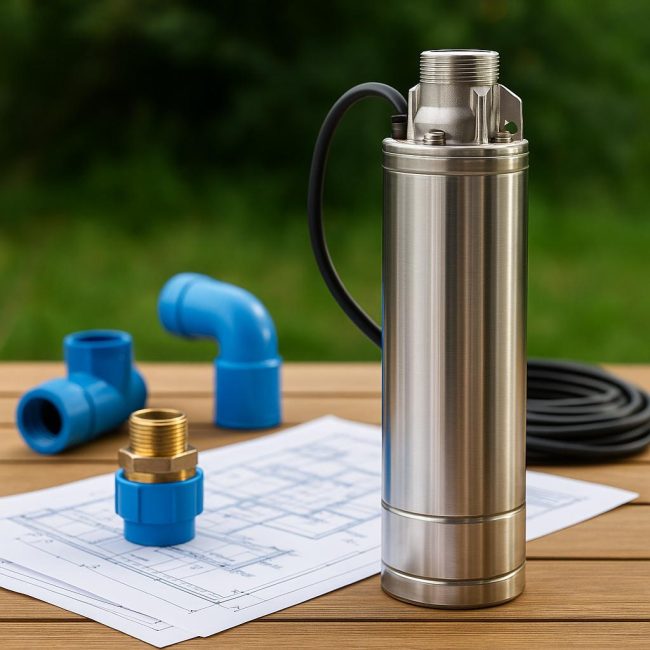
When planning a water supply for a country house, summer cottage, or farmland, many people face the need to select a well pump. This decision isn't as obvious as it might seem at first glance. Even with a well, say, 40 or 70 meters deep, mistakes during the equipment selection stage can lead to an unstable water supply, rapid pump wear, or excessive energy consumption.
Experience and practice help navigate these intricacies. During the planning stage, various equipment options are often considered, including proven solutions like the Grundfos SQ pump—one of a line of compact submersible models adapted for narrow wells. But even if it seems suitable at first glance, it's important to understand which technical parameters are truly critical when choosing.
- Types of borehole pumps: surface vs. submersible
- Key parameters to consider
- ➤ Well depth and dynamic water level
- ➤ Performance
- ➤ Pressure
- ➤ Well diameter
- Materials and wear resistance
- Protective functions and automation
- Energy consumption and features of the electrical network
- Operating conditions and climate
- Control type: manual or automated
- Tips for choosing a manufacturer and model
- Common mistakes when choosing
- Conclusion
Types of borehole pumps: surface vs. submersible
First of all, it is worth dividing all pumps into two main groups:
- Superficial — located on the ground or indoors, they only work when the water level is no deeper than 7–9 meters. They are not suitable for artesian wells.
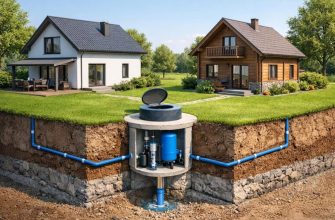
- Submersible — are lowered directly into the well and are capable of lifting water from a depth of up to 300 meters or more.
Thus, for most household and private needs with a deep well or unstable water level, the choice automatically shifts towards submersible pumps.
Key parameters to consider
When choosing a submersible pump, it's important to consider several characteristics. Don't rely solely on well depth or pump power—a systematic approach is essential.
➤ Well depth and dynamic water level
- Static level — the distance from the earth's surface to the water table in the absence of sampling.
- Dynamic level — water level when the pump is actively operating.
The pump should be installed at least 5-7 meters below the dynamic level, but not reach the bottom more than a meter, so as not to suck in sand and silt.
➤ Performance
This parameter is measured in liters per minute or cubic meters per hour. It should correspond to the total demand: shower, kitchen, washing machine, irrigation, storage tank, etc.
For a 3-4-person home with moderate watering and household use, the standard flow rate is 2-3 m³/h. Excessive flow can lead to energy consumption, while insufficient flow can lead to pressure drop.
➤ Pressure
This is the vertical distance the pump can lift water. Head includes:
- lifting height from the installation depth to the surface,
- distance to the house (adjusted for pipe resistance),
- the difference in height between the well and the water intake point,
- the required pressure in the system.
- Typically, another 20–30% reserve is added to the calculated value.
➤ Well diameter
Most domestic wells have a diameter of 110–125 mm. Therefore, pumps with a diameter of 3 or 4 inches, specially adapted for use in narrow boreholes, are so popular.
Materials and wear resistance
The longevity of a pump directly depends on the quality of its components. It's important to consider:
- Body material: Stainless steel is preferable, especially if the water has a high mineral content.
- Bearing type and the working group: floating impellers provide protection against sand and abrasives.
Low-quality pumps made of brass or aluminum alloys fail more quickly when exposed to contaminated water or when running dry.
Protective functions and automation
Modern pumps are increasingly equipped with intelligent electronics. Useful options include:
- Dry running protection (automatic shutdown when there is no water),
- Engine thermal protection (especially important for long-term work),
- Soft start (reduces the load on the power grid),
- Maintaining constant pressure (in models with frequency converters).
While many brands offer similar features, it's important to understand that having at least basic protection is not a luxury, but a necessity, especially for standalone systems without constant monitoring.
Energy consumption and features of the electrical network
Selecting power is not only a question of efficiency, but also safety:
- For summer cottages with limited electricity supply, it's occasionally critical that the pump doesn't create peak loads. This is especially important if there are multiple consumers connected to the line.
- Pumps with soft start and energy efficient motors are the preferred option, especially if the well is used year-round.
Operating conditions and climate
If the site is located in a region with harsh winters, it is important to ensure:
- Thermal insulation of the wellhead,
- The depth of laying pipes below the freezing level,
- Use of pumps that operate reliably at reduced voltage.
Control type: manual or automated
If you don't plan to manually turn on the pump every time before watering or showering, it's worth considering:
- Hydraulic accumulator + pressure switch — a classic system with cyclic pump operation.
- Stations with frequency converter — a more expensive, but economical and stable option: the pump regulates speed and maintains constant pressure.
Such systems are especially relevant for homes with a large number of consumers or unstable water consumption.
Tips for choosing a manufacturer and model
While we avoid overt advertising in this article, it's worth mentioning that experience shows that models from trusted manufacturers are highly reliable. Many homeowners choose devices similar to the Grundfos SQ due to their compact size, built-in protection, and stable operation under challenging conditions.
But it's important to remember: even the most reliable pump won't work if it wasn't selected correctly from the start. Chasing a "brand" without considering the well's specifics is a common mistake.
Common mistakes when choosing
- ❌ Orientation only to well depth.
- ❌ Neglect of water quality (sand, iron).
- ❌ Lack of performance reserve.
- ❌ Ignoring electrical grid requirements.
- ❌ Installation "by eye" without calculating pressure and flow.
Conclusion
Choosing a well pump isn't just a simple equipment purchase; it's a strategic decision that determines the comfort and stability of your water supply. Numerous factors must be considered, from the site's geology to electrical details. The optimal option isn't necessarily the most expensive or the most powerful pump. It's the one that's properly selected for your specific conditions and will serve you for decades without interruption or repair costs.
If you're unsure, it's worth conducting preliminary calculations, consulting with a specialist, or ordering hydrodynamic testing of the well. Only then will the choice truly be "optimal."