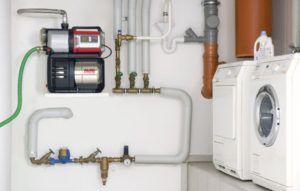
 The operation of many plumbing fixtures and appliances directly depends on water pressure in the water supply network. Low pressure can be a real problem, especially in high-rise buildings.
The only solution to this problem is to use a pump to increase the water pressure. Otherwise, living in such an apartment or house becomes extremely uncomfortable.
- Standard pressure in water supply systems
- Causes of low water pressure
- How does a booster pump work?
- Rules for selecting pump power - technical characteristics and their meaning
- How to choose a pump based on hydraulic characteristics
- Selecting a booster pump based on technical specifications
- Pumps that increase pressure in water supply systems
- The design of a hydraulic accumulator, its characteristics
- Installation and connection of a pressure boosting station
- Popular models
- Selecting a pressure booster pump for water supply
Standard pressure in water supply systems
The unit of measurement for this indicator is barAnother name is the atmospheric unit. Physically, this can be interpreted as the rise of water under this pressure to a height of 10 meters.
In residential areas, the pressure must be 4-4.5 atmospheres according to regulations, which ensures the service of high-rise buildings.
According to current regulations, as outlined in SNiP 2.0401-85, cold water in the system should be maintained within the range of 0.3-6.0 atmospheres, and hot water within the range of 0.3-4.5. However, it's important to understand that these are extreme values and don't necessarily mean the water supply system will function properly at these extremes. In such circumstances, pumps are used to increase the water pressure in the water supply system.
Excessively high pressure in a water supply network is no less dangerous than insufficient pressure. For example, if this pressure reaches 6.5-7.5 atmospheres, extreme conditions for the operation of connections are created.
In plastic pipes, threaded connections and joints created by soldering begin to leak, causing water leaks. Under these conditions, installation should only be performed using welded metal fittings.
It should be noted that gushing artesian wells can produce pressure up to 10 atmospheres and in such circumstances it is necessary to use pressure regulating equipment.
Causes of low water pressure
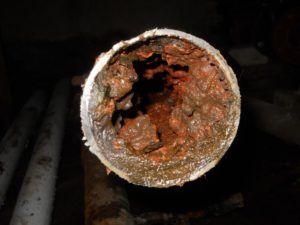 Circumstances leading to pressure drops in a water supply network can be both objective, resulting from natural processes, and subjective, related to errors in design, calculations, and equipment selection. They can be formulated as follows:
- Increased water consumption associated with high seasonal consumption. This occurs in the summer, when private households use large amounts of water to irrigate their gardens.
- Defective or underpowered pump at the distribution station.
- Clogged pipes. In the case of metal water pipes, this could be a mixture of rust and naturally occurring insoluble limescale deposits.
- Water leaks from breaks or leaks in water pipes. These usually form at pipe joints or corrode through their walls. The only way to avoid such defects is to perform regular inspections and maintenance strictly according to a designated schedule.
- Insufficient capacity of the electrical networks supplying the substation.
For the private sector, which uses individual water intake in the form of wells or boreholes, this becomes possible due to the gradual decrease in their flow rate as a result of silting of sources and clogging of filters.
The most concerning thing is that factors that reduce water pressure don't occur suddenly; their effects are significantly spread out over time and go unnoticed. Clearly, constant monitoring of the pipeline's capacity is necessary.
How does a booster pump work?
The most common signs of low water pressure are low water pressure from the tap or the inability to use two or more water points.
This becomes a reality when the pressure drops closer to the minimum standard value.
If the water pipes have been inspected and found to be in good condition, pumping units must be installed to increase the atmospheric pressure in the water supply network. Centrifugal pumps driven by an electric motor are used for this purpose.
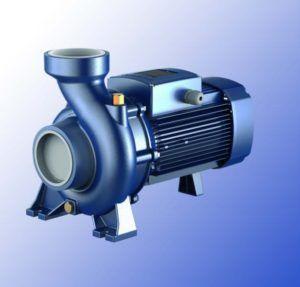 While performing the same function – maintaining water pressure in the plumbing system – they may differ in their operating principle:
- Continuous-action devices operate 24/7, maintaining water pressure in the system. The disadvantage of this type is constant power consumption and accelerated wear and tear on the equipment. These devices perform well when manually activated during peak water demand, such as when watering a garden.
- The pump is automatic and equipped with a flow sensor. It activates when water moves through the pipe, indicating current flow. This operating mode is more energy-efficient than the previous method. The cost of an automatic pressure booster pump is slightly higher, but this is offset by its more efficient operation.
A significant difference for such equipment is the cooling method. In devices dry rotor The impeller is located in a separate chamber and is separated from the water flow by seals installed in the housing.
Watch the video
Pumps wet rotor They operate directly in water, which has a positive effect on their durability, since the liquid acts as both a cooling agent and a lubricant for the bearings.
The main advantage of these devices is their silent operation, which allows them to be installed indoors.
Rules for selecting pump power - technical characteristics and their meaning
The main factor influencing the choice of a device for supplying water and maintaining normal pressure in the system is the nature of the water intake point:
- Self-priming units are used in situations where the water intake point is located below the unit's installation level. They are designed to independently suction water from a depth of up to 8 meters.
The shorter the distance from the water to the pump, the more efficiently it draws water, so the installation location should be as close to the source as possible.
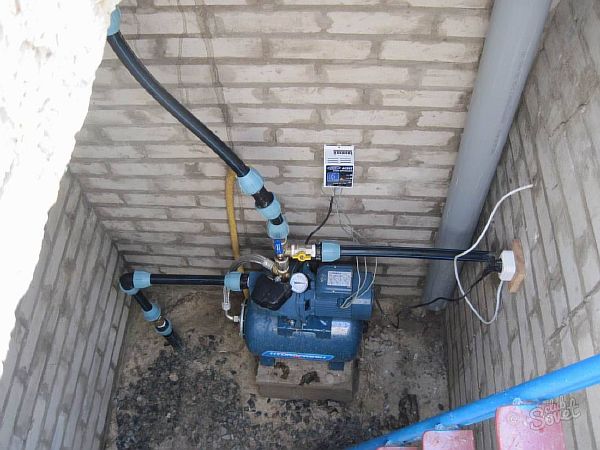
- Typically, suction units are installed in the water supply system and maintain pressure within it. The water intake source is typically located above the unit itself. This could be an inlet pipe or a water storage tank.
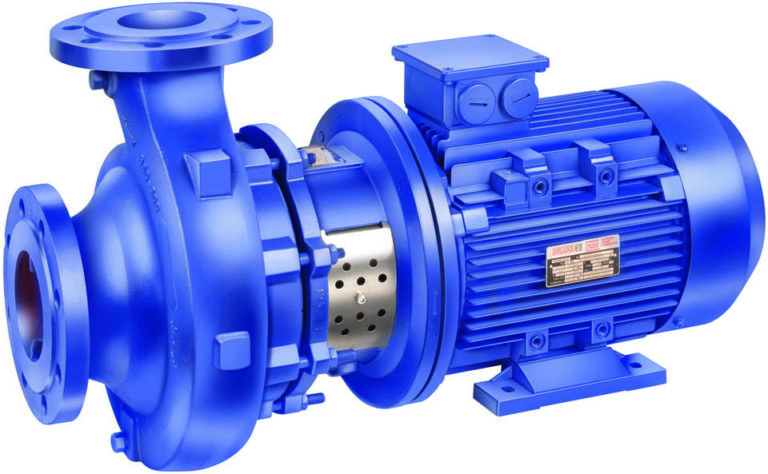
A separate line of circulation devices is produced, designed to ensure accelerated coolant circulation in heating systems. They are equipped with a temperature sensor for automatic flow rate regulation. They are installed in the return pipe of the heating circuit.
- Well pumps are used to pump water and maintain pressure from large tanks and wells. The design of this device ensures virtually silent operation. Air intake is prevented when the water level drops. This is guaranteed to prevent this if the unit is equipped with an automatic shut-off device when the liquid level is critically low.
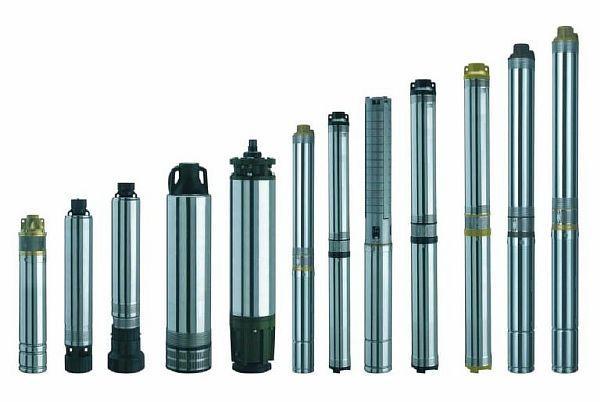
- Submersible borehole pumps are designed for installation in confined spaces, determined by the diameter of the water intake casing. Therefore, their diameter is small, yet their performance is high enough to meet all consumer needs.
How to choose a pump based on hydraulic characteristics
The main indicators when choosing are the following:
- Q – the device’s performance, measured in cubic meters per unit of time – m3/hour;
- N – pressure value – the height of the water column, measured in meters.
These two parameters determine the device's operating characteristics. They are interdependent; changing either parameter changes the other accordingly.
Recommended performance indicator value:
- For a country house for 4 people it is 1-2 cubic meters per hour.
- When using water for irrigation of the site - 2-3 cubic meters per hour.
The pressure required for a water supply network can be determined with sufficient accuracy from the ratio:
H = Hgeo + (0.2 + L) + 10 (m), where:
N – pressure;
Ngeo;
L - total length of discharge and suction pipes;
10 – the minimum value of the required pressure at the water intake point.
Using the selected parameters and the calculation performed, you can select a device that meets the requirements of a specific water supply network.
The pressure of the selected pumping unit must ensure that it performs the following functions:
- Raising the water column from the suction point to the required height.
- Overcoming the hydraulic resistance of a pipeline, including the pipes themselves, fittings, measuring instruments and control equipment.
- To achieve the required pressure at the final point of consumption, a reserve of 10-12 meters must be added to the calculated result.
The characteristic indicating the height of the column is a passport parameter and is always indicated in the accompanying technical documentation.
Watch the video
[sociallocker]
If the distance between the building and the water intake point is 25-28 meters, you should choose a submersible pump instead of a self-priming one.
Selecting a booster pump based on technical specifications
Domestic pumping stations are used to supply water to private homes. These units can draw water from various sources, including tanks, wells, boreholes, or natural reservoirs. The advantages of using such a device include the following:
- The systems maintain uniform pressure in the piping system, which allows the use of various household appliances and plumbing equipment in the home.
- There is no need for regular monitoring of the station – built-in automation ensures the operation of the device for a long time.
Domestic pumps require a stable power supply.
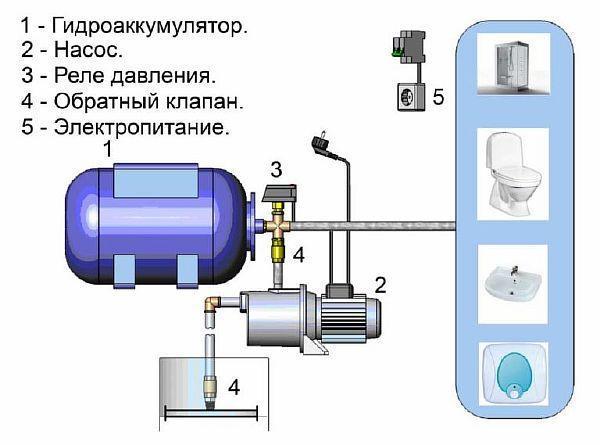
The main components of such a device are:
- hydraulic accumulator;
- surface or submersible pump;
- pressure control relay;
- non-return valve on the water intake;
- power supply and control device.
A hydraulic accumulator is a cylindrical vessel divided internally by a flexible partition. During production, gas is pumped into one compartment at a set pressure.
Water enters the piping system through the accumulator, while the pumping unit continuously pumps fluid, which acts on the flexible connector. When the set pressure is reached, the membrane actuates the pressure control relay, and the pumping stops.
When one or more taps are opened, the pressure in the vessel decreases and the pump starts pumping water again.
This unit is the main component of the station, and the operation of the entire installation largely depends on its characteristics.
Watch the video
Pumps that increase pressure in water supply systems
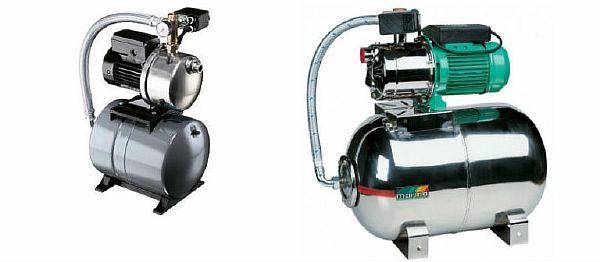
Automatic stations are supplied with external pumps. They are mounted on a metal base—a frame—along with hydraulic accumulators and control units. A water intake pipe is connected to the pump inlet, which is inserted into a casing, a well, or another water intake.
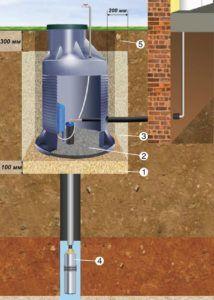 The system with a water intake pipe allows such a device to be installed on wells with a narrow casing pipe.
Pumps are designed as either vortex or centrifugal pumps. The former create water suction by rotating a rotor with blades located directly within the pump body.
They operate virtually silently, which determines their primary use as a pump for increasing water pressure in a water supply system, built into the piping system inside the house.
These units are used in systems that operate only at positive liquid temperatures. They simply become unusable when defrosted.
Centrifugal pumps produce a lot of noise during operation, but they are capable of pumping water from deep aquifers. Furthermore, they operate at sub-zero temperatures, so they are installed either in freestanding structures or in a well caisson.
The design of a hydraulic accumulator, its characteristics
As mentioned above, when using pumping stations, the home's water supply is provided indirectly through a hydraulic accumulator. This device equalizes the pressure in the system and protects it from hydraulic shock when the pump is activated.
Watch the video
A key indicator for a battery is its capacity. The higher its capacity, the less frequently the station's pump is turned on, which increases its lifespan and saves energy.
Installation and connection of a pressure boosting station
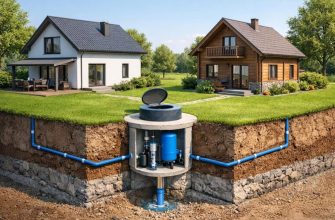
The location of the pressure booster device is always selected closer to the water sourceIn the second case, it is necessary to dig and equip a special bunker – a caisson.
Video installation
Watch the video
[sociallocker]
Such a tank should be at least 2 meters deep. A clay water seal should be installed in the bottom, and the walls should be lined with brick or a concrete wall.
It is also possible to install the pump system in a separate room inside the house if a silent unit is used.
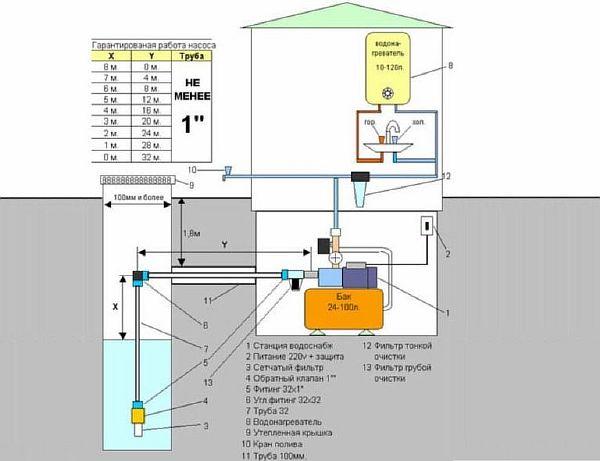
When installing a water intake in a well, it is necessary to make a special shelf on its wall on which the equipment is placed.
In houses with periodic visits (dachas), equipment is usually dismantled for the winter and stored in the house.
Watch the video
Since well depths often exceed the capacity of a suction pump (8-9 meters), a station with a submersible or ejector pump is used, which allows water extraction at well depths of up to 45 meters. However, such equipment will be somewhat more expensive.
Popular models
Currently, one of the leaders in the pumping equipment market is the brand DzhileksVery affordable in price—starting from $100—they are quite durable and reliable in operation.
The pumps are available in cast iron, polypropylene, and stainless steel housings. The latter option is slightly more expensive, up to $350, but is offset by its higher reliability. The battery capacity is 24 liters.
A submersible pump option can cost up to $500; it reliably pumps water from a depth of up to 32 meters with a flow rate of up to 1,200 liters per hour.
Pumping stations are also popular on the market. GrundfosThey are manufactured in chrome-plated metal housings with 24- and 50-liter hydraulic accumulators. The stations operate virtually silently and boast enviable durability.
A significant drawback of Grundfos's supply chain is the lack of spare parts, which are not supplied to our country. Therefore, any equipment malfunction requires a complete replacement.
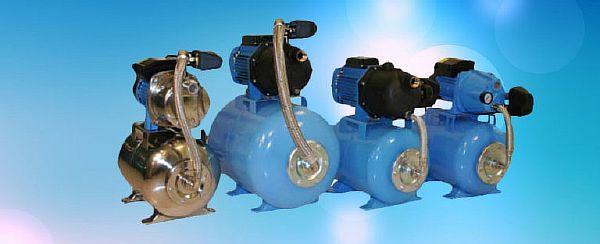
Grundfos pumping stations start at $250. These are low-power units—starting at 850 watts—with an external pump with an 8-meter lift and a flow rate of up to 3,700 liters per hour.
Equipment with a higher capacity, up to 5000 liters, with a 1.5 kW pump costs twice as much – around $500.
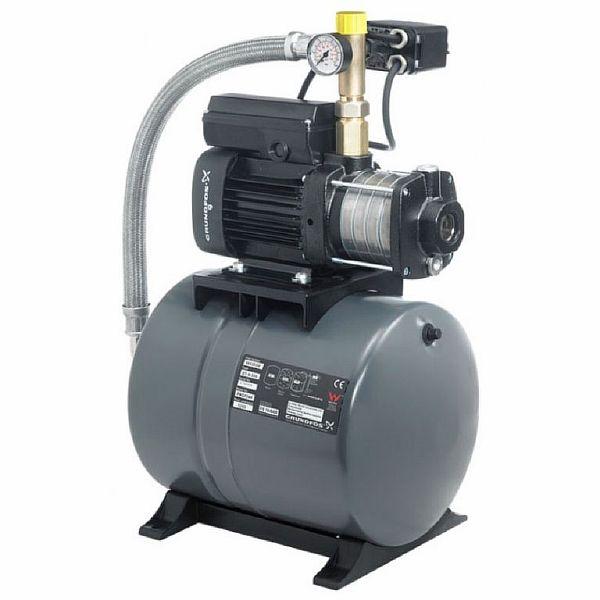
The Grundfos family of stainless steel pumps starts at $450, with configurations available for $1,200. They are equipped with numerous features, including overheating and idle protection, as well as water cooling.
Good reviews come from consumers of plumbing equipment ViloThese are higher-power stations designed to supply water to fairly large facilities, while the control circuit allows for stepless adjustment of all key parameters.
Control is via an active display using a programmable processor. The equipment is very robust, and the price of $1,000-$1,300 is entirely justified in this case.
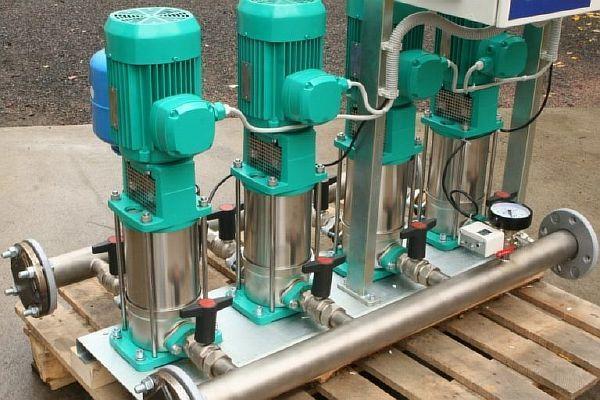
It should be noted that up to 4 surface pumps can be installed in a pumping station of this type.
Selecting a pressure booster pump for water supply
It's impossible to create comfortable living conditions in a country house without a reliable water supply. Modern plumbing systems also require a booster pump to increase the pressure in the water supply.
What should you consider when choosing a water heater based on electricity costs and clean water needs? Let's look at some points:
- A pump used in suburban water supply systems must meet not only the immediate needs of residents but also watering the garden and property. And if there's a swimming pool, it must also ensure its filling and operation.
- For a small country house with a close-lying groundwater table, a surface pump is the preferred solution. Its capacity is sufficient for both domestic and irrigation needs.
- Deep water may require the use of an ejector pump. If no other options are available, a caisson will need to be equipped, as such equipment produces considerable noise.
- A private water supply system requires a storage tank, often located in the attic. An automatic water refill and overflow control are essential, otherwise the house could flood.
- The ideal solution to the water supply problem is the installation of a pumping station with all the necessary adjustments.
Watch the video
The water pressure in the water supply when using a washing machine or a jacuzzi bath should be not less than 4 atmospheres.