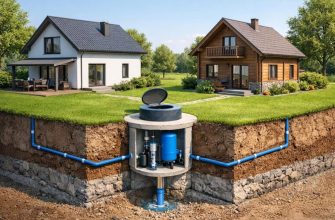
Well casing is a system of vertically assembled pipes, each with a reinforced casing and sealed together. This system ensures the integrity of the well and accumulates water thanks to a pump installed within it.
Drilling water wells for private homes and country properties is becoming increasingly popular to meet both domestic and commercial needs. A casing pipe is a necessary component of a water intake system.
What is it, its purpose and scope of application
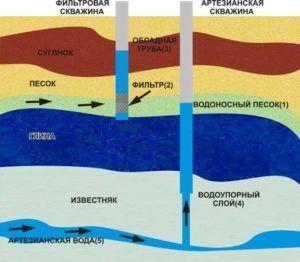
When drilling a well, the tool passes through various types of soil, such as:
- soil layer;
- sandy or clayey-sandy aquifer (perched water);
- secondary clay-sand layer, in which water-bearing sands and lens-shaped water occurrences are often found;
- sand and pebble formations;
- Limestone deposits, which are the main carriers of artesian water, are capable of supplying the highest quality and most delicious water. This is explained by their great depth, which ensures high-quality filtration of the water entering these layers;
- rock formations that provide a reliable base for aquifers.
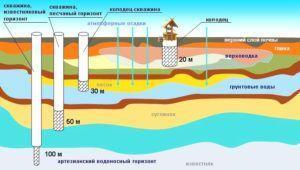
In addition, quicksands are often encountered – constantly shifting layers of water-bearing sands with a high moisture content.
The casing pipe, as the name suggests, serves primarily to strengthen the walls of the pit, which, due to soil displacement or the effects of quicksand, can completely block the well in a short time.
Additionally, a filtering device is installed on the lower casing ring to purify groundwater from mechanical impurities. Thus, it's clear that the application of such devices is well drilling and well completion. Moreover, they are used for drilling water wells, as well as gas and oil wells.
What types of casing pipes are there?
The main material for the production of casing pipes is steelPlastics and asbestos-cement products are also used. Let's take a closer look at products made from these materials.
Steel pipes
Metal pipes are widely used in drilling wells of any complexity, and the following design variations are distinguished:
- with coupling connection;
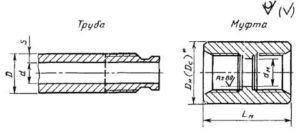
As can be seen from the connection diagram, the casing pipes are joined through an intermediate piece—a coupling. High-strength trapezoidal threads are precision-cut using specialized thread-cutting equipment. The threads are surface-hardened using high-frequency current (HFC) equipment.
- pipes with upset ends.
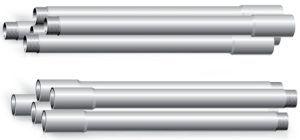
Casing pipes are manufactured in accordance with the requirements of GOST 632-80.
Plastic pipes
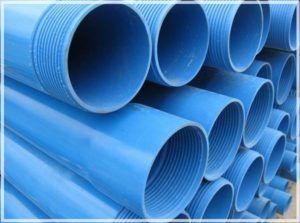 These products are made of unplasticized polyvinyl chloride and are used exclusively in water wells. They are available in blue or white, and both ends of the pipe are threaded.
Its application is to strengthen and seal the walls of water wells. The pipe is resistant to corrosion and ultraviolet radiation, and can withstand mechanical stress caused by ground movement during operation.
At sub-zero temperatures, mechanical damage from accidental impacts is possible, but operating conditions preclude this possibility, as the wellbore is always above freezing. The upper end is insulated with a caisson.
Asbestos-cement pipes
The material used to make these products is a mixture of cement and asbestos fibers, a natural reinforcing material. This additive makes the material strong enough for use as a casing for water wells.
The qualitative indicators that allow such application are as follows:
- relatively low cost of asbestos-cement pipes;
- absolute chemical passivity of the material;
- durability, since the pipe is not subject to corrosive influences.
The disadvantages of these products include their fragility, which limits their use in deep wells. The maximum permitted depth is 100 meters into the artesian limestone horizon.
It is commonly believed that asbestos fibers are carcinogenic, but this is not supported by research. Furthermore, only individual fibers of this substance can enter the water supply, and they are easily captured even by household filters.
Products with protective coatings, such as galvanized pipes or enamel-coated pipes, are not used for well casing. Zinc oxide is extremely hazardous to human health, and the enamel coating is extremely fragile; a slight impact is sufficient to damage it.
The lifespan of a water well depends not on the durability of the pipe, but on the condition of the aquifer and the filtering device. If the condition of the steel casing becomes a concern, a secondary plastic casing with a filter at the end is simply inserted, giving the well a second life.
Selecting a casing
When deciding on the material for well pipes, the following conditions must be taken into account:
- Due to their strength characteristics, plastic products can be used at well depths of up to 70 meters. Therefore, before beginning work, it is necessary to determine the probable groundwater level in the drilling area. This can be determined by interviewing owners of nearby wells and boreholes. This information is also available from hydrogeological maps of the area;
- Plastic and asbestos-cement pipes do not allow for well cleaning operations when silted up. Such operations are only possible with steel casings;
- When using steel pipes, iron oxides enter the water as a result of oxidation, causing it to acquire an unpleasant metallic taste and a yellow color. It should be noted that any filter, which is mandatory for well water, primarily works to remove iron from the liquid, and this does not incur significant operating costs.
- Restoring wells with any casing other than steel is practically impossible.
The life cycle of wells with metal casing, with proper operation and timely maintenance, can be up to 50 years.
Calculation of casing size
The parameters for selecting casing pipes depend on the required water supply. This is determined based on the maximum instantaneous consumption when using the maximum number of water points, such as:
- bathrooms and showers;
- mixers;
- washing machines and dishwashers;
- storage devices for household use (tanks);
- storage devices for household purposes (irrigation tanks).
In practice, reliable results of actual consumption were obtained, determining the need for 3 cubic meters per hour.
When reviewing the technical specifications of pumping equipment, we found that the main types of pumping equipment with this capacity are approximately 75 mm in diameter. This refers to submersible and deep-well pumps.
Attention! Vibrating pumps, which contribute to the rapid destruction of the casing, are strictly not recommended for this purpose.
Next, you need to allow for a mandatory gap of 4-5 mm between the pump and the well wall, resulting in an internal pipe diameter of 85 mm. Adding the wall thickness, which is 4.5-5 mm for this diameter, yields a final external dimension of 95 mm. This means you can use a standard 95 x 5 mm pipe.
The casing has developed leaks, and unfiltered groundwater is entering it. However, if the casing was selected with the option of installing a repair pipe, it is possible to insert a second, smaller-diameter pipe with a standard filter inside the primary casing, and the water intake can continue operating. In this case, taking this into account, the primary casing size should be increased to the next standard size, for example, using a 108 x 5-6 mm pipe, or a 118 x 6 mm pipe.
To be honest, I hadn't heard of asbestos-cement pipes before. They always suggested either plastic or steel. Durability is the key—they say up to 50 years, so I agree, the characteristics of these pipes are intriguing. I didn't quite understand from the article how to calculate the casing size. I calculated as suggested, but it didn't add up, but I suppose you should call a specialist for advice.