Polypropylene pipes are rolled tubing materials made from a thermoplastic synthetic polymer (polypropylene). These pipes are used in plumbing, heating, and sewerage systems, as well as for transporting aggressive liquids and compressed air.
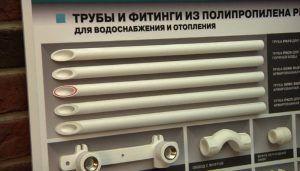 Polypropylene water pipes are a modern solution for laying mains, replacing metal pipelines. Water supply systems have become an integral part of not only city apartments but also country homes, as they offer a number of attractive consumer characteristics.
Let's list the main ones: a relatively low price, easy installation that can be done by yourself, and a long service life that can reach 50 years.
This article provides a detailed examination of all types of these products, their pros and cons, which is better—polypropylene or metal-plastic—for water supply, and which type of piping materials are suitable for hot water supply.
- Types of polypropylene pipes and their characteristics
- Marking of water pipes made of polypropylene pipes
- Types of reinforcement for polypropylene pipes
- Major manufacturers of polypropylene products
- Advantages and disadvantages of polypropylene
- Which pipes should I choose for my water supply system?
- Installation Features
Types of polypropylene pipes and their characteristics
Polypropylene is produced by the polymerization of free ethylene gas molecules. The resulting material has high technical properties, making it suitable for the production of products such as water pipes.
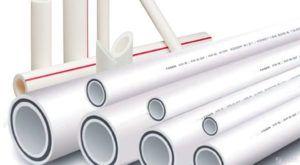 Modern products made from this material successfully resist the effects of chemically active substances and also possess a number of characteristics that allow them to be used at high pressure in water supply systems for various purposes, including cold or hot water supply networks or heating systems.
At the same time, their walls are free from deposits and bacteria growth. The inner surface of the pipeline is resistant to wear caused by solid particles, which are always present in the flow of transported liquid.
The main characteristics of polypropylene are given in the table:
| GOSTs and other ORDs | Parameters | Indicators |
| DIN 52612 | Thermal conductivity at 20OWITH | 0.24 W/cm |
| 15139 | Material density index | 0.9 g/cm3 |
| 23630 | Specific heat capacity at +20ABOUTWITH | 2 kJ/kgf |
| 21553 | Melting | 149O |
| 11262 | Tensile strength | 34-35 N/mmO |
| 15173 | coefficient of linear thermal expansion | 0.15 |
Polypropylene water pipes are manufactured in the following size range: 16 – 20 – 25 – 32 – 40 – 53. These are the primary sizes used in the installation of in-house and residential water supply systems. Larger pipes are used in external pressure distribution systems and gravity sewer systems.
A distinctive feature of this designation is that dimensions are specified not as for metal pipes according to GOST 3262-80, but rather according to the actual outside diameter and wall thickness, for example, 32x2.5. Metal products are designated by their nominal bore: DN25, with an indication of the series—light, medium, or heavy.
Polypropylene water supply pipes have a nominal bore designation based on their outside diameter, one notch lower than that of metal pipes. Thus, a size of 32x2.5 corresponds to a nominal bore of DN25.
Based on the material they are made from and the methods of application, polypropylene water pipes can be divided into three types:
- PPH type – produced from homogenized polypropylene. Applications include industrial water, ventilation systems, internal water supply networks, and gravity pipelines.
- Type PPB – made from a copolymer of the same plastic. Its primary application is in plumbing systems and underfloor heating systems. Pipes and fittings made of this material withstand impact loads well. They are also used in heating systems.
- PPR type products Manufactured from random copolymer polypropylene, they can withstand increased internal system pressure. Applications include hot and cold water supply systems and underfloor heating systems.
A modification of the third type of pipe product is products marked PPS. Their main feature is their ability to withstand temperatures up to +95°C (205°F) with possible short-term exposure to temperatures up to +110°C (220°F). Due to these properties, they are widely used for transporting hot water in plumbing and heating systems.
Marking of water pipes made of polypropylene pipes
The modern construction market is saturated with tubular products for a wide variety of purposes. Therefore, acquiring the right material presents a significant challenge.
Plastics occupy the leading positions, with polypropylene clearly leading the way for a wide range of applications. This is primarily due to the lower prices of this type of product, coupled with its relatively high performance characteristics for plumbing applications.
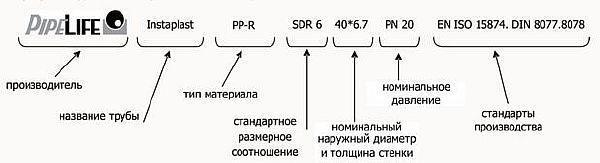
If you read it correctly, you can get a full understanding of its purpose. Let's look at the markings from left to right:
- Logo and name of the manufacturer.
- Product name.
- The type of material, in this case pipes, can withstand high temperatures well and are suitable for use in heating systems.
- Product type – SDR
- Size indicating outside diameter and wall thickness
- Nominal value of pressure inside the pipeline.
- Reference to the technical documentation on which this product is based. Global and European standards are specified. Russian-made products are marked with information on compliance with GOST or TU standards. International regulatory documents are specified if the product has been certified according to them in European or global laboratories.
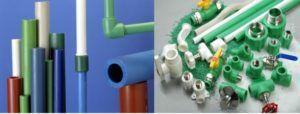 In addition, a blue or red stripe is applied to the surface of the pipes, which naturally indicates the possibility of using the pipeline for hot or cold water supply.
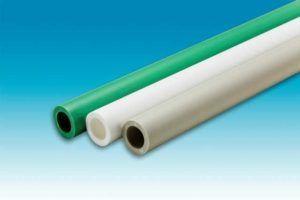
The color solutions for this product may vary. The pipes are produced white, gray, green or blackHowever, such differences do not convey any information; they are simply the manufacturers' decision.
Except black - these products speak about their UV resistance, therefore, they can be used on open sections of outdoor pipelines.
Types of reinforcement for polypropylene pipes
Many good words have already been said about polypropylene, but every good thing has its downsides, too. One significant drawback is its high coefficient of linear thermal expansion.
Don't be surprised if the pipeline begins to sag when heated – this is a visual sign of the main defect. Plastic begins to flow at 170 degrees Celsius, while the operating temperature of this material is 95 degrees Celsius. While the heating network can withstand pressures of up to 20 atmospheres at room temperature, at 95 degrees Celsius it shouldn't exceed 9.
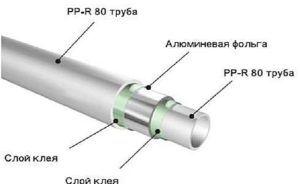
The metal thickness is 0.1-0.5 millimeters; it is applied as an outer shell or sandwiched between layers of the base material. Visually, the presence of the reinforcing layer is identified as a thin, shiny strip on the end face.
When installing a water supply system made of polypropylene pipes, the aluminum layer is removed with a special tool – a shaver – before soldering.
The second method of reinforcement The construction of polypropylene products involves the use of fiberglass inserted between layers of the base material. When the plastic polymerizes, it penetrates the reinforcing layer, creating a virtually monolithic structure.
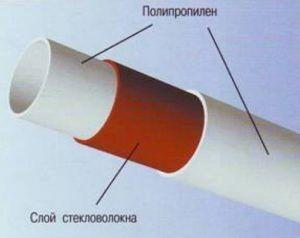
This material doesn't expand; its molecules simply deform, twisting into bundles. This reinforced pipe doesn't bulge under pressure or sag under its own weight.
Major manufacturers of polypropylene products
The popularity of plastic products made from this material has increased significantly in recent years. As a result, domestic production of these products in Russia is also growing. Hundreds of companies currently produce polypropylene products. The most significant of these are:
- Sinikon is a major Moscow-based manufacturer that supplies polypropylene products for cold and hot water supply systems, as well as for gravity sewer systems.
- Ikaplast was founded over ten years ago. Its products are distinguished by their high quality, ensured by a multi-stage quality control system. Its main specialization is reinforced pipeline pipes, including those used to transport aggressive media.
- YarInterPlast has two factories producing reinforced plastic pipes, the main one being located in Yaroslavl. Its main products are reinforced products, as well as fittings for pressure and non-pressure water supply systems.
- Politron is one of the largest manufacturers of polypropylene products. Using state-of-the-art equipment, the company produces a significant volume of construction pipes and fittings.
- Cosmoplast is a specialized company producing various fittings made of polypropylene.
- Almetyevsk Pipe Plant OJSC. Its production began during the Soviet era, manufacturing steel products. Today, it produces a significant amount of polypropylene products for water supply systems.
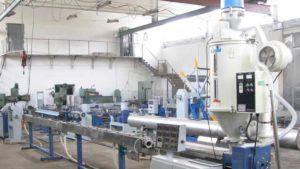 Of course, this list is only a small part of the hundreds of companies that produce plastic construction pipe products.
If you want to organize your own production of such products, you should take into account that a complete set of equipment for its production will cost approximately 700 thousand to 2 million rubles.
Advantages and disadvantages of polypropylene
This type of plumbing product has a number of advantages over its steel counterparts:
- The material is chemically inert and is not affected by aggressive environments.
- Manufacturers declare a service life of at least 50 years for polypropylene water supply pipes. For low-pressure pipelines, this can be extended to 100 years. In heating systems, such products can last up to 25 years. In any case, this limitation is many times, or even an order of magnitude, higher than similar characteristics for steel products.
- The materials are not electrically conductive.
- The product is environmentally friendly and does not release substances harmful to humans and animals into the water or surrounding area.
- Polypropylene products are easy to install using soldering technology. The process is accessible even to untrained personnel.
- During operation, a pipeline made of this material does not require additional maintenance to protect against corrosion.
The following points can be considered as disadvantages:
- The pipes do not withstand coolant temperatures above +95-100 degrees, especially at pressures exceeding 10 atmospheres.
- Difficulties in repair associated with the use of permanent connections during installation.
Which pipes should I choose for my water supply system?
The question naturally arises: polypropylene or metal-plastic, which is better for water supply?
In terms of price-quality ratio, of course, polypropylene should be chosenFor low-pressure systems, you can choose a product made of pure plastic, while for pressures exceeding 10 atmospheres, you can choose a fiberglass-reinforced one. In any case, with the variety of these materials, you can always find the right option for your plumbing system.
Regarding materials for the construction of heating systems, it is preferable to use aluminum-reinforced polypropylene.
Installation Features
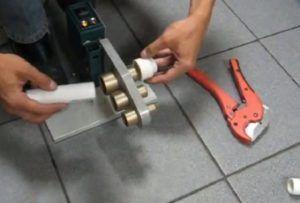
Once you have a plumbing plan, you need to purchase the required number of basic and component parts. The various components are connected by soldering using a specially designed soldering iron.
It comes complete with special mandrels and couplings for heating parts ranging from 16 to 53 millimeters. For more information on installing polypropylene plumbing, see this article.
Larger size equipment is purchased separately.
The parts to be connected are heated for a few seconds, removed from the soldering iron, and then joined manually.
I replaced all the old metal pipes in my apartment with polypropylene. I did it all myself, and I liked that even without any experience, you learn quickly, and working with polypropylene is a pleasure. And, of course, its durability and resistance to corrosion are a huge plus. I'm happy with it.