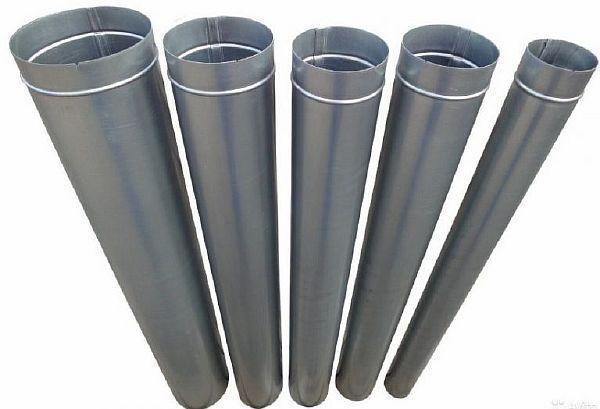
 When building a house or cottage, owners consider how and from what materials to build a chimney.
Some people prefer brickwork, but when connecting to a gas boiler, it is preferable to use tin samples.
Galvanized chimney pipe is the ideal solution for a stove because it's corrosion-resistant and has a beautiful, shiny appearance. Its zinc coating significantly extends its service life.
General information
One of the most important enemies of any chimney is the smoke that forms during boiler operation. condensation, which quickly destroys steelTherefore, manufacturers decided to coat the pipe with a protective layer that would protect it from corrosion and excess moisture.
Galvanized chimney pipe for a stove is very simple to manufacture. Sheet steel is dipped in liquid zinc, which bonds with the iron, creating a durable protective layer on the surface of the sheet.
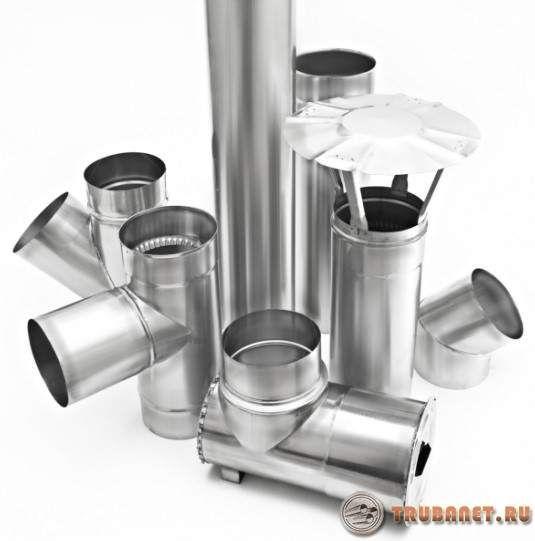 In addition, the galvanized pipe for the stove chimney has a number of positive traits such as:
- ease of installation;
- fire resistance and fire inertness;
- versatility (suitable for various heating devices: boilers, stoves, etc.);
- heats up quickly, which increases draft and activates the heating process;
- possibility of using thermal insulation;
- minimizing condensation that settles during the heating process.
Construction of galvanized products
Manufacturers produce single- and double-circuit modifications of these chimneys.
Single-circuit products made of galvanized steel are often installed inside the house or lined with brickwork.
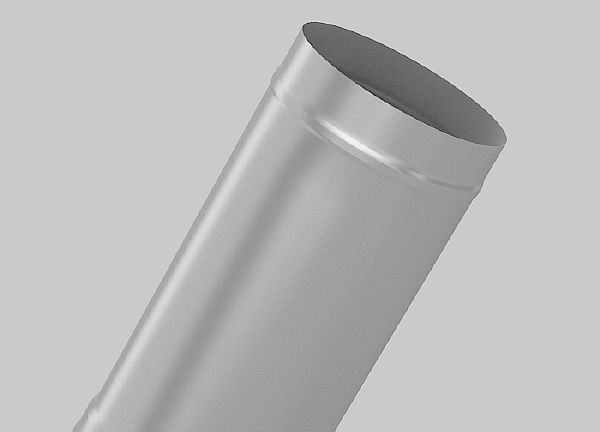
To avoid condensation it must be insulatedIt is not recommended to use single-circuit galvanized steel chimneys without insulation outdoors.
You can set it up yourself in a barbecue area or barbecue room.
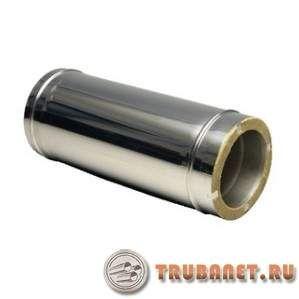 The double-circuit version (galvanized sandwich pipe) is so named because of its multilayer construction. It consists of three components: two pipes, an inner one and an outer one, which are insulated with mineral wool or another fire-resistant material.
This design heats up quickly, which activates the heating devices and minimizes the amount of moisture that accumulates on the walls.
Choosing a galvanized sandwich pipe results in an aesthetically pleasing appearance that blends harmoniously with the overall exterior design. In addition to the technology described above, structures are also made from so-called black steel.
These galvanized sandwich pipes assume that the pipe installed inside will be made of ordinary steel.
Galvanized sandwich chimney pipes are used in homes with heating boilers, stoves, or fireplaces. They are also an ideal option for baths and saunas.
Since the design of a sauna differs from that of a regular home, sandwich structures are used to maintain a high temperature in the steam room, and the space between them is filled with mineral wool, which is an environmentally friendly thermal insulator that is not susceptible to combustion at high temperatures.
Advantages
Besides being stronger, galvanized steel chimneys are also impervious to damage from moisture, sudden temperature fluctuations, and mechanical impact.
If we talk about price, then galvanized steel is worth it an order of magnitude cheaperthan similar products made of ceramic or copper. Moreover, it requires absolutely no additional maintenance during operation.
Video
[sociallocker]
While brick chimneys tend to clog very quickly, the porous structure of the brick quickly accumulates soot, requiring regular cleaning.
Galvanized pipes do not have this problem; soot simply does not accumulate on the smooth surface and therefore does not require constant maintenance and cleaning.
If the house was not previously equipped with heating, such as in country houses, but with the onset of cold weather you decide to equip the home with heating equipment, then the galvanized pipe for the stove chimney can be routed outside the house along any of the walls.
DIY Chimney Construction Techniques
Making a straight chimney with a standard diameter of 11 cm is easy. Building a galvanized chimney yourself isn't as difficult as it seems.
Video
First, you need to take a sheet of metal and cut it correctly. The process is similar to making a drainpipe, but in our case, the steel needs to be thicker. It's also important to insulate the chimney to prevent condensation, which can lead to icicles forming on the chimney in winter, in addition to corrosion.
To cut galvanized steel sheet yourself, you can use readily available tools such as a rotary cutter on a stand, a guillotine, or reciprocating shears.
The next stage is rolling and shaping the surface of the future product. This process is carried out using manual rollers or electric-mechanical drives.
The main thing is that the surface being processed matches the desired size. A galvanized pipe for a stove is made from a sheet 125 or 200 cm long. The rollers should be able to pull the sheet about a millimeter thick.
It's advisable to choose a machine with asymmetrically positioned rollers. This way, even the edge of the future chimney will be rolled properly, leaving no flat spots. The minimum rolled diameter should also be considered. The standard product has a cross-sectional size of 10 cm.
Video
The next step is insulation to protect against moisture caused by condensation. After insulation, a second pipe is installed over the first one, which holds the mineral wool in place and improves the technical characteristics of the chimney. The diameter of the second pipe is 11 cm. This is how you create a galvanized sandwich pipe for your stove.
Assembly Features
Once you've fabricated the structural elements yourself, you can begin assembly. Initially, it's a good idea to create a blueprint to mark the location of each section, as well as the connection and fastening points, adhering to certain standards:
- the galvanized pipe for the stove must be at least 5 meters long;
- the structure must be 150 cm higher than the highest point on the roof;
- When creating a project, don't forget about windows for cleaning soot.
The chimney system consists of sections of varying slopes, but it must be taken into account that all of them do not exceed a meter in length.
Video
[sociallocker]
A galvanized pipe for a stove is installed by hand using adapters, tees, clamps, and elbows with the required slope. Installation begins at the heating unit and extends upward by joining sections together.
The appearance of a galvanized chimney directly depends on the location of the outlet pipe. If it's installed on the side, the chimney will be a side-mounted unit, connecting to the outlet pipe and venting through the wall, after which it extends upward to the roof.
The lower section of the chimney is equipped with a condensate collector and a window for cleaning out dirt and soot. The entire external structure is attached to the wall with brackets, and the internal structure is secured with special bushings.
Video
Making a galvanized chimney pipe for your stove isn't all that difficult. Just follow the step-by-step instructions carefully and be persistent, while remembering safety precautions to avoid injury from the sharp edges of the sheet metal. Good luck with your project!
In my sauna, I installed galvanized sandwich panels only in the attic. I installed stainless steel sandwich panels from the stove to the ceiling and at the chimney outlet.
Galvanized steel doesn't handle temperature fluctuations well, and when exposed to moisture, it begins to peel off. A galvanized chimney cap rots almost completely within three years.