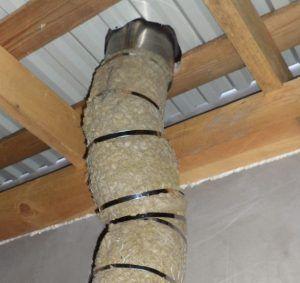
 The question, "How to insulate a metal chimney pipe?" is a very common one. This is necessary to protect against the following damaging factors:
- overheating of the structure;
- leakage at joints.
It is recommended to produce complex insulation (hydro- and fire-resistant thermal insulation).
Insulating a chimney in a bathhouse
When deciding how to insulate a metal chimney pipe in a bathhouse, the safety of people must be a priority.
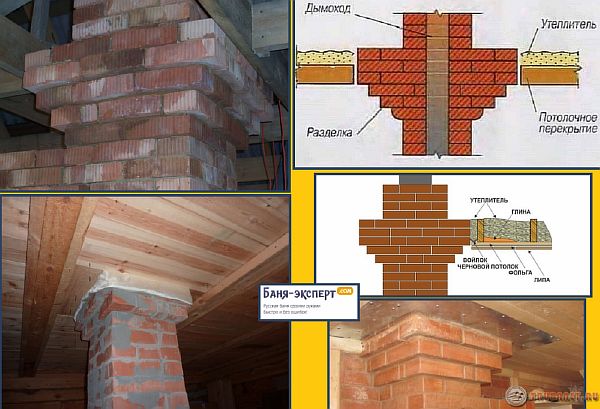
The main threat in this room is the presence of a live fire. Isolation is essential in this case. Without proper protection, the ceiling can easily catch fire.
Most saunas are built from wood, a material known to be highly flammable. Many people mistakenly believe that covering the ceiling with metal sheets will provide excellent protection and that further insulation is unnecessary.
However, this protection heats up and won't prevent a fire. You can insulate the pipe with red brick, but not every sauna's design is suitable for this.
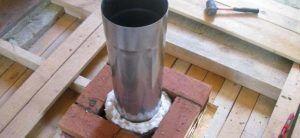
The modern building materials market offers several products for chimney insulation:
- Foil insulation. A sauna with this finish is similar to the design of a thermos. Heat is not lost, the room warms up quickly and cools down slowly.
- Thermal insulation. It can be wrapped around the chimney pipe and secured with wire or special metallized tape.
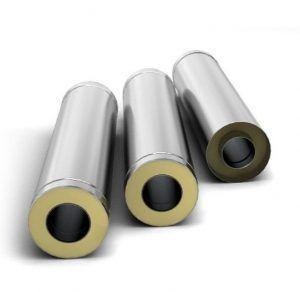
They call it a godsend for a bathhouse sandwich pipes, which are characterized by high safetyWith these, you don't have to worry about insulation. This structure is made of several sections that easily fit one inside the other. It's even suitable for a sauna with a metal stove.
Red brick is used in traditional Russian banyas. It is resistant to high temperatures and retains heat for a long time.
Such a structure must be laid correctly. The building's useful life depends on the quality of the masonry.
It is not recommended to save money on such a building, because the cost of repairs may be much higher.
How to wrap a metal chimney
Deciding what to wrap a metal chimney pipe with isn't difficult. The building materials market offers a wide range of products for this purpose.
IMPORTANT! The most important thing to know when insulating is that you cannot use a covering that contains flammable substances.
It's better to insulate with a good-quality product that meets fire and building codes. This will create additional safety conditions.
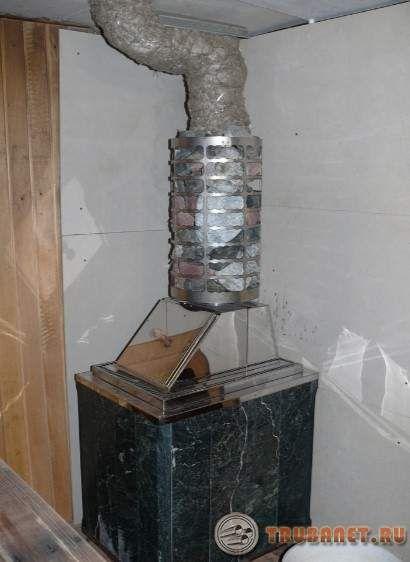
Of the proposed options, the most commonly used are:
- Fibrous building material;
- Mineral wool;
- Glass wool.
Let's learn how to insulate a metal chimney.
The metal version, and in particular its insulation, deserves special attention. The dilemma of how to insulate a metal chimney pipe must be resolved during drawing up a construction project.
If you're constructing a modern structure, you can use prefabricated sandwich pipes. These structures are quick to build, requiring minimal labor costs.
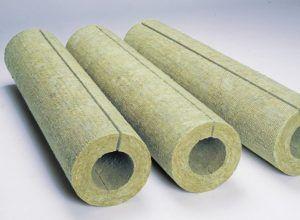
But they're not cheap. However, their long service life and simple design justify this cost.
They sandwich mineral wool between two panels, providing superior insulation.
Insulation is used to stop or prevent irreversible chemical reactions that occur under the influence of moisture and fuel decomposition substances.
Failure to insulate the chimney pipe in a timely manner may result in damage to the integrity of the house due to destruction.
Acid-enhanced condensation slowly but intensely damages building materials. Condensation is especially dangerous during the post-winter thawing period.
Manufacturing of boxes
Many people are afraid to build a metal chimney box themselves. However, it's not very difficult.
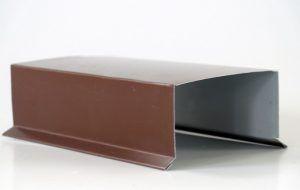
To make the box you will need the following tools:
- Metal shears.
- Galvanized sheet.
- Self-tapping screws.
- Tsyrkul.
- Drill.
- An opening is prepared. Its edges need to be secured with support beams. These will provide support for the frame.
- A pair of pieces are cut from galvanized sheet metal. A 90-degree bend is made along their edges, five centimeters apart. These U-shaped pieces are attached with screws to the prepared holes in the ceiling covering.
- Two more U-shaped blanks are prepared in the same manner and are overlapped onto the existing sheets. The result is a seamless frame for the opening created in the ceiling.
- The next step is to create the bottom of the box. A piece of the same galvanized sheet is cut to fit the opening. A circle is drawn in its center with a compass for the entrance of the flue gas vent.
- Four fasteners (each two centimeters wide) are placed from the center of the bottom of the box. These are then cut and bent at a 90-degree angle. This creates a base with a hole and four strips for fastening.
- The bottom is secured to the walls. A flue pipe is inserted through the opening and secured with a clamp. The empty space is filled with an insulating layer.
The instructions provided make it easy to make a box. If you follow them carefully, even a less-experienced DIYer will be able to complete the job.
Chimney installation
The problem of how to properly install a metal chimney isn't as easy as it seems. It's crucial that it functions properly.
Otherwise, combustion products will not only damage furniture, but also harm people's bodies.
Any construction of this type is made according to the following principles:
- Regarding smoke, a tee is installed in the network to remove condensate.
- Regarding condensate, this tee is not used.
The first stageThis is the design selection and materials selection process. At this stage, it becomes clear what kind of structure the building will be (straight or with transitions and bends).
The second stageThis is the assembly. All joints, elbows, and tees must be securely fastened with clamps.
The third stagePassing through the roof. The outlet through the roof is accomplished using a special section.
Next, an opening is cut and the pipe is routed. The passage is protected from the inside with a roofing sheet, and a roof trim is installed on the outside.
The slope angle is adjusted using a section of the groove, and its ends are adjusted to fit the ridge. Insulation is installed along the walls of the pipe.
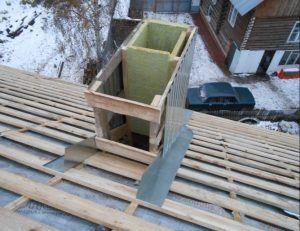
Fourth final stageAn adjustable apron is attached to the branch pipe, and the pipe is extended to the required length. Its ends are covered with a cap or umbrella. This will protect from precipitation.
Chimney fastening
After passing through the attic, the workpiece is taken out onto the roofIn this case, the gaps between the roof and the pipe must be sealed with waterproofing. It is recommended to raise the structure above the roof in accordance with existing regulations.
For security, the chimney is secured to the wall with special brackets. These may be included in a ready-made kit when purchased, or they can easily be made from metal angle iron.
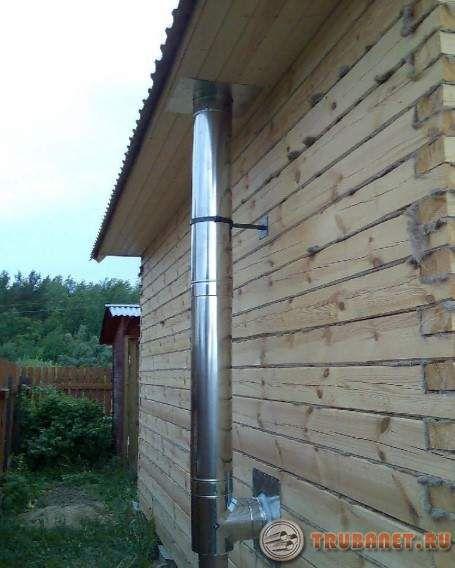
Once the structure is raised to the roof ridge and securely fastened to the wall, an umbrella is always placed on top. This protects it from clogging by fallen leaves, rainwater, and snowfall.
Transition from a brick chimney to a metal one
How to extend a brick chimney with a metal pipe? This question is asked very often.
To extend a brick chimney, you need to make a flat steel platform with a pipe. The pipe diameter should match the diameter of the extension piece.
This extension platform must be securely fastened. Dowels and screws are used for this. However, such a fastening will not be reliable without sealant.
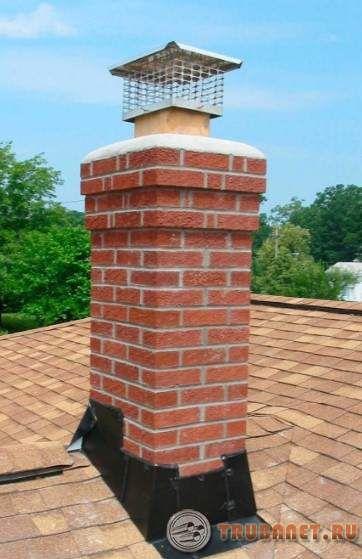
And now all the elongation actions in order:
- All fastening points must be marked on the brick foundation. These points should not be located on the mortar joint or on the edge of the brick.
- Next, holes are drilled in the platform for screws, and holes are made in the bricks for dowels.
- The site is placed on a brick base that has been pre-treated with a fire-resistant sealant.
- After this, the platform is evenly secured around the entire perimeter with self-tapping screws.
- Further installation of this transition is possible only after the sealant has completely dried.
Now a brick structure can be extended to any desired distance using a metal blank.
Some installation rules
- If the smoke outlet rises above the roof by more than 1.5 meters, it is recommended to additionally secure it with guy wires.
- The length of the pipe from the stove to the head should not exceed 5 meters.
- To clean out condensate, special plugs are installed.
- The structure should extend beyond the roof by at least 1.5 meters.
- When installing the smoke exhaust pipe, do not allow its diameter to become narrower.
- Nearby structures made of flammable materials should not heat up to more than 50 degrees.
- The smoke outlet must be located at a safe distance from electrical wiring.
When deciding how to insulate a metal chimney pipe, everyone makes a decision based on their preferences and financial capabilities.
The main thing in this matter is to do everything in accordance with the standards and requirements, and then the work will please you with a high-quality result.