 Chimneys are a vital utility system in a private home, and their proper functioning largely determines comfortable living conditions. Cracks and leaks that develop during operation can significantly reduce draft in the system.
As a result, combustion products can enter the room and create conditions for soot to accumulate on the walls of the chimneys.
It is known that when ignited it creates a temperature of up to 1300OC. Therefore, using a sealant for stove pipes is not just desirable, but vital.
Today the market offers prefabricated chimneys for stove pipes, including galvanized ones Or stainless steel, with long warranties. But sooner or later, you'll still have to use sealant.
Types of sealants
Heating equipment in private homes, especially those made of brick, often cracks both along the brickwork and at the seams. This is caused by thermal expansion, which varies depending on the individual components, such as stoves or fireplaces.
For use in different places, a sealant with appropriate properties is used.
 The main components of sealing materials are polymersTypically the sealant is one-component composition, packaged in tubes or tubes that allow the use of a mounting gun.
Two-component sealants For stove pipes, they require mixing before use, and the dosage accuracy must be high, otherwise the stove pipe sealant will not fully exhibit its properties, as declared by the manufacturer.
Suffice it to say that the dosing accuracy of sealants is up to 2 grams, and if even a trace of one component gets into the other, the paste's shelf life is only a few hours.
Therefore, in domestic conditions, single-component compositions in the form of pastes are more popular.
High-temperature sealants are used to repair stove pipes. There are two main types of these materials:
- heat-resistant – resistant to temperatures up to 350 degrees, used for routine repairs of external surfaces of fireplaces or stoves when sealing cracks in masonry or bricks, including for stove pipes made of this material, especially at joints. This sealant is used to seal roof pipes, except for metal ones;
- Heat-resistant or heat-resistant sealant can withstand temperatures of approximately 1500 degrees Celsius and is used for stainless steel and other metal chimneys, both at joints and on the roof. This material is primarily used where brickwork meets metal parts. for example, for a stainless steel stove pipe when sealing the joint between the chimney and the stove.
The specified compounds are used depending on the location of the damage and the temperature in it, choosing between silicone heat-resistant and silicate heat-resistant sealants for stove pipes.
Heat-resistant sealants
This group of polymeric materials is produced using a silicone base. Different formulations have different temperature resistance properties.
To increase resistance to this factor, iron oxides are added to the composition, giving it a reddish-brown color, making it convenient for working with brickwork, and repair areas remain invisible.
Before use, please check the maximum operating temperatures indicated on the packaging.
When using silicone sealant, you need to take into account its other properties:
- Silicone sealant may react acidically when used, releasing acetic acid. Such compounds should not be used on metal chimneys;
- the use of some varieties on the roof may be limited by the instability of the composition to ultraviolet radiation;
- high water resistance allows it to be used on a silicone base for working with the upper structure of the chimney;
- Silicone compounds have good adhesion to many types of substances, including concrete, brick, ceramics, metal, glass and others, which expands the scope of its application.
Important! Construction-grade silicone sealants cannot be used on chimney components.
Video
- During polymerization, silicone compounds retain a certain plasticity, which allows them to be used for sealing joints in the upper part of chimneys that are subject to significant wind loads with vibration;
- Curing of the compound can take anywhere from a few hours to several days, depending on air temperature and humidity. The optimal temperature range is 25°C and 50%. Polymerization occurs from the outer layers, spreading inward as it absorbs moisture from the air. Therefore, using silicone sealant for deep joints is not advisable, as this can result in leaks to moisture or smoke.
- To enhance the adhesive properties of the paste, the crack surface must be treated to remove dust, dirt, and grease stains, then degreased and rinsed with water. Use only after the surface is completely dry.
High-temperature sealants
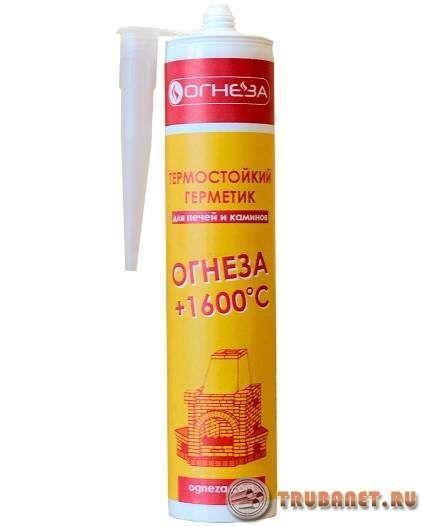
These compounds are silicate-based and therefore can withstand very high temperatures—up to 1200–1300 degrees Celsius—but can also withstand short-term exposure to temperatures up to 1600 degrees Celsius if the packaging is labeled "fire-resistant." These sealants are dark gray or black in color.
If sandwich-type elements are used for a chimney, sealant at the joints is practically essential, even when using stainless steel components. It's important to remember that sufficient adhesion of the sealant to the surfaces is only possible on rough surfaces.
To achieve this, the joints must be treated with abrasive materials. The easiest way is to sand them with sandpaper. Furthermore, the treated surface must be thoroughly degreased, preferably using acetone.
Please note: Drying time after degreasing with acetone is at least 15 minutes.
Silicate-based sealants can be used in temperatures ranging from +5°C to +40°C. The optimal temperature is above +20°C, where they cure most quickly and efficiently.
Video
When these materials harden, the seam becomes very strong and hard, so such sealants should not be used in areas where increased vibration is possible.
Application of sealants
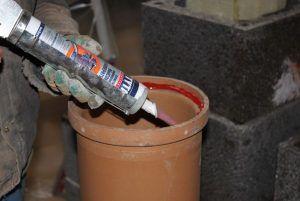 Preparation of the surface for the use of silicate compounds for stove flues is carried out in the same order as for silicone ones..
IMPORTANT! Please note that porous surfaces must be moistened when using silicate-based sealants.
Traces of the substance on the mating surfaces can be removed with a wet cloth, but only before it has completely hardened; after that, this can only be done mechanically.
Manufacturers
Companies producing such specialized materials typically include a special label indicating their intended use. The most popular in our market are:
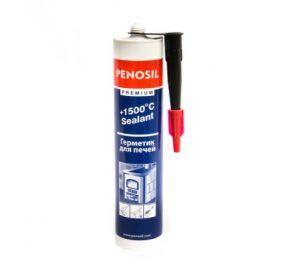
- brand Penosil is a heat-resistant black material with a maximum temperature of 1500 degrees, a protective film forms on the surface of the sealant after just 15 minutes;
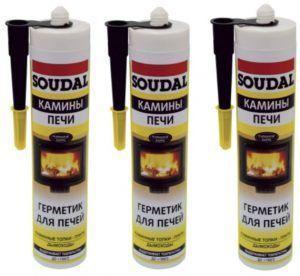
- The Belgian manufacturer introduces sealants of the brand to the market Soudal, including high-temperature ones for furnaces and chimneys.
Video
Tips and recommendations
There's no doubt about the advisability of using sealant for flue gas exhaust systems in stove heating systems. Even when using stainless steel sandwich pipes, which feature tighter joints, air can be drawn in from outside, reducing chimney draft. A more dangerous factor is the release of combustion products into the house.
Caution! Avoid contact with skin by using protective equipment. If this occurs, rinse the affected area thoroughly with water.
Please note the possibility of using SMX polymer-based sealants. This material is not a high-temperature sealant, but is classified as a sealing adhesive with a maximum application temperature of up to 200 degrees Celsius.
Video
Its advantage is that there are no restrictions on the temperature of use, which makes it possible to carry out prompt chimney repairs in small volumes even in winter.
Conclusion
This type of heating system material is not widely known. Therefore, we hope the information provided here will be helpful. Good luck!