There's a lot of debate about blocking sewer lines for debtors—whether this method of collecting debt from the management company is legal or not. According to Russian law, in particular Article 153 of the Housing Code of the Russian Federation (HC RF), all individuals and legal entities are obligated to pay for utilities.
If there is a debt, the management company (MC) can either file a lawsuit or disconnect the utility service that has become a stumbling block (however, this rule does not apply to heating and cold water supply).
Since the first method entails significant costs, not only financial but also time, management and housing and utilities employees resort to installing so-called plugs. Read below to find out whether this approach to dealing with debtors is legal.
The procedure and features of blocking sewerage for debtors
The first thing to note when discussing restricting or completely shutting off water supply from an apartment for non-payment of utility bills is that the debt to the management company alone is not sufficient. Two conditions are required:
- The debt is 2 months or more old.
- Compliance with the procedure for shutting off sewerage for debtors.
The first point is clear. But the second requires more detail.
The procedure for shutting off sewerage for debtors prescribes:
- The management company is required to submit a demand for payment of utility services in writing. This demand must include:
- amount and term (listing months) of debt;
- the time available to repay the debt – usually 20 days.
The document is delivered in person or by sending a letter with a list of attachments and a receipt.
- The management company is obliged to notify about the restriction or complete blocking of water drainage from the apartment 3 days in advance.
- The management company has the right to install a plug only if:
- there are no transfers from the debtor to the bank account;
- The water supply is not suitable for restriction.
A complete blockage of water drainage from an apartment may occur:
- if the water supply system has straight sections without branches;
- if there is 0.8 m of space above the riser;
- if the pipe is compliant in material.
Thus, under two conditions: the debt is two months or more old and the debtor's sewerage system is shut off, the management company can draw up an agreement to shut off the water drainage system from the residential premises.
What types of blockages can there be?
Several types of blocking plugs are available. Each has its own advantages and disadvantages. The most popular are the "Sprut" and "Kit."
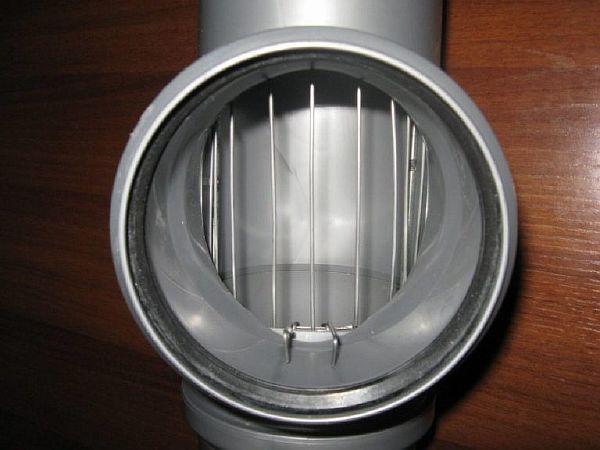
The first sewer blocking system we'll look at is called "Sprut." It consists of a video camera, a probe (several meters long), a blocking device, and a manipulator. Its advantages include:
- presence of a video camera;
- the ability to completely or partially block the sewer riser.
It is lowered into the sewer pipe through the vent and partially or completely blocks the flow of wastewater. However, this does not disturb the pipe's geometry, and other residents experience no inconvenience.
This plug is made of steel. It is resistant to mechanical and chemical damage.
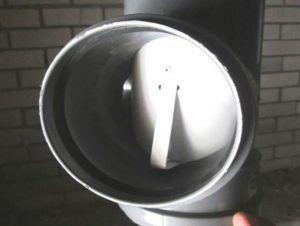
The second sewer blocking system, "Kit," consists of a probe, a control panel, and a camera. Its advantages include:
- the presence of LED bulbs makes it easier to find an apartment;
- The presence of a compact control panel means that there is no need to rent a car for specialists.
There are other types of blocking:
- TerminatorProfi;
- "GLOT" - consists of a cable, at the end of which there is a manipulator and a miniature video camera;
- "SOV" – involves the presence of a plug in the form of a polymer sleeve, which is pressed into a section of the debtor's pipe and locked.
The condition for lifting the block is full payment of the debt to the management company.
Is it possible to remove the blocking myself?
It's virtually impossible for a debtor to lift the freeze on their own. This is because:
- This requires special equipment, which only management companies have (however, other companies and private contractors also have it, but we will talk about this later);
- This requires dismantling the toilet, which is quite problematic.
Therefore, the best way out of the situation is to pay the utility bills and not solve the problem yourself.
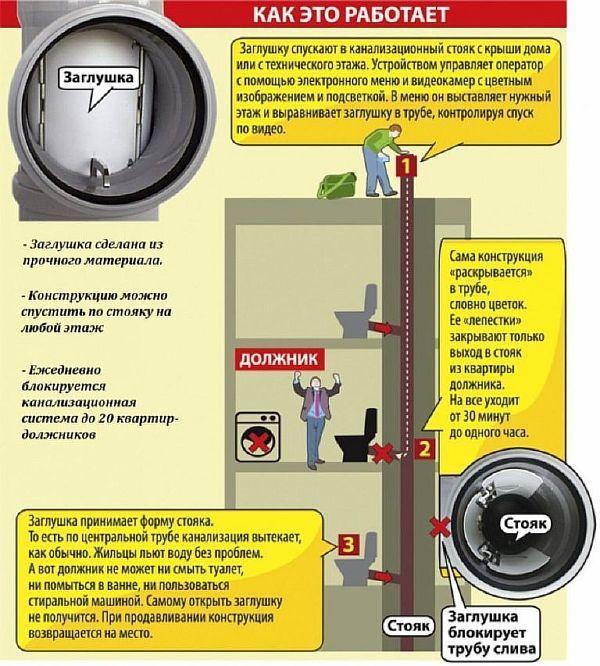
But if, for whatever reason, you can't pay off your debt and contact your management company to unblock the system, you have only one option left: disconnecting the toilet from the main riser and partially dismantling the main riser.
To do this, we need to prepare the following tools:
- strong hook;
- adjustable wrench;
- several wrenches;
- pliers;
- dowels;
- hammer;
- flashlight.
Remember that removing the blockage yourself is highly likely to cause a malfunction in the main riser. Therefore, weigh the pros and cons, and if the pros outweigh the cons, proceed.
The process of removing a blockage from a sewer
As noted earlier, removing the toilet plug requires dismantling the toilet. This step cannot be skipped, as the blocker is located right after it.
The process of removing a blockage from a sewer includes:
- Shutting off the water.
- Dismantling the drain tank and all communications.
- Unscrewing the bolts from the toilet.
- Dismantling the bell. The lock is located at its base.
- Removal using a rigid hook. The locking device must be hooked and pulled toward you.
In some cases, you can use pliers to hook the sewer shutoff device. If the stopper is rubber, you won't need a rigid hook or pliers. The elastic walls simply pull it in, allowing you to fully use the toilet, sink, and bathtub as before.
If the plug is metal and won't come out, perform an inspection. Tap the pipes. This will reveal the location of the blockage. Drill a hole and insert a pin into it. Then, tapping it with a hammer, gradually push the device in.
Companies and private specialists in removing blockages from sewer systems
Removing sewer blockages without notifying the management company is currently legal, but it's unclear what the future holds. Therefore, there are companies and private contractors who remove blockages. They have the same equipment as the management company.
Therefore, if you don't want to pay for utilities and are afraid to solve the problem yourself, then seek help from one of these companies or a private repairman.
Judicial practice
Restricting and completely blocking sewerage is legal. However, some are trying to challenge the management company's actions. Some are successful, others are not.
For example, in case A56-19200/2014, the Thirteenth Arbitration Court of Appeal sided with the State Housing Inspectorate. The case was that the housing cooperative had installed the plugs without proper procedures. The judge explained that:
- The housing cooperative is obliged to calculate the debt for each debtor and utility service;
- The housing cooperative is obliged to notify about the complete shutdown of the water supply from the apartment 3 days in advance;
- The common riser must meet sanitary and hygienic requirements.
Because this management company's policy rendered the property non-compliant with sanitary and hygienic requirements, i.e., unfit for habitation, the Thirteenth Arbitration Court of Appeal sided with the State Housing Inspectorate.
But there's also a contrary court decision. It's from the same court—the Thirteenth Arbitration Court of Appeal. Case No. A56-27564/2014, for example, states that the housing cooperative installed the plugs in accordance with the law. The judge noted:
- the fact that the housing cooperative reported that the water supply from the apartment would be completely shut off within 3 days;
- that this did not result in damage to the debtor's property;
- that it did not result in damage to the property of other residents.
Thus, the actions of the management company employees may be considered unlawful if:
- there is no message about restriction or complete drainage of water from the apartment for 3 days;
- this resulted in damage to the property of the apartment owner, who did not pay for utilities;
- This led to damage to the property of owners of other apartments who did not have debts to the management company.
In this case, the debtor has the right to demand compensation for material and moral damages.
The issue of the management company's costs for installing and removing the plug is highly controversial. The law doesn't stipulate that these costs fall on the shoulders of the non-paying utility bills. Therefore, if you are being asked to pay for installing and removing the plug, file a lawsuit—it's illegal.
The best way to resolve a restricted or completely blocked water supply in your apartment is to pay your utility bills. Even if you remove the blockage yourself or hire a professional plumber, it will reappear. And if your actions result in damage to the property of other apartment owners, they may sue.
Good afternoon. I need the phone numbers of companies that install a sewer cap for a persistent utility defaulter. She hasn't paid for three years. The debt is 120,000 rubles.
Hello. You forgot to specify your city.
And the time from the installation of the plug is paid for, since I don’t use the sewer system?
...and how legal is it to charge for water supply and drainage (30 cubic meters per month, however) while there is a plug in the apartment's sewer pipe?
Hello. According to Russian Government Resolution No. 354 of May 6, 2011 (as amended on February 27, 2017), no charges are made for services not provided. A recalculation must be made at the time the sewer cap is installed and reflected on the receipt. If charges continue to accrue, the management company's actions fall under Article 1102 of the Russian Civil Code—unjust enrichment. You will have to defend your rights in court.
Regarding water supply, if the sewer line is disconnected and the water supply is not sealed, and you continue to use water for cooking or other purposes, payment is legally charged based on the meter reading. If the water supply is also disconnected by the service provider, payment is not charged in accordance with the same Law No. 354.
Good afternoon. I need the phone numbers of companies that install a sewer cap for a persistent utility defaulter. Novokuibyshevsk, Samara Region.
Hello. Please contact your management company regarding this matter.