A great solution for creating a sewer system is to build a septic tank yourself using Eurocubes. Its assembly is straightforward, so homeowners can handle it without the help of specialists.
However, outside assistance may be required for excavation and installation of the structure. Before installation, it is recommended to not only study the installation diagram and prepare the necessary tools and equipment, but also check the groundwater level, soil freezing depth, and a number of other parameters.
Properly performed preparatory work will ensure long-term, uninterrupted operation of the sewer system as a whole.
- What is a Eurocube? Let's look at its design.
- Features of the arrangement
- How to choose a location for a Eurocube sewer system?
- Assembly and installation technology
- Design, calculations, what materials and tools will be needed
- Preparatory work
- Installation and assembly - step-by-step instructions
- Operation and maintenance
- Pros and cons of a septic tank made from Eurocubes
What is a Eurocube? Let's look at its design.
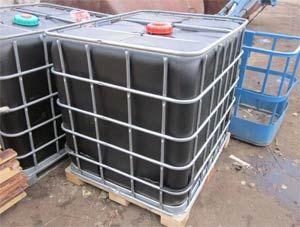
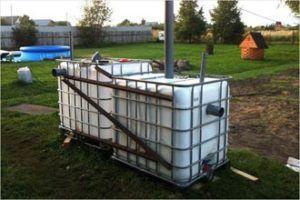 A Eurocube is a special container whose primary purpose is to transport and store various liquids: food, water, fuel, etc. The structure is usually made of polyethylene.
Their intended purpose requires thick walls for increased strength. Purchasing a Eurocube is not particularly difficult and can be found at various large hardware stores. These structures are most often used to store water in country houses.
The most common volume is 1000 liters, but there are also models with a smaller volume (640 liters).
Such products have some features that it is advisable to know about before purchasing:
- made of low-pressure polyethylene;
- have a neck with a cross-section from 140 to 230 mm;
- at the bottom of the structure there is a branch pipe for connecting a drain pipe, with a diameter of 45 to 90 mm;
- The strength and reliability of the Eurocube is increased by additional reinforcement of the outer walls of the product with steel mesh.
These models are ideal for constructing a stand-alone sewage system. You can build a septic tank yourself using Eurocube containers, using the diagrams and installation instructions.
This type of sewer system will function without problems for many years, although it requires periodic maintenance. It is capable of effectively serving a suburban property or a small home.
Features of the arrangement
A sewer system built with Eurocubes (Eurocubes) is not only reliable and long-lasting, but also cost-effective. Below is a detailed diagram of a two-chamber septic tank with ventilation and a concrete pad.
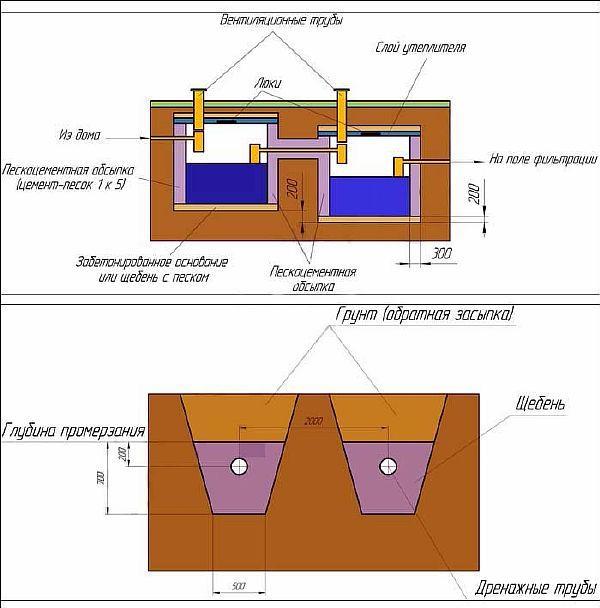
However, there are some features and subtleties that it is recommended to learn about before starting the construction process:
- The installation procedure involves a significant amount of work, so it will take some time and require the assistance of several people. A fairly large pit will need to be dug and the product lowered into it. This is very difficult to do independently, as the Eurocube is large and heavy.
- It's important to follow all installation instructions. If the preparatory procedure isn't completed correctly or the installation process isn't followed correctly, the septic tank will be exposed to negative environmental influences and will quickly become damaged.
- An additional filtration system will be necessary, as a homemade septic tank made from Eurocubes, for example, can only treat about 50% of wastewater. Therefore, before construction begins, it's essential to consider additional treatment (installing filter fields, infiltrators, etc.) and allocate space for it in the layout.
How to choose a location for a Eurocube sewer system?
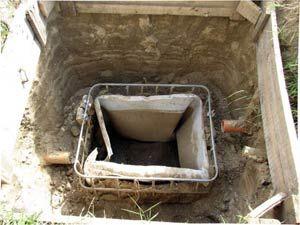 An important step in preparing to build a septic tank from Eurocubes is studying the diagram, as well as selecting and preparing a site for the sewer system. When choosing a location, it is advisable to follow certain recommendations and rules listed below.
Main rules:
- the structure must be located at a distance of 5 meters from buildings, at a distance of about 50 meters from a well where drinking water or water for irrigation is taken, at a distance of 10 meters from rivers and 3 meters from trees;
- When laying a sewer pipeline, it should be taken into account that pipes should not be placed parallel to the ground level, a certain slope is required and the whole path should be as short as possible;
- If a septic tank needs to be installed further than 15 meters, it's essential to allocate space for an inspection well. This is necessary for quickly clearing blockages in pipes;
- If it is necessary to use a pipeline with a bend, then special turning wells must be installed in these places;
- The structure must be positioned to ensure unimpeded access for sewage disposal equipment. This equipment may be required if a malfunction occurs and the septic tank contents need to be removed.
Based on these factors, the most suitable location for building a septic tank from Eurocubes is determined. It is also recommended to immediately identify the location for an additional treatment system on the property plan. As mentioned above, this could include filtration fields, a dedicated well, or infiltrators.
Assembly and installation technology
Watch the video
Watch the video
Building a septic tank from a Eurocube at your dacha yourself will save your family significant money compared to purchasing and installing pre-fabricated sewer systems. Before installation, you need to prepare and assemble the parts according to the diagram.
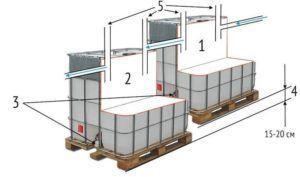
 To achieve this, the following actions are most often performed:
- The existing drain hole is sealed. Due to its small cross-section and low location, it is not suitable for connecting to a sewer pipe;
- new holes are created in the first Eurocube to connect the pipe through which waste liquids flow, and to allow waste liquids to flow into the second container;
- In the second unit, openings are required to allow the inlet from the first cube and the flow of wastewater into the filtration field. It is recommended to equip the last opening with a check valve;
- The holes on the upper walls of the Eurocubes are intended for the exit of ventilation pipes.
It is imperative to seal the pipe connections in all created openings. The openings must also be equipped with tees to allow for connection to the pipeline.
Design, calculations, what materials and tools will be needed
The importance of preparatory work cannot be overstated; it allows for the highest quality independent installation of a sewer system using Eurocubes.
It's essential to consider the soil type, groundwater depth, soil freezing, and other parameters. It's also crucial to correctly calculate the required septic tank capacity to ensure it can effectively handle the amount of wastewater supplied.
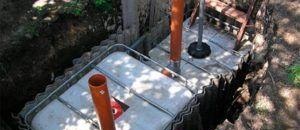 The easiest way to calculate this is by using meter readings. This allows for a simple and accurate determination of how much liquid the building's residents discharge into the sewer system daily. However, this method isn't always feasible; in such cases, manual calculations are required.
It's generally accepted that the daily water requirement for one person is approximately 200 liters. However, in reality, families of 4-6 people often use only about 500 liters. To select a septic tank of the appropriate size, consider the average water consumption of the household over three days.
Once you've determined the type of septic tank you need, you need to select a suitable location. When selecting a septic tank, it's important to follow certain guidelines, as outlined above.
It's important to note that when choosing a pipe, it's essential to consider its distance from buildings and other objects, as well as the location of the pipeline. This will help prevent future clogs and contamination of nearby bodies of water or wells.
Preparatory work
To construct the structure, you will need a Eurocube, four tees, plastic pipes for connecting to the septic tank, overflow and ventilation pipes, and fittings. The following tools are required: wooden planks, gloves, an angle grinder, foam, a welding machine, a sealant, rebar, and a spirit level to determine the slope of the sewer pipe.
To install a sewer system, 2 to 3 Eurocube tanks are typically used. This is sufficient for most standard cases. It's recommended to purchase tanks designed for storing non-food products.
If saving money is important, you can buy a used unit that hasn't been cleaned. It should be washed with plain water, and it will function just as effectively as a new cube. Once you've got all your tools ready, you can begin the prep work.
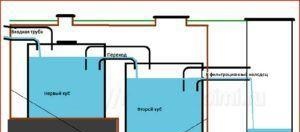
Scheme of actions:
- Dig a trench for the sewer pipes that will supply wastewater to the septic tank. When digging, keep in mind that the depth of the supply pipe should be no more than 3 meters from the surface, but below the frost line.
- Dig a pit based on the dimensions of the Eurocubes. The pit should be large enough to accommodate all the tanks and have approximately 20 centimeters of free space on the sides.
- Dig a trench to accommodate the pipeline carrying the treated wastewater. Since a septic tank cannot independently purify wastewater 100%, additional treatment will be required. In most cases, filtration wells, embankments, or special treatment fields are used. Therefore, at this stage, it's important to determine the location of the filtration site on the site plan.
- Assemble and prepare the tanks: install tees, make the necessary openings, and provide additional waterproofing at the joints. It's important to note that each Eurocube is positioned approximately 20 cm below the previous one. This ensures that the inlet and outlet openings in the tanks are not aligned.
Watch the video
[sociallocker]
Once the pipes are installed and the connections are sealed, you can begin the main construction process—building a septic tank from Eurocubes yourself.
Installation and assembly - step-by-step instructions
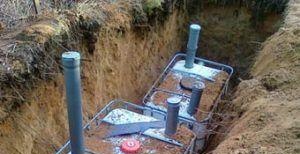 How to build and install a septic tank from Eurocubes yourself:
- The first stage depends on the soil type. If it's clayey and fairly loose, attention must be paid to compacting the bottom. To do this, add a layer of sand and gravel, then lay a concrete screed on top to prevent the bottom from collapsing and warping when the tanks are completely filled. When pouring concrete, remember that each tank will be 20 cm deeper than the previous one.
- The assembled and prepared septic tank is lowered into the excavated pit. At this stage, it is recommended to anchor it using cables or chains. Otherwise, the tanks may float to the surface, causing serious damage to the structure and a breach in the seal.
- Pipes are connected at both ends, carrying wastewater to the septic tank and treated effluent to a filter field or well. It is recommended to maintain a slope of 2 cm per meter of the pipeline to ensure free gravity flow of the wastewater. The outlet pipe should be positioned at an angle toward the drain field.
- It is recommended to insulate the area where the pipeline is located above the soil freezing level to prevent the negative consequences of soil heaving.
- Then the walls are insulated; in most cases this is done using foam plastic, but any other insulating material can also be used.
- A septic tank made from Eurocubes, built with your own hands, is filled with water, and the pit is filled with sand.
If groundwater is close to the surface, the side walls of the reservoirs should be additionally protected. Reinforcing bars or wooden planks are placed in the "pocket" left between the pit and the reservoir during excavation, and then slowly filled with concrete.
Watch the video
As long as you don't pour too quickly, the structure won't become deformed or damaged. The key is to fill the tank with water before beginning this process.
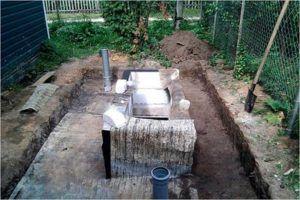 If the groundwater level is not too high, then you only need to take care to prevent damage due to soil heaving (this process is an increase in soil volume during freezing).
To do this, simply fill the gap with sand, occasionally adding water, and compact it thoroughly. Whether or not to fill the top of the pit with concrete depends entirely on the region and terrain. It's essential to protect any ventilation pipes located above ground, as they can allow foreign objects to enter the septic tank.
After installation is complete, additional wastewater treatment is required. The following methods can be used for this:
- A percolation well is the optimal choice for small plots. It can be installed if the soil is sandy and the distance between the well and the groundwater level is greater than 1 m.
- Installing infiltrators is an effective method that's easy to do yourself. However, it requires a lot of available space, i.e., a fairly large plot;
- drainage field – like the previous option, requires free space;
- creation of a ditch - there should be a distance of more than 1 m between the bottom of the ditch and the groundwater level.
Operation and maintenance
To ensure your homemade septic tank functions perfectly for a long time, it's recommended to follow the operating instructions. Like any other system, a septic tank requires regular, yet relatively simple, maintenance.
It is advisable to follow these rules:
- The installed large-section pipes allow not only for a simple visual inspection, but also for pumping out the contents using a sewage pump and eliminating insoluble waste;
- Periodically, a layer of grease, solid waste, and other light substances accidentally introduced into the system forms at the top of the first tank in 2- or 3-chamber sewers. These substances are non-degradable and must be mechanically removed occasionally. The frequency of this removal depends on the sewer system's usage.
 In the fall, it's recommended to check for solid sediment at the bottom of the tank. If a significant amount has accumulated, you'll need to call in specialized equipment for septic tank removal or remove the sediment yourself using a sewage pump. The removed sediment can be placed in a compost pit for later use as fertilizer.
- When spring arrives, it's important to inspect the septic tank after winter, especially if it hasn't been used during the winter. If any damage or deformation is detected, repairs will be required immediately. Do not use a septic tank made from Eurocubes if it's not functioning properly, as this will result in untreated wastewater entering the soil, which will harm the environment.
- If the sewer system is used infrequently, specialized bio-preparations containing bacteria can be used to accelerate the decomposition of biological residue. If the system is used regularly, this is unnecessary, as the microorganisms actively reproduce on their own.
Pros and cons of a septic tank made from Eurocubes
All sewer systems have their pros and cons, and a septic tank made from Eurocubes is no exception. Advantages:
- economic benefit, Eurocubes are inexpensive, other components are also available;
- The structure and sewer system are easy to assemble and install, even a novice in construction work can handle it;
- high-quality wastewater treatment;
- the cubes are hermetically sealed, which allows the septic tank to be installed even with elevated groundwater levels;
- You can always expand the system by installing additional tanks;
- no need for power sources.
 Flaws:
- to dig trenches and a pit, and to install the structure, outside assistance will be required;
- Strict installation instructions that must be followed carefully. Incorrect installation or omission of any step will result in damage to the septic tank or improper operation;
- It is necessary to regularly check the condition of the septic tank and carry out its maintenance;
- shorter possible service life compared to a reinforced concrete structure.
It's worth noting that you can build a septic tank yourself using Eurocubes without pumping. Its key feature is an electric compressor that supplies oxygen to the tanks. This promotes rapid and effective wastewater breakdown, as microorganisms are capable of digesting most of the sediment.
To install a septic tank yourself, simply study its design diagram and read the installation instructions. This process takes time, but isn't very difficult.
It is important to follow the operating rules and recommendations; they will help you use your septic tank as efficiently as possible over a long period of time.
This will also significantly reduce the likelihood of sewer clogging and silting of the bottom, thereby preventing many unpleasant situations for the residents of the building.