The longevity of a building and the comfortable living conditions of its residents depend on the quality of rainfall and meltwater drainage from the roof. Therefore, stormwater drainage in a multi-story building receives special attention, both at the design stage and during construction.
It is important not only to collect water from the roof without leaks, but also to efficiently remove it into the storm drain.
- Stormwater drainage system in a multi-story building – internal and external
- Rules for installing water drainage in a multi-story building
- What types of gutters are there – gravity and siphon
- External drainage system of a multi-story building
- Who is responsible for maintenance and repair of the wastewater drainage system in a multi-story building?
- Regulatory and technical documentation for design and construction
- Features of installing a drainage system in a multi-story building
Stormwater drainage system in a multi-story building – internal and external
A storm drain on a house roof consists primarily of pipes and is designed to collect water from the roof surface, direct it into specially designed drains, and transport it beyond the supporting foundation of a multi-story building – into a storm sewer collector.
Multi-story buildings are designed with internal storm drains. Rainfall is directed downhill to water intake funnels, which are then extended into vertical risers that channel the water into the collector system.
In addition, internal storm sewerage is designed to solve the following problems:
- Protection of the soil adjacent to the building from erosion, protection of the supporting foundation.
- Draining water from the building to a safe distance.
- Protecting the surface of walls and building finishes from the effects of water flow, which helps maintain their appearance and acceptable humidity.
- The absence of pipes on the building's outer surface improves its visual perception.
Also, most of the storm sewer elements are located inside the building, which protects them from the effects of frost during the cold season.
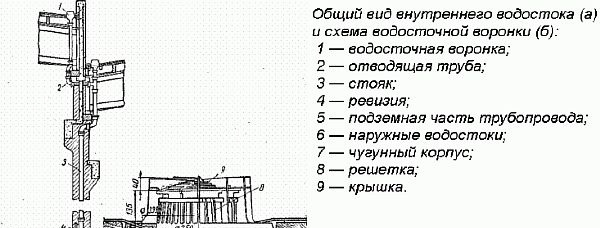
According to a typical design, storm sewers in a multi-story building are constructed from the following components:
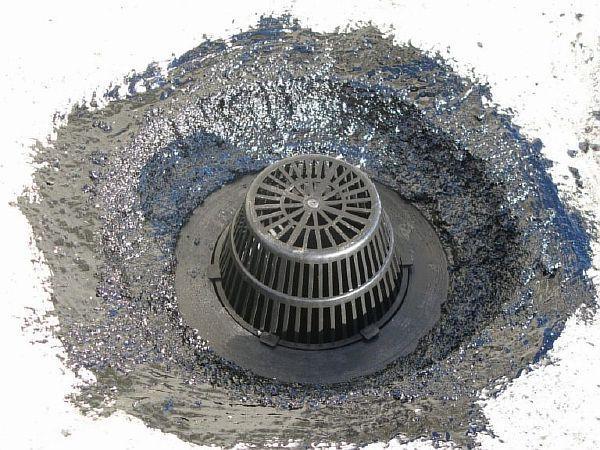
- A rainwater collection funnel with a protective grate to prevent clogging by leaves and other debris. A heating cable can be installed in the neck to prevent freezing in winter.
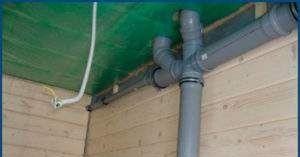
- Drain pipe.
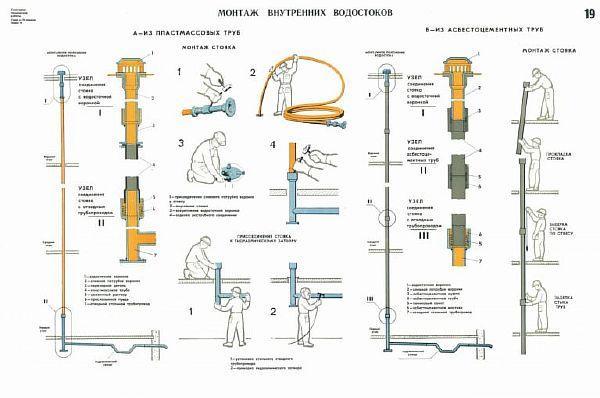
- A water drainage riser is a pipe. Products made of steel, asbestos, and cast iron are used. However, plastic pipes are the most popular.
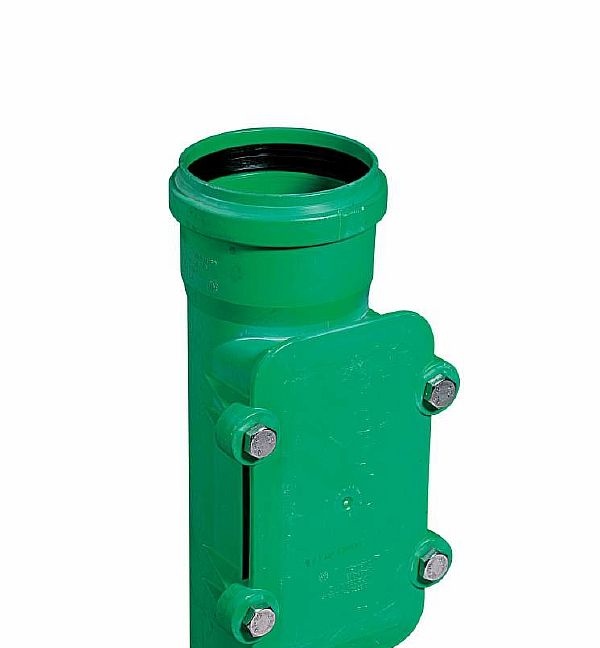
- An inspection hatch is required on the riser. It consists of an insert with a branch pipe and a screw-on cover. It is sealed.
- A section of the water supply system hidden underground is installed to drain water into a collector, which is a tray with a grate that is installed around the building.
Rules for installing water drainage in a multi-story building
A flat roof's gutter system must perform its primary function—effectively removing water from the roof surface—in all weather conditions. Storm drains should not be installed against the building's walls, as this will promote freezing. It is recommended that gutters be positioned parallel to the building's longitudinal axis.
Next we will look at the device in more detail.
- Before installing the concrete screed, the entire roof surface should be divided into zones of 160-200 square meters. A riser with a water inlet should be located in the center of each zone.
- The slope from the edges of the zone to the funnel should be at least 1 - 2 degrees, which ensures that water flows into the funnel with the required capacity.
- An underground drainage system is installed from the riser to the water collection collector.
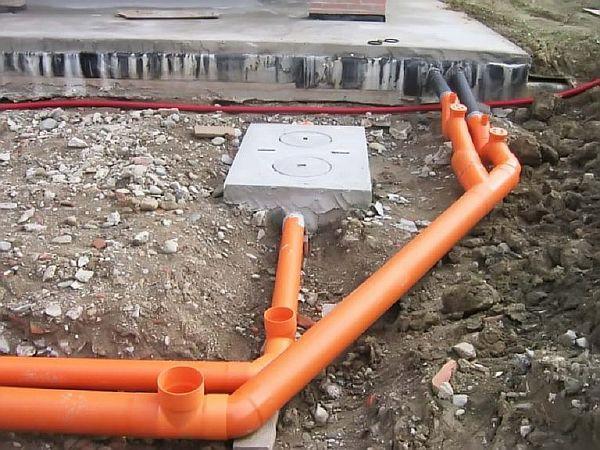
- For stormwater drainage systems in multi-story buildings, pipes with diameters of 100, 140, or 180 millimeters made of various materials are used. Their length must be 70 or 138 millimeters, as required by design standards.
- The cross-sectional size of the pipe is selected so that 1.0 - 1.2 of the active plane drains water from a square meter of roof surface.
- Roof decking must be waterproof, which is achieved using bitumen and rubber-bitumen materials. Good waterproofing results are achieved by using roll-on materials, manufactured specifically for reliable roofing.
What types of gutters are there – gravity and siphon
In modern construction, two main schemes for the installation of sewage systems are used:
- gravity-flowing;
- operating on the siphon principle.
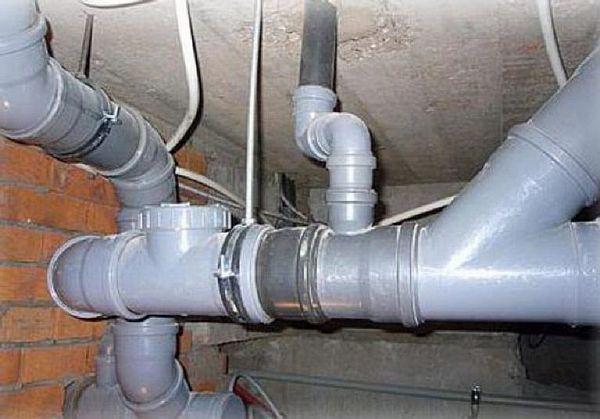 The first of these collect and drain water using sloped gutters. The system is then partially filled with water.
This drainage method is not particularly efficient, as the pipes are filled with both water and air simultaneously. It requires large quantities of pipes of a larger diameter.
A drainage system designed using the siphon principle separates water from air as soon as the flow enters the storm drain pipe. This creates a continuous water column, significantly increasing the system's efficiency.
When determining the main parameters of a storm sewer, many factors are taken into account:
- Climatic conditions in the construction region in terms of precipitation and ambient temperature.
- Roof type.
- The catchment area is an indicator that takes into account the size of the roof.
When operating siphon systems, the following requirements must be met:
- the storm drain must be carefully insulated, including the installation of heating cables;
- Soundproofing is necessary because the flow of water makes loud sounds.
The optimal design of a water intake funnel consists of a cup and a lid. The cup is made as a single unit with the funnel, but with a removable lid.
Structurally, the glass can be wider than the funnel, in which case it can be used to fix the edges of the roofing sheet.
To summarize, there are four components of a storm sewer system in a multi-story building:
- funnel for collecting water from the roof surface;
- a riser used as a transmission link for supplying water to the bottom of the system;
- drain pipes for removing water from the sewer system away from the building;
- Release – responsible for discharging sewage into the city’s public network.
All these elements are located inside the building and protected from external climatic factors. The exception is the funnel, which is exposed to frost and therefore, it requires additional heating with an electric cable.
Furthermore, it is installed at the junction of the roofing layer and the gutter, so it requires careful sealing. The funnel is located at the lowest point of the roof section, and the slope is achieved by pouring the roof screed.
Installing an internal sewer system is not a particularly difficult task; you only need knowledge and some professional training.
When designing and installing storm sewers for multi-story buildings SNiP 2.04.01.85 is the main document regulating the requirements for this system and the rules for its installation.
External drainage system of a multi-story building
 External drainage systems are installed on buildings with pitched roofs. Therefore, their design is fundamentally different from the previous version.
During precipitation, water collects on the roof slopes and flows freely down the slope to the gutters. These devices prevent large quantities of water from entering the property, foundation, and walls.
Water flows through gutters to receiving funnels, which also serve as downspout heads. They are installed at the corners of buildings, and in regions with high precipitation, even in the middle of walls.
In a properly designed system, water from the downspout flows into storm drains installed under each drain. These storm drains are essentially a channel concealed by a grate at ground level.
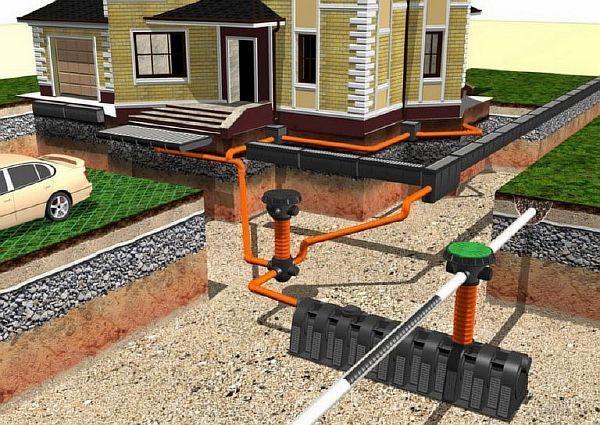 Its purpose is to protect the drainage system from clogging by leaves, branches, and other debris. Rainwater inlets are constructed as a closed ditch around the house, 1.5 to 2 meters from the walls and foundation.
Gutters are made from a variety of materials, including concrete, cast iron, and plastic. Plastic is becoming increasingly popular due to its ease of installation, light weight, and durability.
Water flows through drainage pipes into the city storm drain collector.
Who is responsible for maintenance and repair of the wastewater drainage system in a multi-story building?
As stated in housing legislation, ensuring the functionality of common property in the adjacent territory is considered maintenance during the warm season. This utility service falls under the purview of homeowners' associations (HOAs) or other similar organizations or associations.
Based on this, one can draw a conclusion about who maintains the storm sewer system in a multi-story building.
In accordance with the Rules and Regulations for the Technical Operation of Housing Stock (RF Gosstroy Resolution No. 170 of September 27, 2003), the organization servicing the housing stock is required to perform preventative cleaning of the sewer system at least once per quarter. Storm drains are cleaned at least twice a year – in spring and fall.
These same organizations are also responsible for regularly cleaning gravity sewer systems, including those adjacent to buildings. If significant leaks are detected, they are also required to install temporary pressure sewer systems to pump out the sewer system's contents.
It should be noted that all seasonal, emergency, and routine maintenance work is considered necessary during the maintenance of the building and is performed regardless of whether it is specified in a specific contract for the maintenance of the building and surrounding area.
Regulatory and technical documentation for design and construction
It should be noted that this highly important structure is designed individually for each home. A number of regulatory documents are mandatory, from the design stage through the construction process.
The documentation for storm drains is developed taking into account the requirements of GOST 21.604-84.
At the initial stage of design work, the basis is the requirements of SanPiN 2.1.5.980.00, GOST 3634-99, SNiP 2.04.03.-85.
Based on these documents, a feasibility study, construction deadlines, and control methods and techniques are developed.
Features of installing a drainage system in a multi-story building
Stormwater drainage performance is directly related to the quality of the roofing. If the roofing is improperly constructed and leaks, determining the cause and location of the leaks can be extremely difficult.
So, what's leaking in this case—the roof or the gutters? Therefore, when installing the roofing pie, special attention should be paid to the areas where it meets adjacent surfaces—pipes, curbs, and walls.
The funnel is a critical area. Its design must not only provide a connection point but also protect the drain pipe from debris clogging, for which purpose it is equipped with a protective grate. The condition of this area must be monitored regularly, with routine inspections performed regularly and after each period of prolonged inclement weather.
Whenever a pipeline bends, inspection windows should be installed at their location. This will allow for visual inspection of the pipe's condition only on straight sections. This also allows for thorough cleaning of the clogged section.
When installing a storm drain, it's important to purchase storm drain inlets with sand traps—rainwater isn't always clean, and sand accumulation in storm drains can be quite significant. Preventative cleaning should be performed at least twice a year—at the end of the spring and fall rainy seasons.
Double-layer plastic pipes with a corrugated inner surface should not be used for drainage, as they are prone to rapid clogging.
The distance between inspection wells in the external part of a storm drain should be no more than 10 meters. If this requirement is not met, an additional inspection well should be installed, even on a straight section.
In this case, the collected water from the septic tank can be reused for other purposes, such as watering the garden or washing the car. Such devices are used in low-water regions.


The storm drain pipe of a 16-story building is draining water onto the lawn, creating a huge puddle. The water sits for a long time, resulting in dampness under the windows and moss growing. Someone should fix it and install a drain along the ground?
Hello. The management company should resolve such issues.
Hello. We live in a nine-story building and the storm drain pipe used to be covered (perhaps by the residents). We recently replaced the pipe, and the housing office didn't cover it. You can see the floors above and below, and cold air is blowing in from there because the door on the first floor is always open, but it could be blowing in from any floor (we're a small family with shared balconies). The housing office says the project doesn't allow for it to be covered. Is that even possible? It's terribly windy in the winter. Shouldn't they at least cover the openings between the floors? When the wind blows from there, the wall gets very cold, and the vestibule feels like the street. Could you please tell me if this is supposed to happen or if they should cover it up?
Hello. In your case, you need to convene a general meeting of residents. Submit a request to the management company. Contact the local authorities and request that they appoint a committee. The technical issue with the storm drain needs to be addressed locally, as it's not entirely clear in words. The risers inside the building may be equipped with inspection hatches, but they must be closed. Without seeing the plans for your building, it's impossible to give specific advice.