A water main outage in a country house, whether for any purpose, causes a great deal of inconvenience for residents. Gone are the days of wells installed along the street within walking distance.
Therefore, installing a self-regulating heating cable can be a lifesaver in a crisis. After all, one of the common causes of water mains failure is freezing due to extremely low temperatures, which nature has been more generous than ever in recent years. Clogged drains, caused by the same cause, are no less of a nuisance for residents.
The need for additional heating measures for water supply and sewerage systems is obvious and inevitable for another reason. It can be safely installed below the frost line and insulated. But let's consider the fact that, for example, in the Moscow region, the ground freezes to a depth of 1.8 meters.
Let's imagine digging a two-meter-deep trench and evaluate our actions in the event of repairs. Naturally, attention shifts to artificial heating with self-regulating devices.
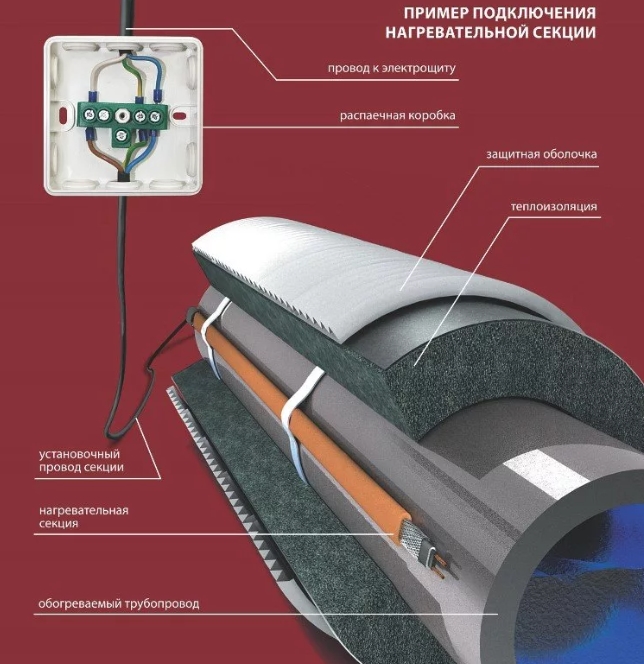
Heating cable for water pipes prevents pipes located in areas exposed to low temperatures from freezing.
- The design and types of self-regulating heating cables
- Heating cable manufacturers
- How to choose a self-regulating heating cable, let's look at the technical characteristics
- Using a thermostat
- Determining the power of a self-regulating heating cable
- Service life
- Self-regulating heating cable – DIY installation inside a pipe
- Do-it-yourself installation on the external surface of the pipeline
- Insulation of water pipes
- The main manufacturers of heaters are Devi Deviflex, SVK20, Thermo and Ensto
The design and types of self-regulating heating cables
Currently, two types of cables for pipes are actively used: resistive and self-regulating.
 The first of these heats up when an electric current passes through it. The heat source is a regular, high-resistance conductor. Naturally, the amount of heat generated will always be the same, depending on the cable's own parameters.
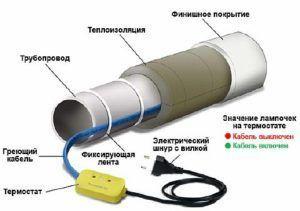
A thermostat is installed in the heater control circuit to regulate the heating level. A device similar to that used in underfloor heating systems can be used for this purpose.
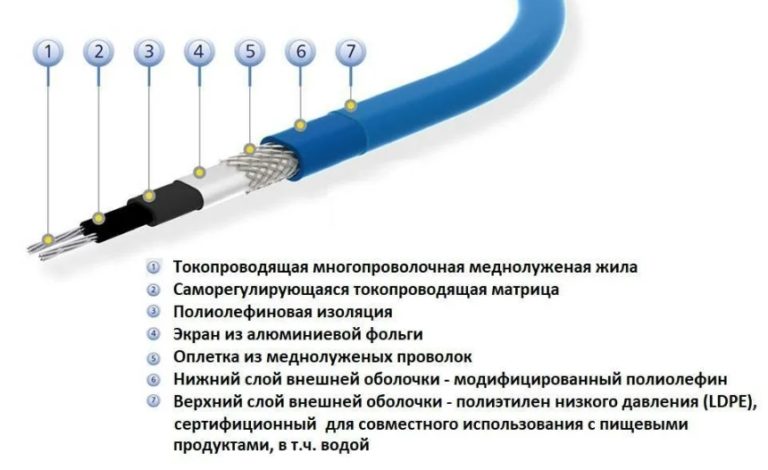
It consists of a heavily insulated conductor enclosed in a sealed inner plastic sheath. Inside the sheath is a colored thread, which serves as an identification mark. A braid of tinned copper wire is wound over the sheath, serving as a protective shield. The outer sheath is made of a durable polymer.
A special feature of using resistive heating cable is the need to avoid crossing itself when winding it over a pipe.
At the points of contact, mutual influence is inevitable, resulting in local overheating and the device may simply burn out.
Resistive type cables can be single or double-wireThe latter are somewhat more expensive, but are used more often because they require simpler connections. While a single-wire heater requires power at both ends, a two-wire heater simply requires a standard Euro plug connected to a 220-volt outlet.
The second drawback of single-core cables is that they can't be cut to the required length; they won't work in this condition. If you purchase a longer cable, you'll have to use the entire length.
A self-regulating heater operates on a completely different principle.
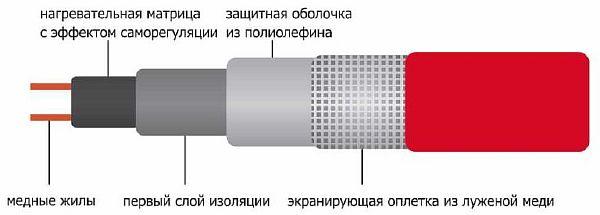
The heat source is a matrix installed inside which two wires pass. The matrix material itself generates heat as current passes through the wires.
Moreover, the higher the ambient temperature, the less the heat source heats up, and vice versa. Thus, it regulates its own heating, hence its name.
The advantages of self-regulating cable are:
- its undemanding nature regarding intersections during installation; they do not lead to local overheating and failure;
- They can be cut to the required length, but this must be done along the special markings on the outer shell. After cutting, the installation of a termination sleeve is mandatory.
The disadvantages include the high cost. However, given the long service life—over 10 years with proper installation and operation—these are worth it.
In general, equipping water supply systems with heaters is becoming traditional.
Heating cable manufacturers
 The need for heating homes and infrastructure is in high demand among residents of northern regions, so this technology and materials came to us from there.
There are many companies producing thermal cables on the global market. Below is a detailed description of the most popular, high-quality products:
- Ensto (EFPO10, TASH0.05) is manufactured in Finland. It produces self-heating cables that meet the latest innovation standards. These products are easy to install and feature an improved design.
- Nelson – the American company produces a fairly extensive line of models (CLT; LT; LLT; HLT; SLT-2; QLT; HLT; NC). These products have a long service life and consistently deliver improved performance.
- Lavita is a South Korean company. It produces three main models:
- HPI 13-2 CT – long, trouble-free operation;
- GWS 10-2 - Energy efficient performance;
- VMS 50-2 CX (CT) is a model with increased resistance to external loads.
- DEVI is a Danish company. It offers a wide range of models (DEVIflex, DEVIsnow, DEVIiceguard, DEVIpipeguard, DEVIhotwatt), all with a 20-year warranty, including replacement and reinstallation of faulty cables. Furthermore, its products are renowned for their high performance and speed. They are successfully used in both outdoor and indoor heating systems.
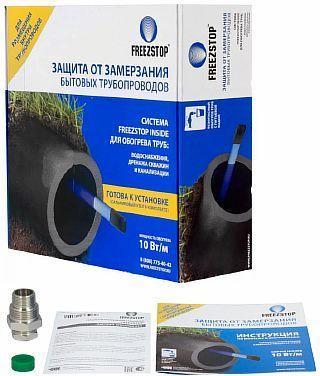
- FreezStop, a Russian manufacturer, is also worth considering. All models (FreezStop, Freezstop Inside, Freezstop Simple, FreezStop-Lite) are high quality and suitable for a variety of systems.
The Swedish heater should also be noted. SVK 20 with a power of 1645 W, it is designed for both underfloor heating and heating water pipes.
As you can see, the range of self-regulating pipe heating cables is vast, and it's up to you to decide which model to choose. The key is to ensure the product meets the performance requirements of your system.
How to choose a self-regulating heating cable, let's look at the technical characteristics
When choosing a heater, first decide on its type. Resistive heaters are prone to burnout, and they are manufactured in pre-cut lengths and cannot be shortened or extended. Their output remains constant, regardless of the current heat demand. They are typically used for heating small-diameter pipes, water tanks, or drainpipes.
Self-regulating conductors are more common. They handle power surges without burning out, and offer energy savings. There are no length limits when using them. Naturally, this option is more acceptable, despite its higher price.
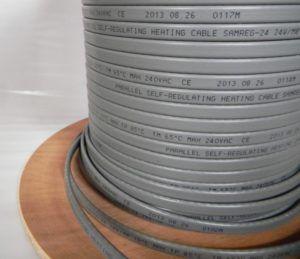 When choosing a cable, it's important to pay attention to the product's design. In an effort to reduce costs, manufacturers sometimes omit the shielding braid. This is known as a budget option. The purpose of this design element is... strengthening of the product and grounding device, which is important.
The outer sheath of the self-regulating cable should also be considered. For domestic use, a polyolefin sheath is quite sufficient (for gutters or roofing). When installing heating cables in gravity sewer systems, it is better to use devices with a fluoroplastic sheath, which is resistant to aggressive environments.
Not all products are suitable for both indoor and outdoor use. Please check with a sales consultant or the quality certificate for specific intended use.
When choosing a self-regulating cable, the temperature class should also be taken into account. Low temperature They heat up to 65 degrees Celsius, consuming up to 15 W/meter. They are used to protect small-diameter water pipes from freezing.
Medium temperature – heat up to 120 degrees, using a power of 10-33 W/m. They can be used to heat medium-diameter pipes and downspouts.
High temperature products are heated to a temperature of 190 degrees and are used for large diameter pipes.
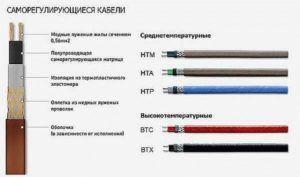
The choice is also determined by the size of the heated pipes. As a rough guide, the following parameters can be recommended:
- for pipes 25 – 40 mm – 16 W/m;
- 40 – 60 mm – 24 W/m;
- 60 – 80 mm – 30 W/m;
- More than 80 mm – 40 W/m.
Using a thermostat
The standard response thresholds for self-regulating cables range from 3 to 13 degrees. This means that the heating turns on at the lower setting, and turns off at the higher setting.
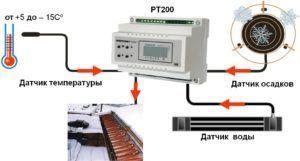 Well water temperatures never drop below freezing, typically 4-5 degrees Celsius. This means the heater will run constantly, consuming a significant amount of electricity. It can be turned off in the summer, but during the transition period from autumn to spring, it's easy to lose control and freeze the mains due to a sudden drop in temperature. Wells are easier to manage; during the hot summer months, the water will warm up to its maximum operating temperature.
There is no need to heat water for the toilet, and for the water heater or shower, the water is heated in the boiler.
Therefore, using a thermostat offers many advantages, including extending the life of the cable, which has a limited lifespan. It's best to set its cutoff temperature to 5-6 degrees.
When installing this device, pay attention to the sensor's location. It should reflect the water temperature in the pipe. To ensure accurate adjustments, the heater itself should not affect the device.
Determining the power of a self-regulating heating cable
The use of heating cables for heating water pipes is associated with the following circumstances:
- When installing an outdoor system. This method is rarely used today and requires careful thermal insulation, even when using heaters.
- Heating is necessary at the section where the pipeline enters the house.
- If the pipelines are located in an unheated and uninsulated attic or basement.
Internal self-regulating cables are installed when an external heater was not used during network installation. However, the pipe size is limited; this type of insulation is used up to 32 mm. This is due to the limited power of these devices—9-13 W/m. Heating of the pipe occurs only in the section where the conductor is located.
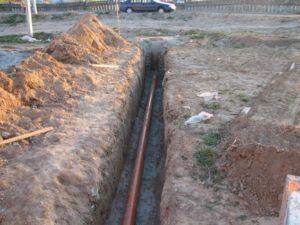
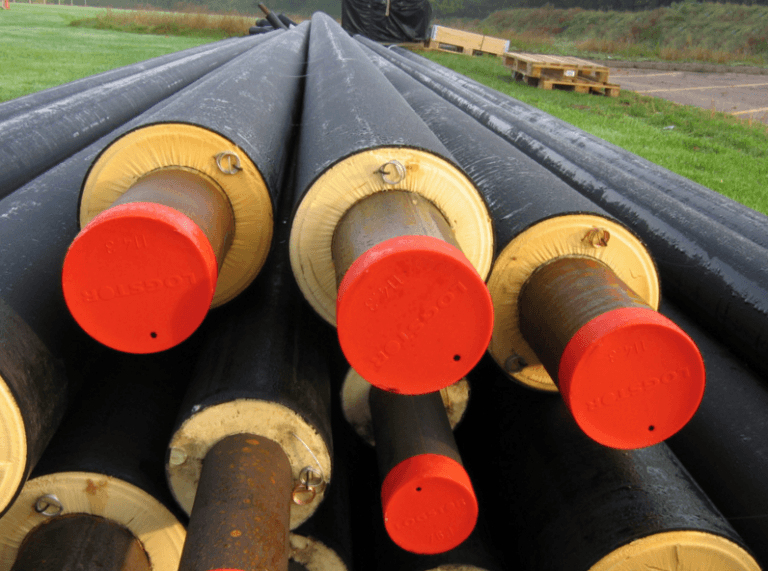
External heating cables come in higher power versions – 17, 23 and 30 W/m, in resistive or self-regulating versions.
Some caution should be exercised when installing heating on plastic water pipes. The limitations here are the properties of the pipe material itself.
The maximum allowable temperature for most plastics is 95 degrees, which corresponds to a maximum heating cable power of 17 W/m.
This must be taken into account when planning water supply work. It should be noted that plastic pipes do not thaw when frozen, and emergency measures are not necessary during the winter.
Heat output and energy consumption are directly dependent on the cable's wattage. The higher the wattage, the more intense the heating and the more energy consumed. Wire wattages range widely, with a minimum of 5 W/m and an average maximum of 150 W/m. Therefore, it can be difficult for a specialist with limited knowledge of heating cables to select a product with the required wattage..
To facilitate the power calculation process, there are special tables that take into account all operating features that may affect efficiency:
- area of application;
- ambient temperature level;
- material of the heating object, its size, diameter;
- placement features;
- cable length.
| Purpose of the heating wire | Installation conditions | Material of manufacture | Power | |
| For heating the water supply system | In soil layers | Inside the pipe | plastic | 5 - 10 |
| metal | 10 - 15 | |||
| Outside the pipe | plastic | 10 - 20 | ||
| metal | 15 - 25 | |||
| By air | Inside the pipe | plastic | 20 - 25 | |
| metal | 25 - 30 | |||
| Outside | plastic | 25 - 30 | ||
| metal | 30 - 25 | |||
| For roofing and drainage structures | Roof heating | Roof with insulation | — | 30 - 40 |
| Cold roof | — | 40 - 50 | ||
| Heating of a separate section of the roof along the perimeter | — | 300 - 400 | ||
| Gutters and downspouts | — | 30 - 60 | ||
| For self-regulating heating | The floor is wooden on joists | — | 8 - 10 | |
| The floor has a concrete screed | — | 18 - 20 | ||
Using a cable heating system in conjunction with a programmable thermostat will significantly reduce power consumption, thereby saving the family budget.
When purchasing a self-regulating cable, special attention should be paid to its power, because:
- Excessive power will lead to overheating of the cable, which in turn will cause damage and premature failure of the heating system;
- Using a cable with a lower value will contribute to the freezing of the structure, since the system will not provide the necessary heating.
Correctly calculated power means efficiency, cost-effectiveness, safety and durability of your heating system.
Service life
The standard service life claimed by manufacturers for self-regulating heating cables ranges from 10 to 40 years. These cables are manufactured using semiconductor matrices, which is precisely why users are wary of such long-term operation.
It's worth noting that this isn't unfounded, as the matrix can wear out up to 15% in a year of operation. Experts recommend several solutions to address this issue:
- If the installation is underground, then a 100% reserve should be made, that is, a rubber thread of the heating cable should be laid;
- use a cable channel and place the heating wire in it; in case of a malfunction, it will not be necessary to open the entire pipe, but only the section where the junction box is located;
 install the cable inside the pipe - an industrial certified product for food water supply is suitable;
- Laying the pipeline along the ground, with an increase in the thickness of the thermal insulation, will reduce heat loss.
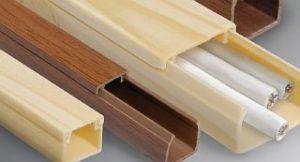
In addition, there are several rules that should be followed to extend the life of the self-regulating cable:
- When purchasing a heating cable, it's best to focus on reputable manufacturers. Naturally, these products are much more expensive, but repairing or rebuilding the entire structure will be much more expensive.
- The type and power of the selected cable must correspond to the load that will be placed on it during operation.
- A temperature control system and protective automation should be installed.
- It is necessary to test the self-heating system before its installation.
- Strictly adhere to the conditions of the technological process during installation and the operating instructions.
The key condition under which a product is guaranteed to be replaced is that the temperature regime is observed during use.
Manufacturers conduct an examination to evaluate the wire remaining in the stabilizer's outer sheath. This examination allows us to determine the operating temperature of the heating cable.
Self-regulating heating cable – DIY installation inside a pipe
- The outer sheath of the self-regulating cable must not emit harmful substances. These heaters are used on small pipes carrying drinking water.
- Due to the use of electrical energy in an aquatic environment, the degree of electrical protection must not be lower than IP.
- The end cap must be airtight, so before installing the self-regulating cable, you must carefully study the technical documentation and fully follow the recommendations provided.
To ensure the cable is inserted into the pipe, a tee with the required bend angle must be installed at its end and then proceed as follows:
- Shut off the water supply to the water supply system.
- Measure the required length of cable, having first taken the necessary measurements on the pipeline.
- Cut off a piece of the heater at the nearest mark on the cable sheath.
- Install the end sleeve.
- Place the heater inside the pipe.
- Place the sealing sleeve, rubber washer, conical metal clamping washer and clamping sleeve on it.
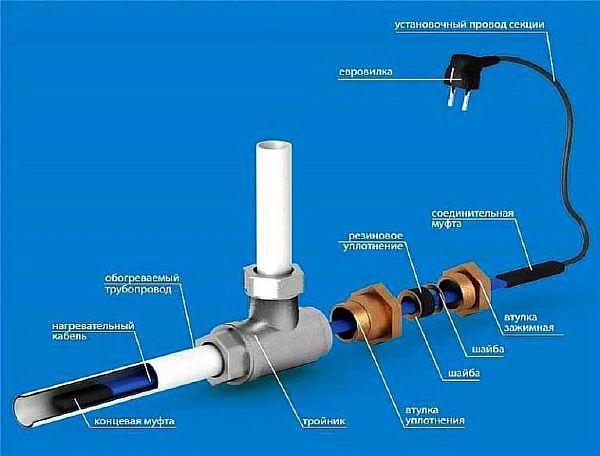
- Assemble the seal in the order listed and tighten the connection carefully.
- Connect the connecting sleeve with the installation wire and the Euro plug to the rear end of the heating cable.
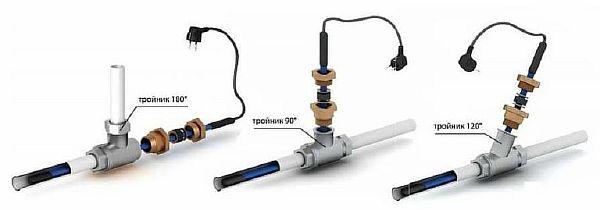
If cutting is necessary, heaters can be installed in several places in the water supply network.
Do-it-yourself installation on the external surface of the pipeline
When installing such a device on an external surface, a tight fit is crucial. Therefore, before installing the coolant, the pipe surface (especially metal) must be thoroughly cleaned of any dirt or corrosion. This can be accomplished effectively using a wire brush attached to an electric drill.
If several heating elements are installed, they should be placed at the bottom of the pipe, where the coldest water is located.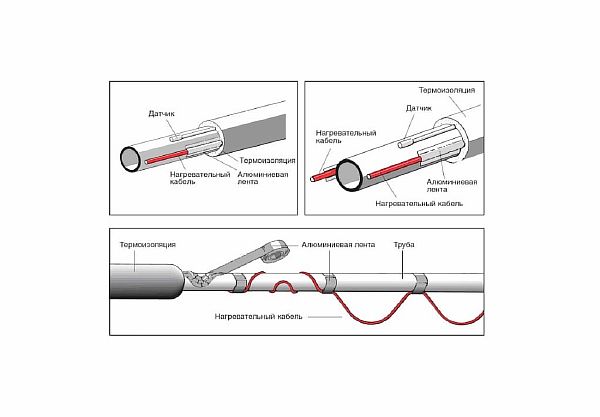
The heater can be installed in a spiral while being secured with metallized tape. This increases the contact surface between the cable and the pipe, resulting in more intense heating.
When heating plastic pipes, it's recommended to wrap a layer of metallized adhesive tape underneath the coolant. Its good thermal conductivity allows it to distribute heat more evenly throughout the pipe, eliminating localized heating at the points of contact. This eliminates localized overheating, which can cause plumbing failure.
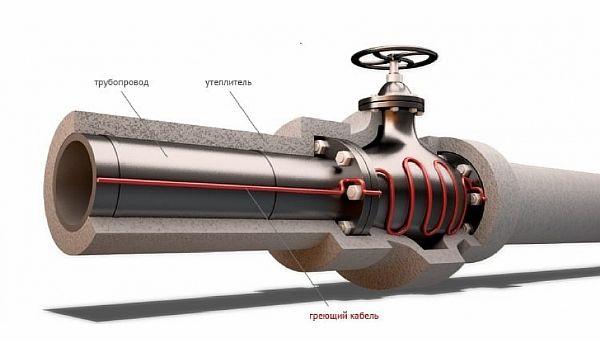
During winter operation of the water supply system, the fittings are subject to increased cooling. Therefore, when routing the heater along these elements, it should be positioned in a serpentine pattern, while maintaining the allowable bend radius to prevent kinks.
Insulation of water pipes
Heating a water pipe doesn't mean raising the temperature of the entire space surrounding it. To use the heat effectively, it needs to be insulated using available methods.
 Fibrous materials such as glass wool, mineral wool, and various rolled insulation materials should not be used for insulating water pipes. They are highly hygroscopic and absorb moisture, losing volume and thermal insulation properties.
The choice of insulation depends on the pipeline installation method. If it's installed in a concrete channel that protects it from mechanical stress, even foam rubber can be used. However, the pipeline must be additionally reinforced under backfill. This is achieved by using larger-diameter jackets and plastic pipes.
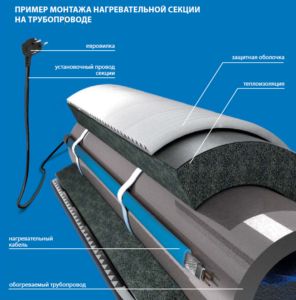
The best insulation material is detachable polystyrene foam fittings, which are inserted onto the pipe and secured with construction tape. The additional cost is offset by the system's durability.
The main manufacturers of heaters are Devi Deviflex, SVK20, Thermo and Ensto
The need for increased attention to heating homes and infrastructure is typical for residents of northern countries, so the technology and materials themselves come from there.
In particular, one of the popular heaters SVK 20 is made in SwedenThe section is 8 meters long and has a power output of 1645 watts. Its primary application is underfloor heating and water heaters. A thermostat is included.
Heaters Deviflex Dtip Widely used in outdoor and indoor home heating systems for various purposes, including warm fields and heating water pipes. It is a two-core product, securely insulated with a durable outer sheath. Not recommended for roof heating. Manufactured by DEVI.
Heaters Ensto is produced in Russia by the ENSTO-Rus company.The main product is a self-regulating heater, which is used for both underfloor heating systems and pipeline heating.