Connecting a shower stall to the water supply and sewer system yourself involves several steps. First, you need to understand the features of the various models and the installation details.
Next, you need to choose a location for the shower stall and gather the necessary tools. After that, you can begin the process of installing the shower yourself.
First, the foundation is installed or poured, then the direct connection to the sewer line, water supply system, and electrical network is made. It's also important to follow the recommendations of professionals.
Types of shower cabins
A standard shower enclosure consists of a shower enclosure with doors, a shower tray, and water supply devices (faucets, whirlpool systems, shower heads, etc.). Models additionally equipped with speakers and steam generators are also popular today.
There are two main types of cabins:
- open type - the structure has no ceiling, there are only 2 (sometimes 3) walls, a drain is often used as a base;
- closed type - a small internal box that is completely closed.
The main advantage of the first type of model is its low cost and ease of installation; its disadvantage is that it only offers basic functionality. Enclosed cabins, while more expensive, offer advanced features and can often be custom-made to suit your taste and design.

Before installing an open shower enclosure, it is important pay special attention to waterproofing the walls, as well as their alignment, to ensure the plumbing is completely sealed. Failure to do so may result in water leaks and spreading dampness throughout the bathroom.
Enclosed booths are hermetically sealed and require no additional maintenance. Sometimes, these models are additionally connected to the power grid if required for their functionality.
These sanitary fittings also differ in size (both miniature cabins and those with dimensions of 2.1 x 2 m, with a bathtub as a base, are sold) and in the material from which the elements are made.
The shower stall's connection to the sewer and water supply is generally independent of these factors. Difficulties arise only if the foundation is completely missing, as in this case, the drain and sewer outlet must be sealed into the floor.
Before purchasing a shower cabin, you should consider the following parameters:
- water hardness;
- protection of electricity sources;
- area of the premises;
- location of water supply and sewerage;
- room humidity level.
How to choose a booth location
Before connecting the shower enclosure to the sewer system yourself, you should find a suitable installation location. At this stage, the most important thing is to understand the location of the plumbing lines.
It's recommended to install the shower enclosure near access to the water supply and sewer lines. If installing a modern multifunctional system, close access to the electrical network may be necessary. It's also recommended to ensure adequate ventilation. This will prevent water buildup on the walls.
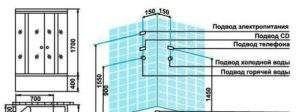
After choosing a location, you need to ensure the floor is level. A tilted shower stall will cause a host of problems. It's a good idea to level the floor in advance. Some shower stalls come with special feet, but adjusting them correctly with a spirit level will take time.
In most cases, showers are installed in a corner, so before beginning work, it's important to check that the angle between the two walls is 90 degrees. If it isn't, a gap will appear between the wall and the shower stall after installation. If the gap is small, this can be corrected with silicone, but if the shower stall is wide, additional wall alignment will be required.
Preparatory work, necessary tools and materials
Once you've chosen the shower location and, if necessary, prepared the walls and floor, you can begin the actual installation. DIY installation instructions are often included with the shower, so it's important to thoroughly review them first.
Before connecting the shower enclosure to the water supply and sewer system, you should inspect the assembly yourself, prepare the room, ground any metal components that will be connected to the power supply, and gather the necessary construction tools. These include:
- adjustable wrench;
- building level;
- pliers;
- slotted and Phillips head screwdriver.
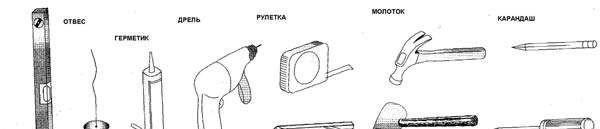
Next, you should ensure that all necessary parts are included. In some cases, you may need to purchase additional tools:
- sealant;
- compression fittings;
- sealing material, such as fum tape;
- 2 flexible water hoses;
- hoses for connecting plumbing;
- siphon and tees;
- connection adapter.
It's recommended to check the water supply. Then, it's advisable to install special water filters to extend the life of the plumbing fixtures. After that, you can proceed to the first stage of installation—connecting the shower tray to the sewer system yourself.
Installation of the pallet
It's worth noting that installation techniques may vary between different cabins. For example, the water supply and sewer connection points are often different. Therefore, before beginning work, it's advisable to carefully review the technical documentation for the model you've purchased.
First, install the shower tray, if it's part of the structure. It's mounted on special support legs, allowing you to adjust its height from the floor. The edge is also leveled horizontally using these legs, using a spirit level. It's important that the base fits flush with the wall, and that there are no small holes in the floor to prevent water accumulation.
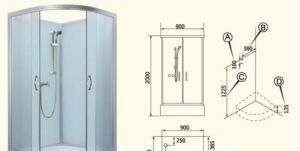
If the room's functionality requires electrical appliances to be located under the tray, it is recommended to place them on an additional metal frame. Leaving them directly on the room floor is prohibited by safety regulations.
The shower tray must be installed strictly horizontally. The manufacturer intentionally creates a slight slope to ensure the drainage of wastewater into the sewer. If this element is not positioned perfectly level during installation, the water will not drain on its own, and after drying, it will leave marks on the floor.
Watch the video
Some open-type models lack a shower tray, so you'll need to build one yourself. In most cases, a concrete podium with tile or mosaic tiling is constructed on a small raised platform with a drain. The process consists of the following steps:
- The perimeter of the foundation is laid out. Most often, a ceramic variety of solid brick is used.
- At the required height, a trap is placed, which must then be connected to the sewer.
- A concrete screed is made with the obligatory creation of a slight slope towards the drain.
- The tiles are laid using waterproof adhesive.
- The joints must be sealed using a water-repellent agent or a sealant designed for plumbing work.
To prevent the base from becoming damp, you can add PVA or liquid glass to the cement mortar. This will significantly improve the structure's water-repellent properties. It's also advisable to coat the floor, side walls, and the resulting concrete base (before laying the tiles) with a special waterproofing agent.
The standard drain pipe diameter for a floor drain is 4 cm. Choosing a smaller diameter increases the risk of clogging. A larger diameter will make it difficult to fit into the small space under the shower stall.
Types of pallets
The properties and installation features depend on the material of manufacture:
- Acrylic – these models are highly wear-resistant and durable, and they look good. However, if one of the residents is heavy, a fiberglass-reinforced acrylic shower tray will be required.
- Cast iron – these varieties are the most durable and reliable. Their heavy weight ensures high system stability, but this can make installation challenging;
- Earthenware – despite its massive size and excellent stability, it is quite fragile. It should be installed with extreme care on a pre-leveled floor;
- Enameled steel – these shower trays are lightweight and have a long service life. The surface cools and heats up fairly quickly, which may not be suitable for everyone. A disadvantage is poor soundproofing. Also, be very careful when using the shower and monitor the quality of the enamel, as damage (cracks or chips) will significantly detract from the shower's appearance.
Watch the video
[sociallocker]
The specific breed to choose depends on the owner's budget and preferences. It's also recommended to consider whether the dog has children or overweight family members, as well as the dog's appearance requirements.
Connecting the tray to the sewer
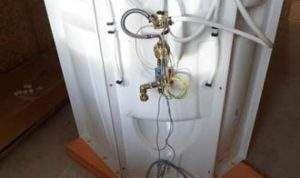 Shower cabin connection diagram to the sewer system:
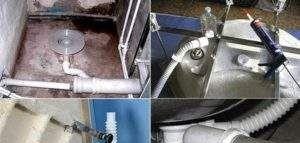
- The drain hole is being installed.
- The siphon is installed using silicone sealant and rubber gaskets. This waterproofing will reliably prevent leaks and puddles.
- A corrugated pipe is installed to drain wastewater into the sewer system. It is advisable to place a rubber cuff on its end, the diameter of which should be equal to the cross-section of the sewer tee. This will prevent odor from penetrating through the joint between the corrugated pipe and the sewer system.
A trap is essential because it uses water pressure to create a water seal, preventing unpleasant odors from entering the room. A corrugated pipe allows the cabin to be easily moved without disconnecting it from the plumbing.
Connecting pipes to the water supply
In most cases, water is supplied to the shower stall from the sink using flexible hoses of appropriate length or plastic elbows. It's also recommended to install additional valves on these hoses to avoid shutting off the entire water supply if repairs are necessary. To reduce the risk of sand or other debris clogging the water supply, it's advisable to install special filters.
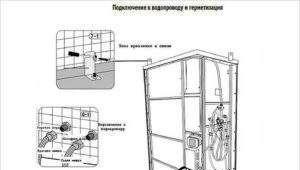
The mechanism for connecting the system to the water supply yourself:
- Turn off the water completely.
- If it is not possible to shut off the water, then find out How to make a tap into a pressurized water supply yourself.
- If there is a connected mixer, you should open the tap to reduce the pressure level in the pipeline.
- Remove the old shower or faucets if necessary.
- Connect the water pipe and install eccentric bushings (compression fittings) on its ends. They should be adjusted so that the axes align with the faucet outlets.
- If a panel connection is made, the adapters are replaced with special flexible reinforced hoses.
- All connections must be covered with a special waterproofing agent.
- A sealing tape is wound onto the thread, after which the fitting washers are tightened.
Plumbing systems typically consist of metal-plastic and plastic pipes connected with sleeves or welded together. However, the shower enclosure should be connected to threaded fittings, as it is often necessary to disconnect the plumbing. Connecting adapters allow you to connect pipes of different diameters and select the most appropriate bend angle.
If the model is equipped with a whirlpool system, no additional water supply is required. The pump uses water to create jets from the shower tray, so the pipes should be connected there. Models with a sauna function also don't require a water supply connection.
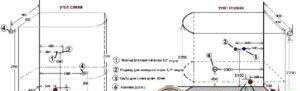
When using a thermostatic mixer, do not connect the shower to a gas water heater. This type of mixer causes a pressure drop in the pipe, and the gas water heater may shut off automatically. If the shower is installed in a building with a separate heating system, hot water should be supplied only through a storage water heater.
Watch the video
Connecting to the power grid
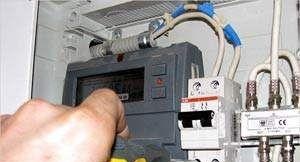 The final installation step is connecting to the power supply, followed by checking the plumbing for leaks and ensuring the structure is tight. If the shower tray is made of cast iron or steel, it will need to be grounded. Failure to do so could result in the accidental fall of an electrical appliance (such as a hair dryer or razor) causing significant harm to a person.
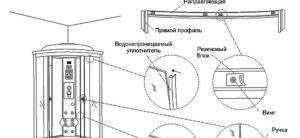
First, assemble all the panels together, making sure the screws are not fully tightened. Once the panels are assembled correctly, with no distortions or misaligned components, the fasteners can be tightened.
The electrical line must be grounded and have wires of the required diameter. Shower models with many additional features typically consume a lot of electricity. Therefore, it is recommended to use a separate 3-wire cable from the panel with a residual-current device.
The power supply voltage is only 12 V because it passes through a step-down transformer. A shock in this situation is unlikely. However, other devices powered by 220 V are often located in the room. These devices can cause a strong shock, so it's important to properly ground the cable and other devices and connect them to the power supply according to all regulations.
Tips and recommendations
When connecting a shower to the water supply and sewerage system yourself, you should follow certain recommendations:
- Despite the apparent reliability of the assembled structure, it is recommended to additionally check and tighten all nuts on connected pipes, hoses, and other components with a wrench. Once the installation is complete, all connections will be hidden;
- Ensure high-quality waterproofing and ensure the tightness of pipe joints and the entire system. Failure to do so may result in leaks, leading to flooding and other unpleasant consequences;
- In some cases, the wastewater outlet is located far from the sewer drain. In this case, a wastewater pump must be installed, as gravity drainage cannot be ensured. The pump will be located under the sump and operate silently;
- The water and sewer pipes under the shower stall should be positioned at a slight slope. The sewer pipe should be angled toward the riser, and the water supply pipe should be angled away from the riser. This is necessary to ensure that water is completely removed from the pipes when they are shut off.
- Before purchasing, it's advisable to pay attention to the material the drain pipe is made of. In inexpensive shower stalls, it's often made of silumin alloy, but its service life is only a few years. It's best to immediately replace the pipe with a stainless steel equivalent, which often comes with a suitable high-quality plastic trap.
- It is recommended to equip the water supply line with special dirt and grease traps, as well as ball valves. Incoming water does not always meet purity standards, so the nozzles can become clogged with sand, grease, and dirt, causing them to stop working. Filtration equipment should be installed near the riser or at the ends of the pipe leading to the shower stall.
Therefore, connecting a shower to the water supply and sewer system isn't a particularly complicated process. It can even be done by yourself. However, it's important to follow the installation instructions included with the factory assembly and the advice of qualified professionals. This will ensure the installation is completed as quickly as possible, and the shower enclosure will be usable for many years to come.
It's worth noting that if you're planning to install an ultra-modernized system with a multitude of additional features, it's best to entrust this procedure to professionals.
Watch the video