Before starting construction of a stand-alone sewer system, it's important to complete the design phase, which determines the system's location. There are requirements regarding the distance from the septic tank to the house, drinking water well, and natural bodies of water.
All requirements are regulated by law and special regulations. Sanitary standards also determine the distance from fences, neighboring properties, green spaces, and other objects.
Failure to do this will result in flooding of the house foundation, flooding of the garden and other problems.
- Regulatory standards
- Distance to home
- Distance to drinking water sources
- Distance to the site boundaries
- Distance between the septic tank and natural water bodies
- Septic tank and neighboring areas
- Septic tank and garden plantings
- How to choose a location for a septic tank
- What to do if you have little space
- Why can't you build a septic tank closer?
Regulatory standards
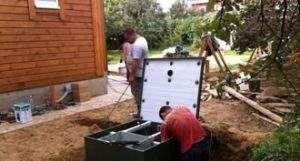 Sewage treatment plants are considered potentially hazardous to the local environment. They can cause significant contamination of soil and water bodies, so the placement of such systems is regulated by law. The regulations specify the minimum distance from the septic tank to the house, wells, fences, and other buildings and objects.
It's important to follow the regulations when installing a septic tank, as failing to do so will subject the owner to administrative liability and several fines. It will also be necessary to relocate the sewer line to ensure the length to the house and other properties complies with established standards.
Construction is regulated by the following regulatory legal acts:
- SNiP 2.04 (paragraphs 01-85, 02-84 and 03-85);
- SanPiN 2.1.5.980 and 2.2.1/2.1.1.1200-03.
The SNiP (Building Code and Regulations) provides the property owner with information on water supply regulations and local sewerage system installations, as well as current restrictions. SanPiN (Sanction Rules and Regulations) defines standards regarding groundwater levels and the area of the sanitary zone.
Before starting construction, you must obtain permission from the relevant Sanitary and Epidemiological Service. SES representatives have the right to conduct an inspection at any time if a complaint has been received.
Distance to home
All detailed information should be found in the documents listed above. According to SNiP, the distance from the septic tank to the house (the boundary of its foundation) must be more than 5 meters. This distance prevents unpleasant odors from entering the house, but only if the septic tank is functioning properly and is regularly cleaned or self-cleaning.
It's important to note that a percolation well (if included in the sewer system) must be located at a distance of 5 meters. Failure to follow this rule could result in the liquid escaping from the well, potentially causing the foundation to erode and ultimately collapse.
Containers can be placed closer, but only within reasonable limits (installing waste containers near the house is not a good idea).
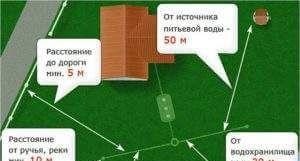
5 meters is the optimal distance. Sometimes owners place the septic tank as far away from the house as possible – 8-15 meters. However, with such a sewerage system placement, it will be difficult to adhere to pipeline construction regulations. First and foremost, it's important to remember that the following standards must be met for each meter of pipeline: slight slope (2 - 3 millimeters, depending on the pipe diameter) to ensure free flow.
It's also worth noting that placing a septic tank at the maximum distance from the house (more than 8 meters) significantly increases the risk of blockages. This necessitates regular cleaning.
All of the above restrictions apply only to standard models of local sewer systems. If one of the modern, upgraded models, which is protected against water infiltration into the ground, is used, the 5-meter distance may be waived. However, this should be discussed further with representatives of the Sanitary Service.
Watch the video
Distance to drinking water sources
An important parameter to consider when constructing a septic tank is its distance from wells where drinking water is obtained. Improper placement significantly increases the risk of wastewater entering the well and contaminating the water.
As a result, people using the water will be infected with dangerous microorganisms—virus pathogens. This can cause significant harm not only to health but also to life.
Even with modern, fully sealed systems, there remains a risk of failure or other emergency. To prevent waste from entering the water, it's important to follow proper location guidelines.
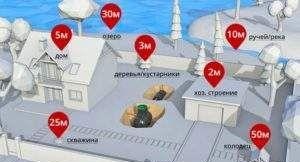
Distance requirements are determined by SNiP (Building Code and Regulations) and are based on the soil type on the site. Often, soil with improved permeability significantly simplifies the construction process and slightly reduces the required distance. However, regardless of the soil type and permeability, a minimum distance of 25 meters must be maintained.
To determine the quality of soil filtration, a professional geological assessment is required. The best type of soil is considered to be one with a high clay or sand content. If this type of soil is present on a summer cottage, the structure should be installed at least 50 meters from drinking wells.
Watch the video
[sociallocker]
Distance to the site boundaries
Such restrictions are intended to prevent the spread of foul odors to neighboring properties. When building several neighboring houses and installing utility lines, it is recommended to discuss the placement of sewer lines in advance. This will ensure that the homeowner can properly locate them on the property and avoid potential disputes with neighbors over this issue in the future.
The distance from the septic tank to the fence, according to SNiP articles and other regulations, should be at least 2 meters.
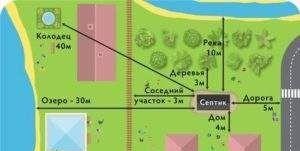
Sanitary regulations also govern the installation of pipelines on a property. The distance between water supply and sewer pipes must be greater than 10 meters. This prevents waste from entering the pipeline if an emergency or blockage causes a leak.
As a rule, a stand-alone sewer system is located below wells and boreholes. If possible, it's advisable to increase this distance slightly to minimize the risk of wastewater leaking into the water supply.
Watch the video
Distance between the septic tank and natural water bodies
This parameter largely depends on the type of natural body of water. In most cases, a country house is located near a pond, small lake, or river. In this case, the owner should install the system at least 10 meters from such a body of water. If there is a reservoir near the property, the owner must ensure that the distance from it to the septic tank is at least 50 meters.
Violating these restrictions will result in significant environmental degradation in the area. Wastewater infiltrating natural waters will cause widespread mortality of the flora and fauna living there. This will also likely lead to stagnation and waterlogging. In some cases, pathogenic microorganisms may begin to proliferate in the water, posing a potential health threat to swimmers.
For the property owner, this means paying several large fines and possibly a lengthy legal battle. The sewer system will also inevitably need to be dismantled.
Septic tank and neighboring areas
In most cases, the purchased dacha plot is located in a cooperative, which necessitates discussing the construction with local authorities and neighbors. Just like the owner, neighboring residents want to avoid flooding of their gardens, foundation erosion, and the spread of foul odors throughout their homes. Therefore, choosing the right location for the structure is crucial.
Watch the video
[sociallocker]
According to current legislation, the distance from a neighbor's fence must be at least 3 meters. However, sometimes situations arise where this is insufficient and the structure must be installed even further. For example, if a neighbor's house is located right next to the fence, it is advisable to calculate the maximum distance from the septic tank to the house so that it is greater than 5 meters.
Therefore, when designing a system, it's important to consider the distance not only to your own home and other buildings, but also to objects on neighboring properties. This applies to the home, as well as drinking water wells, other buildings, and gardens. Otherwise, the neighbor has the right to file a lawsuit and demand compensation or relocation of the local sewer system. Therefore, it's best to discuss the septic tank location with neighboring property owners in advance.
Septic tank and garden plantings
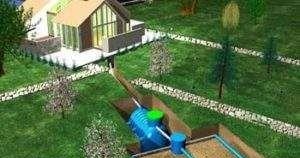 Quite often, when constructing a property, the owner forgets to calculate the distance to garden plants. These include fruit trees, shrubs, greenhouse plants, and vegetable gardens, the fruits of which are later consumed as food. Current legislation stipulates that the distance to them must be at least 3 meters.
Failure to comply with this restriction may lead to two unpleasant consequences:
- Without a high-quality filtration system (with up to 95% purification), wastewater entering the plants may contain harmful microorganisms. Therefore, when consuming fruits from nearby plants, a person may become infected with a virus.
- Only a small amount of water has a positive effect on plants. However, with frequent use of the sewer system, filtered water will lead to overwatering of plants. This will cause root rot. In this case, shrubs and plants will dry out during the first few years of using the autonomous sewer system.
Therefore, it is advisable to take this limitation into account when choosing the location of the septic tank.
How to choose a location for a septic tank
The easiest way to select a location for the structure is to contact a specialized construction company. Professionals can quickly and accurately determine the most suitable installation site, but this procedure is quite expensive. If desired, the property owner can determine a suitable location themselves.
The process consists of several stages:
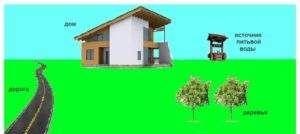
- A plan needs to be drawn up. To do this, a copy of the site plan must include all the objects located on it (houses and wells, greenhouses and vegetable gardens, roads and fences, natural reservoirs and boreholes, etc.). The dimensions of the buildings must also be indicated.
- Draw circles around each object, positioning the objects at the center or on the inner edge of the circle. The diameter (or radius) of the circle should be schematically equal to the required distance. The key to drawing the diagram is to maintain scale.
- Find a free space on the site plan where there are no circles.
- Consider the location of the wastewater collection tanks and determine the location of the filtration well.
- Find out the plan of the laid communication networks and compare it with the site plan.
What to do if you have little space
In some cases, after the procedure, it turns out there's not enough space. A small dacha, numerous structures, or poor placement of structures means there's no room to properly install a septic tank while maintaining the required distance from the house, buildings, wells, etc.
Sometimes homeowners decide to install structures in violation of the rules and regulations contained in SNiP and other regulatory documents. However, this is not permitted; in such cases, alternative methods exist.
The best solution in this situation is to install a storage tank, which resembles a cesspool. A storage tank is a type of septic tank and is completely sealed (neither the walls nor the bottom allow liquid to pass through). However, there are several operating considerations that are important to be aware of.
Since this type of septic tank lacks a filter element, it requires regular emptying of the waste tank. This is accomplished using specialized sewage disposal equipment. Therefore, despite the low cost of construction, septic tank maintenance is not cheap.
Why can't you build a septic tank closer?
 To summarize, the main problems that arise when installing a system in the wrong place are:
- the possibility of wastewater entering the soil and fruit-bearing plants, which can cause the development of serious diseases and pathologies in humans due to microorganisms found in wastewater;
- groundwater pollution, i.e. deterioration of the local environmental situation;
- Failure to follow the system cleaning schedule will cause the wastewater in the tank to overflow, resulting in contamination of the entire area and an unpleasant odor spreading throughout the house;
- flooding and destruction of the foundation of the house, other buildings, and roads is possible;
- If the structure fails to work, the stench will spread into the house and onto the neighbors’ property;
- If the distance between the house and the septic tank is not maintained, the owner will be fined and the structure will have to be dismantled and reinstalled.
To avoid unpleasant consequences from improper placement, it is recommended to immediately study the relevant regulations and familiarize yourself with the requirements. Only then should you design the sewer system.
Watch the video
Therefore, it's essential to consider the distance to the house, well, and other objects on the property. You can find a suitable location yourself, without the help of professionals. Sometimes, space is not sufficient to install a septic tank without violating regulations. In this case, consider alternative design options.