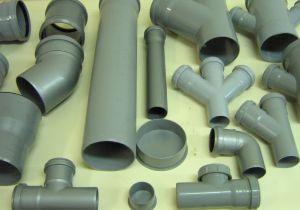
 A high-quality and durable sewerage system is essential for a person to live as comfortably as possible in a house or apartment.
When installing sewerage systems, plastic is the leader compared to other types of materials.
Plastic offers a number of advantages that its closest analogues lack. These advantages are also found in products such as PVC plumbing pipes and sewer fittings.
- What technical characteristics do the structures have?
- Varieties. Structural features
- About the pipeline structure, the use of adapters
- How is external sewerage system arranged?
- Forced drainage
- Tips for choosing
- PVC plumbing pipes with pressure
- A non-pressure type of PVC pipe
- About corrugated varieties
- How to connect plastic pipes to cast iron ones?
- What other adapters are there for plastic products?
What technical characteristics do the structures have?
PVC is the name given to any type of polyvinyl chloride.It is produced by polymerizing vinyl chloride. The new material has the following advantages:
- Resistance to corrosion processes.
- UV resistance.
- The ability to resist the negative effects of various substances.
- Long service life.
- They are extremely durable, just like the 50mm PVC sewer pipe.
Plumbing fixtures made from this material, measuring 250 mm, also have positive qualities. They are lightweight, making installation and transportation significantly easier.
The low price is what attracts customers most. Compared to cast iron and steel counterparts, products made from this material are the least expensive.
Installation is simple and can be done by the owner without any additional assistance. Simply use the appropriate fittings. However, like other materials, it's not without its drawbacks.
Plastic is very sensitive to freezing temperatures. It can also deform at high temperatures—70 degrees Celsius or higher. Water flows through such pipes quite noisily.
Varieties. Structural features
Most often, a special extension, called a socket, is installed on one end of the pipe. Without this element, it is impossible to create a high-quality connection. The end, which has a smooth surface, connects to the socket and is inserted into the pipe.
The type of product determines its composition, structural details, and possible color scheme. PVC plumbing pipes for sewerage systems are no exception, as GOST 51613-2000 defines clear requirements for them. Learn more about See GOST 51613-2000 here..
About the pipeline structure, the use of adapters
Gray products are most often used by those installing risers and plumbing systems inside their homes. They are made of unplasticized polyvinyl chloride.
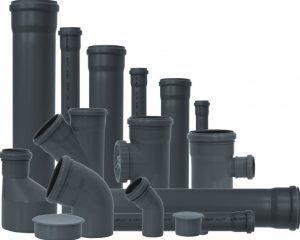
This is a smooth-walled variety of pipes and fittings. It can be any size. 5 and 11 centimeters are the most common cross-sections.
When it comes to indoor plumbing, fittings with rubber seals are most often purchased. These help make turns in the pipeline and connect components to each other.
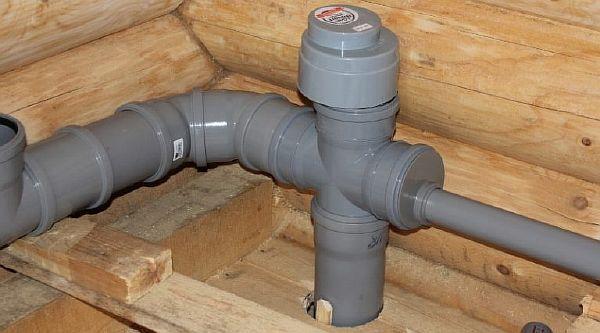
Adapters are divided into several types according to their functions:
- Expansion joints. These are indispensable tools during repair work. They can also be used to connect 250 mm diameter PVC pipes for outdoor sewerage systems.
- Elbows. Available in 90-, 30-, and 45-degree angles.
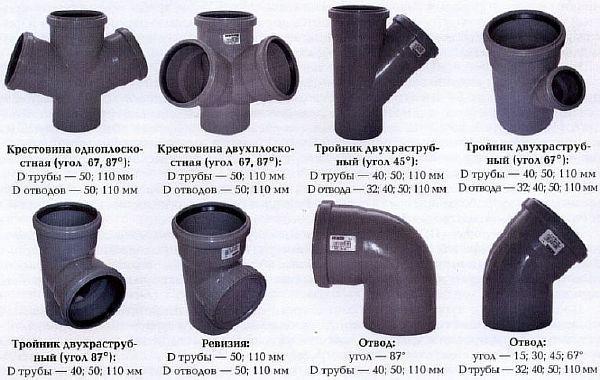
- Tees with various angles – from 45 to 90 degrees. Crosses are also used to connect several 50 mm diameter pipes; they typically have an angle of 45 or 90 degrees.
- Inspection hatch. This type of equipment is essential when specialists inspect the system and perform diagnostics.
- Elements with different diameters are connected using a reduction.
- Couplings are used where socket connections are not possible. They also assist with installation where PVC plumbing pipe is present, where the diameter is irrelevant.
How is external sewerage system arranged?
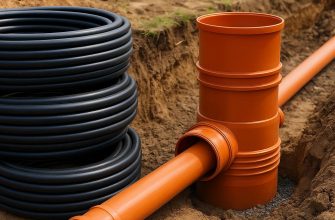
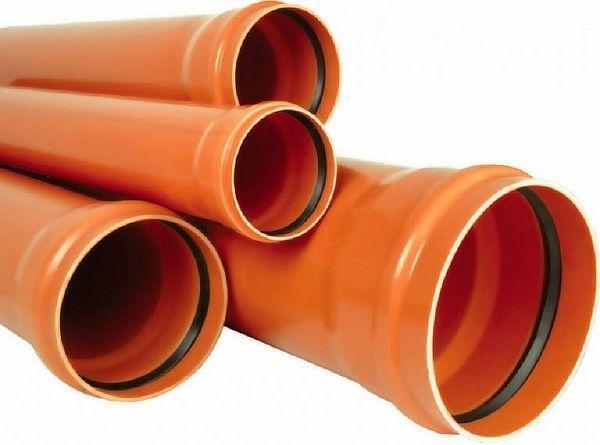
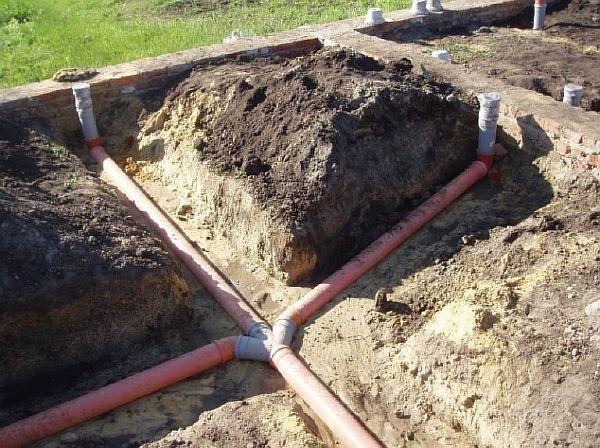
Yellow or orange color indicates plumbing components that are used for laying external sewerage systems, where the diameter size is 50 mm.
Their walls come in different designs: single-layer and smooth, or three-layer and corrugated. These options fully comply with GOST 51613-2000.
Wall thickness and strength become the most important parameters for this group. Based on these characteristics, smooth structures can be further divided into three categories.
- SN8Plumbing fixtures with the highest durability. They can be installed even under busy highways, at great depths.
- SN4It is better to lay them under roads without much traffic.
- SN2They cannot withstand heavy loads.
1.1-6.3 centimeters is the most common diameter for outdoor sewerage.
When installing external networks outside the home, specialists use the following types of connecting elements.
- A single-plane cross with a right angle. Or a tee supporting angles of 45, 67, and 90 degrees. This rule complies with GOST 51613-2000.
- Right angle tee, three-socket type.
- Reduction.
- Plumbing inspection hatches for structures measuring 50 mm.
- Siphons equipped with two knees.
- Check valves.
- Elbows with two sockets, rectangular in shape.
- Plumbing bends with a large number of possible angles: 15, 30, 45, 67 and 90 degrees.
- Coupling. The main thing is that it complies with GOST 51613-2000.
Forced drainage
A special category of products made of PVC. The main requirement is the ability to withstand high pressure.
These plumbing pipes and adapters are available in three varieties depending on the pressure they are designed for. Typically, products are designed for 6, 10 and 12.5 kg/cm2.
According to the type of assembly, structures are divided into two main categories.
- For the adhesive method, which allows the use of special fittings
- For classic bell.
Tips for choosing
An important consideration when installing a sewer system, whether it's internal or external, is the installation location and the expected operating conditions. The size and quality of the pipeline are equally important.
It's quite difficult to independently calculate the appropriate diameter for an outdoor sewer system in any given situation, but there are general recommendations that can help solve the problem.
- A 5-centimeter diameter is quite sufficient for a shower, draining waste from a sink, and similar elements.
- From the toilet, wastewater is diverted into 11-centimeter structures.
- For a full-fledged bathroom in apartments and private homes, the minimum size is also 11 cm. In multi-story buildings, contractors often choose vertical systems with a diameter of up to 15 cm, provided they comply with GOST 51613-2000.
- The cross-section of the pipeline should be 20 centimeters if we are talking about a horizontal main line that collects and drains wastewater from the entire house.
- The branch through which wastewater flows from plumbing fixtures to the pipe vertically should not be smaller than the riser.
Video
PVC plumbing pipes with pressure
These 50 mm pipes differ from others in that they can withstand pressure up to 10 atmospheres.
They are relevant for systems in which pumps are responsible for forced fluid circulation. This creates artificial pressure, resulting in a continuous flow.
The installation of pumps will be especially relevant in places where there are many apartments and large premises.
The wall thickness of a 50 mm pipe must be increased to withstand the increased load. Multilayer products are permitted. Here, too, the characteristics are regulated by GOST 51613-2000.
Pressure external piping materials with a diameter of 50 mm are installed even in places where the pump will not operate on a permanent basis.
A non-pressure type of PVC pipe
They are most commonly used in modern sewer systems. Their design is standard. They are not recommended for use in systems with artificially created pressure.
It's possible to install pressure pipes along the entire length of an outdoor sewer system, but this solution is prohibitively expensive. Similar non-pressure materials are 25 percent less expensive than pressure pipes.
Watch the video
[sociallocker]
About corrugated varieties
They have a most unusual appearance. The walls resemble an accordion, allowing for installation even in difficult-to-reach areas.
The design consists of an inner and outer layer. The inner layer is made of a smoother material to prevent clogging. The outer layer is standard PVC.
How to connect plastic pipes to cast iron ones?
Transition cuffs and fittings help connect any external pipes, even if part of the branch is made of cast iron and the other part is plastic.
A standard rubber adapter is sufficient if you need to connect a system with a socket. Plastic external adapters are needed where there is no socket.
When using rubber cuffs, replacement is carried out as follows.
- We clean the 250 mm socket from plaque and dirt, if any has appeared on the surface.
- We apply a layer of sealant to the outer surface of the socket. Then, the part is inserted.
- The plastic pipe for the sewer system is connected to the cuff.
Plastic fasteners require a slightly different procedure.
- We straighten the edge of the pipeline by 250 mm using a grinder if part of it has cracked during operation.
- We place a 250mm rubber cuff on the structure. Its surface is pre-coated with a sealant to ensure a high-quality seal.
- A plastic adapter is put on top.
Video
What other adapters are there for plastic products?
There's a wide selection of plastic external adapters on the market today. They're less reliable than metal ones, but they're more affordable. And they're easy to install yourself.
Adapters made of polyvinyl chloride and polyethylene are produced for 250 mm, which are mounted in systems with rubber cuffs.
A strong hold is achieved by using an elastic ring inside; no additional tools are required for installation.
Not able to withstand high pressure and PVC fittings for adhesive mountingAlthough they are more reliable than the previous variety.
Video
We produce 250mm polypropylene adapters that are installed by welding. They form permanent connections. Special soldering irons and nozzles are required for this application. They are manufactured to the same size as the pipeline diameter.
Finally, some manufacturers produce 250 mm designs in which the plastic elements are inserts, and the product itself is metal or made of composite.
These are also quite popular PVC plumbing pipes and adapters for sewerage.