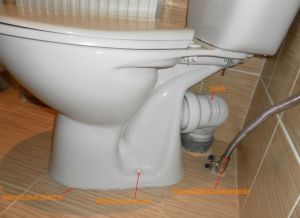
 If desired, the apartment owner can connect the sewer pipes to any plumbing fixtures themselves.
Connecting the toilet to the sewer pipe yourself allows you to personally monitor the quality of each joint and save on hiring workers.
Only when connecting pipes made of different materials do some difficulties arise.
Plastic elements: how to connect them?
Depending on the location of the drainage system, the option with the most suitable characteristics is selected.
The financial capabilities of the owner and customer also influence the outcome and final choice. There are several types of connections that are the most widely used.
- Bell-and-socket connection.
Here, it's important to use parts with an extension at one end. This is where the rubber gasket is inserted. Alternatively, a special solution can be used. Then, the straight end of the second part is inserted into the first.
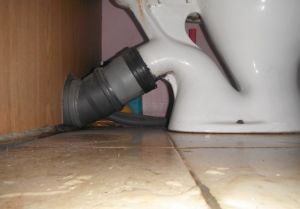
This type of connection is most often used inside buildings or in systems that are located horizontally.
But the system will only last a long time if all elements are made of the same material.
- Thermal welding.
Compared to other options, this one is the most expensive. Without expensive equipment, the problem will definitely not be solved.
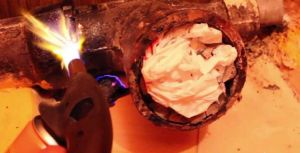
The joining is done either by applying high temperature to the edges or by using electric current.
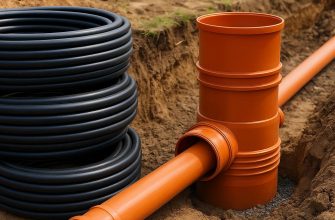
For hard to reach places use thermal couplingsThere are other types of sewer pipes and connections, as the photos confirm.
- Various materials for sealing.
They allow the use of not only the latest modern equipment, but also slightly outdated ones.
Outdated solutions in this case include: rubber seals to join different parts when the difference in diameter is small; and the use of flax strands for structures with smaller diameters.
The structures themselves are then mounted into pipes with a wider diameter. A more modern version of the technology allows for the elements to be simply glued together. This involves the use of a special mortar for this purpose.
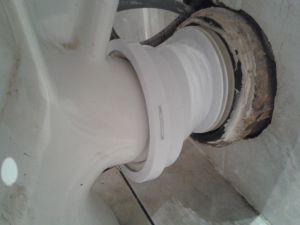
PVC sewer pipes. How are they connected?
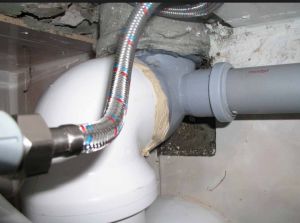 Doing the work yourself is easier if it's done indoors rather than outdoors. It's even easier if the wiring is installed inside an apartment. It's more challenging if, for example, the wiring needs to be done inside a two-story private home.
- Gluing
This type of connection of the toilet to the sewer system assumes that there are two segments of the pipeline with different diameters.
But the difference should be small, just a few millimeters. Fine sandpaper is used to smooth the ends where they meet. Then, the surface is wiped with a special degreaser.
Video - Installing PVC pipes on a sewer system with glue
Excess glue will almost naturally come out of the joint. There's no need to remove the glue itself; it's what creates the secure seal. Apply a little more glue on top once the rim is almost completely dry.
- Welding technology
On segment ends that require connection, install special equipment that produces heatingThe parts can be removed only after the temperature has been maintained at the required level.
Video - Welding Technology
The parts on which the seam has already cooled need to be rotated around their axis. They need to be turned in different directions from each other.
- Using compression fittings
Additional parts must be purchased to complete the connection. The nut located on the side of the fitting, which contains sealing rings, must be removed.
Video: Connection using compression fittings
How to connect the sewer system to the plumbing?
Some difficulties may arise when connecting toilets and sewer systems if you do not know some of the features.
The connection method for such plumbing equipment is selected based on the design features. There are several options.
- Use of corrugated pipes.
Connecting a toilet to the sewer system using a corrugated pipe is suitable for installations with a horizontal or oblique outlet. Using such solutions should be straightforward.
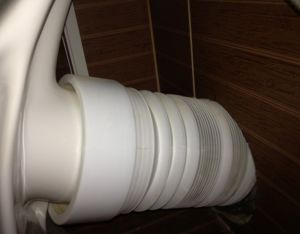
First, we seal one end of the structure with sealant. Then, we insert it into the pipe. The other end must first be connected to the structure, dry-fitting. Then, we perform a test run to check for any leaks.
The edge is removed if they are missing. The inside is sealed with the same sealant and then returned to its original position.
- Screw flanges
An excellent solution for models with a vertical outlet. The sewer pipe is first inserted into the circular hole in the center.
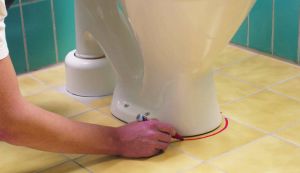
Then the toilet itself is placed on the structure and twisted until fully engaged. The pipes and drain outlets are pressed together as tightly as possible.
Thus, we obtain an absolutely hermetic connection.
Installed if the outlet is horizontal. A special sealing cuff is used for installation. It is inserted into the sewer outlet, which is made of plastic.
About cuffs
Sometimes difficulties arise with connecting the toilet, even if all the parameters seem to be suitable.
The main reason for the difficulties is that the floor level changes during renovation. For example, it becomes higher after installing ceramic tiles. Cuffs help solve this problem..
They can be corrugated or eccentric, and depend on the method used to connect the toilet to the sewer system.
Eccentric cuffs are essentially two pipes with offset centers that connect to each other.
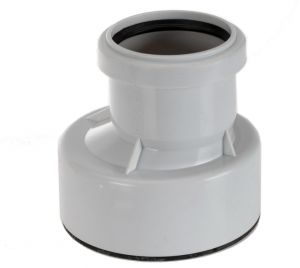
It is enough to rotate and connect them correctly to each other to achieve uninterrupted operation of the toilet in the future.
Thanks to this method, you can avoid any problems during the connection use sealantsThe fastening is quite effective thanks to the use of so-called rubber seals. Sealants should only be used when working with cast iron pipes.
If eccentrics can't be used, corrugated structures are used. Corrugated material is flexible and stretchable under any conditions. This makes the mounting method very convenient. However, there are some caveats.
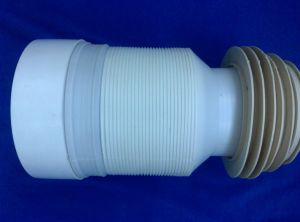
For example, to complete the job, it's best to stock up on material at least 15 cm long. Corrugated cuffs come in varying quality and are sold in various stores.
It's best to choose reinforced products – they are covered with stainless steel, have increased strength and wall thickness.
Video: Connecting pipes of different diameters in a sewer system
About toilet fixation
You can proceed directly to fixing the toilet only after all its elements are connected to the pipe, when you have managed to carefully measure all the elements.
For this process you can use:
- Screws (if the toilet is attached to tiles or concrete).
- Mounting board.
- Epoxy adhesive. Toilet types vary in how they are connected to the toilet bowl.
Epoxy adhesive requires careful surface preparation before further application. This requires:
- Level the surface.
- Completely clean the material from dirt and dust.
The adhesive will spread evenly across the entire surface if it's level. This means the plumbing fixtures themselves will be more securely attached.
Video instructions for installing a toilet
There are a few important points to consider when using a special board for fastening.
Tufts or planks are made only from highly durable materials. The planks are not simply installed; they must be treated with drying oil.
Several nails are driven into the taffeta, and then this portion of the structure is lowered into the cement mortar. The connection between the toilet and the sewer pipe is complete.