A sewer system is one of the most important components of a private home, ensuring comfortable living conditions for residents. While apartment owners solve this problem by simply connecting to the central sewer system, summer residents or homeowners often have to construct their own sewer system using tires. This is a simple and inexpensive option for improving a private property.
The structure looks like a reservoir consisting of two or three chambers, the purpose of which is to collect, settle and filter waste, which is achieved thanks to special bacteria.
Typically, all liquid collected in a tire septic tank is purified by 97-98%, according to sanitary and epidemiological standards. Homeowners won't have to spend a lot of money to build such a structure, as worn tires are an excellent material.
In this article, you will learn how to properly construct a high-quality sewer system from tires.
- Rules for constructing the structure
- Where to start construction
- The optimal location for the excavation pit
- Options for a tire sump
- Sedimentation tank with a filter system
- Septic tank with two wells for settling and filtering water
- Sump with drainage pipe
- Materials and tools needed for building a sewer system from tires
- How many materials will be needed?
- Building a septic tank from tires
- Preparing the excavation pit
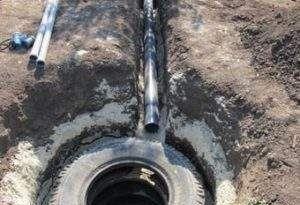
- Laying tires for a septic tank
- Construction of a structure for a purification system
- Connecting a septic tank made from tires and a wastewater treatment tank
- We install ventilation
- Conclusion
Rules for constructing the structure
 A DIY tire sewer system is an excellent solution for those who don't want to spend a lot of money on a septic tank but still want an efficient, long-lasting system. To ensure the system works properly, certain construction guidelines must be followed.
This will not only ensure the successful operation of the tire sewer system, but will also reduce the risk of environmental problems that may arise from ignoring the basic requirements for installing a septic tank.
It is important to follow the following basic rules:
- Construction of a wheel septic tank can begin only if the groundwater level is below the 2-meter mark. This will ensure secure anchorage of the structure, preventing shifting, undermining, or deformation due to soil heaving.
- It's preferable to install a sewer system on a site with sandy loam soil. This ensures optimal and rapid drainage of treated water.
- When constructing a sewer system, it's important to consider the depth to which the ground freezes. This rule is important to follow even when constructing a small reservoir that will collect household waste.
- It's also important to consider that the tire wastewater system must be properly positioned relative to other buildings and drinking water sources on the property. The optimal distance between the house and the septic tank is 5 meters. The wastewater system should be located 20 meters or more away from water sources. To minimize the risk of waste entering groundwater, it is recommended to locate the tire wastewater system at the lowest point on the property.
- The water intake level is necessarily lower than the level of the treatment plant.
- It is essential to ensure unimpeded access for wastewater treatment vehicles.
Advantages:
- absence of large monetary costs;
- short construction period for sewerage system;
- you can build it yourself without involving a lot of people;
- Any tires will do, regardless of newness and size;
- simple design.
Flaws:
- low productivity;
- serves on average 10-15 years;
- unpleasant odor;
- Incomplete sealing of tires increases the risk of soil contamination with waste.
This type of sewer system is also unsuitable for areas with high soil moisture. It's also important to consider that waste entering surface or groundwater can increase the risk of dangerous infectious diseases.
Where to start construction
It's important to obtain a permit for sewer construction if the pit will be deeper than 5 meters. Obtaining one is not difficult, especially if all land surveying requirements are met. These requirements are detailed in the Russian Land Code. If you have a cadastral passport obtained before 2014, it should be updated. The cost of land surveying itself varies around 6,000 rubles.
Watch the video
If a communications cable runs through a property, special permission from the owner is required. A specialist must visit the property and use a metal detector to identify a point where digging is prohibited.
The optimal location for the excavation pit
After receiving permission from all authorities, it's necessary to select a location for the sewer system. There are certain standards established by SanPiN (Sanitary and Epidemiological Rules) that must be followed. For example, if the septic tank is located near a drinking water source, the risk of wastewater entering the groundwater increases.
Leaks can make drinking water unfit for consumption. A sealed septic tank and a special filtration system will help prevent soil contamination.
It's also a good idea to avoid building a sewer system close to a house or sauna, as this can cause soil to settle during excavation, damaging the concrete foundation of the septic tank. Furthermore, clogs can cause the foundation to become damp, weakening it over time.

Placing the tank too far from the house is also a bad idea. This will significantly increase the construction costs.
As a rule, at least one manhole is required for the external section of the sewer system. If the pipeline is longer than 25 meters, additional manholes will need to be added.
If the water line is too long, there's a high risk of frequent blockages. This should be taken into account even if a special pump is installed to remove wastewater from the sewer.
Options for a tire sump
The choice of structure depends on how much wastewater will be discharged from the residential building. If the property has only a few residents, the simplest option will suffice.
Watch the video
[sociallocker]
This option is not suitable for families with more than four people, as it will quickly become unusable due to excessive load. Therefore, experts recommend considering a two-well system.
Sedimentation tank with a filter system
This is an inexpensive sewerage system option. To construct it, you'll need to dig a pit, construct the bottom, and lay tires underneath. Keep in mind that this type of septic tank is not recommended for construction near buildings or cellars.
It is better to give preference to wheels from large vehicles with a wide diameter, since they can accommodate more waste and increase the working capacity of the sewer.
The operating principle of such a septic tank is simple:
- waste flows through the sewer pipe into the well through the drain;
- the part of the wastewater that does not dissolve does not enter the soil and remains on the crushed stone layer;
- The purified liquid is absorbed into the ground through the drain.
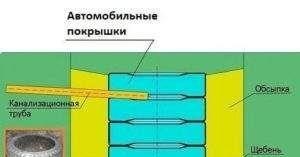 We also suggest you familiarize yourself with the diagram of a septic tank made from tires. The main drawback of this design is that it is only suitable for domestic wastewater. It is not recommended for use with heavy, insoluble waste, as it will quickly fail.
However, if the bottom is made sealed rather than drained, and the connection in the walls is impermeable, then this option will act as a reservoir for all wastewater, which will have to be pumped out frequently in the future.
The main advantage of a sewer system is that it's easy to build and problem-free to operate. Expanded clay, sand, and even plain soil are suitable for the top layer. Another drawback is that sludge quickly accumulates at the bottom of the tank, causing the pipe to clog over time, impeding water drainage. In this case, homeowners will have to frequently use a pump to pump out the water, clean the bottom, and then replace the gravel.
Septic tank with two wells for settling and filtering water
This design is more complex, but it will last a long time. It consists of two reservoirs. One serves as a well where the liquid settles, and the other filters it before it enters the ground.
Unlike the previous septic tank type, this version has a settling tank with an impermeable bottom where the incoming wastewater settles. Insoluble waste remains at the bottom, and the remaining liquid passes into an absorption well for subsequent filtration.
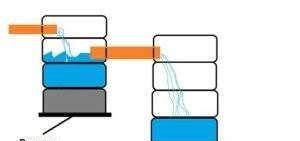
The essence of the septic tank’s operation is as follows:
- waste passes the first well;
- the insoluble part remains at the bottom;
- the light liquid passes through the adjacent pipe into the cleaning chamber;
- The liquid is filtered through a special system and then absorbed into the ground.
Another advantage of this design is that it does not require large construction costs and does not harm the environment, which makes it attractive compared to other options.
The septic tank is pumped out about 4-5 times a year.In addition, with constant use of the sewer system, there is no need for additional insulation.
Sump with drainage pipe
This design is considered unsuitable for a private home. The drain pipe doesn't perform any special functions in sewerage systems.
Next, drill several holes in the pipe using a drill bit suitable for the pipe material. To prevent the drill bit from heating up and warping, it's important to cool it regularly.
The operating principle of a septic tank is as follows:
- waste flows into a special tank;
- insoluble fractions settle to the bottom;
- The drain and crushed stone carry the filtered liquid into the ground.
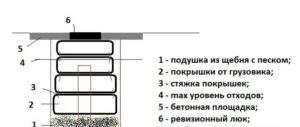
The basic design principle is that water flows through a pipeline, bypassing the silt-contaminated bottom. However, the pipe quickly becomes clogged with this same silt, making it short-lived.
Materials and tools needed for building a sewer system from tires
If a private property owner can't afford an expensive sewer system, they can easily handle the job using materials readily available to any DIYer. Old car tires are ideal for installing a septic tank.
This material isn't hard to find; it's readily available at companies that scrap tires and other used tires. You can also find ads from private individuals online. The best option is to go to a tire shop. They'll have plenty of old tires from various vehicles, and the shop owner can donate heavily worn tires for free, thereby saving on disposal costs.
 As noted earlier, any tires can be usedOf course, no one will buy new material to build a septic tank, and that's right. Worn-out materials are just as suitable for a septic tank and won't deform in any way when buried in the ground. Rubber, as we know, doesn't rot or react to aggressive environments.
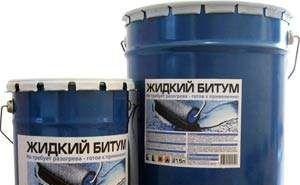
To cut polypropylene pipes, you can use a regular, well-sharpened hunting knife. Liquid bitumen will be needed to seal the areas where the elements are joined and where the pipe is inserted. Of all the possible materials, it is most suitable for tire material.
It's worth stocking up on sand, no matter what kind. It's perfect for filling the pit in which the septic tank and trench with pipes will be installed. The original soil left over from digging the pit and trenches is also suitable for this type of work. However, it's only suitable if it doesn't contain layers of loose soil with a high concentration of sand and clay.
The drainage layer also needs to be backfilled. Crushed stone with a diameter of 5 to 20 mm is suitable for this purpose. The required depth is about 1 meter. Expensive crushed stone is not necessary; any budget option will do. Plastic ties are used to secure the tires, but regular wire can be used instead.
How many materials will be needed?
 The number of pipes required is determined by the distance between the tire septic tank and the house. It's advisable to purchase extra pipes, as they may become deformed during construction. You'll also need an extra pipe to connect the two septic tanks.
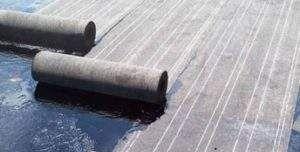
Five clamps are required for two wheels, so use this information when purchasing materials. If you use binding wire instead, 1-2 meters will be sufficient. For moisture protection, you'll need a piece of rubber and one roll of roofing felt.
To construct a filter bed, you need two tons of gravel and two tons of sand. Sand-gravel mixture (SGM) is also suitable, but it will reduce the quality of wastewater treatment, as the sand will quickly become contaminated with silt.
Building a septic tank from tires
It's time to start building a sewer system from tires once all the materials have been purchased and the drainage system from the country house has been installed.
It's best to sketch out a septic tank to accurately calculate how much material will be needed, how deep the bottom of the structure should be laid, and where and at what depth the pipes will be laid.
Watch the video
Installing tires won't present any difficulties for the property owner. However, preparing the pit will be quite a labor-intensive process. This work is difficult to do on your own and can take at least a week. When digging a pit manually, the most difficult part is removing the soil, especially if the depth exceeds 1.5 meters.
Something like a bucket secured with a rope to lift the blade, along with a cart to remove excess soil, is ideal for this purpose. For example, you can use specialized equipment such as an excavator, thereby facilitating and speeding up the process.
Preparing the excavation pit
Using an axe, remove any plant roots growing in the hole, as many of them could grow into the pit and deform the septic tank. Then, level the area for the bottom. This will ensure a secure fit and seal between the rubber and the underside of the tire, so try to make the bottom as level as possible.
Watch the video
The area where the bottom of the cleaning chamber will be located must be further increased downwards by 30–60 cm. It is not necessary to level the layer, since gravel will be placed on top.
Laying tires for a septic tank
 Before laying rubber, you need to carefully prepare the base for it.
- Then the first tire is placed.
- Liquid bitumen is applied to the joints between the tire and rubber.
- The second tire is placed.
- Liquid bitumen is applied to the joints of the two tires.
- The first two wheels are connected using wire.
- The same is repeated with the third tire.
- A hole is drilled on the last busbar to carry the drain pipe out of the building, from where we will drain the sewage water.
- A larger tire is placed on top.
- The joints between the last two tires are lubricated with liquid bitumen or sealant.
Once all the external and internal sewerage elements have been installed, it is time to begin installing the septic tank pipes.
Construction of a structure for a purification system
The instructions are basically the same as those described above, with a few exceptions. First, the bottom should be sandy. Place the first tire on it and cover it with crushed rock or gravel. Then add the next tire. Second, you'll need four tires, and drill holes in the last one for the drain pipe. The last two steps are identical to the previous instructions.
Once the settling and filtration tanks are installed, it's time to begin laying pipes between the wells. The pipe diameter is 110 mm, as a greasy film will form on its walls during use. Over time, the pipe's clearance will decrease.
It is recommended to trim the edges of the tire from the inside, due to which the well volume will increase significantly.
Connecting a septic tank made from tires and a wastewater treatment tank
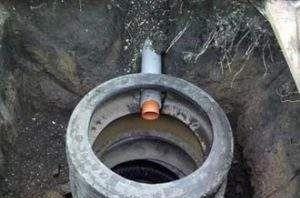 To do this, you'll need a grinder to cut two holes either at the bottom of the third tire or at the top of the second. Keep in mind that the septic tank outlet is located at a lower level than the drain pipe from the living space. The pipe should be installed horizontally and inclined at an angle of 15-20 degrees.
Additional sealing is required at the points where the pipe and tire meet. This is accomplished using small patches cut from roofing felt, with liquid bitumen used as an adhesive. This eliminates the risk of pipe contamination. Only then should the final stage be carried out.
We install ventilation
It's essential to install a ventilation pipe on the external sewer line. Ideally, it should be installed in the lid of the treatment tank. The best option is to install the ventilation in two locations: at the house exit and above the treatment well.
A gap may form between the well walls and the pit; fill it with sand. Compaction of the soil will be necessary from time to time.
Watch the video
[sociallocker]
Once the first rain falls, the soil in the pit will settle, so it will need to be backfilled. The septic tank itself can be covered with simple metal lids.
A tire septic tank in a private home will last about 15 years. Pumping will only be required for the septic tank when it's filled to the brim with heavy sewage.
Conclusion
This article detailed how to make a sewer system from tires yourself. Not only is it inexpensive, but it's also quite simple: you don't need to be a builder to construct a structure from rubber tires.
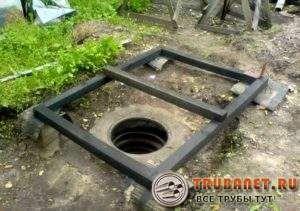
However, it's still important to consider a few basic rules that will help you properly build a cesspool or septic tank in a private home. Careful sealing of all joints and seams between tires is essential to prevent wastewater from leaking into the ground.
It is worth deciding in advance on the type of structure and its location.
The sewer system's location must comply with all standards previously outlined in the article. The structure itself must also be installed below the frost line.