Polypropylene is one of the most common materials for pipeline construction today. Its properties are truly optimal for most consumer groups. That's why they choose polypropylene sewer pipes.
What raw materials are they made from?
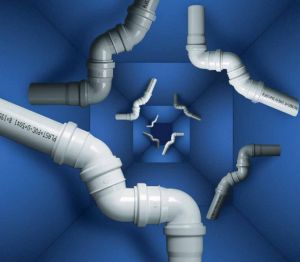 All pipes in the original group are called polypropylene. The raw material composition may vary among different samples. For example, mineral or organic substances are added to the original polymer. This allows for the development of specific sets of properties.
The composition of the raw material is an important factor for those looking to select the optimal polypropylene pipe. The most information can be obtained from the markings. PPR80 is considered the most optimal solution.
Where else are polypropylene products used?
For the installation of internal sewerage systems, the following positive qualities of polypropylene pipes become especially relevant.
- Quick installation of the system due to high-quality and reliable connections between the elements.
- The material is very lightweight. With a similar diameter and length, polypropylene weighs at least ten times less than cast iron. This also applies to the fittings.
- Heat resistance. At working fluid temperatures of up to 80-90 degrees Celsius, polypropylene retains its original properties for a long time. Exposure to boiling water also shouldn't pose a serious problem, unless it's prolonged.
- The ability to withstand mechanical stress. Under mechanical stress, the material begins to deform, but then quickly returns to its original shape. No significant damage to the base occurs. Shaped parts are no exception.
- Environmentally friendly (chemically passive material).
Nowadays, you can create a sewer system with any configuration, thanks to a wide selection of both pipes and fittings. Take, for example, the PP 110-millimeter model—the ideal choice for toilet drains and standpipes. Polypropylene pipes with cross-sections up to 50 millimeters are more suitable for bathtub and sink drains.
Polypropylene in outdoor networks
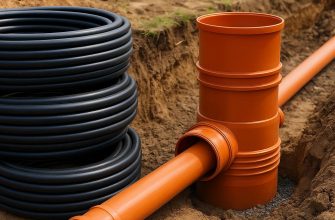
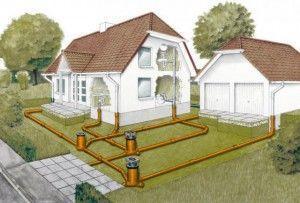 Polypropylene sewer pipes are used not only in internal but also external networks. Although the material itself is quite soft, the key is to choose the right type of pipe for the job and select the right fittings.
For example, only single-layer, smooth polypropylene structures are produced for indoor sewer systems. For outdoor networks, the material has a slightly different design.
The two-layer construction is the main difference from conventional sewer pipes. The inner layer is corrugated, while the outer layer is completely smooth. This design makes them resistant to any load.
Thanks to the elasticity of polypropylene, sewer pipes successfully resist freezing. They simply deform around the circumference if the water temperature drops to a certain point. When the ice plug melts, they return to their original shape. Fittings also respond in this manner.
Diameter. About the differences
Sewer pipes come in two diameters, as do fittings. This is because Russia has a single standard for this type of product. There's no need to develop a wider range.
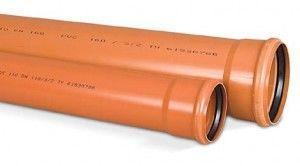
The cost of finished products is reduced thanks to the presence of clear parameters in the organization of large-scale production. When it comes to industry, cost efficiency always comes first.
For example, for transporting sewage in industrial and public buildings, products with a diameter of 50 mm are used. In this case, it's easy to distribute the entire system among individual workshops and rooms. These products are durable, strong, and reliable. Fittings are no exception.
Pipes with a diameter of up to 110 mm can play the role of a central drain in all rooms.
How to make the right choice?
Many companies now produce polypropylene sewer pipes. German manufacturers have long been known for their high quality, and they have remained market leaders for many years. Their relatively low price and excellent quality have also made Czech sewer pipes popular in our country.
Turkish designs are inferior to previous options in terms of technical specifications, as are the fittings. However, they have also become quite popular among buyers. And their price is more attractive.
Pipes manufactured by Russian companies are considered budget options. They are durable and reliable, but still inferior to their foreign counterparts.
More about the product range
Video 1
Extrusion technology is currently the primary method for producing polypropylene sewer pipes. This allows for the creation of custom-sized sections with specific characteristics. Manufacturers can independently determine the specifics of their product range.
- 2-8 meters is the standard sewer pipe length according to GOST. There is a one-meter increment between adjacent sizes. Ultimately, the length will be 6-12 meters, but this is rare.
- The most commonly used sewer diameters are 110 mm and 50 mm, according to GOST. Fittings are selected based on these diameters.
The range of so-called pressure sewer pipes is even more impressive. These products range in diameter from 32 to 1600 millimeters according to GOST standards. In this case, the increment between sizes is one inch. Their lengths reach 12 meters and more according to GOST standards. They are produced in fairly large coils.
Buyers can choose from a limited selection of parameters if they are satisfied with standard dimensions. Pressure sewer pipes are suitable for those with more specific product requirements, as are fittings.
About fittings
Sewer fittings are available in two types: adhesive-bonded and socket-welded. Their range is quite extensive, encompassing the following design types. A wide selection of shaped fittings is also available.
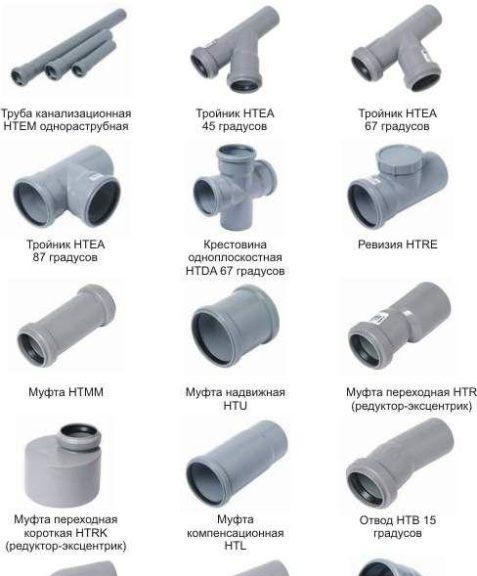
- Couplings. These help connect two pipes together. A coupling is a section of pipe 90-160 mm long according to GOST. The ends of this product are called sockets. Its diameter is equal to the diameter of the pipe itself.
- Crosses and tees. These are components that allow lateral branches to be connected to the main sewer line. Crosses and tees can have the same or different diameters. The connection itself is made in perpendicular and parallel planes. The ends of these components can be smooth or flared.
- Elbows. Special devices used to create angular connections between horizontal and vertical lines.
If the angle of deviation is 45 or 87 degrees according to GOST, it is an acute-angle elbow. There are rectangular varieties with a 90-degree angle. The ends are either socket-shaped or have a smooth surface.
- A transition pipe. It helps connect 50mm and 110mm pipes according to GOST standards. One pipe should be smooth, and the other should be a socket.
- A removable socket. Fits pipes with a diameter of 310 mm or greater, according to GOST. These fittings are not used in domestic pipelines.
Installation and its features
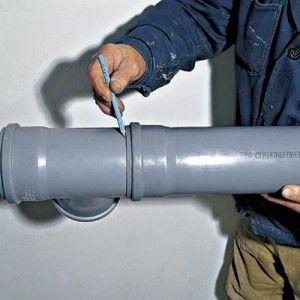 Speed and ease of installation are the main advantages of polypropylene products. Also worth noting are the high-quality connections between the elements.
These plumbing products are more rigid than standard polyethylene, making it possible to use various types of fittings. In a polypropylene sewer system, all fittings are non-detachable.
There are just a few nuances that need to be taken into account when carrying out installation.
- All parts are connected by diffusion method according to GOST. also called socket welding. Enables the creation of homogeneous products with absolute strength.
- Heating, cutting, and joining are the three main processes during installation. The work itself takes little time.
- The connection can be put into operation immediately after the three stages outlined above are completed. The connections are very strong.
- There are special fittings that allow you to install a thin branch from the main line.
- Almost any tool can be used to adjust the sewer pipe to its proper size. This includes both power tools and manual tools. However, in some situations, burrs can form on the end of the pipe. For example, when working with an angle grinder, these burrs can damage or even tear the rubber sealing ring. Therefore, it is necessary to trim the rough edge before installation. Fine-grit sandpaper is perfectly adequate for this task. To create a tapered cut, sand the cut edge down to a depth of approximately 0.5 cm.
Polypropylene sewer pipes compliant with GOST standards are a reliable and simple solution for those who need to install pipelines, whether in private or multi-apartment buildings. Such a system, if all requirements are met, can last for decades or more, just like the polypropylene sewer pipes themselves.