Choosing a toilet for an outdoor outhouse requires careful consideration. It's recommended to consider not only the price and material, but also the type of toilet and ease of care and maintenance.
Owners can purchase a factory-made stall with a ready-made toilet or build one themselves.
Depending on the craftsman's construction skills and the availability of consumables, a product can be created from wood, galvanized steel, or even an old chair.
Below, we'll explore this issue in detail, tell you all about toilets for country houses, select the optimal material and type, and learn how to make a toilet seat yourself.
Types of toilets for a country house
Before choosing a sanitary fixture for an outdoor toilet, it's recommended to carefully study all the different models available. Each model has specific features that are important to be aware of before installation.
The most common materials used for manufacturing:
- ceramics;
- porcelain;
- tree;
- plastic.
Porcelain
Country models made of porcelain are smaller than their apartment counterparts. They also lack a bottom; these structures are installed over a septic tank.
The main requirement for a porcelain toilet in a country house is that it must be installed on a foundation (usually concrete), as the material makes it heavy. Country models feature a large bottom opening, which allows waste to flow freely into the pit.
Advantages of outdoor porcelain products:
- it is easy to care for, there is no need to use specialized cleaning products, as, for example, for plastic analogues;
- the material is non-porous, so it does not absorb dirt, moisture and various odors, which is especially important in a country toilet;
- increased strength and reliability of the material, resulting in a long service life.
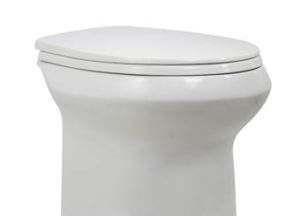 Disadvantages The product's heavy weight, which requires installation on an additional base, and its relatively high cost can also be attributed to this.
The installation procedure is similar to installing a toilet in an apartment. Let's look at the installation procedure for porcelain models using the Leroy Merlin toilet as an example:
- The structure is installed over the drain hole. To prevent objects from falling in, cover the hole with a piece of plywood with the drain perimeter marked in chalk.
- Holes are drilled for bolts.
- The product is mounted on a platform, and the structure is secured in the required places using bolts and nuts.
- The toilet seat is being installed.
If a septic tank is built on the site, then a large-diameter pipe will need to be connected to the toilet hole, through which all waste will flow into the sewer.
Ceramic
Ceramic toilets are the most common among both summer residents and apartment dwellers. This type of outdoor toilet for a summer residence lacks a cistern. A key difference from apartment models is the absence of a bowl. Since the cistern does not flush, all waste goes directly into the septic tank.
However, sometimes site owners, for greater convenience, connect a hose with water, which allows them to flush away waste.
The main advantages of ceramic models:
- ability to withstand loads up to 180-200 kg;
- stability and reliability of the structure;
- possibility of operation over a long period;
- when used carefully, it is resistant to contamination;
- easy to maintain, just use regular chemical cleaning products;
- Thanks to the wide opening, a hose from a sewage disposal truck can be used to clean the cesspool.
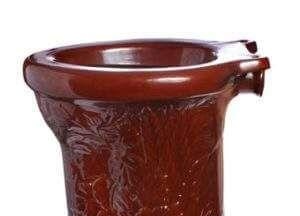 Outdoor toilets for summer cottages are typically available in a variety of colors, so you can choose one that complements your restroom design. A hinged lid is recommended for these models, but some toilets have a wide rim, making them suitable for use without a lid. Special holes are provided for attaching the seat.
Installation is quite simple; no additional equipment is required beyond standard construction tools. Installation consists of the following steps:
- A hole is created in the floor of the cubicle, the diameter of which is equal to the cross-section of the toilet outlet.
- The structure is secured using four fasteners. These fasteners are cap screws. In most cases, these are not included with the plumbing fixtures but are purchased separately.
- A structure is installed above the hole, which is attached to the bottom with bolts, then the inside is treated with silicone sealant in the places where the floor and toilet walls are connected.
- To ensure waterproofing, it is essential to treat the external joints with a silicate agent or other sealants.
DIY toilet
Building a toilet for a country outhouse is a moderately labor-intensive process, and can be accomplished even by a handyman with little construction experience. An outdoor outhouse toilet can be made from a variety of materials.
Watch the video
Wooden step
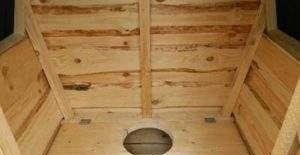 The most popular option is to install a wooden step. Before beginning the process, it's important to study the construction plan to calculate the appropriate dimensions for the outdoor toilet.
Algorithm for constructing a wooden structure of this type:
- Cover approximately half of the floor with boards.
- At a distance of 35-45 cm from the floor surface, install a cross beam in the middle; it will become the basis of the frame.
- The vertical part of the step is built up to the cross beam.
- The upper part of the structure is being laid.
- A hole must be cut in the top boards that matches the diameter of the plastic seat.
- If necessary, the structure is covered with varnish or paint.
- The seat is installed on top and secured with screws or nails.
If you plan to build a wooden country outhouse with an outdoor toilet, it's important to consider a ventilation system at the design stage.
Since sewer systems often have an unpleasant odor, it is recommended to install a ventilation pipe approximately 3 meters long. This will significantly improve the comfort of using the bathroom.
Galvanized toilet
The main advantages of this type of outdoor toilet are ease of installation and the availability of materials. The design is a cylinder with allowances on both sides.
Due to the low cost of consumables, this option is often chosen by owners of rarely visited sites.

Installation instructions:
- Find the optimal pipe size. Its height should be more than 40 cm, and the diameter should be approximately 33 cm.
- Make small cuts (5 cm intervals) on the seam allowances, then bend the ends to give them a daisy-like shape.
- The lower bent ends are fixed to the floor with screws, and the upper ends to a plywood sheet (with a width greater than 8 cm).
- Adjust the base to fit the toilet seat and secure it on top.
- Place the created structure over the cesspool.
To improve the appearance of an outdoor toilet, the frame is covered with plywood sheets or boards. While this design is generally unattractive, the materials are relatively easy to find, and installation takes minimal time.
Toilet from a chair
The simplest solution is to make a toilet seat from an old chair. This type of toilet without a water seal for an outdoor outhouse is fairly quick to build and only requires plywood sheets and, in some cases, plastic.
It's important that the chair be sturdy and its components securely fastened. Otherwise, the chair will quickly break, and the entire construction process will have to be started over.
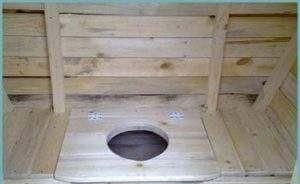 Algorithm for construction:
- Instead of a standard seat, you will need to place a sheet of plywood.
- A small hole is made to accommodate a jigsaw. Then, using a jigsaw, the hole is cut to the size of the plastic toilet seat.
- The toilet seat is placed on the hole and then securely fixed.
- To improve the appearance or increase stability, the chair can be covered with plastic around the perimeter of the legs.
- The chair is installed over the drain hole.
For added security, the chair legs are additionally secured. This is the cheapest and easiest way to build an outdoor plumbing fixture for your garden.
However, it is important to note that such a solution will most likely not be suitable for permanent use if the bathroom is used year-round.
The design is best suited as a temporary solution or when visiting the dacha not all year round.
Ready-made toilets with a toilet
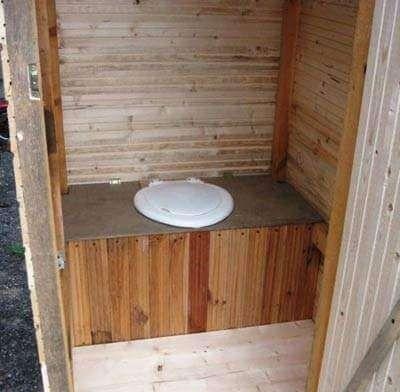 In addition to the above options, prefabricated models are also popular. Their main advantage is that they eliminate the need for independent design and assembly, making the entire installation process significantly faster.
The most commonly used models include peat toilets, composting toilets, and plastic cubicles. In some cases, chemical toilets are used, such as powder toilets, luft toilets, and so on.
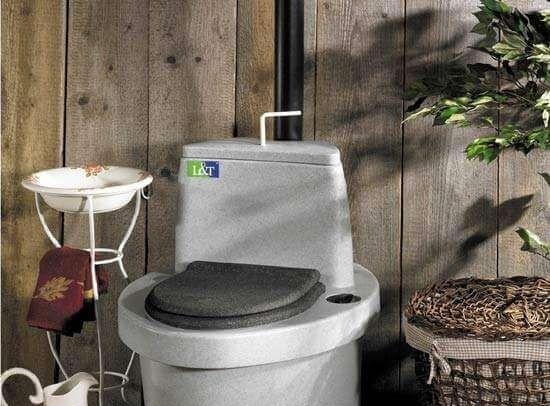
Peat toilet
The main advantage of this outdoor design is the absence of unpleasant odor. The principle of operation is that all waste after toilet use is covered with peat. The liquid portion is then discharged into a cesspool, while the solid waste needs to be periodically transferred to a compost pit. The compost can then be used as fertilizer.
Peat is used for its bactericidal properties. It significantly accelerates the decomposition of fecal matter, preventing the spread of odor, and the waste can then be composted.
Simply digging a cesspool and installing a structure on it isn't enough to construct a cesspool, as this could lead to the walls collapsing, damaging the toilet, polluting the environment, and spreading unpleasant odors. Therefore, it's important to additionally reinforce the pit walls with bricks or other dense materials (such as cinder blocks), and to create a layer of peat at the base of the pit, which will speed up decomposition and increase garden yields.
The construction consists of combining two main components of a country outdoor toilet:
- A cesspool where wastewater treatment occurs. A prerequisite for installation is a sealed cesspool to prevent wastewater from entering the soil and groundwater;
- A toilet cabin for a country house toilet, which is connected to a unique sewer system.
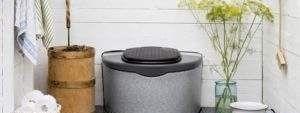
The dimensions of these components depend entirely on the owner's preference. It is recommended to dig a hole more than 1 m deep, and place the toilet seat approximately 40 cm away.
A biological peat toilet is also sometimes used as a country outdoor toilet. It consists of two tanks: the upper one contains the peat, while the lower one is where the actual processing occurs. The lower tank typically holds 50-230 liters. A ventilation pipe is essential in this design; it is recommended to choose a model with a straight pipe up to 4 meters long.
Watch the video
Plastic booth
A plastic toilet stall is easy to install, making it a popular choice when installation is required as quickly as possible. The first step is choosing the right model of plastic toilet for your outdoor outhouse. In most cases, a straight model without an elbow is chosen to ensure waste flows directly into the flush tank. These models are typically somewhat more expensive than their wooden counterparts, as they are more durable and can be used for a long time.
Today, the market offers a wide variety of toilet models, and the choice determines the installation process for an outdoor toilet in your country house. A popular and simple model is the bucket-shaped toilet. It is highly durable and can support up to 150 kg of weight.
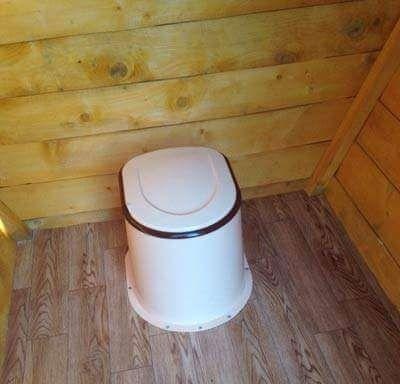 If a summer resident uses a septic tank as a waste collection container, installation won't be a problem. However, using a buried cistern will require additional effort. The difficulties stem from the different shapes of the two objects (a cistern is round, while a toilet is oval) and the fact that the toilet outlet diameter is larger than the cistern's neck.
To carry out installation in such a situation, the following materials are required:
- boards for laying the floor;
- bitumen mastic for waterproofing the joints of structural components;
- a sheet of galvanized steel to make the transition between the necks of the cistern and toilet bowl of different shapes.
Instructions for installing a plastic toilet for a country outhouse with a buried cistern as a reservoir:
- A sheet of galvanized steel is rolled into the shape of a funnel, the lower part of which is equal to the diameter of the tank neck, and the upper part is equal to the cross-section of the toilet outlet.
- The upper section is cut into a daisy shape and securely fixed with screws to the toilet structure; the lower section should be installed in a barrel.
- The joint areas must be sealed using bitumen mastic or other sealant.
To create a beautiful appearance, the toilet is attached to the decking, and then the floor covering is laid. If the toilet for a country outdoor toilet does not have holes for floor mounting, small corners are made from galvanized steel for fastening.
Watch the video
[sociallocker]
Biotoilet based on microorganisms
This type of country composting toilet can be used indoors. The design is completely sealed, so homeowners don't have to worry about stench spreading indoors. It's important to note that its popularity is largely due to the fact that there's no need to dig a cesspool.
In most cases, such country toilets are installed when the groundwater level is high enough or there are other factors that prevent the creation of a cesspool.
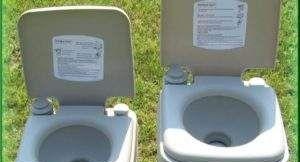
The operating principle is similar to that of a peat-based outdoor toilet. The difference is that waste is not sprinkled with peat, but is periodically coated with a special biological solution. This biological solution contains live microorganisms that significantly accelerate the decomposition and recycling of waste. However, when using this type of outdoor toilet, it is important to use special toilet paper that is completely dissolving.
The design consists of two tanks: the first holds untreated waste, and the second holds recycled waste. The second tank is usually removable; once full, the owner can place the waste in a compost bin or use it as fertilizer in the garden. To make life easier for gardeners, models have been developed with an automatic tank-full indicator.
Watch the video
[sociallocker]
Maintenance of an outdoor toilet
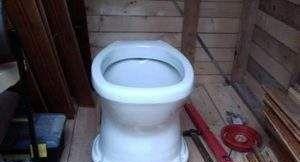 To extend the lifespan of your outdoor toilet, it's important to properly care for it. While the system doesn't require extensive maintenance, it's recommended to follow these guidelines:
- Regular cleaning of the bowl with specialized products is essential to eliminate germs and prevent odors. Chemicals should be selected based on the material the toilet is made of. For example, abrasives and strong chemicals can be used to clean a ceramic or porcelain toilet, while a plastic toilet should only be cleaned with mild products designed for plastic.
- If an unpleasant smell begins to spread around the area or in the toilet, then it is necessary add biological preparations or chemical activators to the cesspoolThey should be placed in the pit to significantly accelerate the decomposition of fecal matter and clean the drain. If biopreparations were used, this also improves the quality of the compost fertilizer;
- When connecting an outdoor toilet to the sewer system, silting may occur after some time of use. Solid waste and grease settle on the walls, reducing the pipe's effective cross-section. To prevent this, periodically use specialized drain cleaners or regularly run water with acetic acid and baking soda through the pipes.
A toilet will last significantly longer if the owner inspects it twice a season for cracks, deformation, rot, and other signs of damage. It is also recommended to perform minor cosmetic repairs to the outdoor toilet and bowl every five years or less frequently if necessary.
It should be noted that if a homemade toilet made from a chair is used, the need for repairs may arise sooner.
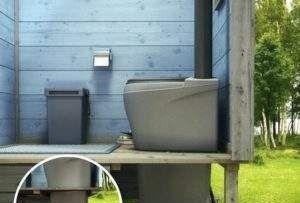
If the decision has been made to build an outdoor toilet for a summer residence, the next important decision after designing the stall is choosing the toilet. Toilets can be made from a variety of materials, including wood, galvanized steel, porcelain, and ceramic. Each of these options has its advantages and disadvantages, and the construction process and complexity also vary. If the owner doesn't want to build or install the toilet themselves, purchasing a prefabricated model is a good solution.
Watch the video
For some reason, I prefer wooden options. I'm in favor of a wooden step or a toilet made from a chair. I have the former. It's simple, practical, and you can quickly replace the step if it gets damaged. Plus, since the toilet itself is wooden, the wooden interior elements look better too.