There are many ways to build a sewer system in a summer cottage or private home. A popular option is a DIY cesspool made from concrete rings. Installing such a structure is minimally priced and provides a simple yet effective wastewater disposal system for your home.
To install a high-quality sewerage system in your home, It is important to know all the nuances How to build a reliable cesspool that will last for years. It's important to choose the right location and materials for the cesspool.
Furthermore, there are various construction schemes. Therefore, before beginning work, it's best to carefully review the information on the construction of such a structure.
- The main functions of a cesspool, aspects of its construction
- Popular options for cesspools
- The strengths and weaknesses of a cesspool made of concrete rings
- Design of the future building and calculation of the amount of materials
- Location of the excavation pit
- Calculating the volume of a container
- How to choose the right concrete rings
- Materials
- Construction of a sewerage system
- We are making a pit
- We arrange the bottom
- Installation of concrete rings
- Providing a sealed lid for maintenance
- Typical mistakes
- How much will construction and materials cost?
The main functions of a cesspool, aspects of its construction
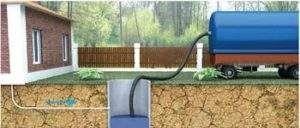 Cesspools primarily collect wastewater from a residential building. In this respect, they are similar to septic tanks. However, unlike septic tanks, cesspools are unable to filter the incoming liquid. The wastewater flows into the cesspool, where it is only partially broken down.
In this respect, septic tanks are significantly superior to cesspools, as this design allows for the separation of liquid into solid and light components, which are then purified in a separate container.
So how do you handle the waste that ends up in the cesspool? It's simple: the waste is pumped out as it fills, using a vacuum truck. In other words, cesspools are waterproof structures designed solely for collecting waste and wastewater.
Popular options for cesspools
There are two options: sealed (with a closed bottom) and non-sealed tank (open).
To build a sealed cesspool, you need pre-fabricated standard bottoms. While you can pour the foundation yourself, using pre-fabricated bottoms will significantly simplify the work and reduce construction time. The bottom dimensions correspond to the dimensions of the concrete rings. You'll also need metal mesh, crushed stone, and other reinforcement materials to complete the structure.
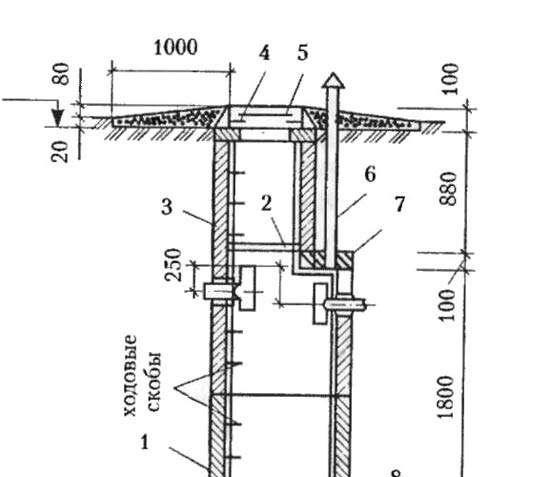
1 – concrete blank up to 1 meter wide; 2 – wooden floor; 3 – concrete blank up to 0.7 meters wide; 4 – upper opening; 5 – cover; 6 – ventilation pipe; 7 – partition; 8 – concrete bottom; 9 – leveling layer of cement-sand mortar.
The second type of cesspool differs significantly from similar non-sealed structures. Essentially, it is a cesspool made of concrete rings without a bottom. The base of this structure is covered with several layers of earth, which subsequently filter the incoming liquid.
First, river sand is laid. It allows wastewater to pass through easily and prevents stagnation, but sand has weak filtering properties. Then, small crushed stone is added, followed by a larger layer. On top, various debris, leftover construction materials, or any other coarse soil is placed.
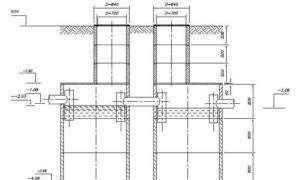
Multi-chamber designs are also becoming more common. Typically, they consist of two waterproof containers fastened together. This design helps ensure waste purification. Building a multi-chamber cesspool is significantly more expensive, but it can help save money on sewage disposal services.
The strengths and weaknesses of a cesspool made of concrete rings
The main advantage is its long service life. On average, it can function for about 50 years. To extend this lifespan, regular cleaning of the septic tank and repair of small cracks that could otherwise lead to structural failure are sufficient. Other advantages of a concrete tank are also worth noting:
- The walls of this cesspool are sealed, except where the rings meet. This ensures reliable protection from waste.
- The groundwater level does not affect the placement of concrete rings in the ground, which cannot be said about septic tanks made from tires or plastic tanks.
- This type of drain is easy to operate. Various homemade chemical and sanitary products are ideal for cleaning it. A wire brush can be used for mechanically removing sludge from the surface.
- Availability. Concrete rings are a material you won't have to search long and hard for at every building supply store in town. They're typically available at every one.
 The cesspool also has its disadvantages:
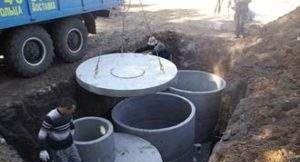
- Difficulties in installing concrete rings. To solve this problem, lifting equipment will be required. Typically, a single concrete ring with an internal diameter of up to 70 cm can weigh approximately 46 kg. Naturally, a person alone cannot lift such a weight.
- Soil movement has a detrimental effect on the integrity of reinforced concrete elements. Therefore, cesspools should not be located in areas with heaving soils containing high clay concentrations.
- Difficulties in determining the optimal depth for a cesspool. In most cases, a fairly deep excavation is required for the tank. This can lead to problems with future sewerage systems. For example, difficulty with vacuum cleaning, and the pit will quickly become filled with silt.
Design of the future building and calculation of the amount of materials
Below, we'll cover everything step-by-step and in detail, from choosing a location for the foundation pit to selecting the required number of concrete rings, and determining their optimal diameter based on your needs.
Watch the video
What other materials and tools will we need at different stages of building a cesspool ourselves?
Location of the excavation pit
If you want to install a high-quality cesspool made of concrete rings that will last for many years, you need to choose the right location.
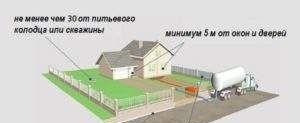
So, the distance between the pit and drinking water sources should be at least 20 meters. Between residential buildings and sewer lines, the distance should be 15 meters, and from non-residential buildings, the distance should be 10 meters. The optimal distance between the pit and the fence and road is at least 1-2 meters. To avoid problems with neighbors, you should keep a 4-meter distance from their property.
It's difficult to say exactly at what ground level a cesspool should be located. Building it at the lowest point increases the risk of waste leaking into groundwater. On the other hand, a high location for the tank complicates the construction of a reliable pipeline.
Calculating the volume of a container
This process requires precise determination of the tank's dimensions and volume, requiring several calculations. If a residential property has a bathroom and water-consuming appliances, then each resident will consume approximately 150-200 liters of wastewater per day.
So, if a family of three lives in a house, approximately 450-600 liters of wastewater will be collected per day, resulting in a total of 1.35-1.8 m³. This is the smallest possible volume.
When calculating the size and volume, do not include the dimensions of the manhole neck or the area of the well above the pipeline inlet. This means that only the dimensions of the lower portion of the tank are taken into account in the calculations.
You can also use the frequency of sewage collection truck visits as a guide. Let's take the same small family as an example. If sewage collection trucks come every week, the formula is: 150 liters (volume of wastewater) * 3 (number of people) * 7 (days) = 3.15 m³.
We invite you to take advantage of online calculator for calculating the volume of a wastewater tank.
How to choose the right concrete rings
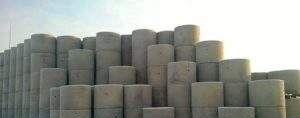
The size of the concrete rings significantly affects the capacity of the septic tank. Standard ring sizes are 0.89 meters high and 1 meter in diameter. This type is produced by almost all precast concrete factories. For a house with one to three residents, three concrete rings are sufficient, along with a neck and a base.
Many factories produce a complete kit of parts required for construction. This includes the lower section with a base, 1-5 standard-sized concrete rings, a narrowed neck, and a top plate with a hole for the lid. The lid itself is purchased separately.
If you are not satisfied with the standard sizes, you can purchase rings of a larger diameter.
Materials
Concrete rings aren't the only thing you'll need to build a cesspool. You'll also need to stock up on the following building materials:
- staples to fasten the elements;
- seam sealant;
- liquid bitumen or any other means that will ensure the well is sealed on both sides;
- cement to increase the strength of the backfill;
- backfill for leveling and cleaning layer.
To remove excess soil, you'll need buckets, shovels, and winches. It's also advisable to arrange in advance for a truck rental to deliver the concrete rings. You may also need specialized equipment with a crane if your property doesn't have a winch.
This type of work isn't meant for one person, so if possible, ask family or friends for help. As a last resort, you can hire a construction crew.
Construction of a sewerage system
Each construction stage requires a specific approach. The installation of each component is significantly influenced by the terrain and the location of the sewer line. Here are the instructions for constructing a cesspool.
Watch the video
[sociallocker]
We are making a pit
The first stage involves excavation work. This doesn't require a large number of people, so it's easy to handle on your own. It's a bit time-consuming, but cost-effective. If desired, you can hire a crew or a mini-excavator.
 When digging a pit, it's important to keep in mind that the shape and dimensions of the reservoir must match the configuration and dimensions of the tank. The resulting well will be circular, with a width approximately 0.3-0.5 meters wider than the concrete rings on all sides. This is important because this gap will later be backfilled to seal and insulate the cesspool from the outside.
It's also important to consider how deep the ground freezes. The piping and main part of the septic tank should be located slightly lower to avoid problems with the tank's operation during cold weather. Don't ignore this information, as otherwise, the waste will simply freeze in the winter.
The height of the outlet opening should be added to the working pit dimensions. The opening should be 15-20 cm above the ground.
Before construction begins, the foundation and walls must be smoothed and a pipeline excavated. To prevent frequent pipe clogs, it's important to maintain a slope of approximately 2 cm per meter toward the septic tank.
We arrange the bottom
If you've decided to install a regular waste collection pit in your yard, the pit must be watertight. It's best to build the base from a specially prepared material for the bottom of the well. To ensure secure installation, it's essential to construct a neat, solid bottom. To prevent the base from settling, pour a leveling layer of cement-sand mortar over it.
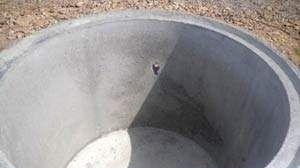 It's easy to prepare: use a 1:4 ratio of cement to sand. To ensure strength, it's recommended to add small crushed stone in a 1:6 ratio. All of this is dumped into a container and then spread over the entire well bottom and leveled. The concrete screed should be lightly moistened for about a week to prevent cracking.
Continue further installation of the bottom no earlier than 7 days laterIf you want to reduce the time it takes to build a cesspool, a prefabricated concrete slab is the way to go. It's placed on a flat, smooth bottom, and the first concrete ring is placed on top.
The backfill should be inoculated with colonies of specialized bacteria that break down and filter waste. The thickness of this bedding varies: for a shallow pit, 0.3 m is sufficient, while wells with 3-4 wheels require up to 0.6-0.7 m. As for the cleaning backfill located in the well shaft, its thickness should be greater than 1.0 m.
The layers are arranged in the following order:
- sand;
- small crushed stone;
- large fraction crushed stone.
Unlike the container itself, the pad and cleaning layer require regular replacement. When they become dirty and no longer allow liquid to pass through, they must be removed and replaced with a new layer.
Installation of concrete rings
Once the pit is properly prepared, the first concrete ring with a bottom is placed underneath. Place the piece carefully to prevent the structure from leaning to one side.
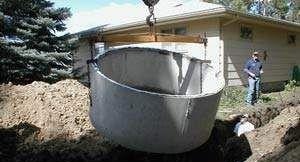 Then, the second layer is laid, and the seams are immediately sealed. Mortars, coatings, or roll materials are all suitable. A piece of roofing felt can be glued to the joints and cracks using liquid bitumen, but this is only suitable for the exterior. It's best to avoid cement mortar, as it's too weak for this type of work. If the soil shifts, the cement will crack and crumble.
At a hardware store, you'll find a wide variety of materials that will ensure the quality and reliability of your septic tank. Some are even suitable for treating damp joints and seams, even if they're already under water pressure. Others will reliably protect concrete rings from the harmful effects of chemicals, which are an integral part of any waste disposal process.
When installing concrete rings, it is recommended to give preference to the means indicated below:
- hydraulic seals – after hardening, they quickly expand, covering any cracks;
- solutions – applied to the entire surface of the well;
- deep joint sealants containing fibrous rubber;
- sealing rubber strips;
- liquid glass mixed with cement mortar;
- acrylic sealant.
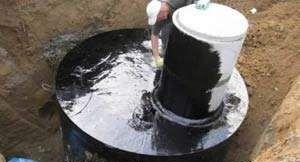 Due to high-quality protection from external factors, the pit will last for about 35 years.
Before installing the next element, ensure that no water can leak between the concrete pieces. An inlet for the pipeline should be made below the frost line. Install the pipe immediately and connect it to the tank. Ensure the connection is properly sealed.
In places where the pipe passes above the freezing level of the ground, it is necessary to additionally insulate it.
A manhole is installed on the surface of the outer ring, followed by the floor slab. It's important that it has a space for the hatch. A smaller hole will be needed for the ventilation pipe. The final step is backfilling. To increase the stability of the pit and minimize the risk of its collapse due to soil movement, it is recommended to add dry cement to the soil.
Providing a sealed lid for maintenance
The optimal option for covering a septic tank is a metal manhole cover with a sealed lid. If you're looking to save money and buy something less expensive, consider a wooden cover with hinges.
The hatch will be needed for servicing the cesspool - pumping out wastewater or renewing the treatment layer.
Watch the video
Recently, camouflaging a cesspool has become popular, especially if it's not visually appealing. Specialty stores offer a wide range of options for this type of camouflage, from greenery to large stones. Of course, you can also create your own decorative element from household items, such as adorning the structure with flowering plants.
Typical mistakes
Building a cesspool from concrete rings yourself isn't difficult. Positive results can only be achieved by following all the rules. However, sometimes people encounter mistakes that subsequently affect the cesspool's functionality:
- The pit is not sealed properly. Gaps may form between the concrete rings;
- incorrect determination of the cesspool volume;
- inaccessibility for access by sewage disposal vehicles;
- failure to comply with SanPiN standards.
Regarding the last two points, even if the cesspool is constructed properly, it will still have to be removed. Therefore, these points require special attention.
Watch the video
[sociallocker]
How much will construction and materials cost?
The cost of building a concrete cesspool is influenced by the amount of materials used.
- Excavation of a foundation pit and laying of 5 concrete rings – from 8,000 rubles.
- Construction of a reinforced concrete roof – from 1000 rubles.
- Installation of a polymer hatch – from 600 rubles.
- Construction of the cesspool bottom – from 1500 rubles.
- Excavation of a pipeline main and backfilling costs from 1,000 rubles per linear meter.
- Making holes for pipe entry – from 1000 rubles.
- Installation and fastening of PVC pipes – from 100 rubles per linear meter.
The price may also vary depending on whether additional work and materials are required, such as installing a filter bottom or masking the cesspool with decorative elements.
Watch the video