 In our country, preventing freezing of water supply and sewer pipes is more pressing than anywhere else. Climate conditions, where ground freezing depths reach two meters or more in most regions except the southern ones, urgently require protecting pipes from freezing with heating cables.
After all, in such a situation, it is not just a cessation of water supply or wastewater disposal, but also the need for large-scale repair work with the replacement of sections of the network.
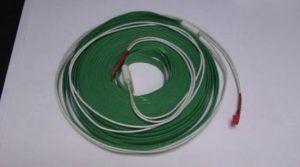
The solution to this problem is additional heating of the pipeline, for which a heating cable for plastic pipes is used.
The operating principle of cable heating
The use of plastic pipes is becoming increasingly popular, given that these products rarely fail when frozen due to the inherent flexibility of the material. However, heating cables for defrosting plastic pipes are increasingly being used, as they allow for the avoidance of extensive repairs and continued operation of the pipeline.
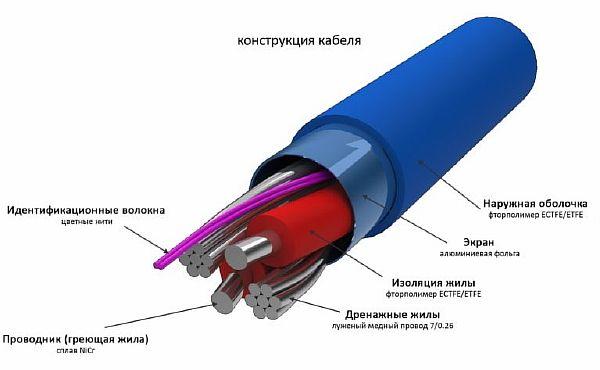
The heating element in such systems is a wire made of a nichrome-type alloy, coated with a heat-resistant sheath. Drainage wires are located directly in contact with the wires, ensuring uniform heat distribution across the cable cross-section, facilitated by the material's high thermal conductivity.
These elements are made of copper wires. Heat is transferred from the first two components to the high-conductivity aluminum alloy sheath and distributed evenly across the conductor's surface. Furthermore, the aluminum interlayer provides additional strength to the heating cable.
The final coating of the conductor is heat-resistant fluorinated plasticThis design of the cable route for heating plastic pipelines ensures its durability and functional qualities.
Video
In addition to the components listed above, the design of the product often includes a signal wire with a sensor that responds to a decrease in the temperature of the heating cable and sends a signal to turn on the relay of the heating control circuit.
This type of heating system for plastic pipes is suitable for use in country houses and country cottages where people are present periodically.
Types of heating cables
According to the operating principle, heating cables are produced in two modifications:
- resistive;
- self-regulating.
The first type operates continuously after being turned on, heating the water in the main line to a temperature of between 5 and 13 degrees Celsius, depending on the pipe cross-section and the heating cable's power. Resistive heating cables can be single-core or dual-core, with the only difference being the wiring diagram.
The operating principle of a self-regulating cable is based on the property of most conductors to change their resistance with changes in ambient temperature. As the conductor cools, its resistance increases, and therefore, its heating capacity increases.
The operating principle of a self-regulating conductor is much more complex, and the core material is quite expensive. As a result, the price of such a cable for heating plastic pipelines starts at 300 rubles per linear meter, and that's just the lower limit.
However, its use guarantees a virtually constant temperature in water supply or sewerage systems, and the plastic pipe will not be subject to deformation or destruction.
When installing heating cables, thermostats are often used to turn the heating system on and off when the water temperature in the heating system changes. Such devices are expensive, but they are essential for residential buildings with periodic use. Besides maintaining system integrity, these devices also provide significant energy savings.
Installation of heated pipelines
The main requirement for such connections to the source is that the branch pipe must be located below the frost line. This factor depends on the local climate.
Video
For the Moscow region, it's around 1.8 meters, and in the Chelyabinsk region, 1.9. Let's imagine a situation where the access section needs to be 10-15 meters long with a trench depth of over 2 meters (up to 30 cm will be required for the drainage layer). Its width should also ensure convenient excavation. In this case, it's time to order an excavator!
When using heating cable routes, it is sufficient to dig a trench with a depth up to 50 cm and a width of the order of 30Drainage is also essential. The plastic pipe and heating cable must be laid loosely, not stretched.
With this type of pipe placement, deformations due to soil movements are inevitable, but when using plastic products, this is not dangerous due to the plasticity of the material.
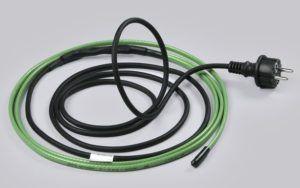
The heating cable for plastic pipes can be placed on it in various ways:
- winding on a pipe
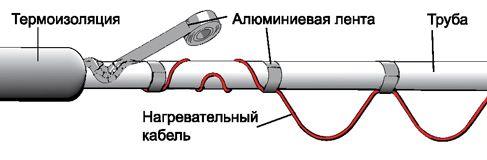
This type of fastening ensures the greatest The contact surface of the object and the heating element. Fastening is done with metallized tape in the transverse and longitudinal directions;
- laying the heater along the wall of the pipeline parallel to its axis
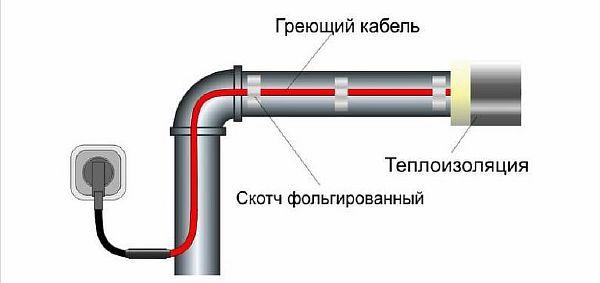
With this heat sink arrangement, one or two threads are laid on opposite sides of the pipe. Fastening is performed in the same manner;
- Installing the heater inside the pipeline. This operation is best left to experienced professionals, as it can damage the wire, leading to its rapid failure.
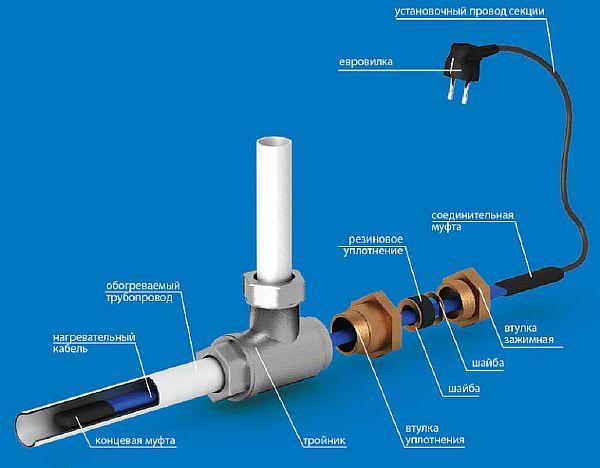
Cable installation in plastic pipes is performed using a specially designed tee with a crimping element to seal the conductor outlet. Depending on the cable cross-section, which occupies a portion of the water pipe cross-section, the supply pipe is selected to be larger.
To prevent heat loss into the environment, heated pipes are in all cases equipped with an additional heat-insulating layer of detachable insulators, winding porous sheet insulators or conventional roll insulationVarious materials, from roofing felt to metal foil, are used to protect it.
Installation of cable in plastic pipes with internal placement is not applicable. for heating drainage systemsSuch wastewater often contains chemically active substances that can cause significant damage to the pipeline in a short period of time.
A key feature of drainage systems is the need for them to have a slope of at least 5 degrees toward the sewer main. If the site has its own water treatment system or water collection tank, they must be insulated and heated with separate devices.
Heating cables are often used to thaw drainpipes to prevent them from collapsing. More powerful heat emitters, rated at 30–50 watts per meter, are used for this purpose.
The cable for defrosting plastic pipes of drainage systems must have the same power.
Errors when installing heating cables
Let's look at typical mistakes when installing heating systems:
- Installing heaters at a depth below the frost line can be considered a waste of money. In this case, it's sufficient to install local heating in high-risk areas where the system's depth is insufficient. This location is typically the entry point into the house.
- Some consumers believe that a heating system can replace pipeline insulation, but this is not true. Without external insulation, they end up with an ineffective heating system that does not protect against freezing;
- It's a misconception that a heating system must operate continuously. This is often unnecessary, and energy consumption, at a standard consumption of 18 watts per meter, can be significant. The additional cost of an automatic heating on/off system using temperature sensors will pay for itself in a very short time.
Video
Installing cables on plastic pipes is so simple that it can be done by yourself using only the instructions for performing these works and does not require any additional skills.
A cable for defrosting plastic products is usually installed as a preventative measure to avoid the formation of ice plugs in high-risk areas, in particular at the outlet of the drainage system from the house.
It's not guaranteed to be used constantly, but extreme operating conditions can arise in any climate. In this case, an additional heating/defrosting option for the pipes would be a welcome addition.
Conclusion
The investment in heating cable for plastic pipelines and its installation will significantly reduce construction costs and reliably protect consumers from climate change.