The Mayevsky valve for cast iron radiators is a mechanical air vent with manual or automatic adjustment. It is used to relieve excess pressure in a central heating system.
With its help you can quickly remove the airlock, preventing hot water from flowing through the radiator sections. By turning the screw or handle on the end of the device, air is released from the cast-iron radiator.
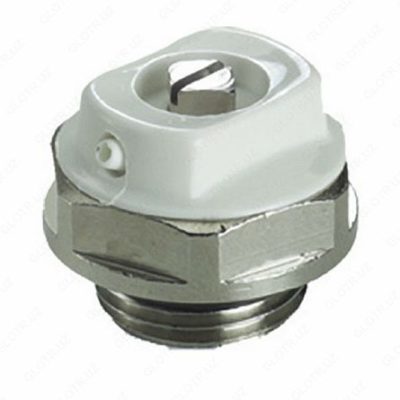
Initially, the device was a primitive design proposed by Minsk plumber Roev in 1931. Two years later, it was modernized by engineer Mayevsky and acquired its modern form. The device for bleeding air from a heating system, registered as a shut-off valve STD 7073V, became popularly known as the Mayevsky valve.
After reading this article, you'll learn how the device is designed and how it works. Instructions on how to install a Mayevsky valve on old cast iron radiators will help you install it correctly. The process of bleeding the radiator will be presented as a step-by-step guide with photos and videos. You'll also learn about the differences between automatic and manual adjustments of the Mayevsky valve.
Design and operating principle
It should be noted that Mayevsky cranes come in two types: manual and automatic valves.
To understand the features of the devices and their operating principles, we need to examine them in more detail.
Mayevsky's manual crane
This is a relatively simple device, yet it is manufactured using high-tech equipment and the latest materials. The metal-plastic device is a wide cylinder with an outer plastic shell (cage), inside which is a metal sleeve with internal and external threads.
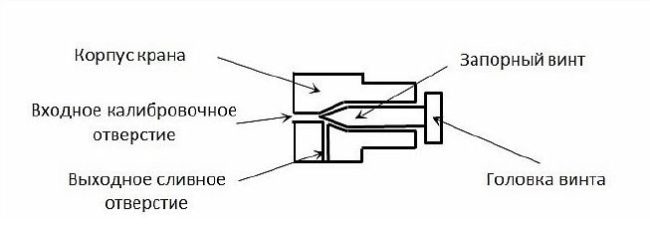
A needle-type locking screw with a hexagonal head protruding from the outside and slotted for a screwdriver is installed inside the sleeve. A drain outlet is located on the side of the housing. The plastic rim can be rotated around its axis, adjusting the outlet to a convenient position for draining water.
The operating principle is to release the airlock by inserting a screwdriver into the screw. When the shut-off needle is turned counterclockwise by half a turn or one turn, the inlet calibration hole gradually opens. Air accumulated in the upper part of the cast-iron radiator begins to escape through it.
Mayevsky automatic crane
Installing an automatic Mayevsky valve on old cast-iron radiators is necessary in hard-to-reach areas of the heating system or in areas where people are not constantly present. These areas may include walkways, utility rooms, etc.
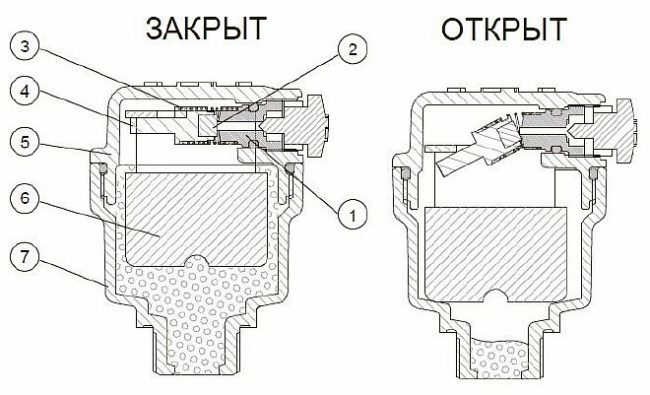
The device structure: 1. Nipple. 2. Spool. 3. Spring. 4. Spool cage. 5. Cover. 6. Float. 7. Body.
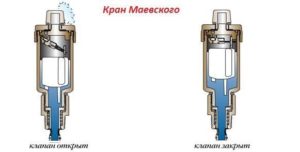
The automatic device is a hollow metal cylinder. A float is attached to a movable lever at the top of the cylinder, which is in turn connected to a valve. The device operates by allowing air to accumulate, causing the float to drop downward under its own weight, thereby opening the valve.
When all the air has escaped, the restored volume of coolant will return the float to its original position, which will close the outlet again.
Features of operation
Residents of older buildings with cast-iron radiators on the upper floors are forced to bleed the air themselves at the start of the heating season. Using screwdrivers, apartment owners strip the screws on the Mayevsky manual faucets, making them difficult to operate.
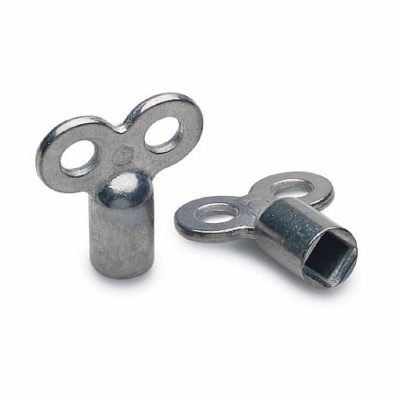
In this case, it's best to purchase a special wrench that completely grips the screw head without damaging it. You can also choose valves with rotating plastic handles when purchasing.
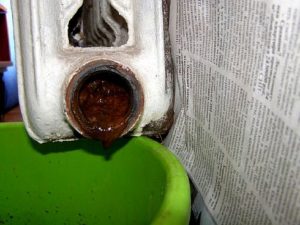
Sometimes, a rusty deposit appears around the rim of the manual or automatic valve at the radiator inlet. This indicates that the rubber seal is damaged and needs to be replaced. This is difficult to do during the heating season if the cast iron radiator doesn't have its own shutoff valve.
If there is no coolant flow, then You can wait until spring to replace the gasketIf the radiator cap threads are poor, instead of installing a rubber gasket, use a winding of flax tow.
In old cast-iron radiators, where the plugs haven't been removed for years, or even decades, you might find rusty threaded inlet holes after unscrewing them. Clean them and lubricate them with mineral oil or another lubricant. The mounting sleeve is screwed in with flax tow wrapped around it.
The old radiator must be cleaned of rust buildup. In the spring and summer, before installing a Mayevsky tap on the cast-iron radiator, the radiator is removed and placed outside. All openings should be plugged, except one.
Place the radiator on its edge with the open end facing up. Add a solution of 200 grams of caustic soda to 10 liters of water. Let it sit for 24 hours. Drain the solution. Rinse the radiator with hot water, preferably under pressure. Return the cleaned radiator to its original position.
Over time, the outlet hole in the Mayevsky faucet can become clogged with suspended solids in the hot water. You can clear the hole with a pin or sewing needle. Be careful not to damage the orifice's calibration. Cleaning should be done with the valve open.
How to choose
Mayevsky valves are available with two thread sizes: ½ and ¾ inches. To install the valve into the cast iron radiator cap, you need to drill a threaded hole in it that matches the thread of the air vent. This can be done in a workshop or by hand with the appropriate tools.
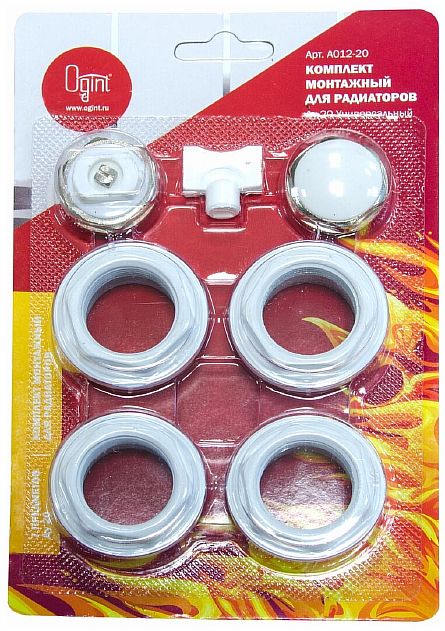
You can purchase a repair kit with plugs (sleeves) ready for installation on Mayevsky valves at the heating appliance market. All you need to do is select the appropriate thread diameter.
There are air vents with an adjustment screw that requires a screwdriver and wrench. A valve with a rotating plastic handle is more convenient to use. Automatic air vents are purchased by housing offices and other utility companies for installation in public spaces, buildings, and structures. They are rarely installed in cast-iron radiators.
Installing "Maevsky" on a cast iron radiator
A Mayevsky tap is installed on the cast iron radiator at its top, cutting into the plug on one side of the radiator. Proceed as follows.
- Shut off the shut-off valves (taps) on the coolant supply and return pipes.
- If there are no taps on the pipes, you will have to wait until the end of the heating season.
- After placing a bowl or suitable container to collect the water, proceed to remove the plug.
- At the top of the battery, on the opposite side of the pipe inlet, use an adjustable wrench to unscrew the cover.
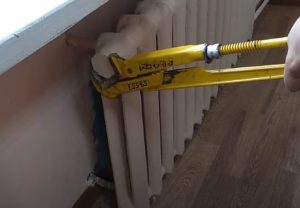
- If the lid does not give in, then tap it on all sides with a hammer.
- The old paint is burned off with a blowtorch.
- You can move the plug along the thread by hitting the end of the cap with a hammer and a chisel.
- A universal spray WD-40 is introduced into the gap around the plug, which is capable of disconnecting rusty threaded connections.
- By rocking the cover left and right with an adjustable wrench, it is gradually unscrewed from the battery socket.
- The exposed seat and internal threads are cleaned of dirt and rust with a wire brush. Sometimes this is done with a round brush inserted into a drill.
- A union nut and a Mayevsky tap are taken from the set.
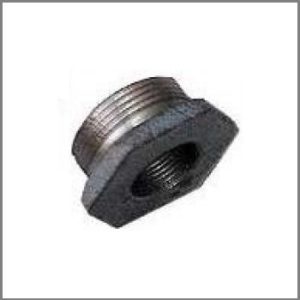
- The thread of the coupling is sealed with FUM tape or flax tow.
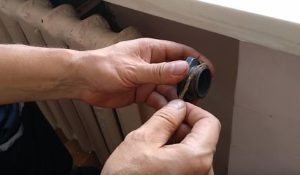
- The plug is screwed into the mounting hole in the battery.
- The threads on the tap are wrapped with FUM tape or linen tow.
- The tow winding is moistened with water or impregnated with a sealant - Unipak paste.
- The Mayevsky tap is screwed into the fitting with a wrench.
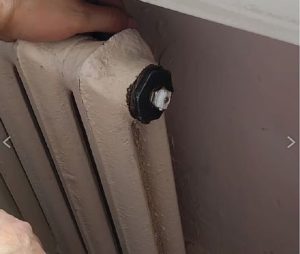
This completes the installation of the Mayevsky crane on the cast iron radiator.
How to bleed air
Bleed the air manually through the Mayevsky valve. This should be done when the radiator feels cold to the touch at the top. Proceed as follows.
- The tap head is turned so that the hole faces downwards, otherwise the stream of water will flood everything around.
- A bucket or some other container is placed under the valve.
- Use the handle to turn the needle valve until air hisses.
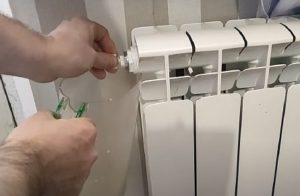
- Water will appear, which, together with air, will form an interrupting stream.
- Keep the valve open until a continuous stream of water appears without a hissing sound.
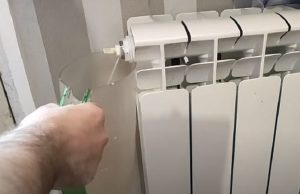
- The tap is closed and its dryness is checked tactilely.
- After some time, the operation is repeated.
- If a continuous stream of water immediately starts to flow, then the air release is considered complete.
Causes of air lock in the heating system
Airlocks in cast iron radiators can occur for a variety of reasons. Here are the most common:
- with the onset of the heating season, when hot water is supplied, air locks may form in the upper parts of the radiators;
- after repair and installation work, air remains in the heating devices;
- in multi-story buildings, air in heating systems rises and accumulates in radiators on the top floors;
- Air begins to accumulate not only at the top, but also at the bottom and in other parts of the battery due to contamination of the radiator sections.
The difference between automatic and manual valve adjustment
The Mayevsky automatic tap is a self-regulating, non-separable type device.
If the device becomes clogged or breaks, it is replaced with a new one. For this reason, automatic machines are unpopular. They are installed only when absolutely necessary.
If the Mayevsky manual valve fails, adjust it with the cast-iron radiator completely disconnected from the heat supply. Unscrew the valve, and clean the inlet from the back with a regular sewing needle.
If possible, blow out the valve while it's open using an air compressor. Afterward, return the valve to its original position and reconnect the battery.
Conclusion
The advent of the Mayevsky tap literally saved the old cast-iron radiators from wholesale dismantling. After capitalism took hold in the country's economy, the period of wasteful water consumption ended.
Bleeding air from cast-iron radiators required draining a large amount of coolant. Using a universal air vent allowed for the removal of air pockets with minimal water consumption.