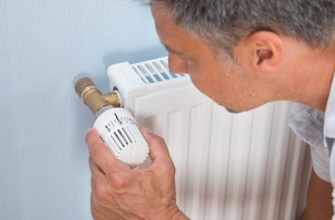
A thermostatic radiator valve provides significant savings on heating costs during the heating season.
Automatic valves for regulating the heating degree of batteries are successfully used, both in autonomous systems of private houses, as well as in apartments with centralized heating.
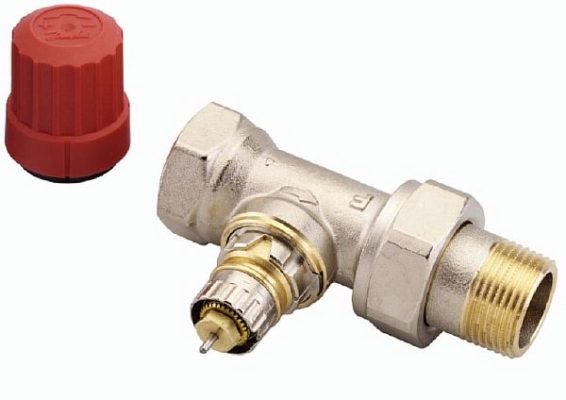
The valve's design, operating principle, and device variations, as well as the intricacies of thermostat installation and adjustment—the reader will learn all about this in this article.
- Purpose and scope of application
- Benefits of using
- Operating principle
- Thermostatic valve device
- Types
- Purpose
- Type of execution
- Heating system
- Type of substance in the bellows
- Control
- Mechanical
- Automatic
- Electronic
- With a remote temperature sensor
- Material of manufacture
- Installation of a thermostatic valve for a one-pipe system
- Installation of a thermal valve in a one-pipe system
- Installing a thermostatic valve in a two-pipe system
- Adjustment
- Operating recommendations
- Common mistakes
- Features of selection
- Material
- Method of execution
- Sensor type
- Conclusion
Purpose and scope of application
A thermostatic radiator valve is designed to regulate the heating of a heating radiator. The shut-off device automatically controls the clearance in the pipe through which the coolant flows into the radiator. This device is also known as a thermostatic valve head.
The valve, as mentioned above, is designed to regulate the room temperature. It provides significant benefits in both autonomous and central heating systems. It is installed not only in front of radiators but also in areas where plastic pipes cannot withstand high-temperature hot water.
A thermostat is also necessary when residents leave their apartment or house for an extended period. During this period, it's sufficient to maintain the temperature in the house or apartment at 15-16 degrees Celsius. This measure helps save on heating costs.
However, it should be remembered that the thermostat is capable of reducing the heating level of the battery, but it cannot exceed the initial temperature of the coolant.
Benefits of using
The economic benefits of using thermostatic heads can only be realized when heating costs are measured on a per-apartment basis. That is, one meter records the heat consumption of one apartment.
When installing a meter for the entire building or entrance, the costs are divided among all apartments based on the size of their living space. Equipping radiators with thermostats in individual apartments makes no sense.
In private homes, an automatic shut-off valve, synchronized with the boiler, constantly maintains the radiator's preset temperature. This eliminates excess heat consumption. The boiler equipment consistently consumes fuel at the optimal level.
The benefits of using a thermostatic valve become apparent in your electricity or gas bills. When using liquid or solid fuel, savings are reflected in reduced fuel consumption.
Operating principle
The operating principle of a thermostatic control valve is based on the phenomenon of thermal expansion of bodies when heated. The thermostat head contains a thermally expanding liquid.
Any fluctuation in ambient temperature in the room causes a change in the volume of liquid, which in turn acts on the stem as a float.
As the hot water temperature increases, the piston rod moves downward, narrowing the clearance in the thermostatic head, thereby reducing the flow of coolant into the radiator per unit of time. The heating of the heating element decreases.
If the battery cools down excessively, the thermostat's operation is reversed. The optimal heating temperature of the battery is marked on the scale with a notch on the thermostat's rotating cap.
For example, the head is set to a temperature of 22 degrees Celsius. If the air temperature rises to 23 degrees Celsius, the thermostat will shut off the coolant from entering the radiator. The radiator will cool to a temperature at which point the radiator valve will open the orifice, and hot water will resume circulating through the unit.
Thermostatic valve device
The hydraulic device consists of two main components: a valve and a thermostatic head. The valve is a metal rod (stem) with a conical shut-off cup at the lower end.
The upper part of the spring-loaded rod fits into the bellows (a corrugated capsule containing a liquid or gaseous substance) of the thermostatic head. The thermostat cover is screwed on top and also serves as the temperature adjustment knob.
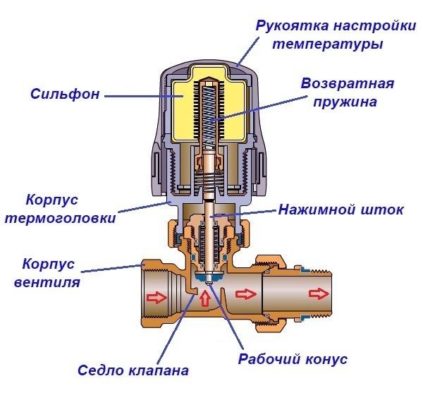
Turning the handle creates a certain force in the return spring. The stem's locking cup hangs at a certain distance from the valve seat (the valve's orifice). The expander in the bellows changes its volume depending on changes in the room temperature, exerting pressure on the stem in one direction or another.
In this way, the valve's adjustment mechanism operates, and the radiator heating temperature remains stable at a given level.
Types
Thermostatic radiator valves of various designs are available on the plumbing market. Thermostats can be categorized by purpose, design, heating system, type of material in the bellows, control type, and material.
Purpose
The devices are:
- Mixing – mix two streams of coolant of different temperatures;
- Separating – direct the coolant along different flows;
- Switching – changes the direction of flows.
Type of execution
The design of the thermal head corresponds to each type of installation. Devices are classified according to this feature as:
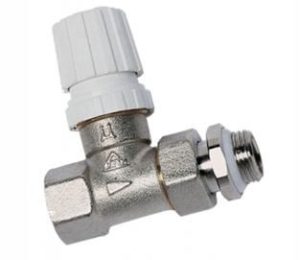
- straight valves for installation on pipes parallel to the floor;
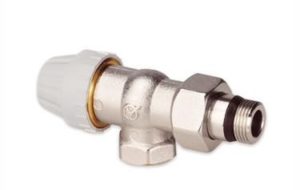
- Axial thermostats are installed on pipes coming out of the wall;
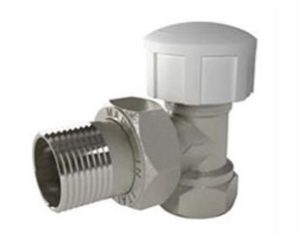
- corner devices are mounted on pipes perpendicular to the floor;
- Three-way thermostatic heads are used to mix hot water with the main flow of the coolant;
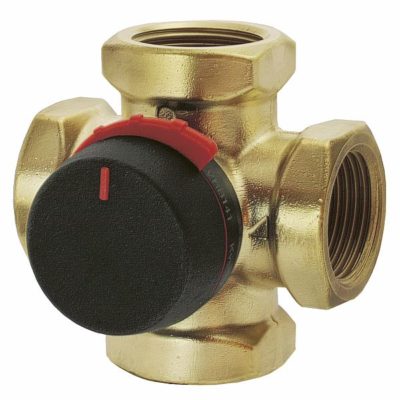
Heating system
Thermostats are available in models for two types of radiator connection systems: single-pipe and two-pipe systems. A single-pipe system is a series connection of heating devices.
With a two-pipe system, each radiator is independent, with its own coolant supply and return. How to install thermostats on both systems will be discussed below.
Type of substance in the bellows
Thermostats are manufactured with three types of expansion valves. Based on this feature, the devices are classified as:
- Gas;
- Liquid;
- Paraffin.
The most reliable and durable are valves with gas bellows. At the bottom of the quality ladder are devices with paraffin heating elements. Liquid valves occupy a middle position in this ranking.
Control
According to the control method, thermal heads are divided into devices:
- mechanical;
- automatic;
- electronic;
- with a remote temperature sensor.
Mechanical
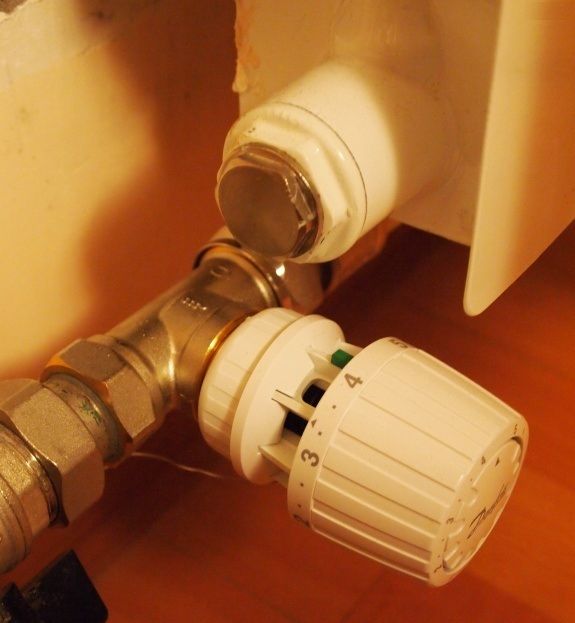
This type of device can be called a thermostat, albeit a stretch. The operating principle of a manual thermostat is similar to that of a regular faucet. The head, rotating along the valve threads, moves the stem up or down.
This allows the flow rate of coolant entering the radiator to be manually adjusted. Unlike a valve, a thermostatic valve head smoothly adjusts the valve opening, allowing for exceptionally precise adjustments.
Automatic
This is the most common and popular type of thermal valve head; its operating principle and design are described above. Temperature control is achieved by changing the volume of the bellows, synchronized with the movement of the stem.
Below are the characteristics of automatic thermal heads with bellows filled with gas, liquid and paraffin.
Electronic
Due to the specific design, electronic thermostatic heads are significantly larger than their counterparts. The electronic device is powered by two batteries.
A microprocessor controls the valve stem's movement, sending commands to a micromotor. A liquid crystal display (LCD) is built into the thermostatic head housing, displaying a wealth of additional information.
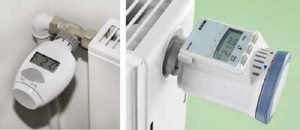
The head also functions as a programmer. Using the software, you can set the temperature settings of heating devices by hour, time of day, day of the week, and month.
For example, when a home is unoccupied during the day, it's economical to lower the indoor temperature, as well as at night. The same applies when residents are away on vacation for several days.
With a remote temperature sensor
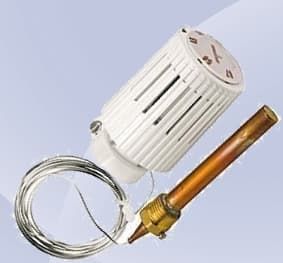
A thermostatic valve with a remote temperature sensor is useful when you need to record the air temperature in a specific area of a room, for example, for specific beds in a greenhouse or a drying room in a workshop. The sensor itself is a capsule filled with a high-expansion liquid.
The sensor is connected to a thermal head via a capillary tube. When heated, the fluid in the tube presses on the valve stem, cutting off the coolant flow to the radiator. When cooled, the fluid is drawn off, and the stem rises.
Material of manufacture
Radiator control valves are made from corrosion-resistant metals. Thermostats are made from stainless steel, bronze, and brass with a galvanized chrome and nickel coating.
Stainless steel valves are the most expensive items. Brass and bronze valves are the most common on the market.
Installation of a thermostatic valve for a one-pipe system
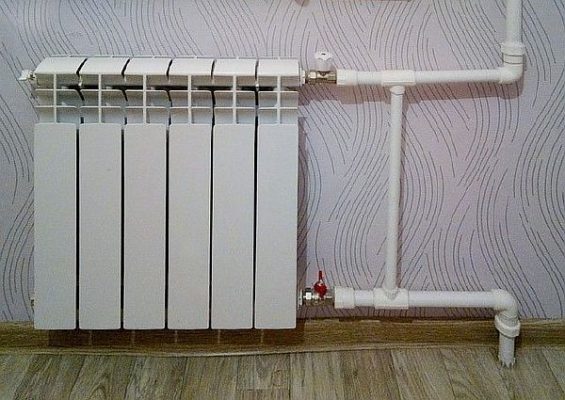
A single-pipe heating system can be thought of as a string of objects strung together. The coolant flows from one radiator to another through a single pipe. Hot water enters the radiator through the top opening and exits through the bottom outlet.
It can be assumed that the heating temperature of the last heating appliance will be much lower than that of the first radiator in the heating chain. To avoid significant heat loss at each subsequent heating appliance, the supply pipe and return pipe before the radiator are connected with a jumper, which acts as a bypass.
When the thermal valve completely blocks the flow of coolant, hot water begins to circulate through the jumper without losing thermal energy.
Installation of a thermal valve in a one-pipe system
This happens as follows:
- Water is drained from the system.
- The upper supply pipe is cut with an oxyacetylene torch or an angle grinder to the size of the built-in thermostatic unit.
- A thread is cut on the remaining pipe from the radiator and the thermostat is screwed on, using fum tape or flax fibers as a sealant.
- On the other side, an “American” (a fitting with a coupling and a union nut) is screwed onto the cut thread, sealing the connections with a winding of flax.
- The union nut is screwed onto the outlet of the thermostatic valve.
- If there is no jumper, it is cut between the pipes with an oxyacetylene torch, using a small diameter pipe section for this purpose.
- Open the tap on the riser and check the tightness of the radiator unit connections.
Installing a thermostatic valve in a two-pipe system
In two-pipe systems, each radiator is independently connected to the riser. The heating appliances are connected to the supply and return pipes.
Thermostatic valves are installed in the same way as in single-pipe heating systems, with the only difference being the absence of jumpers. Installing a bypass is pointless and impossible.
Adjustment
There's a fairly simple way to adjust and set a thermostatic radiator valve using a room thermometer. Before adjusting the device, you need to know exactly what a comfortable room temperature should be. Let's say it's 22 degrees. Follow these steps:
- with the valve open, record the readings on the room thermometer;
- The thermostat is closed completely and the temperature on the thermometer is expected to reach 22 degrees;
- the cap-handle is removed from the valve and put back on so that the mark corresponds to the fully open position of the thermostat;
- By gradually opening the passage hole in the valve, the coolant is let into the radiator, and the thermostat housing becomes warm.
This completes the thermostat setup.
Operating recommendations
Experts advise:
- the direction of water movement must match the arrow on the device body;
- If leaks appear in the connections, the radiator unit is disassembled and reassembled with a new seal;
- after a certain period of time, check the correctness of the thermostatic valve settings;
- you need to ensure that the thermostat head is not obscured by furniture;
- the thermostat should not be exposed to direct sunlight;
- when ventilating the room, the valve is closed;
- Before the heating season, thermostats must be in the open position to prevent the stem cup from sticking to the valve seat;
- The thermal head must be kept clean and dry.
Common mistakes
The thermostatic head must be in free contact with the room air and respond accurately to changes in temperature. The following mistakes are often made when installing a thermostat.
- The control valve head is installed vertically. This will cause the sensitive bellows to be blown by heated air from the supply pipe, which will not correspond to the actual temperature throughout the room.
- The device is mounted on the opposite side of the flow. An arrow on the body of each thermostat indicates the direction of coolant flow.
- Do not obstruct the thermostatic valve with furniture or other objects. The device must have free access to air.
- The device must not be installed so that it is under a wide window sill or in any niche.
Errors in the installation of the thermostatic valve result in the device being exposed to increased ambient temperature in the room. This leads to incorrect operation of the temperature sensor, which in turn creates discomfort in the room.
Features of selection
When selecting a thermostatic valve model for a heating radiator, the following characteristics are taken into account.
Material
Thermostats with stainless steel housings are considered the best devices. However, they are also the most expensive.
When choosing cheaper products made of brass and bronze with galvanization, you should choose from reputable manufacturers.
Method of execution
Depending on how the radiator is connected, a straight-through, axial, or angled device is selected. This was discussed in detail above. For complex connection assemblies, 3-way valves are used.
When purchasing a device, you need to make sure that the thermal valve is designed for connection to a one- or two-pipe heating system.
Sensor type
Gas sensors are the most popular, followed by liquid-based devices.
The list concludes with paraffin temperature sensors.
Conclusion
Installing thermostatic valves will undoubtedly result in significant energy savings on heating your home. In addition to reducing your expenses, your home will always remain comfortable.
The larger the area of the house or apartment, the more profitable it is to use thermostatic equipment for heating radiators.