How to heat a house during the cold season is a question every homeowner faces. Many opt for hydronic underfloor heating. But for effective operation, a hot water source—a boiler for underfloor heating—is required, and it must be efficient.
Today we'll look at the different types of boilers and discuss which are suitable for underfloor heating systems. You'll learn how to calculate boiler capacity and install one yourself.
- Types of boilers for underfloor heating
- Gas
- Solid fuel
- Electric
- Diesel
- Choosing a boiler
- How to calculate power
- Wiring diagram for connecting a water-heated floor to a boiler
- Three-way valve diagram
- Scheme with mixing unit
- Circuit diagram with electronic thermostat
- Direct connection diagram
- Connecting underfloor heating to a heating boiler
Types of boilers for underfloor heating
There's a wide range of boiler equipment on the market. Boilers vary by the type of fuel they run on—gas, diesel, electric, and solid fuel. They're made from a variety of materials, including cast iron and steel.
They also differ in the installation method:
- Floor-standing units can have a power output of up to 120 kW. They require additional space for installation, so they are placed in a separate room.
- Wall-mounted units have a capacity of up to 35 kW, are easier to install, and are less expensive. They already have a built-in pump that provides liquid circulationTo start the unit, you need to connect it to the heating pipeline.
In addition, heating boilers have a different number of circuits and can be: single-circuit and double-circuit.
Single-circuit — are designed solely to heat the coolant for home heating. To expand their range of application, additional components (boiler, heat exchanger, etc.) are required.
Double-circuit — multi-tasking units that simultaneously heat water for both the heating system and domestic hot water. The latter function is performed by a built-in storage boiler and a flow-through heat exchanger.
Gas
Gas boilers have bodies made of cast iron or steel. Cast iron boilers weigh twice as much as steel boilers of the same power rating. They are bulky and expensive. Steel boilers are lightweight and compact, and are easy to repair.
Modern floor-standing gas units operate on natural gas and liquefied petroleum gas. However, wall-mounted mini-models are more convenient to install; they don't take up space, and their power (7-30 kW) is sufficient to heat a small private home.
Standard gas boilers can only operate at full efficiency when the water is heated to its maximum temperature—70–90 degrees—which is unacceptable for underfloor heating.
Operating gas equipment at low temperatures can lead to condensation, which can impact its service life. These boilers can be converted to underfloor heating with some modifications.
The most suitable gas boilers are condensing boilers designed for underfloor heating. They have an additional feed from the condensate generated. Even when operating at low temperatures, their efficiency is close to 100%.
Gas units come in single- and dual-circuit designs. Underfloor heating is connected to a dual-circuit boiler via a hydraulic manifold.
Solid fuel
Solid fuel boilers operate similarly to wood or coal stoves. However, the boiler burns wood in the absence of air, producing wood gas that heats the coolant. These generators are problematic when connected to underfloor heating systems; they require constant attention and maintenance.
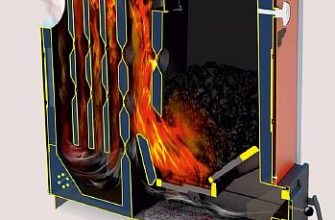
The exception is pellet boilers with automatic controls, as they have a long burn period. However, they also require more attention than gas or electric units.
To maintain the coolant temperature at the required level, the automation must periodically shut down the furnace, which leads to a loss of boiler efficiency. Installing a buffer tank will help prevent this.
Then, the unit will be able to fully utilize its potential, transferring heated water to the buffer tank, and the floor will draw it from there in the required volume. This will lead to savings, as the pause between fuel feeds to the furnace will be longer.
Electric
Electric boilers are the most efficient water heaters for underfloor heating systems. They come in a variety of heating elements, ionic elements, and induction heaters. They convert electrical energy into heat. They are fully automated, easy to install and adjust, and can be configured remotely. These units maintain the water temperature at a preset level without losing efficiency.
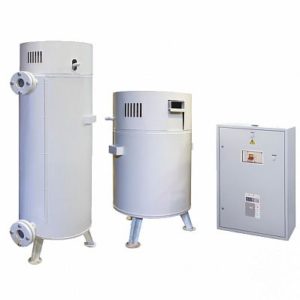
Wall-mounted heating elements are commonly used due to their simple design and easy installation. They are equipped with an expansion tank and pump.
If the area of the room is not large, then the TP circuits can be connected directly to the heat generator.
When installing a warm water floor from a heating boiler in a large private house, installation will be required mixing and distribution unit.
The disadvantages include the high cost of energy. To reduce the cost of heating, it is recommended to use a system with an external water storage tank and a dual-tariff energy meter.
Diesel
Diesel boilers, fueled by diesel fuel, operate on a similar principle to gas boilers. Their combustion process is fully automated. They offer high performance with low fuel consumption, are easy to install, and are convenient to maintain. They are also environmentally friendly and cost-effective.
The downside of such models — the smell of diesel fuel, so they are installed in a separate room (boiler room). In addition, a fuel tank and a pump for supplying it are required.
Choosing a boiler
There are no water heaters specifically designed for underfloor heating. Some manufacturers produce units with a "warm floor" function, but this only limits the water heating level. Furthermore, it's important to consider the type of coolant approved for a given model. Some units cannot be used with antifreeze, as indicated in the instructions.
In principle, any model of water heater can be used with heated floors; the main thing is to properly install and connect the system.
What are the features of choosing a water heater, and what should you pay attention to?
- Is it compatible with underfloor heating? Is it capable of maintaining the required coolant temperature? Otherwise, additional equipment will need to be selected.
- How efficiently it will work in the system affects the consumption of resources (fuel).
- Is it easy to maintain and operate? How long does it take to set it to the desired heating level?
- Are there any difficulties with installation? Will you be able to install it yourself?
In addition, heat generators must be selected depending on the area and operating conditions, with attention paid to:
- Power rating is determined based on the size of the room being heated and its insulation level. The documents specify the area the appliance is designed to cover, assuming adequate insulation. If you don't know your home's heat loss, then the power must be taken with a 25% reserve. Excessive exceeding the required performance can lead to overheating and equipment failure.
- Power control—gas boilers often have this feature. Regulation can be done manually or automatically. Automatic models are more economical; you only need to set a few parameters, and then the automation maintains the temperature at the set level and shuts off the heating.
- Energy dependence - the use of an electric pump to force the liquid to move increases the boiler's performance, but makes it less autonomous and dependent on energy resources.
- Heating type: If the equipment is needed not only for space heating but also for hot water supply, a double-circuit instantaneous boiler is required. If you need to heat a large volume of water, a storage model is better.
Each person determines the cost of a heater for themselves, based on their cheapest energy source. For some, this is gas, for others, wood. If the home has a multi-tariff meter, electricity will be more cost-effective.
An electric boiler is the most suitable for hydronic floors, as it can maintain a set temperature with low power consumption. 1 kW of electricity is converted into 1 kW of heat. If the heating area is small, it can be connected directly.
To connect a cottage of impressive area, a mixing unit will be requiredWhen installing gas equipment, a distribution unit is essential, as direct connection is not recommended. Feeding underfloor heating from a solid fuel boiler increases costs due to the purchase of additional components.
In addition, installation of gas or solid fuel boilers requires the arrangement of a boiler room.
How to calculate power
The right boiler for underfloor heating needs to be economical, so we choose based on its performance. To select the right model, we need to calculate its power.
The average unit output for a country house is 1 kW per 10 m², meaning a specific output of 100 W per m². However, this is a fairly rough estimate, suitable for a brick building with minimal heat loss.
When installing gas equipment, it's necessary to prepare and coordinate the project with government agencies and obtain permission from the gas inspectorate. The project includes a section that specifies the calculation of the appliance's capacity.
If you plan to install an electric or pyrolysis boiler, use the calculation form for the house load. This formula is suitable for temperate regions; if the apartment is located in northern regions, a correction factor of 1.2 or 1.3 is used. If the insulation or hot water supply is poor, a factor of 1.2 is also used.
Мк = 0.1*По*к1*к2*к3, where:
Let's calculate the generator's output for a 250 m2 house in the northern region, with poor insulation and hot water supply, using the example below:
Мк = 0.1*250*1.2*1.2*1.3= 46.8 kW
If the premises are located in the central area, then the calculation of the indicator looks like this:
Мк = 0.1*250*1.2*1.2= 36.8 kW
If the room is well insulated and hot water supply is not required, then:
Мк = 0.1*250 = 25 kW
It is not recommended to create a large power reserve, as this will not only increase the cost of thermal energy, but will also lead to overheating of the transformer substation and its failure.
Wiring diagram for connecting a water-heated floor to a boiler
There are different ways to connect a boiler to underfloor heating. Each has its advantages and disadvantages and is designed for specific conditions. Let's look at popular methods for connecting hydronic underfloor heating to a boiler.
Three-way valve diagram
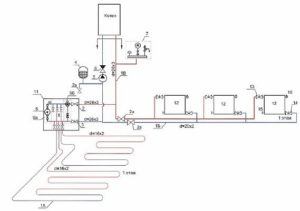
A common design for a multi-circuit system with different heating devices is a three-way valve. It's suitable for combined heating systems—radiators with a water temperature of 80 degrees Celsius and underfloor heating with a temperature of 45 degrees Celsius.
A three-way valve with a circulation pump can help ensure this temperature difference. The desired heating level of the coolant is achieved by mixing water from the boiler with water coming from the return line. The amount of cold water added is controlled by opening or closing the valve.
Scheme with mixing unit
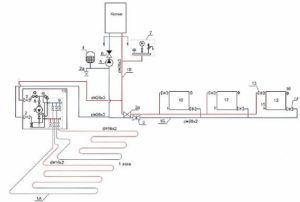
This method is designed for combined systems—a radiator and a heating substation. Here, a pump-mixing unit is installed instead of a thermostatic valve.
Connecting the manifold to the boiler is an energy-efficient scheme in which, using a balancing valve, hot and cooled water are mixed in strict proportions.
Circuit diagram with electronic thermostat
The TP supply system operates using small-sized thermionic heating units; they can provide operation of only one heating loop for an area of no more than 20 m2.
A thermostat is a small device with a plastic housing that contains:
The operating principle is simple: heated liquid is fed directly from the boiler into the circuit, without any additional water. Temperature control is accomplished using a built-in regulator.
It commands an electromechanical valve, which controls the gas supply to the boiler. Water moves through the circuit without the assistance of a pump and is cooled directly within the loop.
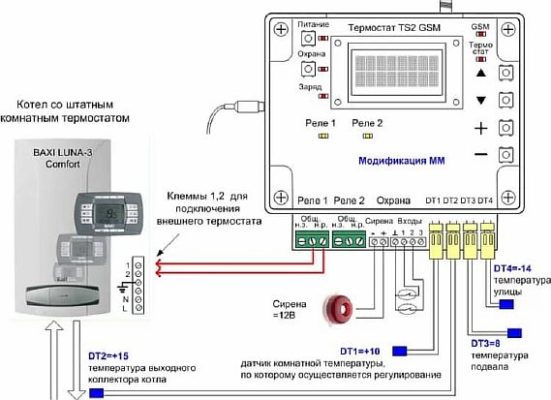
The circuit is simple and this harness is inexpensive, but it doesn't allow for precise tuning. It's suitable for:
Direct connection diagram
To supply the floor with this system, a hydraulic separator is used. This method differs in that when connecting the underfloor heating to a boiler with a pump, its circuit must have a pumping unit that works in conjunction with a thermostat. These units will regulate the fluid flow rate based on the air temperature.
The process is as follows: heated water from the boiler moves into the hydraulic manifold, where it is distributed along the floor contours. After passing through the loops, it returns to the heater through the return pipe.
This method is primarily used only on condensing units, as it does not reduce the temperature in the supply pipe. If a conventional gas boiler is installed, operating in this mode will quickly lead to heat exchanger failure.
When installing a solid fuel boiler, to ensure the system functions properly, it will be necessary to install a buffer tank, which will limit the temperature level.
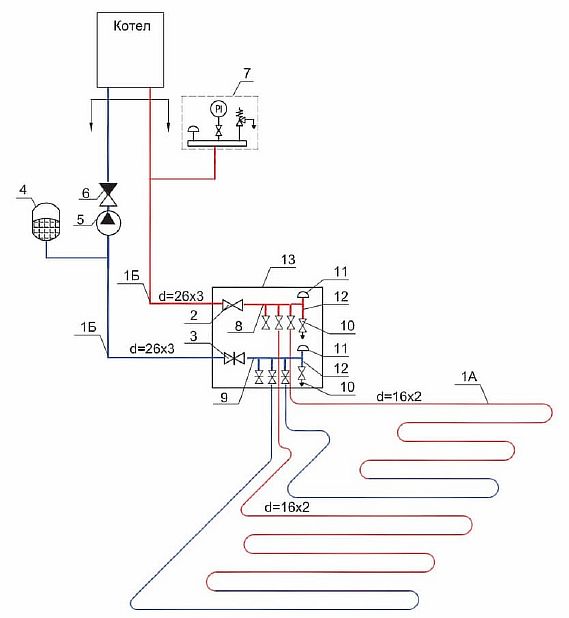
Connecting underfloor heating to a heating boiler
Electric boilers are the easiest to install and operate. Therefore, we'll explain how to connect an electric boiler to an underfloor heating manifold.
We'll connect a 3 kW heating element to a 30 m² heated floor via a three-way valve. For this, we'll purchase a recirculation boiler equipped with outlets for connecting a cold and hot water hose. The standard outlet size is 2.6 cm. To avoid distractions, we'll stock up on all the necessary tools in advance.
Before you start laying out the boiler, it is necessary to lay a "pie" of warm flooring.
Then install distribution unit to which the water floor circuits are connected, one end of the hose to the cold and the other to the hot supply.
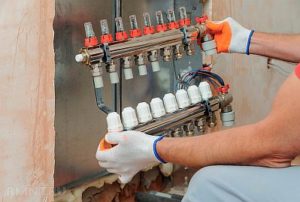
Now you can proceed directly to the piping of the boiler, which was installed in the planned location:
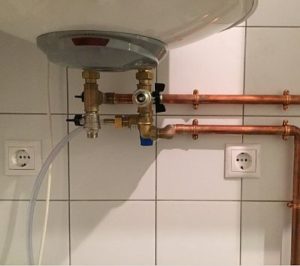
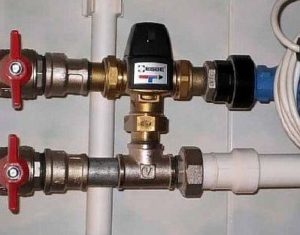
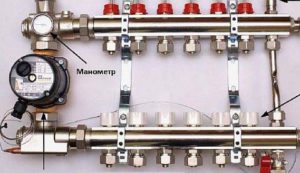
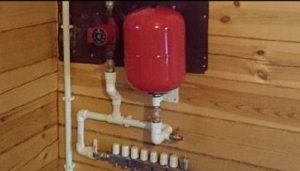
After connection, be sure to check the floor for leaks by performing a test run. This test is performed for 24 hours with the system under operating pressure.
Only then can the concrete screed be poured and finishing materials (tiles or slats) laid. The system should be turned on after the mortar has completely dried.
To ensure successful operation of a water-heated floor, any heater model can be installed. After all, all parameters—power, performance, etc.—are calculated identically for all types. It's important to connect the equipment correctly.


I have an older house with a gas central heating system (GVH) that I'm planning to replace, so I'm wondering how to choose a new boiler. I want to install underfloor heating in the bathroom (it's always cold there), but it never occurred to me that I should consider this when choosing a boiler. So, thanks for the article, and especially for the power calculation formula; it'll be very helpful. Now I'm at least armed with knowledge before making a purchase and can estimate future costs.