Today, many people choose underfloor heating systems for heating their homes, despite the significant installation costs. After all, the investment pays off when the system is in use.
How efficiently the heating device will work depends on a number of factors, the main one being the correct placement of the cake with heating. The pie is the layers that make up the heating system.
Features of the underfloor heating system, its layers and their thickness
Underfloor heating consists of special materials laid in a specific sequence. This structure is also called a "layer cake" with heating elements (water pipes or cables) inside.
The main task of the pie:
- reduce heat loss;
- protect heating elements from moisture penetration;
- direct heat in the desired direction;
- provide sound insulation;
- protect the heating system from the negative effects of the environment.
Installation of a pie on a concrete screed
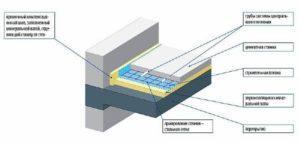
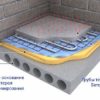
The underfloor heating system on concrete slabs, regardless of whether it is water or electric, looks like this:
- concrete base - this can be a concrete foundation or monolithic concrete slabs;
- waterproofing - regular polyethylene film;
- insulation with a reflective surface - polystyrene foam, cork backing, etc.;
- reinforced mesh;
- pipes or cables of the heating system;
- concrete screed;
- floor covering.
On the ground
Installation of the pie on the water ground, or another type of floor, is permitted in the presence of loose soil and a groundwater table at least 5 meters above the surface. This design differs from a concrete floor pie in that it requires an additional step.
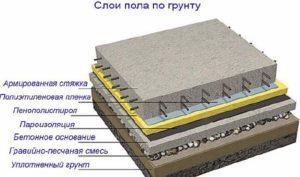
The gist is this:
- the surface is cleaned and leveled;
- sand is poured (5 cm), which is compacted and lightly watered;
- the next layer of the heated floor pie, 7-8 cm thick, is gravel or expanded clay, it is also compacted;
- Next comes waterproofing, which is reinforced with mesh;
- then a rough screed is poured (10 cm);
- then a layer of waterproofing and insulation made of expanded polystyrene is laid, its thickness depends on the conditions of the room itself (5-15 cm).
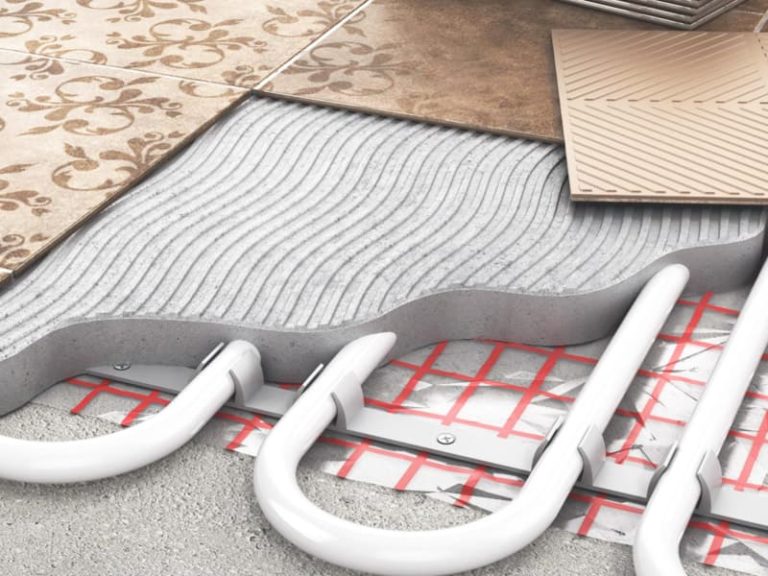
Subsequently, the process of installing underfloor heating on the ground is no different from laying a pie on concrete slabs: reinforced mesh, heating elements, pouring a screed or underlay, and flooring.
On a wooden base
If the base for the heating system is a wooden covering, then the principle of installing the pie is the same as on concrete slabs.
There's a second method, which differs in technology: using wooden joists. In this case, plywood is laid like a pie base. Joists are placed on it, and a waterproofing membrane is laid on top of them.
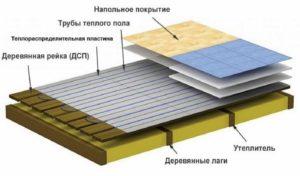
10 cm thick insulation boards are laid between the joists. Grooves are made for the heating elements (pipes or cables) to be installed. When installing a water pie, a reflective plate or foil is first placed in the grooves, and only then are the pipes installed.
There is another option - a flooring option, when sheets of chipboard equipped with channels for pipes are laid on the insulation laid in the joists.
Another method is the slatted method, where they are nailed to a base. The distance between them should correspond to the size of the heating elements.
For your information! The concrete screed in the pie with logs, when using the slat or floor method of installing the structure with heating, is not poured.
A thin plywood base is used as a base for the final flooring. The decorative covering is then installed on top of this plywood. If you plan to install laminate flooring, you can skip the plywood and lay it directly on the water pipes, as any of the profiles listed above can withstand this load.
On a dry screed
Dry screed is a loose material over which plasterboard or plywood is laid. The instructions for laying a dry screed under underfloor heating are as follows:
- the damper tape is rolled out around the perimeter of the room;
- sand or crushed stone is scattered on the floor and leveled;
- aluminum plates are laid out along the contour of the pipes;
- A dry screed is laid on top - two plasterboard sheets, on which the floor covering is mounted.
Professionals advise using expanded clay, it is the best thermal insulator.
What is the best base for a heated floor pie?
Almost any type of heated floor can be installed on any surface. In city apartments with concrete floor slabs, any type of heated floor can be installed over them: electric, infrared, or hydronic, although the latter is recommended only for the ground floors of high-rise buildings.
In a private home, the flooring is typically installed on a wooden base. Any type of flooring can be installed on it. However, infrared flooring is preferable due to its fire safety and ease of installation. Read the article to learn how to install it. installation of water and electric underfloor heating on wooden floors in a private house.
If you're using a cable system, you'll need to take extra care to ensure safety, including installing metal plates where the cables are routed. When installing hydronic underfloor heating on a wooden base, ensure the flooring can support the heavy structure.
When building a new home, the ideal solution would be underfloor heating on the ground, either water or cable, which would be installed in parallel with the construction of the building.
CONCLUSION! To summarize, it can be said that the easiest and fastest way to install a pie with infrared mats is to lay it on a concrete or wooden base.
Water or cable systems with concrete screeds are more expensive and take longer to install, but this option is considered more efficient and therefore popular. Installing underfloor heating on a dry screed is also a simple and inexpensive method and is suitable for any system.
Water heated floor pie
Let's look at the sequence of work for installing a water-heated floor on monolithic concrete slabs:
- Subfloor preparation and surface leveling include sweeping away debris and assessing the slabs' condition. A hydronic underfloor heating system allows for unevenness of up to half a centimeter. Otherwise, the surface must be leveled. This can be accomplished using a thin concrete screed.
- Waterproofing: A material is laid to protect against moisture penetration. This can be a standard polyethylene film 100-150 microns thick, preferably laid in two layers. The film covers the entire surface and should extend up the walls to the planned height of the future screed. The strips are laid with a 10 cm overlap and sealed with adhesive tape.
- Applying the damper tape—it's laid across the entire surface, at the junction of the wall and floor. After the screed is poured, the tape should be 2 cm higher than the screed. It can be self-adhesive or secured with hardware. The purpose is to compensate for the thermal expansion of the concrete; otherwise, the heat will cause the screed to crack.
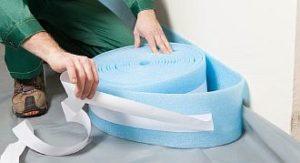
- Thermal insulation is necessary to prevent heat loss.EPS, cork underlay, or EPPL are suitable as insulation, with a density of at least 30–35 kg/m³. EPS with studs, which make it easy to lay heating pipes between, is an excellent underlay. It's worth noting that for hydronic underfloor heating, the insulation thickness should be at least 50 mm. Furthermore, basalt wool is not suitable as thermal insulation due to its hygroscopic properties.
For your information! When choosing basalt wool for a water system, it is essential to install a vapor barrier material.
For a water-heated floor pie, the thickness of a standard type of EPS is determined depending on the characteristics of the base:
- if the base surface is located above a warm basement (not less than +18°C), or on the second floor or higher, then the thickness of the substrate is 3 cm;
- if the temperature under the base is from 10 to 17°C - 5 cm;
- at temperatures from 0 to 10°C - 7 cm;
- above a cold room - 10 cm.
When using insulation without a reflective layer, you will need to additionally lay aluminum foil.
- Installing a reinforcing mesh—this is laid across the entire surface of the room. It strengthens the entire floor structure and will also be used to secure the heating elements (pipes) using plastic clamps.
- Heating system installation: The water-heated floor pipes are laid according to the planned pattern: a serpentine pattern, a snail pattern. When attaching the heating element to the mesh, it is necessary to leave a gap; otherwise, the floor or pipe may crack when heated.
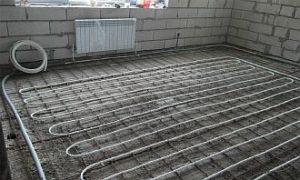
The maximum length of the contour should be 90 meters. If the area is larger, several separate contours should be created.
After installing the heating system, it's essential to test the unit. This includes checking for proper operation and checking for any pipe leaks.
- Preparing the base for the decorative covering of the underfloor heating system involves pouring a concrete screed, the thickness of which ranges from 3 to 7 cm. It must dry for a month before laying the flooring. Plywood or foamed polyethylene can be used as a substitute.
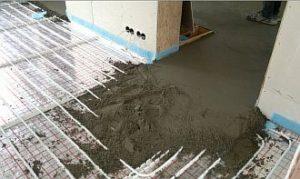
- Installation of flooring - this can be linoleum, tiles, laminate.
This is what a heated water floor pie looks like, installed on a monolithic concrete slab.
Installation of an electric floor pie
The process for installing an electric cable-based underfloor heating system is almost the same as for a hydronic system. However, installing an infrared system is much simpler and faster.
Foamed polyethylene with a foil layer is laid on the subfloor. The reflective surface should face upward. Infrared heating mats are placed on top of this and secured with adhesive tape.
Next, a waterproofing layer is laid, which can be polyethylene. The polyethylene sheet can also serve as an underlay for flooring (laminate, parquet).
For your information! Infrared mats should not be installed under furniture. Regardless of the type of underfloor heating chosen and the substrate on which the system will be installed, a properly designed system must include waterproofing, thermal insulation, and a reflective layer. This will ensure the system operates efficiently and lasts a long time.
The thickness of the electric floor screed should be between 2 and 6 cm. This value will ensure reliable and trouble-free operation of the underfloor heating system.
The thickness of the mat for electric underfloor heating is available in the following sizes: 3 mm, 3.5 mm, 4 mm, 4.5 and 5 mm.