According to underfloor heating installation technology, its structure must include a low-conductivity thermal insulator. A water-based system is no exception.
Today, manufacturers offer a wide variety of thermal insulation substrates, making it difficult for someone unfamiliar with construction to choose insulation that meets all requirements.
- Is thermal insulation necessary for underfloor heating?
- Types of insulation for underfloor heating
- Cork backing
- Expanded polystyrene
- Mineral wool
- Roll thermal insulation made of foamed polyethylene
- Which insulation should I choose?
- Features of laying insulation
- Installation of polystyrene foam boards
- Laying rolled foamed polyethylene
- Laying mineral wool
- Optimal insulation thickness
- Video instructions
Is thermal insulation necessary for underfloor heating?
Thermal insulation plays a vital role in the underfloor heating system; the proper functioning of the entire heating system depends on it. A screed poured over the insulation creates a large heat-transfer surface.
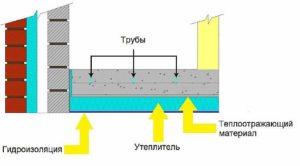
The main functions that a thermal insulation layer under a heated water floor must perform are:
- evenly distribute heat flows throughout the heated room, this is especially important when installing a water structure, since the configuration of this system is straight and curved pipes, so the heat is not distributed evenly;
- prevents the outflow of warm air through the ceilings, it serves as a reflective screen, which also makes it possible to save thermal resources;
- act as sound insulation;
- prevent the penetration of moisture and cold from below - when constructing a structure above an unheated room or on the ground;
- prevent the possibility of mold and fungal growth.
In addition, by using polystyrene foam mats with bosses as insulation under a heated water floor, you significantly simplify the process of installing and securing pipes.
Please note! If the thermal insulation layer is selected and installed correctly, the floor "pie" becomes a closed thermal device where thermal radiation is distributed evenly and in the desired direction.
Types of insulation for underfloor heating
When selecting a thermal insulator material for a heated hydrofloor, you should consider the characteristics and technical parameters of the room, as well as the base on which the underlayment will be installed.
Most thermal insulation materials have the same thermal conductivity. However, the required layer thickness often varies, even within the same room.
The most common types of thermal insulation used under hydronic underfloor heating include mineral wool, cork, polystyrene foam, and profile mats. These materials have varying thermal insulation characteristics and properties, and these should be taken into account when selecting and installing the flooring.
For your information! construction of a warm water structure on the ground, it is recommended to use natural raw materials for insulation: sawdust, expanded clay, washed granulated slag, expanded clay sand.
Let's take a detailed look at each type of material for thermal insulation of a heating structure.
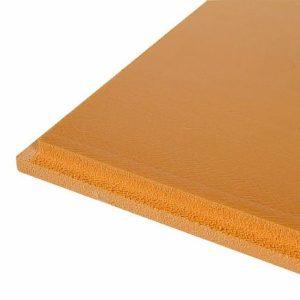
Cork backing
Cork is an expensive product, made from oak bark. It comes in rolls or sheets, but their technical specifications are the same. The only differences are in size and thickness.
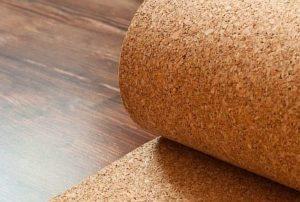
Cork backing:
- has low thermal conductivity;
- waterproof;
- environmentally friendly;
- hypoallergenic;
- elastic;
- lightfast;
- fireproof;
- resistant to sudden temperature changes;
- not susceptible to chemical influences.
Cork is an ideal choice for hydronic underfloor heating systems, and if budget allows, it's the best choice. The thickness of this underlayment allows for efficient heat conservation, which is especially important when installed on the ground.
Cork is resistant to deformation and shrinkage when poured over concrete. It is also impervious to insects, rodents, mold, and mildew.
However, it should be noted that using cork as a substrate will affect the height of the ceilings, and it will be necessary to purchase additional reflective material.
Expanded polystyrene
Expanded polystyrene is the most common type of thermal insulation for underfloor heating systems, and it's quite affordable. It provides high-quality protection against water and steam, a high degree of sound insulation, does not warp under temperature, is chemically insensitive, and resists mold and mildew.
Thermal insulation consists of numerous bubbles enclosed in a shell. To provide strength to the structure, a reinforcing mesh is used under this substrate. Its ease of installation, easily handled even by inexperienced users, also plays a significant role in its popularity. Furthermore, it has a service life of several decades.
The main disadvantage of polystyrene foam is its fire hazard, so it needs to be insulated with a foil backing.
There are several types of polystyrene foam, which differ in production technology and properties:
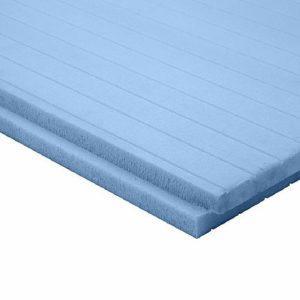
- Extruded polystyrene foam is durable and performs its primary function—thermal insulation—more efficiently. It has increased strength because the particles are tightly bonded together. However, its vapor impermeability is virtually zero. Its thickness is at least 3 cm. The boards are often colored.
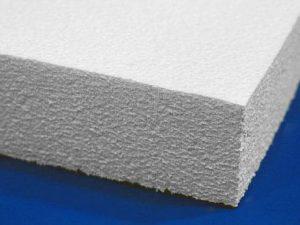
- Foamed polystyrene foam is also known as polystyrene foam. It has a low specific gravity and high vapor impermeability. It is not recommended for foundation insulation, as it deteriorates when exposed to moisture. It is usually white in color. It is produced using a non-extruded process, meaning the structure has cells with air channels.
- Penoplex is inexpensive. It has excellent heat-reflecting properties, making it considered one of the best insulating materials. Installation requires no waterproofing underlayment, and the process itself is simple and easy to do yourself. It is available in sheets of various sizes, with thicknesses ranging from 20 to 100 mm. Packages contain 4 to 20 sheets, depending on the thickness of the product.
Penoplex – types, applications, characteristics, advantages and installation stages thermal insulation.
Key benefits:
- high heat and vapor insulation;
- absence of emissions containing harmful substances;
- resistance to the effects of microorganisms;
- does not allow moisture to pass through;
- has high strength.
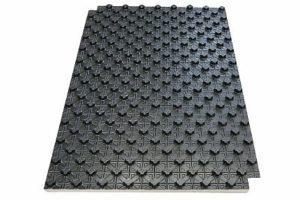
- Profiled mats are also made from expanded polystyrene. They are stamped using a special process and coated with a waterproofing film. The slabs are highly durable and can withstand mechanical loads. They are equipped with protrusions for laying the hydronic underfloor heating pipes, simplifying the installation process. They have side locks, simplifying installation and minimizing seams. This model is considered the most cost-effective for heating installations.
Mineral wool
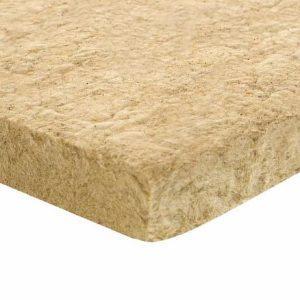
Mineral wool is fireproof, unlike expanded polystyrene insulation, but it's also more expensive. Manufactured in slabs, it's easy to install.
When installed on an aluminum underfloor heating base, this insulation exhibits high efficiency, even when placed on the ground. Furthermore, it offers good noise and thermal insulation, increased rigidity, and is resistant to chemicals.
The main drawback of this product is its presence of carcinogenic and toxic substances, which are hazardous to human health. Furthermore, cotton wool is hygroscopic and vapor-permeable, so when laying it in a screed, care must be taken to protect it from moisture and vapor emissions.
Roll thermal insulation made of foamed polyethylene
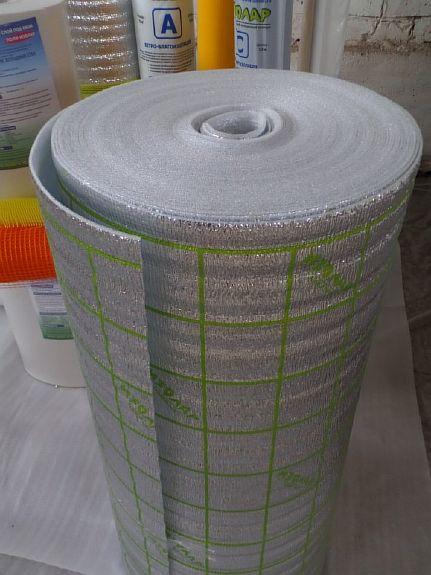
Foamed polyethylene (Penofol) is gaining popularity these days. It's sold in rolls and comes in thicknesses ranging from 3 to 10 mm. It features a foil-coated surface that reflects heat and allows for a significant reduction in the thickness of the foam, eliminating the need for additional waterproofing layers made of polyester or thermal insulation.
There are the following types:
- A - one side has a layer of foil;
- B - foil on both sides;
- C (self-adhesive) - foil on one side, glue on the other;
- "ALP" - one side is foil-coated, the other with a special film.
Each type is suitable for use under underfloor heating and provides virtually complete thermal insulation for the unit.
The technical properties of foamed polyethylene and polystyrene are largely similar, the thermal conductivity coefficient ranges from 0.037 to 0.049 W/m °C.
It is also worth mentioning the material’s ability to absorb water, which reduces its thermal insulation properties.
Furthermore, exposure to wet screeds containing chemicals can cause the aluminum foil layer to deteriorate. To combat this problem, manufacturers began producing sheets with a film coating over the foil.
Metallized polyester film provides effective protection for screeds and flooring from alkaline attack. Insulation with an aluminum layer without a heat-resistant coating is not used. The advantage of this product is its high heat reflectivity.
Important! When laying the product, the foil side should face up.
Which insulation should I choose?
As mentioned above, underfloor heating requires insulation, as it won't function effectively without it. Furthermore, with insulation, the system is more energy-efficient. It's important not only to know how to properly insulate underfloor heating but also how to choose the right heat-reflecting material.
When purchasing thermal insulation, consider not only the material's specifications, heat-saving properties, and parameters, but also its service life. Some products with excellent performance often have a short service life.
Therefore, it will need to be replaced before the system itself requires maintenance. This is especially important in rooms with tiled flooring, as removing it is difficult. Therefore, experts recommend purchasing a product with a 10-15 year warranty.
Among the properties that are recommended to pay attention to:
- thermal conductivity level;
- resistance to mechanical loads and dynamic impacts;
- density index;
- water and vapor impermeability.
For rooms with high ceilings, it's best to choose durable, rigid types with a polymer base. If you're insulating a room with wooden floors - Mineral wool is an excellent option, because it is fireproof.
Don't skimp on insulation when installing underfloor heating. Its cost will pay for itself within three years, and if you use natural gas for heating, the payback period is significantly shorter.
Features of laying insulation
The principle of installing a thermal insulation layer is simple; no special tools or experience are required; the main thing is to follow the technological process.
Watch the video on how to choose insulation:
Installation of polystyrene foam boards
The installation of polystyrene foam boards under a water-heated floor looks like this:
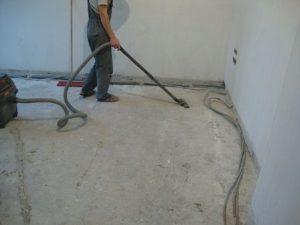
- Regardless of the type of thermal insulation product, you need to start with preparing the subfloor. It must be level and free of cracks. If any unevenness or imperfections are found on the surface, they must be repaired.
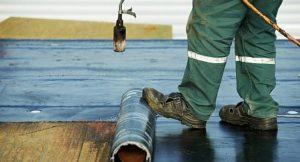
- Waterproofing measures consist of installing a moisture-proofing layer, which can be a polyethylene film.
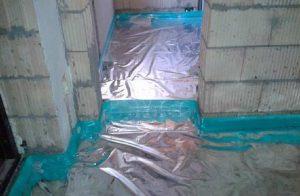
- Applying a damper tape around the perimeter of the room is necessary to compensate for temperature fluctuations.
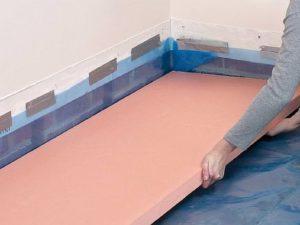
- Laying insulation boards over the entire area - sheets are fixed to the base using plastic staples or dowels; the product can also be glued in place.
- Spreading foil film and installing reinforcing mesh over the insulation.
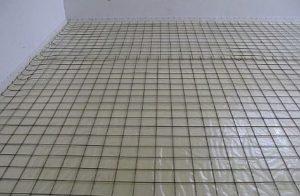
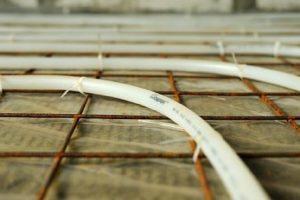
- Install the heating elements (pipes)—they are attached to the grid according to the planned layout. The seams between the slabs should be sealed with tape to help retain heat.
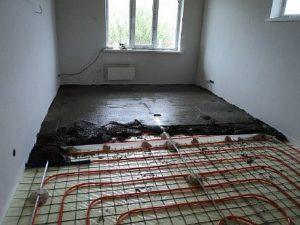
- Pouring a concrete screed over the pipeline. To strengthen the surface, it is recommended to add plasticizers to the solution. Allow the mixture to harden, which will take about a month.
- The final stage is the installation of the finishing coating.
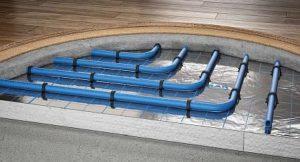
Please note! It's important to remember that underfloor heating pipes with the coolant inside are significantly heavy, plus the screed and finishing coating, all of which, combined, will eventually weaken the insulation.
To avoid this, high-strength thermal insulation is required. Furthermore, to strengthen the structure and evenly distribute the load, reinforcement or the installation of polystyrene foam boards with studs is recommended. Furthermore, such mats facilitate the placement and securing of pipes.
Laying rolled foamed polyethylene
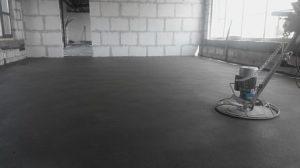
Installation work for the construction of a water-heated floor using rolled polyethylene as insulation begins with leveling and cleaning the base.
The second stage involves preparing the thermal insulation material. This involves cutting the insulation into strips of the required length using a utility knife.
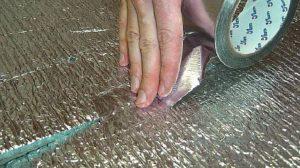
Next, the foil-clad product is placed on the prepared base with the metalized surface facing up to ensure optimal heat reflection. The foil should overlap the walls to accommodate the expansion of the screed when heated. The insulation is secured to the floor with glue or double-sided tape. Seams should be sealed with single-sided tape.
Installing a water circuit on polyethylene rolls is simplified by the printed installation markings that indicate the distance between pipes. Heating elements on penofol can be laid in a "snail" or "serpentine" pattern.
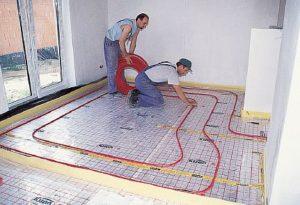
Further work on the construction of water heated floors involves the installation of reinforcement mesh, pouring concrete screed and laying the floor covering.
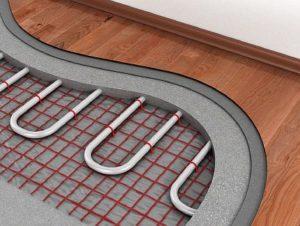
Please note! ALP brand penofol is recommended for use in hot water heating systems.
Laying mineral wool
Mineral wool cannot be crushed, so the best way to install it is on a floor, with the installation of joists.
Step-by-step installation of a warm system with a mineral wool insulation backing is as follows:
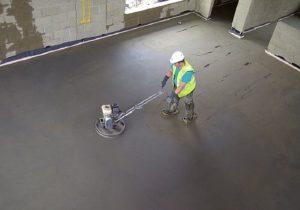
- Subfloor preparation is a mandatory step when installing any underfloor heating system. If the floors in the house are old, it's best to completely remove them down to the concrete or subfloor. The surface should be inspected for any unevenness or cracks; if any are found, they should be repaired.
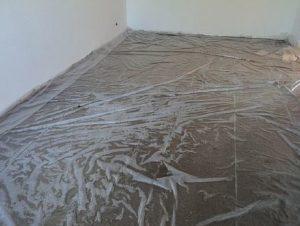
- Laying a waterproofing and vapor barrier underlayment is a necessary step when using mineral insulation, as it is sensitive to moisture. Roll-type waterproofing, such as roofing felt or other modern materials, is suitable for this purpose. The sheets are secured to the base with a polymer or bitumen mastic. The material is laid with an overlap, and the seams should be sealed with mastic.
- Installing wooden joists—they are attached to the subfloor across the entire surface. 5 x 6 cm beams are installed on the concrete surface using dowels, and on the wooden floor using screws. The spacing between fasteners depends on the flooring to be installed and ranges from 40 to 80 cm. The joists require notches to accommodate the contour.
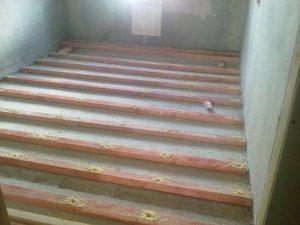
Important! If mineral wool is used as insulation, the distance between joists should exceed the width of the material by 1.5–2 cm.
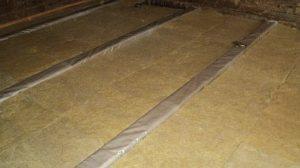
- Insulation installation: mineral wool is installed between the joists. It must be recessed at least 5 cm to allow for ventilation.
- Installing a second waterproofing layer is necessary, as cotton wool is not moisture-resistant. A standard polyethylene film is used, which is laid over the joists and secured with a stapler.
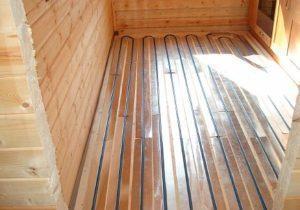
- Preparing the pipe substrate involves using slats nailed across the joists, leaving a 30 cm gap from the walls. There should be grooves between the slats to accommodate the metal pipe routing profile. The size of the grooves depends on the pitch of the pipe installation.
Please note! The metal profile can be replaced with foil wrapped around the pipe.
- Installation of the heating circuit - heating pipes are laid into the installed profile according to the planned scheme.
- Installation of flooring for interior covering - this can be chipboard or plywood.
- Finally, the floor covering is laid.
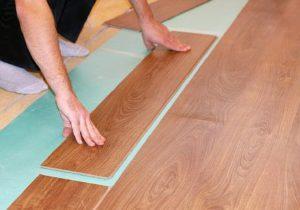
At this point, the heated floor with a thermal insulation backing – mineral wool – is ready for use.
Optimal insulation thickness
It is important to choose not only the right insulation model, but also its thickness, as this will determine your thermal energy savings.
For your information! If the thickness of the insulation is small, then most of the heat goes under the floor; its amount is equal to the flow of warm air rising upward.
The thickness of the insulation should be selected based on climatic conditions. In cold climates, a thicker layer of insulation is needed.
The type of room located beneath the underfloor heating system is also important. If it's a cold basement or the structure is laid on the ground, the insulation layer should be thicker, 100-120 mm. When installing underfloor heating above the room being heated, a thickness of 30-50 mm is sufficient.
Installing a thermal insulation layer under hydronic underfloor heating is not a luxury, but a necessity. Incorrectly installed insulation will lead to poor heating performance and unnecessary costs.
What insulation would you recommend in terms of price-quality ratio? Cork is obviously the best, but it's expensive. Expanded polystyrene?
Is it possible to use natural insulation? After all, sawdust is used as insulation in house construction, so isn't that an option here, not on the ground? What's the difference?
It's best to choose polymer-based types. If you're looking to save money, choose mineral wool. Its advantages include fire safety and low cost.
I spent a long time choosing insulation and settled on penoplex. It doesn't require a waterproofing underlayment, it's inexpensive, and it's moisture-resistant. I also considered cork, but the price tag was outrageous. Mineral wool is good, but it has a lot of drawbacks, so I decided against it.