Hydronic underfloor heating systems, which are often installed in homes today, require a power source. If they are not connected to a central heating system, a separate heating boiler is required.
In this article, we'll look at all types of boilers, their pros and cons. You'll learn which boiler to choose for underfloor heating, how to calculate its capacity, and how to connect it yourself.
- Types of boilers, their pros and cons
- Diesel
- Solid fuel
- Gas
- Electric
- What types of boilers are recommended for water floors, basic requirements
- Which electric boiler should I choose for underfloor heating?
- How to calculate power rating and heating costs
- Top manufacturers
- Buderus Logamax
- Kospel EKCO
- "Galan", "Heart", "Geyser", "Volcano" series
- Ferroli
- RusNIT
- Baxi Amptec
- How to connect an electric boiler to underfloor heating
Types of boilers, their pros and cons
There are various devices for heating the coolant. They differ in the type of fuel they operate on: diesel, solid fuel, gas, and electric.
In addition, boilers differ in their installation method: they are hung on a wall or installed on the floor.
Floor-standing units are more powerful, while wall-mounted units are easier to place and less expensive.
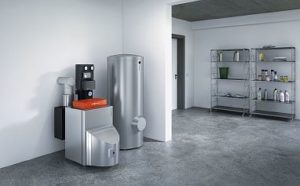
Diesel
These systems operate on diesel fuel. They are efficient, offer high performance, and consume minimal fuel. They are easy to connect and maintain.
Solid fuel
The fuel used for such boilers is firewood or pelletsThey operate similarly to a conventional stove, but the wood burns at high temperatures—250 degrees Celsius—without air.
The liquid is heated by hot smoke that is released during the combustion of fuel.
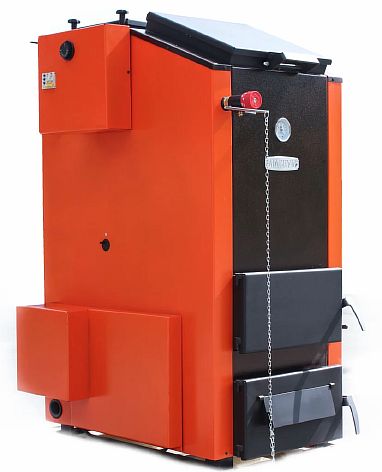
They are rarely installed in apartments; their primary use is in industrial settings or private homes. The advantage of this type is its low cost and ease of use.
Gas
As the name suggests, these units run on gas. Their housing is typically steel or cast iron, which directly impacts the unit's lifespan and installation requirements.
Steel boilers are lighter than cast iron ones, they are compact, and easy to repair, but their service life is short. Cast iron boilers last longer, are reliable, economical, and operate on any type of gas—mains or liquefied petroleum gas—but they are more expensive.
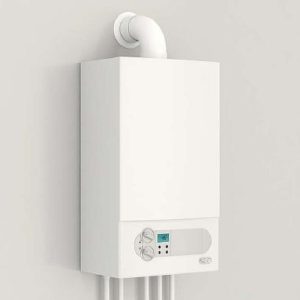
It should be noted that they are not suitable for underfloor heating systems, as they can only maintain water temperatures within the +80°C range. For hydronic floors, the coolant should only reach 45°C, which reduces the unit's efficiency.
But if we add design with a mixing unit, then the boiler can be used in hydro floors.
Electric
Electric boilers operate using electricity. They're the best option for underfloor heating, as they can heat the water to the level needed for trouble-free and economical operation, and are easy to connect. Plus, they maintain their performance even when shut down for extended periods (more than six months).
Their disadvantage is that they are expensive to operate, they are energy dependent, and cannot function without electricity.
Types of electric boilers:
- Heating elements are the simplest and most proven option, so they are most often installed in hydronic systems. They feature a tubular heater—a reliable element with efficiency reaching 98%. Power ratings range from 2 to 60 kW and operate from a single- or three-phase network. Heating element units are available in single- and dual-circuit configurations:
- Single-circuit - these mini-boilers heat only the coolant; for their full use, they also require a boiler and heat exchanger.
- Double-circuit units not only heat water, but are also used for heating purposes; they already have a built-in boiler and heat exchanger, but their cost is higher.
2. Electrode heaters are suitable for hydronic floors. They are compact, durable, highly efficient, and affordable. Their unique feature is that they use only antifreeze as a coolant.
They operate on a different principle: the coolant is quickly heated by the resistance of the positive and negative electrodes.
3. Induction boilers are technologically advanced electric boilers for underfloor heating. They are designed to consume minimal energy, while achieving high efficiency and a long service life (30 years). They can simultaneously operate underfloor heating and radiator heating.
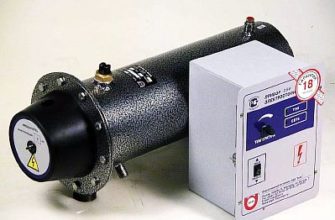
These units are automated, reliable, and silent, and can be used with any heating medium. They require no chimney or separate room for installation.
When in operation, they emit electromagnetic waves, so contact with them will not cause a burn.
They reach operating mode quickly, but they are more expensive than other electric types.
What types of boilers are recommended for water floors, basic requirements
There are no boilers designed specifically for underfloor heating with circulating liquid, and not all existing models are suitable. The equipment specifications specify that they can be installed with heating systems.
The main requirement for a boiler with an electric motor for heating with circulating liquid is low-temperature operation, meaning it must not heat the coolant above 55 degrees Celsius. Then, it will heat the surface to 30 degrees Celsius, a comfortable heating level.
Professionals recommend installing underfloor heating systems in homes using low-temperature electric boilers. To maintain the desired water temperature, they must have a regulator; induction boilers and most heating elements do. Electrode boilers, however, are not considered low-temperature; they have a minimum heating temperature of 60°C, so without a mixing unit, they are not suitable for underfloor heating.
Condenser gas boilers, which are efficient when heating small amounts of water, can be used. Simple gas boilers, for installation in a system with underfloor heating, are only suitable if a mixing manifold is additionally installed.
Solid fuel boilers are also not the best choice for hydronic floors. To ensure proper operation, they require the installation of a number of additional components (mixing and distribution unit, thermostat, pump, etc.), and even then, achieving the required water heating level is difficult.
Which electric boiler should I choose for underfloor heating?
As mentioned above, the most suitable device for hydrofloors is an electric boiler. It operates autonomously and requires no supervision.
When selecting an electric boiler for underfloor heating, it's best to choose models that are approved for installation in underfloor heating systems. Otherwise, conversion and installation of additional components will be required.
When choosing an electric boiler, you need to consider the following parameters:
- The power required to heat your home depends on the room size, the thickness of the screed layer, and the finishing material.
- Mounting options include wall-mounted or floor-mounted installation. The choice depends on available space and the unit's weight. High-power electric boilers are heavy and are not recommended for wall-mounted installation.
- Number of circuits - single or double circuit models are suitable for hydro floors.
- Safety and adjustment system - its presence will significantly facilitate the process of adjustment and control of the device.
Before choosing a device, it's important to familiarize yourself with the manufacturer's information. It's important to choose reputable companies that offer a warranty on their products.
To reduce energy costs when installing underfloor heating from an electric boiler, it is recommended to install automation via a special sensor, which is mounted at a distance of 20 cm from the surface.
It will help maintain the room temperature at a preset comfortable level, even when energy consumption decreases. An alternative option is a GSM thermometer, which monitors the liquid temperature and maintains it at the desired level when the house is unoccupied.
How to calculate power rating and heating costs
The electric boiler power can be calculated using the formula:
M = K x OP x RT x KR x 1 kW/860 kcal,
Where:
- K is the safety factor, it is equal to 1.15 or 1.2;
- OP — area of the room;
- RT is the temperature difference between room temperature and outside temperature;
- KR is the dispersion coefficient.
The standard heating power rating for an electric boiler for a hydrofloor is 1 kW per 10 m². If a dual-circuit boiler is installed, an additional 30% is added to this figure.
A special feature of this unit is that when the hot water supply is turned on, the water continues to heat, which creates an additional load. Therefore, the technical documentation specifies the recommended cable parameters for this type of heating.
Often, when calculating power, the result is 5.2 or 8.2 kW, in which case the value is rounded up.
Top manufacturers
There are many European and Russian companies that produce boilers suitable for installation in underfloor heating systems. We'll tell you about the most well-known, high-quality products.
Buderus Logamax
A German company produces environmentally friendly wall-mounted heating elements of varying power.
Advantages of Buderus Logamax:
- can be connected to any type of heating;
- installation in closed systems is available;
- have increased efficiency;
- not complicated installation.
Among the disadvantages is the high price.
Kospel EKCO
A Polish company produces wall-mounted heating elements that can be connected to underfloor heating systems. They are equipped with a six-stage power regulator and an automatic circuit breaker.
The installation and operation of these devices is simple. However, such electrical equipment is expensive.
"Galan", "Heart", "Geyser", "Volcano" series
Reliable electric boilers from a Russian manufacturer with a 30-year warranty. Easily optimized for any heat loss level, they offer a quick payback.
The equipment is flow-through, so its installation does not require approval from regulatory authorities. Water is heated without a heating element, using ionization.
The advantages include:
- automation;
- prostate mounting,
- silent operation;
- low cost.
Among the disadvantages:
- afraid of sudden power surges;
- the presence of a large load on the wiring.
Ferroli
An Italian company producing a wide range of wall-mounted, single-circuit electric boilers of varying power ratings, which are connected to single- and three-phase networks.
High-quality electric boilers with weather-dependent control and a digital LCD control panel.
Disadvantages: high cost and lack of a sensor to maintain a constant temperature.
RusNIT
This Russian company produces small, lightweight wall-mounted electric boilers capable of heating rooms up to 80 m². They operate on single-phase and three-phase power.
The company's pricing policy is affordable for most consumers. It's worth noting the installation difficulties that sometimes arise during connection for untrained users.
Baxi Amptec
Baxi (Italy) produces units suitable for various heating systems, including radiators and underfloor heating. Some models can operate at low temperatures.
The devices are compact and easy to operate. Their price is directly related to the unit's power.
The advantage is that they work outdoors at sub-zero temperatures.
How to connect an electric boiler to underfloor heating
Connecting an electric boiler isn't complicated, but it does have its own unique features that are important to consider. Therefore, before beginning work, it's important to study the equipment's instructions and consider the wiring diagram for the underfloor heating system and the electric boiler.
Connection can be made directly to the device, through a three-way valve or a manifold group.
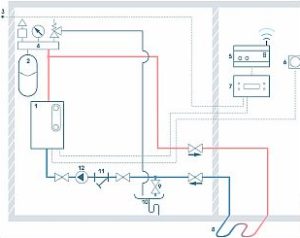
The unit is being installed after laying the heated floor "pie".
We will consider the process of connecting an electric boiler through a mixing unit.
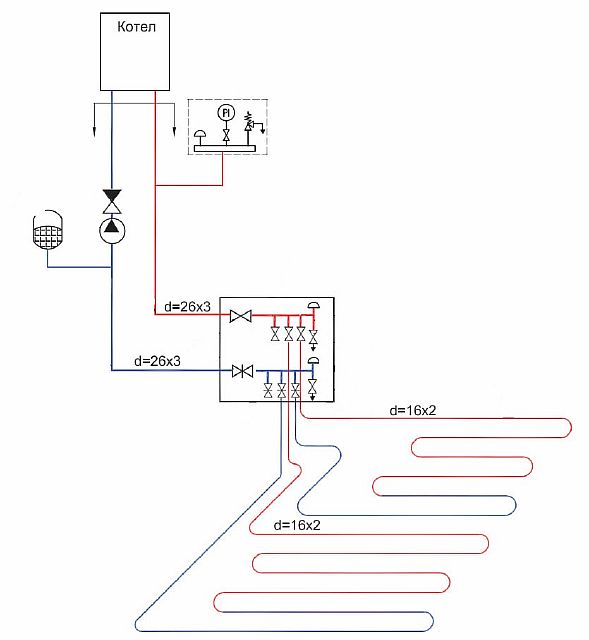
Sequentially, it looks like this:
- Wiring is run to the selected location where the electric boiler will be installed. Since the network load will be high, a separate line is required.
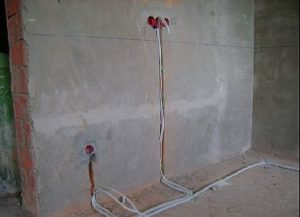
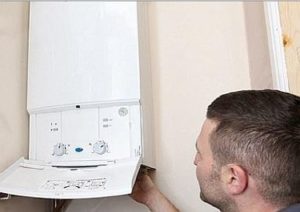
- The boiler is installed in the designated area. If the unit is floor-standing, it comes with a stand on which it is mounted. For wall-mounted installations, holes must be drilled into which anchors are installed.
- The boiler is connected to the power supply. After all the wiring has been completed, additional protection, such as an RCD circuit breaker, must be installed and grounded.
- The distribution manifold is installed.
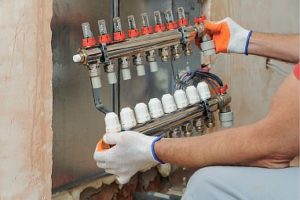
- Underfloor heating pipes are connected to the unit. Supply and return pipes from all circuits are connected to the distribution unit.
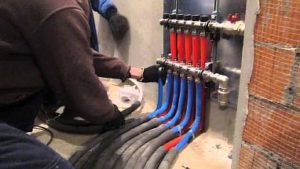
- Using a pipeline, the supply and outlet pipes of the collector group are connected to the corresponding outlets of the boiler.

- The system is being tested for leaks.
Only after this is the concrete screed poured. Installing underfloor heating with electrical equipment can provide the required heating level.
When choosing an electric boiler, you should consider the characteristics of your heating system and the room, and then you will get a more economical form of heating.


The disadvantages are clearly described. Thank you.