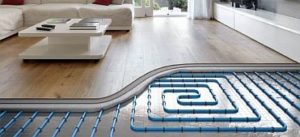
In pursuit of comfort, most owners of private houses or apartments install heated floors.
However, it's worth noting that if air is present in the structure (unless it's vented), the performance of the entire system is significantly reduced. Furthermore, this leads to equipment failure, which is quite expensive.
To avoid these problems and additional financial costs, you should know how to bleed air from heated floors.
- Causes of air formation
- What are the dangers of air locks?
- Types of air vents
- Automatic models
- Manual
- How to bleed air yourself
- How to bleed air from a circuit powered by a circulation pump
- Bleed from a gravity-fed system
- How to bleed air using automatic vents
- We expel the air using a strong stream of water
- Pressing out plugs by draining water
- How to prevent air locks?
- Tips and recommendations
- Video tutorials
Causes of air formation
The main reasons why air gets into water circuits are violations in the design, during installation work, or as a result of floor use.
The accumulation of air masses in the coil can be caused by:
- Inaccurate calculation of heat load;
- Errors made when calculating the size and number of loops, as well as the diameter of the pipes;
- Incorrect selection of pump, safety and control components;
- Laying a highway with a large number of elevation changes;
- Not high quality material;
- Poor installation - lack of tightness of joints and threaded connections;
- Violations of the rules when first starting the floor;
- Failure to comply with temperature levels during operation;
- Depressurization of the pipeline in case of breakdown or defect;
- A disruption in the circulation of fluid in the circuit, which is caused by a decrease in pressure due to a pump malfunction;
- Failure of the automatic air vent, as well as the safety and shut-off valve;
- The release of gases contained in the coolant during heating.
Important! Before, than to perform the first start of the device The air should be removed from the underfloor heating circuits.
What are the dangers of air locks?
If there are voids in the pipes, the floor heating will be less efficient. If the pipeline is not pumped, the voids will expand and lead to a drop in pressure.
Depending on the design features of the device, air locks can lead to:
- to freezing of pipes in corner rooms - when installing floors from central heating;
- to a complete or partial cessation of heating - in the presence of heating hydrofloors and radiator heating operating from the central heating of the entire house located in the basement;
- to partial or complete cessation of heating, emergency shutdown of the boiler and freezing of CO - in floors operating from an autonomous heating system;
- to a complete or partial shutdown of heating, as well as frequent interruptions in the boiler operation - if the house has heated floors and radiators that operate from an individual heating source.
How to properly bleed a heating radiator: in an apartment or house, using a Mayevsky crane and other methods.
Taking into account all the design features: the number of loops in the room, the presence of separate wiring for each room, it is safe to say that a complete cessation of circulation in the pipeline cannot occur.
Only when all the loops of the circuit are simultaneously plugged will the water stop moving along the main line to all the rooms and floors of the house, as a result of which the entire heating system will cease to function.
Types of air vents
To bleed air from a heated floor, vents are most often used, which can be manual or automatic.
Manual devices are mainly installed on heat exchangers, and automatic ones on the upper section of the collector or pipeline.
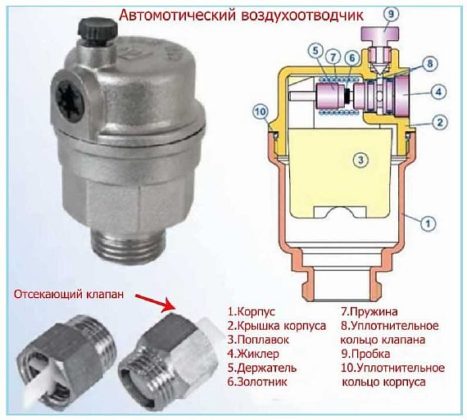
Automatic models
These devices are produced by both domestic and foreign manufacturers, and each type has its own design features, depending on the brand. The devices come in:
- With a reflective plate inside the housing - it is installed at the entrance to the working chamber and is designed to protect internal parts from water hammer.
- With a spring-loaded shut-off valve, which is equipped with an air vent, air can be released through it.
- With side threaded connections.
- Microbubble separators are installed in the pipeline at the two inlet ports. Liquid passing through a copper mesh tube creates a water vortex, which slows the air and directs it upward. The air bubbles are then released through an automatic valve.
- With a rocker mechanism, a plastic float is located in the chamber, connected to a shut-off bleeder needle. When it descends into the air, the needle opens the bleeder hole to allow air to escape.
Manual
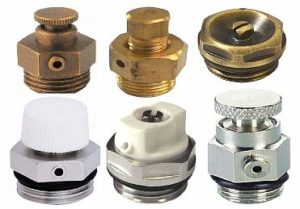
Manual devices are called Mayevsky valves. Their simple design makes them most commonly used in heating systems. A mechanical air vent effectively seals the outlet from the housing during operation.
When air needs to be removed, the valve is turned several times, which begins the air bleeding process.
How to bleed air yourself
Pumping a water-heated floor is not difficult; you can do this procedure yourself.
However, it is worth noting that depending on the design of the structure, the process of removing air flow from the pipes varies.
How to bleed air from a circuit powered by a circulation pump
To bleed air from a floor circuit equipped with a pump, you must perform the following steps in sequence:
- It is necessary to close the flow meters on the manifold leading to all loops.
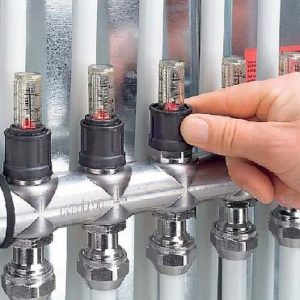
- Bleed the circulation pump.
- Open the ball valve or Mayevsky valve on the comb, and one floor loop.
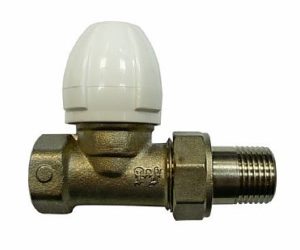
To open a Mayevsky faucet, hold the white part of the valve with one hand to keep it from dangling. Use the other hand to unscrew the valve located in the middle.
- Then, turn on the circulation pump at low speed. The pressure should be 20% higher than normal.
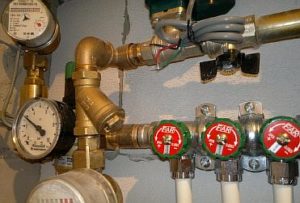
- The pump should be turned off and the valve should be closed after water appears from the air vent.
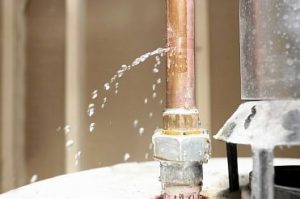
- This procedure must be repeated several times, at intervals of several minutes, until all the air is released.
- This process should be repeated for each loop for 2-3 days until all the air is released.
- Then the pump needs to be turned on to maximum and the entire pipeline needs to be purged.
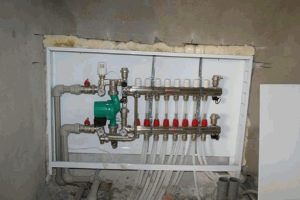
Only after all air has been completely released should the underfloor heating system be started. During operation, air may reenter the circuit, so it is recommended to periodically bleed the air.
Bleed from a gravity-fed system
If you have a gravity-fed system without bleed valves, the question arises: how to bleed the air from the underfloor heating system? You'll have to wait for the air to escape through the expansion tank.
The device must not be running and the water must be chilled. The process may take several days.
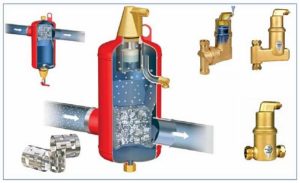
In short, to bleed air bubbles from such a line, you need to turn off the boiler and motor, and let the hydrofloor cool down.
How to bleed air using automatic vents
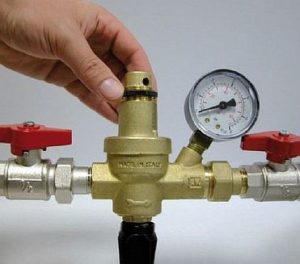
Nowadays, there are special bleeders or separators that automatically remove air masses from the circuit.
They make it easy to bleed plugs, and they do not require any special maintenance or care.
Automatic air vents should be installed at the highest point of the heating pipeline, because this is where air accumulates.
There is no need to include them in the safety group, since there is no concentration of air masses there.
We expel the air using a strong stream of water
It's theoretically possible to bleed air with high water pressure, but it's quite difficult. A powerful pump with over 2 atmospheres of pressure is required to blow out the pipes.
However, this method can only be used to clear blockages in an open system with a small number of branches. Furthermore, this method can cause the expansion tank to overflow. Therefore, it is recommended to use it only if you have experience with similar work.
Pressing out plugs by draining water
This method is recommended if a gravity-fed structure is about to become air-filled. A large amount of water is drained from the bottom while simultaneously being filled from the top.
This method can be used to bleed out plugs. They are displaced, broken, and forced out of the pipeline.
How to prevent air locks?
The main disadvantage of water-based floors is the formation of air locks; otherwise, they have excellent performance characteristics and are easy to use.
Even if installation is performed correctly, the water system may become air-locked during operation. To prevent this, follow these guidelines:
- conduct regular preventive inspection of the structure for defects and leaks;
- monitor the temperature and pressure levels of the coolant, as sudden changes can lead to blockage of the pipes;
- periodically bleed air from the pump body and manifold;
- If you are unable to service the device or replace faulty equipment yourself, you should call in specialists;
- install a circulation pump only for water supply, this will prevent air from entering the pipeline due to the pump's fault;
- install a separator on the return hose in front of the manifold, with its help it will be possible to expel air;
- You should not drain the coolant from the hydrofloor pipeline, since small air blockages can be easily removed using a separator or manifold valves;
- It is better to invite a specialist to set up the collector.
Please note! If a circulation pump is used, it is recommended to connect it to an uninterruptible power supply. This will ensure a constant water flow through the floor loops.
Tips and recommendations
As we know, the more complex the equipment, the higher its cost, and such a device is also less reliable. Therefore, to ensure proper operation of the hydrofloor, it is necessary to purchase and install high-quality components.
There's a huge selection of hydronic flooring kits on the market today. When choosing, carefully review their specifications and features.
A mechanically driven device is an option, as it's affordable. Furthermore, its functionality has been refined over many years of use, so it rarely breaks down. Devices with a sulphur drive are more expensive, and there are more components that can fail in such a design.
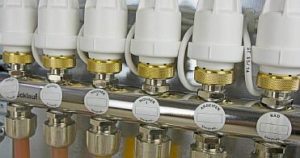
When choosing a bleeder, experts recommend paying attention to Mayevsky valves—they are reliable, durable, and require no adjustment.
Automatic devices have a more complex design and are more expensive. Furthermore, they become unusable when dirty.
As you can see, air locks lead to malfunctions, but this problem is easily solved. The key is to bleed the air from the pipeline promptly, and this must be done correctly and regularly.


Underfloor heating yesterday and today. 3 types of underfloor heating: air-heated, electric, and water-heated.