Underfloor heating is becoming increasingly popular among homeowners. It can be used as both a primary and a secondary source of heating.
When it comes to choosing a heated floor model for an apartment, everything is more or less clear: preference is given to electric types, since water-based systems are heavy and require connection to the central heating system of the apartment building.
Choosing a heating system for a private home is more challenging, as any type of device can be installed. Before choosing a particular model, it's important to carefully weigh the pros and cons.
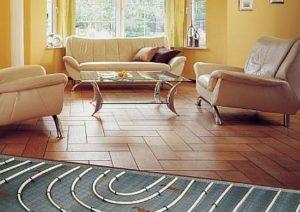
- What is the difference between a water-heated floor and an electric one?
- Water-heated floor heating
- Electric underfloor heating
- Pros and cons
- Water-heated floor heating
- Electric heated floors
- What is more profitable and economical to operate?
- Which flooring installation will be cheaper and easier?
- Which system is the safest and most reliable?
- Which gender is better to choose?
- Video tutorials
What is the difference between a water-heated floor and an electric one?
To compare underfloor heating systems and determine whether electric or hydronic heating is better for your home, you need to consider the specific characteristics of each type. Both systems can provide a comfortable indoor environment with uniform air heating.
As mentioned above, heated floors can be water-based or electric, the main difference between them being the coolant.
Water-heated floor heating
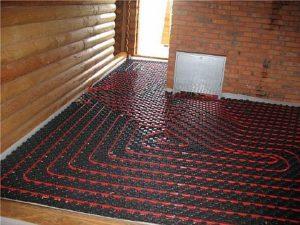
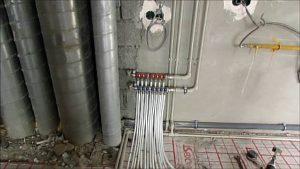
It consists of pipes laid out in a specific pattern (like a "snail" or "spiral"), through which heated water or another coolant flows. To heat it, it must be connected to a central heating system or an individual boiler equipped with a pump.
Hydrofloors evenly heat the area, preventing cold spots. They can be installed in a screed or on a wooden floor. A waterproofing layer and insulation are required in the "pie." The pipes are attached to a reinforcing mesh or laid on a polystyrene foam mat with studs.
Electric underfloor heating
Electric floors are powered by electricity and come in:
- cable - the heating element is a heating cable with current-carrying conductors that have high resistance;
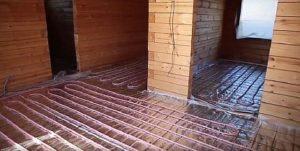
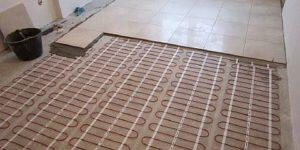
- mats - also belong to the cable type, but the installation process is much simpler, since the wire is already fixed on the fiberglass mesh with a certain pitch;
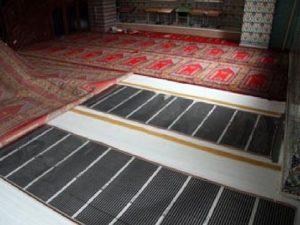
- Film infrared heaters are a film with carbon plates, heat is released in the form of infrared waves.
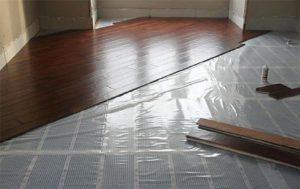
Electric cable-based underfloor heating is installed in a layer of tile adhesive or concrete screed. Dry installation is also possible. A layer of waterproofing and thermal insulation is required.
Infrared systems are easier to install, eliminating the need for screeding. Therefore, among electric underfloor heating systems, they are clearly the best option for DIY installation in a private home, as the process is simple and quick.
Today, a combined electric-water system is recommended for cottages. This type of underfloor heating is also called liquid electric, as the heat transfer fluid is not water, but antifreeze.
It consists of a circuit of pipes containing circulating antifreeze and a special wire. When connected, the heating cable heats the fluid, which in turn transfers heat to the flooring.
Pros and cons
When choosing the best underfloor heating model for your home, you should compare all the positive and negative aspects of each system.
Water-heated floor heating
The main advantage of hydronic underfloor heating over electric underfloor heating, especially when installed in a private wooden house, is fire safety. It's also worth noting that hydronic underfloor heating is suitable for installation in rooms of any humidity, including saunas, swimming pools, and bathrooms.
The disadvantages of this type include more complex installation. Installing it yourself without construction experience is not easy.
In addition, since pipes are generally laid under a concrete screed, if a pipeline is damaged, it is very difficult to determine the location of the leak and fix the problem.
In rooms with low ceilings, the thickness of the floor "pie" plays an important role; in a water-based structure, it is impressive.
To ensure the floor functions properly, the pipe spacing must be calculated correctly. Excessive spacing reduces efficiency, while insufficient spacing can lead to overheating of the surface.
Difficulty also arises when selecting the pump's capacity and installing it correctly. If the capacity is incorrectly selected, the overall pressure in the system may drop during operation.
Important! On the one hand, the high temperature in a water-heated floor means better heating of the room, but on the other hand, it reduces air humidity, which is not very good for human health.
Another important point that complicates the process of installing a water-based floor when connected to a central heating system is obtaining permission to carry out this work.
Electric heated floors
The main advantages of installing an electrical circuit in a private home:
- easy installation – no special equipment required;
- temperature control is available in a separate room;
- In case of breakage, there is no need to dismantle the entire coupler, it is enough to clear the area of the fault;
- in the case of mats or film, if a malfunction occurs in some area, the entire structure continues to function;
- increased reliability.
In addition, some models of this type of flooring (IR film) can be used as a mobile heater, which is very convenient when using the device as an additional heating source.
It's worth noting that electric systems, unlike hydronic systems, have a thinner "pie" thickness. They can be installed within a layer of tile adhesive, while the IR film can be installed directly under the flooring.
The main drawback of electric floors is high electricity costs. There's also a fire safety risk, although it's minimal. It's also worth remembering the potential for problems during a power outage, as the floor's operation depends on it.
As for mats and film floors, their presence under the flooring makes furniture placement difficult, as heavy objects cannot be placed on them. It's necessary to carefully consider the interior design and the layout of the heating elements.
Installing cable floors in rooms with high humidity requires the use of a special heating cable equipped with a protective layer against moisture, which increases its cost.
We invite you to take a closer look at Electric floor installation: types, diagrams, and how to install it yourselfAnd.
What is more profitable and economical to operate?
Which heated floors are better and will be cheaper to operate? This is a question often asked by homeowners.
In terms of coolant cost, water-based systems are definitely more economical. Heating the liquid inside pipes is significantly cheaper, especially with a gas boiler.
The price of energy that powers electric floors is quite high, although with proper use of a thermostat, you can save on energy resources.
When comparing hydronic and electric underfloor heating systems in terms of repair and maintenance costs, it can be said that the cost of repairing a damaged cable is lower than repairing a pipe. And if hydronic underfloor heating is installed on the second floor of a cottage, a serious leak in the circuit will require repairs to the room below.
Which flooring installation will be cheaper and easier?
When considering which type of underfloor heating is better, hydronic or electric, based on the cost of components for installation, experts estimate that the overall cost of an electric underfloor heating kit is twice that of hydronic components, because:
- Electric heaters use a heating cable, which serves as the heating element, and are expensive. Additionally, they require a temperature sensor and thermostat.
- Water-heated floors require the purchase of plastic or metal pipes and standard thermal and waterproofing materials.
However, installing hydronic underfloor heating, if connected to a common heating system, requires obtaining a permit, preparing a number of documents, and paying a state fee. No permit is required for installing an electric system in a home.
Ultimately, the cost of installing both types of flooring is approximately the same.
Which system is the safest and most reliable?
When comparing underfloor heating systems in terms of safety, hydronic systems are undeniably superior. There's no risk of short circuits or electric shock. However, modern cable and film underfloor heating systems offer increased levels of protection, and this risk is minimized.
In terms of reliability, a heating cable is a high-quality product with an extended warranty. Even inexpensive cable can last up to 20 years. The temperature sensor and thermostat are the most likely to break and require replacement.
In a water pipeline, the pipes themselves have a long service life, but the fittings need to be replaced every 10 to 15 years. Replacing them requires removing the concrete screed.
Which gender is better to choose?
Choosing the best type of underfloor heating largely depends on the type and characteristics of the home being heated, so consider this when choosing a model. Floor thickness is crucial: at least 7 cm for a water-based system, and at least 4 cm for an electric system. When installing infrared film underfloor heating, thickness is irrelevant.
In addition, you need to take into account:
- Device power: water heaters heat the floor to a temperature of 50 degrees, while cable heaters have a heating range of 15 to 30 degrees.
- Heating costs for the coolant: Electric floors require approximately 180–200 watts of energy per square meter, with the floor only heating to 30 degrees Celsius. The efficiency of a hydronic system is much higher.
- Fuel type: If your home has gas, then hydronic underfloor heating is definitely the best choice. This type of heating is simple, inexpensive, and allows for temperature control.
- The type of flooring is an important consideration When choosing a heated floor model, consider ceramic tiles. Ceramic tiles are the best option; they are suitable for all types of heated floors. Ideally, the flooring should have special markings indicating the compatibility of the finishing material with the heated floor system.
When choosing the type of underfloor heating for a private home, it's important to remember that installing a water circuit is a labor-intensive and messy process. And if you have a concrete screed, it also takes a long time to harden.
If you're planning to install heated floors in a private home before construction or major renovations, electric underfloor heating is the best choice. If you need a portable unit for installation under carpet, mats or infrared film are suitable.
However, for many, the decisive factor when choosing a warm electric or water floor for an apartment or house is the operating cost of the structure.
When installing a water circuit, a number of nuances and laws must be taken into account—in terms of hydraulics and heat energy distribution—so it is best to have specialists handle the design of the structure.
In conclusion, both types of heated floors have proven themselves to be effective. However, for private homes with a separate heating boiler or gas, hydronic underfloor heating is the better choice.
The final decision, of course, rests with the homeowner. It should be based on their requirements for the heating source, as well as their technical and financial capabilities.
However, it is better to purchase one model or another after consulting with a qualified technician and weighing such factors as operational reliability and cost-effectiveness.