Heating devices that convert electricity into heat are called electric. Electric underfloor heating systems, which are used as a primary or supplemental heat source, are among these heating systems.
There are several types of electric floors.We'll help you understand the features of each model and discuss its pros and cons. You'll also learn how to install electric heating yourself or explore more. detailed instructions on how to install different types of electric floors yourself.
- Types of electric floors
- Cable floor
- Installation of cable floor and heating element
- Operating principle
- Pros and cons
- Heating mats
- Device
- Principle
- Pros and cons
- Infrared film
- Device
- Operating principle
- Pros and cons
- Rod floor
- Devices
- Operating principle
- Advantages and disadvantages
- Temperature regulating and controlling device
- Installation
- Preparing the base
- Laying thermal insulation
- Installing a thermostat
- Laying heating elements
- Connection
- Wiring diagrams for apartments and private homes
- Comparative characteristics of floors, which one to choose
Types of electric floors
Electric underfloor heating designs differ in the type of heating element—cable or infrared heater.
The first type includes:
- heating cable - a single-core, two-core or self-regulating wire can be used;
- Heating mats are the same cable, but fixed on a mesh.
Infrared systems are:
- film - flexible fabric with an infrared heating element;
- rod-shaped - mats with carbon rods.
Below we will consider their features and disadvantages in more detail.
Cable floor
In the design of a cable electric floor, the main element is the wire, in which electrical energy is transformed into heat.
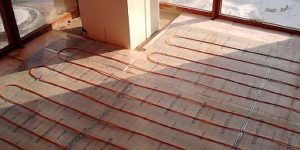
Installation of cable floor and heating element
Cable heating includes: heating cable, connecting couplings, adjustment and control devices.
The main component is the heating cable, which has several insulating layers. It consists of current-carrying conductors, fiberglass reinforcement, polyester film, a copper conductor, an aluminum shield, and a protective PVC layer.
Electric underfloor heating cables come in resistive and self-regulating varieties. Resistive cables include:
- Single-core cable is inexpensive, but its high level of electromagnetic radiation makes it unsuitable for installation in living areas.
- Twin-core cables have one heating core acting as a regular wire, while the other acts as a heating core. This property increases cost but reduces EMI.

Self-regulating cable — it can change the heating level depending on the room temperature. The cable consists of two closed parallel current-carrying conductors with a semiconductor matrix.
These semiconductors are responsible for regulating and controlling the heating level. This type of cable saves electricity, but does not reduce the uniformity of surface heating.
Operating principle
Externally, a heating cable resembles a regular wire transmitting electrical energy, but it's not that simple. Its conductors convert electrical energy into heat.
Since the cable is shielded, it is suitable for installation in rooms with high humidity levels.
Pros and cons
This electric floor model is the most complex in terms of installation. It requires laying and securing the cable, then pouring it with concrete screed—a labor-intensive process (mixing the mortar, pouring it onto the surface, and leveling it with a leveling screed).
This design reduces ceiling height and adds weight to the structure, making it unsuitable for installation in buildings with weak ceilings or in high-rise buildings. Another drawback is that it cannot be placed under heavy furniture or plumbing fixtures.
However, it should be noted that cable-based electric underfloor heating does have its advantages. They can be installed in rooms with irregular layouts and used to heat elements outside the home, such as the roof or gutters. There's also no risk of leaks.
Heating mats
Heating mats are similar to electric cable floors, but the wire is attached to a fiberglass mat.
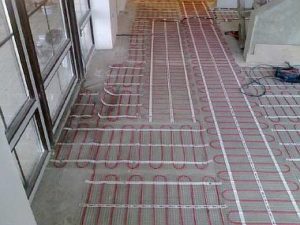
Device
The heating mats are 0.5 meters wide, with a wire attached to them at a preset pitch. The unit includes the heating mats, cable, and a corrugated tube. The corrugated tube accommodates the temperature sensor, protecting it from moisture. If the structure is filled with adhesive and the adhesive does not completely cover the sensor, a moisture-resistant device is required.
To install this type of electric underfloor heating, you'll need a thermostat with a remote sensor, junction boxes, and wiring. When choosing a thermostat, consider the energy consumption level, and the wires, or more precisely their cross-section, are selected based on the appliance's power rating and the material they're made of.
The heating element is simple—a cable, usually two-wire, no longer than 45 mm. The wires are shielded and covered with a protective sheath.
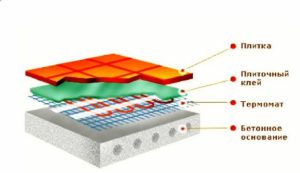
The design of a warm floor with heating mats consists of a subfloor, heat and water material, the mats themselves, tile adhesive and a finishing coating.
Principle
The operating principle of the mat is the same as that of a floor made of ordinary cable.
The current passing through the conductor generates heat, which is transferred by convection to the screed, from it to the floor, and it heats the air.
Pros and cons
The main advantage of heating mats is their simplicity and installation. There's no need to secure the cable or calculate the installation spacing; the structure is completely prefabricated; all you need to do is lay out the mat.
Moreover, this type of flooring warms up faster than a conventional cable floor, the resulting "pie" is less voluminous, and the mats are thin and can be installed in a layer of tile adhesive. Because the device is lightweight, it can be supported by weaker floors. However, such floors are more expensive.
The disadvantages also include:
1. Difficulty of installation, especially when going around an obstacle. For example, plumbing fixtures are difficult to get around because you can't cut the cable; you can only trim the mesh and bend the wire.2. Inability to adjust the laying step to suit your needs.
3. It is not suitable for use as primary heating, as the mats have low power.
Infrared film
Warm floors based on infrared film are one of the models that also operate on electricity.
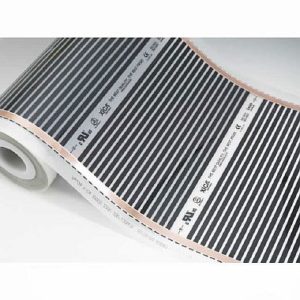
Device
Infrared floors have recently come into use as a heating device. They come complete with thermal film, clamps, insulation, electrical wiring, a thermostat, a sensor, and foil material.
The system consists of a two-layer dielectric durable film with a carbon heater inside; the thickness of the structure is approximately 2 mm.
Infrared films are produced in two types:
- solid - two-layer polyurethane fabric with continuous carbon coating inside;
- Striped - this is the same, two-layer lavsan or polyurethane film, with carbon or ultra-thin aluminum stripes.
The heating elements are connected in parallel and series using thin copper-silver conductors.
The installation method of the film system is “dry”, without pouring a screed.
Operating principle
When the device is connected to the network, the plates heat up and heat energy is emitted in the form of infrared waves, which heat objects in the room.
Pros and cons
Film has advantages over cable floors. Firstly, it doesn't reduce the room's height due to its thin thickness. The structure is also lightweight, making it suitable for installation in high-rise buildings or houses with fragile ceilings.
Secondly, installation is straightforward and easy to do yourself. The film is rolled out on a base and can be cut if needed, thanks to the special lines on it. There's no need to consider furniture placement and no screeding is required. Dismantling is also straightforward.
It's worth noting that infrared floors are a reliable and energy-efficient system, saving up to 50% of energy. They do not emit electromagnetic waves, which have a negative impact on human health.
Disadvantages include high cost and the risk of electric shock, but this is negligible with modern systems. Another drawback, which applies to all electric underfloor heating models, is that they rely on electricity.
Rod floor
Rod floor - it heats the room with far infrared waves.
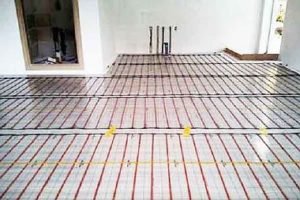
Devices
Rod system - carbon parallel rods, connected into elastic mats by a power cable. The average width of the mats is 0.8 meters, and the length is 25 meters.
The heating element consists of rods composed of carbon, silver, and copper, but only the carbon component generates heat. This electrical equipment also includes a temperature controller and sensor. You'll need bitumen insulation, thermal insulation material, and corrugated pipe.
Operating principle
Infrared core floors are self-regulating, meaning the heat output is directly proportional to the temperature. If heat transfer is poor (say, because you've placed furniture on the floor), the amount of heat generated is reduced, preventing overheating.
This feature allows the mats to be laid over the entire area. Using this system, the air is not heated, but the objects in the room are heated.
Advantages and disadvantages
A key advantage of core floors, like infrared ones, is the absence of electromagnetic radiation. Heating is achieved using infrared waves.
The system can be installed under any flooring, is environmentally safe, and can be installed in rooms with unusual layouts and areas with high humidity. Its self-regulating properties help conserve resources, and therefore money.
The main drawback is that it must be installed into a screed, making removal impossible. This type of heating is expensive and has a short service life—from 3 to 10 years.
Temperature regulating and controlling device
A thermostat regulates and controls the temperature of the electric floor. Once set, it automatically maintains the set temperature.
The thermostat is based on the readings of the sensor, which is connected to it by a thermal protection wire.
Thermostats can be mechanical or automatic.:
- Automatic heaters have a digital display that shows the room's temperature. A convenient feature of these heaters is a remote control for adjusting the temperature.
- Mechanical - equipped with an adjustment handle, which is used to set the temperature level.
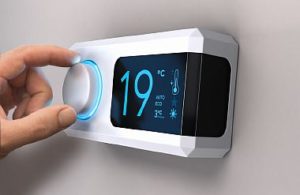
The thermostat operates constantly, so its material must be high-quality and its connections reliable. It responds to any signals from the sensor, turning the heating on or off.
Installation
Let's look at installing an electric floor using the example of a simple, modern model - infrared film.
We will need to buy thermal film, a thermostat, a temperature sensor, wires for connection, tapes - damping, mounting and insulating.
Preparing the base
Underfloor heating installation is considered "clean" work, so before installation, the walls should be cleaned and plastered, and any cracks should be sealed. However, after such work, the surface is covered with dirt and even hardened concrete lumps.
According to the technology for installing and installing underfloor heating systems, the base for infrared systems must be level and clean, so all this dirt must be removed. Hardened concrete chunks can be removed with a spatula or a special compound. Afterwards, the surface should be dampened and all debris swept away with a broom.

If there are deep cracks, they are filled with cement mortar. If there are large differences in the floor surface, a thin layer of screed can be poured to create a level base.
Laying thermal insulation
The function of a thermal insulation product is to minimize heat loss.
A 3-4 mm thick heat-reflective underlayment is installed. It's best to choose a product with a foil-faced surface facing the ceiling. The panels are secured with adhesive tape and attached to the base.
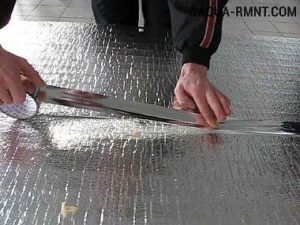
Foam sheets can be used in combination with foil as thermal insulation.
Installing a thermostat
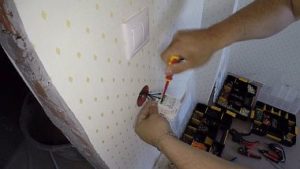
Before installing the heating film, a thermostat must be installed. It should be mounted on the wall, at least 30 cm above the floor.
Before cleaning the base, a recess is made in the wall for the thermostat, and grooves are made for the wires from it to the floor.
Laying heating elements
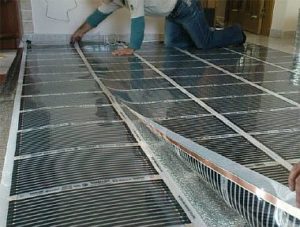
The IR film is laid according to the plan (it is not placed under furniture), 5 cm from the walls. The sheets are laid with the copper strips facing down. Avoid overlapping one sheet. They are secured with construction tape.
If necessary, the film can be cut along the existing lines.
Connection
The process of connecting infrared film consists of several stages:
- The temperature sensor is connected—it's placed in a corrugated pipe, which is positioned in a recess made in the thermal insulation material (its average width is up to 1 cm). The wiring from the sensor, also placed in the corrugated pipe, is pulled through the grooves made in the wall to the thermostat and connected to it. The sensor is placed 50–70 cm from the wall where the thermostat is installed and secured with tape. The device must not protrude above the thermal insulation material.
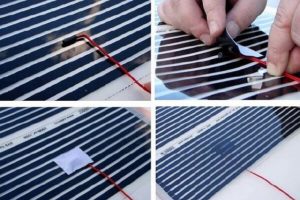
- The film is connected using the terminals included with the flooring kit. The insulation is removed from the wire at the end of the film. It is coiled and inserted into the terminal, and the clamp is secured with pliers. The connection point is then insulated with bitumen tape. To prevent the terminals from protruding from the structure, recesses are also made in the thermal insulation for them.
The terminal itself is installed with one side on the copper strip, while the other side should be located on the inside of the film. The contact between the clamp and the product is also insulated.
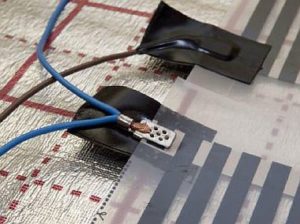
- The thermostat is connected, that is, it is connected to an electrical power source.
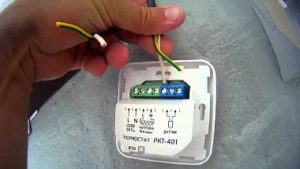
After this, the system needs to be tested for functionality. If all the strips are heating normally and there are no short circuits anywhere, then you can proceed to laying the flooringBut before this, the device is covered with a protective polyethylene film, which will protect it from accidental water ingress.
Wiring diagrams for apartments and private homes
There are several electric floor installation schemes designed for different rooms:
- The screed-based construction method is the most expensive and requires complete renovation. However, the structure is reliable. The installation process using this method is labor-intensive and time-consuming, and the resulting floor "pie" is heavy. This method is recommended for private homes and is not suitable for buildings with wooden floors.
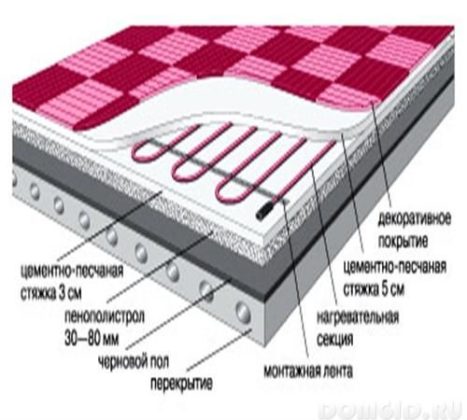
- Built-in structures, if there's a finished screed. They're most often installed under ceramic tiles and in kitchens or bathrooms. This design is used if there's already a good screed, or the floor is being installed on concrete slabs, which are ideal for heating elements. This system simply requires a liquid self-leveling compound, and adhesive can be used when laying ceramic tiles.
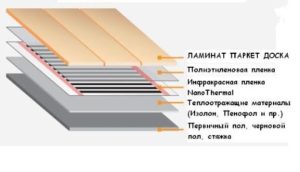
- Installing a film heater is the simplest method. The process is quick and requires no repairs; simply unroll the roll. The lightweight design is suitable for apartments.
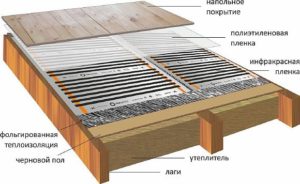
- Installation on wooden floors – here, the infrared film system is recommended, but greater emphasis should be placed on fire safety. Cable installation on joists is also possible.
Comparative characteristics of floors, which one to choose
Before choosing a heating system that will suit your needs and create comfortable conditions in your home, you should familiarize yourself with the characteristics of both the device and the room.
If the floor is planned as the primary heat source, a robust cable system embedded in the screed is required. It's reliable and capable of providing the home with the required amount of heat.
Infrared systems are suitable for installing supplemental heating. Film is especially suitable; it's portable and can be laid only in the desired area. Its light weight makes it suitable for rooms with unstable ceilings and for apartments in multi-story buildings.
Electric underfloor heating is gaining popularity these days because it's easier to install than hydronic systems, making installation a breeze. The only significant drawback is energy costs. However, modern systems offer significant savings. Therefore, to ensure your home is always warm and comfortable, opt for electric heating.




I think that despite the apparent simplicity of installing underfloor heating, many misunderstandings can arise during the process. Therefore, to avoid having to redo the work later, it's best to entrust this work to a professional.
If you have no experience whatsoever in carrying out such work, then it is better not to undertake the installation yourself.