In today's world, underfloor heating systems are no longer considered a luxury—they're a cost-effective and convenient way to heat a home. However, not every flooring can be installed over a heated surface. Therefore, when installing such heating systems, many people wonder: can linoleum be laid over underfloor heating?
Public opinion has developed such that linoleum is rarely used as a finishing surface when installing heated floors. It is believed that when heated, this material can release substances harmful to human health. Furthermore, its soft texture will quickly deteriorate when exposed to temperature fluctuations.
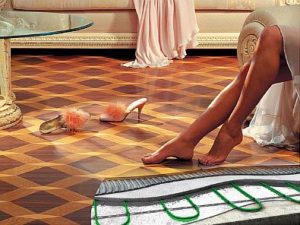
This possibility exists, but only if the linoleum is of low quality and the temperature regime is not observed during operation of the heating system.
With the right approach to selection—high quality and a combination of material and heating devices—it will serve as well as ceramic tiles.
- Types of linoleum, prices, markings, and manufacturers
- Types
- Linoleum markings for heated floors
- Price and manufacturers
- Maintaining thermal conditions
- Types of heated floors
- Water
- Electric
- What type of underfloor heating is best suited under linoleum?
- How to properly lay linoleum over heated floors
- Video materials
Types of linoleum, prices, markings, and manufacturers
Linoleum is a practical and durable product, and it's also affordable. It has long been successfully used as a finishing material in apartments and offices.
Types
To ensure your flooring lasts a long time, you should understand its different types, as well as which linoleum is best to lay over a hydronic underfloor heating system, and which is best for an electric system.
The most famous brands of linoleum are:
- Natural (marmoleum) is the safest option, as it contains natural ingredients (linseed oil, pine resin, cork, and natural dyes). It is fireproof, durable, and highly resistant to deformation. The main drawback is the high price compared to other brands.
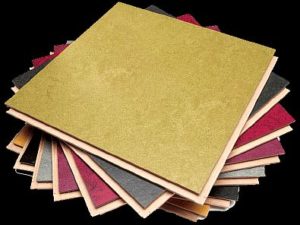
Since the product is natural, no toxic substances harmful to health are released when heated.
- Vinyl – in addition to PVC, it contains additives that provide strength and rigidity. It's a popular finishing material due to its affordability. For underfloor heating, it's preferable to choose a product with a fabric backing or no backing at all. However, adding an insulating layer is not recommended, as it will partially trap heat, thereby reducing the efficiency of the underfloor heating.
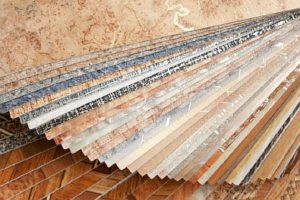
When heated, PVC emits an unpleasant odor, which is why it is not recommended for underfloor heating systems. However, the odor will only be present when the heating system is first turned on, and will disappear after about a month.
This type comes in residential, commercial, and semi-commercial grades, varying in strength. The latter two are recommended for residential applications due to their increased stability and longer service life.
- Rubber (relin) — the base is made from crushed, used rubber, covered with a synthetic rubber coating with additives. This combination of components makes it flexible and moisture-resistant. However, this material is not recommended for use in living rooms or on heated floors, as it may deform when heated.
- Collodoxylin (nitrolinoleum) is moisture-resistant, thin, and highly elastic. However, it is a fire hazard, so it should not be installed over electric underfloor heating.
- Alkyd (glyphthalic) is a high-quality product with a fabric backing. It has excellent thermal insulation properties, but it loses its shape when heated.
Linoleum is classified by structure as either homogeneous or heterogeneous, meaning it can be uniform or multilayered. Homogeneous linoleum is primarily PVC and is used in challenging environments due to its strength and durability. Heterogeneous linoleum, on the other hand, can be used in a wide range of conditions, offering a wide range of options.
Furthermore, the product differs depending on whether it has a backing or not. A backing-free covering is uniform and lacks a fabric or felt layer that serves as reinforcement and insulation. Backing-free coverings are recommended for use in rooms with low humidity.
Linoleum markings for heated floors

Can linoleum be laid over heated floors? Yes, but only special types. These are easily identified by the markings—a "snake" and three arrows—on the back of the product.
It speaks of its resistance to high temperatures and its lower flexibility. However, even despite this, linoleum's specific qualities should be considered and protective measures taken to prevent it from overheating.
Price and manufacturers
As mentioned above, the cost of linoleum varies depending on its brand and quality. Natural linoleum is much more expensive, but if possible, it's better to buy it. PVC linoleum is inexpensive, but its high quality makes it suitable for installation over heated floors. The average price in this segment is 300 rubles per square meter.
However, it's better to buy more expensive options from reputable manufacturers (Tarkett Utex, IVC, Forbo). Tarkett is particularly popular in the Russian market, producing high-quality PVC flooring to suit any budget.
Among manufacturers specializing in natural, environmentally friendly, and high-quality products for underfloor heating, Forbo deserves special attention. The company produces high-quality marmoleum in several grades.
Maintaining thermal conditions
Choosing a high-quality flooring solution doesn't require any special knowledge, as the manufacturer's instructions indicate the suitability of this material for use with heated floors. This information can be found near the markings, which also indicate the permissible temperature level, which is 27 degrees Celsius.
Please note! If the temperature exceeds this limit, the flooring product will be damaged.
PVC linoleum can withstand temperatures of +30, but there is no guarantee that the material will not be damaged, and it may also release harmful substances.
To ensure proper temperature control, you'll need a high-quality thermostat, ideally a digital one. Then, the temperature will be maintained automatically.
Types of heated floors
Underfloor heating systems come in two types: hydronic and electric. The main difference between these heating systems, aside from their design features, is that hydronic floors use a heat transfer fluid with specific properties and qualities, such as heating and cooling inertia.
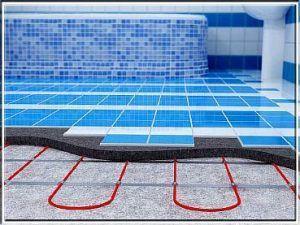
The operation of an electrical device depends only on the presence of current, so this option is more convenient and cost-effective.
Water
In hydronic floors, the heating source is a liquid coolant—water or antifreeze—that circulates through pipes within the floor. The surface heats up slowly. Furthermore, this heating option is not suitable for rooms with low ceilings.
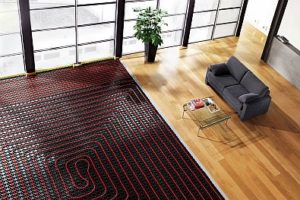
There are two ways to install water-heated floors, depending on the type of flooring:
- With a concrete screed—if there's a strong concrete floor that can support the weight of the cement mortar. The "pie" of a hydronic underfloor heating system consists of a base, insulation, and piping, all covered with a concrete screed.
- Floor-mounted — if the base is wooden and cannot support heavy loads. Water pipes can be placed on specially designed slats or on polystyrene foam mats with studs between which the circuit is secured.
Electric
Electric floors - their main feature is that they are powered by the electrical network.
There are:
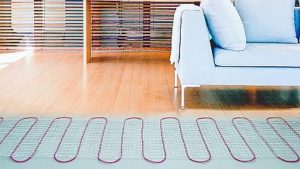
- Cable-based systems use a cable as the heat source, which is laid according to a diagram. Cable-based systems also come in the form of mats, meaning the cable is already fixed to a fiberglass mesh at a specific pitch. Installation methods include dry laying or screed laying. The installation process is straightforward, especially when using mats.
The advantage of this heating system is that the surface heats evenly, which is important for linoleum. However, it is not recommended to lay this type of flooring over cable floors, as it heats up quickly, which can damage the flooring.
Important! If you choose a cable-based design, you must constantly monitor the heating process to prevent the floor surface from overheating.
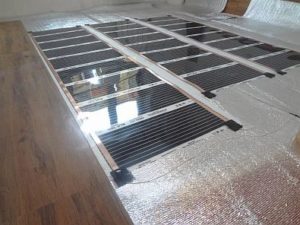
- Infrared heating systems use rods or film with carbon plates as heating elements. This type of heating is installed without screeds. The surface is heated evenly and gradually using infrared rays, eliminating the possibility of coating deformation. The main disadvantage is that the system is sensitive to moisture.
What type of underfloor heating is best suited under linoleum?
Linoleum is a soft and thin product, even one designed for use with heated floors. When exposed to heat, the material softens even further, and after a while, you can see marks from furniture legs on it.
Additionally, surface bulges may occur. Furthermore, it is recommended to install this flooring only on a flat and smooth surface.
We invite you to find out What finishing coatings can be laid on different types of heated floors?.
These features of the product require compliance with a number of rules during installation and operation:
- installation of high-quality flooring;
- the presence of a device for monitoring and regulating the temperature level.
As mentioned above, linoleum should not be laid on excessively hot surfaces or on floors without a rigid underlayment. Therefore, experts believe that the best type of linoleum flooring is underfloor heating installed on a smooth concrete-cement screed.
Cable mats with a chipboard backing are also a viable option. A screed or plywood backing will soften the thermal energy impact on the surface and create a sagging-free surface.
It's worth noting that water-based devices are inert, as they heat up gradually and release heat just as slowly, so there are no sudden temperature fluctuations, which has a positive effect on the appearance of the linoleum during use.
Infrared heated floors are considered a good option; their gentle mode preserves the properties and appearance of the linoleum. They are especially recommended in cases where hydronic heating is not possible due to the heavy structure or low ceilings, as well as when installing heated floors under linoleum in high-rise buildings.
To summarize, there's no definitive answer as to which underfloor heating system is better for linoleum—water-based or electrically powered. When choosing, consider not only the specifics of the heating system but also the characteristics of the room.
How to properly lay linoleum over heated floors
Correct installation of underfloor heating not only affects the efficient operation of the system, but also the quality and extended service life of the product.
The installation of a heated floor "pie" under linoleum is carried out in the following sequence:
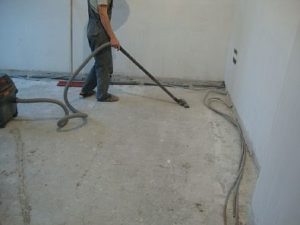
- Preparing the subfloor is an important step. The base must be level and clean, regardless of whether the underfloor heating system is hydronic or electric. Any unevenness is filled with putty, and then the surface is primed twice.
If there is an old base, to make it level, it is better to pour a thin layer of rough screed.
- Hydro and thermal insulation - you can lay sheets of foam plastic with polyethylene film or foil-coated polystyrene foam mats.
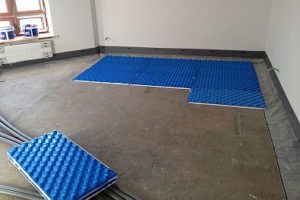
- Installation of heating elements - water circuit, cable or infrared film.
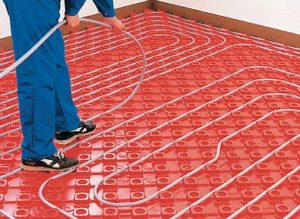
- Preparing the subfloor for linoleum—the surface must be rigid. If a cable or water-based floor is being installed in a screed, the linoleum will be laid on a concrete base, which must be leveled.
If there is no screed, if a film floor is being installed, the heating system should be covered with polyethylene, and then plywood sheets should be laid; they will serve as the base for the finishing coating.
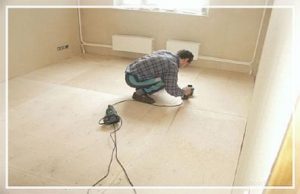
Important! The joints between the sheets must be filled with putty, and the plywood itself must be sanded to remove all imperfections.
- Linoleum installation: Lay it over the entire room and leave it for a day to straighten. When laying on a concrete surface, the material must be glued to prevent ripples. A special adhesive for heat-resistant linoleum can be used for this. The flooring is secured around the perimeter of the room with baseboards. If multiple sheets are being laid, tape them together and glue them to the floor. For linoleum with a felt backing, use Gumilax adhesive, and for natural linoleum, use Bustilat.
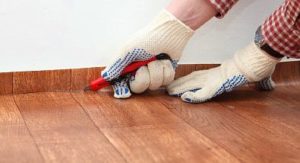
Please note! Linoleum brought in from outside should not be laid immediately; it must be left indoors for 5-6 hours.
In conclusion, it's possible to lay linoleum over heated floors. The key is to choose the right brand and maintain the correct temperature. Then it will last a long time and delight you with its perfect appearance.