Underfloor heating is now widely used and can serve as both a supplemental and primary heating source. Manufacturers claim that this type of heating is more efficient and offers numerous advantages.
This article will help you determine whether this statement is true. In it, we've reviewed all models of heated floors, highlighting their advantages and disadvantages, installation features, and operating instructions.
Types of floors
The physics of underfloor heating differs from radiator heating in that there is no convection of hot air masses. In underfloor heating, the air heats up and rises toward the ceiling.
Today, the heated floors available on the market are divided into two types: electric and water.
Water floors
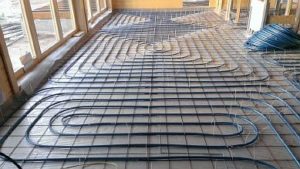
A water-heated floor is similar to a standard heating system, the only difference being the location of the pipes through which the coolant circulates.
Conventional radiators are located on the wall, while the underfloor heating circuit is located under the floor covering.
The most important part of the device is metal-plastic or polypropylene pipes, which are most often filled with concrete screed, although it happens, that the pipes are laid using the dry laying method.
The kit includes a heater (gas, electric or wooden), a manifold unit with a circulation pump and a temperature control device.
Electric floors
Electric floors are simpler in design than hydronic ones, and their installation is less expensive. They consist of heating elements and a thermostat. These floors are powered by electricity. They are designed for areas no larger than 30 square meters. To prevent overheating of the heating elements, it is recommended not to place heavy furniture on them.
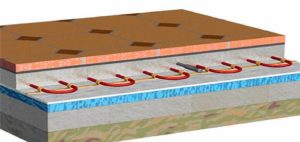
Electric floors are divided into:
- Cable - a cable with conductive cores acts as a heating element.
- Mats are the same as cable floors, only the wire is fixed on a special polymer mesh with a certain pitch.
- Infrared - consist of two layers of metallized lavsan film, between which heating strips are located, and copper or silver wires through which current passes.
- Rod heaters are a modern type that are also infrared devices. Unlike film heaters, they have carbon rods instead of plates.
Advantages and disadvantages of electric underfloor heating
As you can see, there are different models of electric underfloor heating, and to choose the right one for your space, you should know all their advantages and disadvantages, as well as understand the intricacies of installation and operation.
All Pros and cons of underfloor heating various systems in an apartment or private house
Important! A common drawback for all types of electric floors is that they will not function without power.
Cable systems
Compared to standard heating radiators, cable floors have the following advantages:
- efficiency - heats the space evenly;
- equipped with a thermostat, allows you to control the temperature level;
- do not spoil the interior - they are hidden under the finishing coating;
- create a favorable microclimate - do not dry out the air;
- efficiency – allows you to reduce heating costs;
- service life of more than 50 years.
The main drawback of cable floors is the presence of an electromagnetic field, which is harmful to humans. This drawback applies only to inexpensive models, but even in these models, the radiation is within normal limits.
Electrical cable devices, as mentioned above, are produced in the form of a heating wire and a mat:
- Heating cable is designed for installation in apartments or private homes, typically as a supplemental heating source, although it can also be used as a primary heat source, especially during the off-season. It's ideal for spaces where minimal screeding is planned or where adhesive is used.
For the construction of these structures, it is permissible to use resistive or self-regulating cable, which can be laid in a "snake" or "snail" pattern. Resistive cable is divided into single-core and twin-core types.
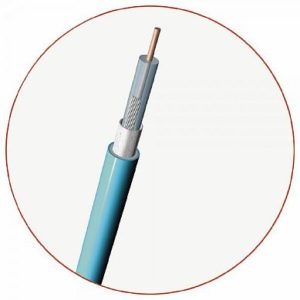
Single-core cables—the heating end is connected to the temperature controller, then the wire is laid according to the planned layout, and the other end is also connected to the thermostat. Compared to a two-core cable, a single-core cable has a higher heating temperature, so it requires less energy. It's also inexpensive.
A two-wire resistive cable—this type of cable only needs to be connected to the thermostat at one end, making it convenient for large rooms with complex layouts.
The unique feature of this type is the insulation of both each individual core and the overall braid. The cable is easy to install, and the voltage passing through it does not affect electromagnetic waves.
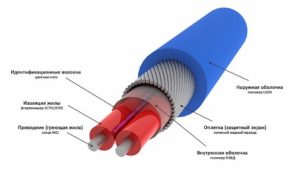
Both types of resistive cables provide uniform heat distribution across the entire surface. However, there is a risk of overheating the flooring under furniture, which can lead to floor failure.
Please note! When designing the installation, it is recommended to consider routing the resistive heating cable so that it does not pass under heavy furniture.
A self-regulating cable is a semiconductor that contacts the matrix. A special polymer material is used for its production. The advantage of this type is its ability to independently adjust the heating level based on the room temperature.
Furthermore, improper installation does not affect the floor's performance, and the cable's design prevents it from overheating. It offers high-quality protection against mechanical impacts and a long service life. Installation of self-regulating cable is simple, and it can be used in rooms of any size, starting from 1 m².
The disadvantages of this type of heating cable include its high cost and short service life. For effective operation, a self-regulating cable floor requires special control elements. Furthermore, this design heats the room slowly and can only create comfortable conditions on the floor surface.
- Heating mats are ideal for installation under ceramic tiles. Their advantage is their ease and speed of installation, unlike conventional cables, as they are already secured to the mesh. The heating elements are spaced at regular intervals, typically 9 cm. They come in various lengths, with a width typically of 0.5 meters.
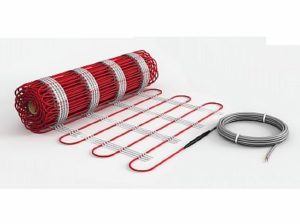
The mat's conductors consist of a shield, insulation, and winding. The aluminum-lavsan shield protects against potential electric shock and makes it safe for humans. Mats are available in single- and dual-core cables. Dual-core cables are recommended for bedrooms and children's rooms, as they have lower radiation levels.
The advantage of this type of underfloor heating is that it can be installed in a layer of adhesive, which means no reduction in ceiling height. Another advantage is that if one part fails, the entire structure continues to function.
Please note! When any cable floor is in operation, electricity is converted into heat. It is installed in a 30-50 cm thick screed or using a dry method.
As with any underfloor heating system, cable flooring requires preparation of the base, including clearing any debris and sealing any cracks.
Lay down the waterproofing and thermal insulation material, at least 3 mm thick, and only then attach the heating cable. It is usually secured to the reinforcing mesh with clamps or studded polystyrene boards.
Important! When laying mats, you need to cut them carefully so as not to damage the cable.
Infrared film
Infrared film is a multilayer structure consisting of a non-conductive substrate, heating plates, copper or silver strips, and a protective layer. During operation, it emits infrared electromagnetic waves with a wavelength of 8–13 microns, which pass through the flooring and heat objects in the room. The film maintains a comfortable indoor climate and does not dry out the air.
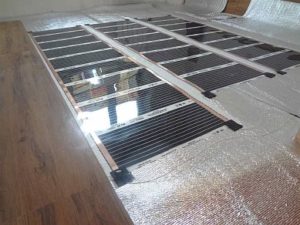
This underfloor heating model is the most convenient and thinnest, recommended for high-traffic rooms. It also offers several advantages:
- versatility – any finishing coating can be laid on the film;
- mobility - easy to move to another location;
- easy installation - no need to pour screed;
- inertia - heating and cooling are fast;
- does not emit electromagnetic waves;
- economy - low energy consumption, which is beneficial during operation;
- has a small thickness - does not reduce the height of the ceiling.
An important advantage of film floors is that if one section fails, the entire system continues to function.
The installation process is simple and quick, eliminating wet and messy procedures, and removal is also straightforward. Furthermore, the film's advantage lies in its recyclability.
Please note! There are special flooring models that can be poured with concrete screed.
However, such heated floors also have disadvantages, although they are not numerous:
- they are vulnerable - they have many connections that are easy to break;
- Additional expenses are required - purchasing connectors, without them it is impossible to make a high-quality contact.
When laying the film, it is necessary to cut it only along special strips so as not to damage the heating elements.
Rod floor
A rod floor is a new and environmentally friendly heating system. Carbon rods emit infrared heat during operation. It consists of mats consisting of two sheathed copper wires, with carbon rods sandwiched between them, connected by a wire.
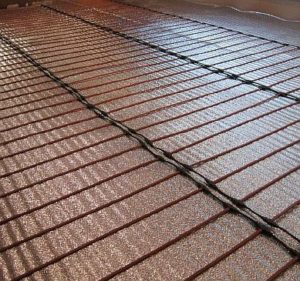
The core floor has high performance properties and many advantages:
- installation is simple - there is no need to plan the furniture arrangement in advance, as it cannot damage the heating elements;
- Can be installed in rooms with high humidity;
- if one element breaks, the entire structure continues to function;
- safe for people;
- economic benefit.
A significant factor in this model's popularity is its ability to be installed under both concrete screeds and tile adhesive. However, a thermal insulation layer must be installed on the base. Furthermore, the use of foil-coated material as a backing is prohibited.
Almost the only drawback of this device is the high price.
Please note: Concerns that the radiation emitted by infrared floors is harmful to human health are greatly exaggerated.
Infrared waves from these structures are within the permissible limits.
Advantages and disadvantages of water-heated floors
Hydronic underfloor heating consists of a pipe containing heated liquid. The hot water comes from the heating system or boiler and warms the floor surface.
After cooling, it returns to the boiler through the return line for heating, and the process repeats. Most often, a circulation pump controls the coolant flow, and regulation is accomplished using a dedicated manifold unit.
The "pie" of a hydronic structure consists of a subfloor, a layer of waterproofing and thermal insulation, piping, a concrete screed, and a finishing coating. Pipes for heated floors are made of various materials: copper, metal-plastic, polypropylene, and cross-linked polyethylene.
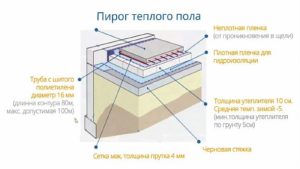
Please note! Laying is possible using a flooring method, without pouring concrete mortar.
This method is used when there are wooden floors that cannot withstand the weight of the screed.
What are the advantages of water heated floors? They are:
- ensure uniform heating of the room;
- require little cost to use;
- They are mounted over the entire area, so there is no risk of overheating under large furniture;
- maintain air humidity at a comfortable level;
- hidden under the floor covering, do not spoil the design of the room;
- have a long service life;
- economical to operate;
- They do not emit electromagnetic waves and are therefore completely safe for humans.
It is worth noting that this type of flooring also has its disadvantages:
- labor-intensive and time-consuming installation;
- reduce the height of ceilings, as they are often laid under a concrete screed;
- require significant financial investments during construction;
- have difficulties when carrying out repair work, since it is necessary to dismantle the concrete layer.
Hydronic heating is recommended for private homes; it's rarely installed in high-rise apartments, as its main drawback is the risk of flooding neighbors below. Furthermore, connecting to a shared heating system requires special permission.
This device can serve as a primary or secondary heating source. A unique feature of this system is its ability to use not only water but also special antifreeze liquids as a heat transfer medium.
For your information! The temperature of the coolant in a warm hydrofloor should not exceed 45 degrees, and the water in central heating batteries fluctuates between 70 and 90 degrees, so it is necessary to install a mixing unit.
Which gender should I choose?
When choosing a heating system for your home or apartment, you should consider not only the characteristics of the floor, but also the room, as well as the conditions under which they will be used.
Particular attention should be paid to the size of the room and its location. For cottages and private homes, there are no restrictions; any system will do. However, for apartments, electric systems are recommended, as water-based underfloor heating systems carry a risk of leakage and require a connection permit.
Moreover, even in a private home, installing hydrofloors requires a large area, as additional equipment must be installed.
Ceiling height is also important, as structures with concrete screeds will significantly reduce their height. Therefore, in rooms with low ceilings, it is recommended to use thin infrared film.
The characteristics of the flooring should also be considered, as the concrete screed layer is quite heavy, and lightweight wooden structures may not be able to support it. In this case, it's also better to consider film floors or dry-installation.
When choosing a heating system, its intended purpose is crucial. If the heated floor will serve as a supplementary heat source, installing an inexpensive infrared film is feasible. However, if it will be the sole heat source, a more powerful system—one with cables and water—is required.
When purchasing underfloor heating, you should give preference to proven manufacturers such as: Teplolux, Nexans, Caleo, Heat Plus, Devi.
Please note! It's important to remember that the operation of underfloor heating is affected by control and regulation devices, such as the pump and thermostats.
Therefore, when purchasing a heating system, it is necessary to take into account the quality of this equipment.
In conclusion, there are various models of underfloor heating, all of which are versatile in their own way and capable of creating comfort in your home. The decision is yours, but it's important to choose the right system that meets the needs of your space.



I installed underfloor heating throughout my entire apartment, which is on the second floor. I've been using it for three years now. It's a new way to heat apartments, and I really like it. It's much more efficient than heating from radiators. And it's plenty warm.