When arranging a heating system, the question arises - Which is better, underfloor heating? or standard radiator heating.
We'll explain how each heating type works, their pros and cons, and determine which type is best for an apartment and which for a private home.
- Underfloor heating in an apartment: pros and cons
- Water floor
- Electric cable floor
- Infrared film floor
- Rod infrared floor
- What type of flooring should I choose for my apartment?
- Underfloor heating in a private home: pros and cons
- What kind of flooring should we choose for a private house?
- Radiator heating: pros and cons
Underfloor heating in an apartment: pros and cons
There are two types of heated floors: hydronic and electric. Heated floors don't detract from the room's design, as they're concealed beneath the flooring (tile, linoleum, laminate, etc.), and they save up to 30% on heating costs.
Floor heating devices are especially recommended for families with children, as they spend long periods of time playing on the floor. It should be noted that these systems are expensive, and installation is labor-intensive, with the exception of infrared film.
Let's consider each type in detail.
Water floor
Hydronic underfloor heating is a common heating system. The main element is a pipe, which can be made of polypropylene or metal-plastic. Water or antifreeze is used as the coolant circulating through the pipe.
The hydropol "pie" consists of It consists of a base, waterproofing and thermal insulation, a heating element, and a concrete screed. Another option is a deck-mounted system, where pipes are laid in grooves in insulation boards or mounted on joists.
In addition, the following is established:
- circulation pump - it is responsible for moving liquid through the pipeline;
- collector group, its function is to distribute water through pipes and control the temperature level.
For the water system to operate, a heat source is required - a heating boiler, but in apartments the source is central heating, although connection to it is only possible with permissionBecause connecting to the general system can reduce the heating level of neighbors.
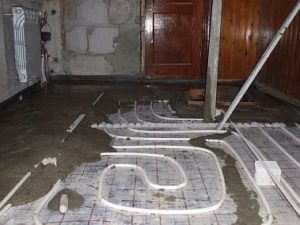
The operating principle of hydrofloors is based on conversion, that is, the heating element heats the screed, and it transfers heat to objects.
Advantages of hydrofloor:
- uniform heating;
- there is no movement of dust around the room, as when heating with radiators;
- the ability to regulate the temperature in a separate room;
- compatibility with any finishing material that is approved for use with heated floors;
- enhanced aesthetics - batteries do not spoil the design of the room;
- lack of attachment to furniture arrangement;
- long service life;
- does not dry out the air;
- does not emit electromagnetic waves;
- creates a favorable atmosphere in the house - the floor is warm, and the air around the head is less hot, which is good for health.
In addition, since the maximum heating level of the coolant in underfloor heating is 50 degrees, compared to 90 in radiators, this leads to significant savings in heat resources.
The disadvantages of hydrofloors include the significant cost of purchasing components, labor-intensive installation, and the time-consuming nature of the installation process. After all, pouring a concrete screed requires a month to dry.
The underfloor heating method is faster, but still labor-intensive. Furthermore, there's a risk of leaks and flooding for the neighbors below. Identifying the leak and repairing it requires complete removal of the screed, which is dirty and difficult work.
For apartment buildings, the greater thickness of the "pie" plays an important role, as it significantly reduces the height of the ceilings.
When turning on water floors for the first time, you should start with low temperatures (+20 degrees) to prevent the screed from cracking, and raise the temperature to the operating level over 2-3 days.
When operating, turn on the device when the first cold weather arrives, as it takes a long time to warm up and should be done gradually. Avoid allowing the temperature to exceed this limit, as this could cause a line burst.
Underfloor heating systems with circulating water require maintenance: pressure testing, checking for air in the pipes, inspecting fittings and seams for leaks, checking the temperature level, and adjusting the system. All these procedures are typically performed at the beginning of the season, before the system is commissioned.
Electric cable floor
Cable-based underfloor heating systems consist of wires made from special alloys. They convert electrical energy into heat. The power source is the electrical grid.
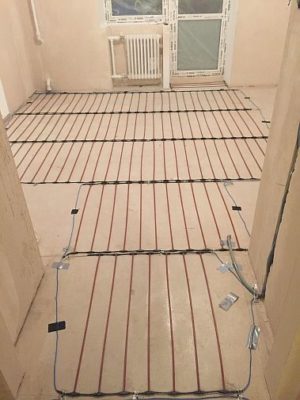
Electric cable-type floors It comes in the form of a regular cable or a mat (the wire is attached to a grid with a standard pitch). Mats are simpler and easier to install. Several types of cable are used: resistive (single- or dual-core), and self-regulating. Single-core cable is cheaper, but emits more electromagnetic waves and is more difficult to connect. Dual-core cable is more expensive, but easier to install and poses fewer health risks.
The self-regulating type of system is more expensive, but the device itself can change the heating level depending on the temperature in the room.
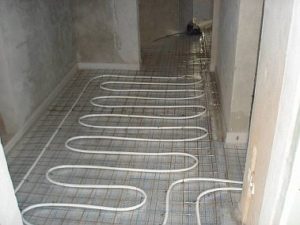
These heaters are mounted on a prepared base, onto which hydro- and thermal-insulating material is laid. The installation is done in a concrete screed or a layer of tile adhesive.
Regulation is performed by a thermostat, either mechanical or automatic. Temperature control is performed by a temperature sensor, which is located directly opposite the heating elements.
Advantages of cable systems:
- long service life;
- resistance to mechanical stress;
- uniform heating of the surface;
- absence of drafts, as warm air rises;
- the presence of a thermostat allows you to adjust the temperature level to your preferences;
- the lightness of the structure, in comparison with hydrofloors, is therefore more suitable for apartments;
- the thickness of the “pie” is not significant - it does not lead to a significant decrease in the ceiling level;
- the installation process is not complicated, especially when using mats;
- The design is aesthetically pleasing, as the device is hidden under the finishing coating and does not spoil the interior.
Another advantage of cable mats is that if an individual element breaks, the entire device continues to work.
Cons:
- installation requires many additional elements, but their cost is not significant, therefore, the construction of such a floor is cheaper than a water floor;
- increased electricity costs, but they are no more than those of a standard electric heating device;
- radiation of electrical waves that are harmful to humans, but their level is not significant, especially in a two-wire cable;
- it is not possible to re-plan, the cable is not placed under heavy furniture, as overheating may occur in these areas;
- Fire hazard - especially in damp areas, but with proper installation the risk is minimal;
- the complexity of repairs, since it will be necessary to open the floor and dismantle the screed.
Cable floors require no regular maintenance; the main thing is to test the network before installation to ensure it can handle the increased voltage. They are easy to operate, especially with an automatic thermostat. You can adjust the heating level depending on the time of day and day of the week.
Infrared film floor
An infrared floor is a thin heating film with carbon plates inside. It operates on electricity, generating heat as infrared rays. The film is placed on a reflective backing to prevent heat loss. Temperature is regulated and monitored using a thermostat and a temperature sensor.
The main advantages of film are the same as those of all types of underfloor heating: comfort, aesthetics, and ease of use. Unlike cables, they do not emit electromagnetic waves, so they pose no health risks.
The film is very thin and lightweight, doesn't increase the load on the floors, and doesn't reduce ceiling height, which is important for installation in apartments. The advantage of film flooring is that if one part fails, the rest of the structure will continue to function.

Infrared film is the simplest type of underfloor heating. Installation requires no special preparation; simply lay the film on a reflective backing and cover with trim. Maintenance and operation are straightforward, and it begins heating immediately after being turned on.
The disadvantages include increased electricity costs, high cost, and a short lifespan of up to 15 years. This type of flooring is intended for supplemental heating.
Rod infrared floor
The rod floor is an infrared electric type, emitting heat in the form of infrared waves. It is a mesh with carbon rods that is embedded in a screed or tile adhesive layer. The installation requires the installation of thermal insulation without a foil layer.
The positive aspects of a core floor, besides providing comfort and eliminating electromagnetic waves, include the ability to place heavy furniture on it, and even if several heaters break, the entire structure will continue to function.
Disadvantages: short service life (up to 10 years) and increased energy costs.
What type of flooring should I choose for my apartment?
If you decide to install it in an apartment, then water heaters should be immediately rejected.
Firstly, they are very heavy, and this is not a desirable load on the floors of an apartment building.
Secondly, they significantly reduce ceiling height. Furthermore, there's a risk of flooding neighbors below, so installing them on the ground floor is the only option. Connecting hydronic floors to central heating requires permission from the utility company.
Electric models are suitable for city apartments. Cable floors are less expensive, and using mats is also easier to install. Porcelain tiles are a good choice for finishing electric underfloor heating, especially in bathrooms or kitchens.
The easiest way to add additional heating to an apartment (if your budget allows) is with infrared film, which can be installed directly on top of the old flooring during cosmetic renovations.
Underfloor heating in a private home: pros and cons
Installing underfloor heating in a private home is the right decision. It can be used as a primary or supplemental heating system to create a comfortable and healthy atmosphere in the home. We've outlined the pros and cons of each model above, and they apply to all rooms.
As we have already said, there are several types of heated floors:
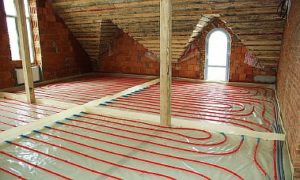
- Water-based floors—their design and installation process are the same as those for apartment installations. They can be poured with a concrete screed or laid using a screed. If the floor is installed during construction, it can be installed on ground. This involves preparing a sand and gravel bed on which the floor "pie" is laid.
A key feature of installing a water-heated floor in a cottage is the installation of a boiler system to heat the coolant. Private homes often already have independent boilers (gas or electric) that supply hot water not only for the heating system but also for the water supply.
In them, the water is heated above the level required for floors, and it is necessary installation of a distribution and mixing unit with a pump in which the coolant, heated to 70–90 degrees, will be diluted to +50—the required temperature for floors.
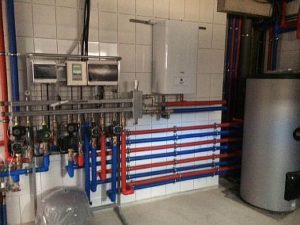
If the cottage is gasified, it is more cost-effective to install a gas boiler, as operating costs will be minimal.
- Electric cables or mats are heating wires powered by electricity, so their costs will increase. The installation of electric floors in private homes is similar to their installation in apartment buildings.
- Infrared heaters—film or rod models—are powered by electricity. They're easy to install, but more expensive, and maintenance is also quite expensive.
The peculiarity of installing such systems in private homes is that they are often installed during the construction of the building, although it is possible to install such heating in an already built cottage.
What kind of flooring should we choose for a private house?
When choosing underfloor heating for a private home, it's important to consider all the pros and cons, as well as the characteristics of the room and the strength of its floors. For cottages, water-based underfloor heating systems are the most suitable and cost-effective option. Despite the labor-intensive installation, they are less expensive to operate than electric systems.
However, if the building is wooden and has existing floors, this model is not suitable. The structure is heavy, and the floors may not be able to withstand the additional load.
In this case, it's recommended to install the pipeline using a dry method rather than screed, or opt for electric methods. These are simpler to install, but their operation will result in higher energy costs.
Electric floors are a fire hazard, especially in wooden buildings, so if the ceilings allow it, it is better to install them in a screed.
Infrared floors in a private home are only suitable as supplementary heating, as their power is not sufficient to heat the entire building.
Radiator heating: pros and cons
Radiators are a traditional heating system that operates from a centralized power grid in apartments or from a standalone source in private homes. They are easy to install and inexpensive. Advantages include:
- fast warm-up;
- no additional load on the floors;
- high efficiency - up to 70%.
The disadvantages of radiators include their bulky size and the fact that they take up valuable space. Furthermore, they spoil the room's design and are unsightly.
After weighing the pros and cons of radiators or underfloor heating, it can be concluded that installing a hydronic system is labor-intensive and expensive compared to radiators. However, underfloor heating is a more economical way to heat a room.
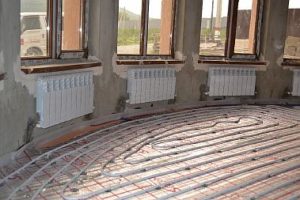
Since the installation of water-heated floors in apartments is prohibited, and using electric heating as the main heating is expensive, a combined heating option is recommended: radiators and underfloor heating.
Together, they can create a comfortable atmosphere without significantly increasing your costs. For example, in rooms with high humidity (bathrooms and kitchens), use radiators and underfloor heating, while in the bedroom and living room, use only radiators.
In summary, underfloor heating is a modern system with its pros and cons. Whether to choose underfloor heating or radiators is up to you.
You need to consider not only your financial capabilities but also the characteristics of the room. If you make the right choice, weighing the pros and cons, you'll be guaranteed a comfortable temperature in your home.