Underfloor heating is a heating system installed beneath the finished surface. Like any other heating system, it comes in different types—hydrogen and electric.
We'll explore which model is best—electric or hydronic—based on the specific needs of each type and room. We'll also explain how to choose a heating system based on your flooring and other factors.
- Which type is better: electric or water?
- Electric floor systems
- Cable
- Cable mats
- Infrared film
- Rod mats
- Which electric underfloor heating should I choose?
- Water floor
- Which floor is better to choose: electric or water?
- We select underfloor heating depending on the type and features of the room
- For a private house
- For an apartment
- For a summer house, garage
- Selecting heating based on the type of room
- Choosing a floor based on installation method
- With concrete screed
- Without screed
- If the ceilings are low
- Select a model depending on the floor covering
Which type is better: electric or water?
There's no definitive answer to the question of which underfloor heating system is best for an apartment or home. Each model has its own advantages and disadvantages and is designed to perform specific functions in specific conditions.
If underfloor heating will be used as the primary heating source, it's best to choose more powerful systems. If it's used as a supplemental heat source, infrared systems are best.
After all, they are easier to install, have a smaller “pie” thickness and are less expensive overall.
Electric floor systems
Which type of electric underfloor heating should I choose? The following types are available: cable, cable mat, infrared film, and rod mat. When choosing a heating system, it's important to consider cost-effectiveness, the area of the room to be heated, the room's layout, and the permissible floor level rise.
Electric heated floors They are heating systems that operate using electricity. They convert electrical energy into thermal energy.
Pros:
- Efficient and uniform heating, as the air above the floor is heated.
- There are no convection air currents that lead to dust circulation.
- It is possible to regulate the temperature level in each room, which makes this type of heating economical.
- Fast heating of the room.
- They do not dry the air.
- Long service life.
The main disadvantage of all electric floors is the increased energy costs and the inability to place furniture and other heavy objects on the heating elements (this does not apply to rod models).
There are several types of electric floors: heating cable, mats, infrared film and rods.
Cable
Cable floors consist of a resistive or self-regulating heating cable with conductive conductors protected by a sheath. The shielded resistive cable can be single- or double-core.
Single-core wire is cheaper, but installation is more complex, as the other end must be returned to the starting point during installation. Double-core wire is more expensive, but it can be connected to the power source at only one end.
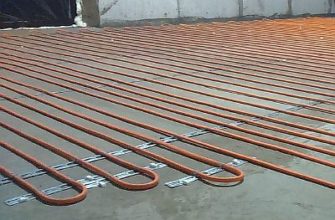
Installing a cable floor is one of the most labor-intensive methods. The cable is laid on a base covered with waterproofing and thermal insulation material, using a "snake" or "snail" pattern. The heater is poured into a concrete screed and covered with flooring.
This heating model is suitable for indoor use. with a large area or high humidityIn addition, the ability to set different temperature levels in different rooms makes the system economical.
However, due to the large thickness of the "pie", the design significantly affects the height of the ceilings, so it is better to plan the installation of this type during the construction of the house.
The main drawback is the presence of electromagnetic radiation, which has a negative impact on human health. However, the level of radiation in such a device is not significant.
The cable has a 30-year service life. This is the most affordable type of electric flooring.
Cable mats
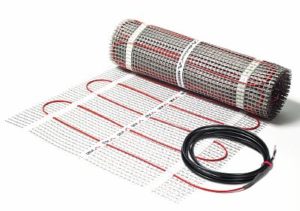
Mats are also a cable system, but made of thinner wire attached to a mesh. Installation is much simpler than with regular cable; they are simply rolled out and connected to the thermostat. The mats can be installed in a layer of tile adhesive, resulting in a thin "pie" that doesn't take up ceiling height.
The service life is over 30 years, and the warranty is 20. The disadvantages include the high cost when compared to a conventional heating cable.
Infrared film
Infrared film — the thinnest type of underfloor heating. It consists of carbon fiber plates sandwiched between two layers of film. This type of heating can be installed in just a few hours, as it is installed directly under the finishing coating.
Among electric systems, this is the best option, more economical and safer. It produces virtually no electromagnetic waves, which are considered harmful to humans, as the heat is generated by infrared waves. A significant advantage of the film is that if one strip malfunctions, the entire structure will continue to heat.
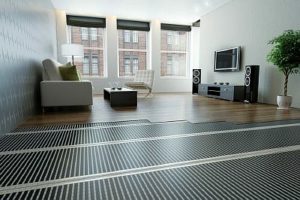
The film has a service life of 30 years or more, and the manufacturer's warranty is 20 years. These floors are significantly more expensive than cable floors, as they are more economical and modern.
Rod mats
Infrared rod floor It's an intelligent, energy-saving, efficient, and environmentally friendly model. The mats are made of parallel carbon rods fixed to a fiber mat. They are installed in screed or filled with tile adhesive. Installation requirements include the absence of a foil layer on the underlay.
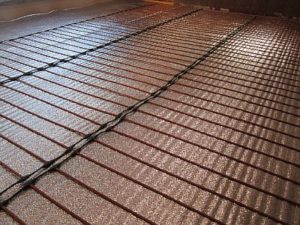
Like infrared film, rod floors do not emit electromagnetic radiation. Furthermore, even if one part breaks, the entire unit will continue to function. Another advantage worth noting is the ability to accommodate heavy objects.
There is one drawback, but it is significant, and that is the high cost.
Which electric underfloor heating should I choose?
The large number of models makes choosing an electric underfloor heating system challenging. Each has its own pros and cons, and each performs well in its own specific applications.
The table below will make the selection process easier.
Table No. 1
| Parameters | Heating cable | Cable mats | Infrared film | Rod |
| Installation | Poured into the screed | Mounted in screed or tile adhesive | Lay under the finishing coating | Filled with tile adhesive or a thin layer of screed |
| Floor covering | Any | Preference is given to tiles or porcelain tiles | Any finishing is acceptable | Any covering except carpet |
| Type of heating | Primary and secondary | Additional | Primary and secondary | Primary and secondary |
| Average power | 110 W/m2 | 160 | 220 | 160 |
| Economy | Intermediate level | Average | High | High |
| Safety | High | High | High | High |
| Reusability | No | No | Eat | No |
| Failure | If damaged, the floor stops working. | If damaged, the floor does not work. | If one section is damaged, the entire unit will continue to heat. | If one section is damaged, the entire floor will function. |
When choosing an electric floor model, you need to pay attention not only to the price, but also to the parameters indicated in the table.
Heating cable embedded in screed is a heavy structure and is therefore not suitable for rooms with weak ceilings. The resulting "pie" is quite thick, reducing ceiling height. Therefore, this system is not recommended for homes with wooden floors or low ceilings.
If funds permit, then it is better to choose infrared filmInstallation is simple, no messy work required, and it doesn't take up any ceiling space. Furthermore, it's easy to remove and reinstall, and it doesn't emit electromagnetic waves.
Water floor
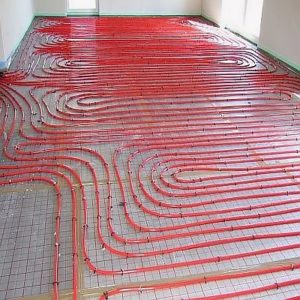
Water heated floors are pipes laid out in a "snake" or "snail" pattern., through which the coolant circulates. The kit includes a circulation pump and a manifold assembly. The structure is often filled with concrete, making it heavy.
This model is cost-effective for large private homes, especially those with a separate boiler. It's not possible to install such floors in multi-story buildings, as they require installation permits and a central heating connection.
Obtaining such permission is difficult, as it negatively impacts the operation of the entire building's heating system. Furthermore, there is a risk of flooding neighbors if a pipeline leaks.
The disadvantages include labor-intensive and time-consuming installation. Installing this type of heating system is expensive and requires periodic inspection. Furthermore, if a pipe leak occurs, repairs will require removing the trim and screed.
Advantages of hydrofloors — efficiency and cost-effectiveness. They don't dry out the air and can be the only heating device in the house. When installing them, there's no need to plan furniture arrangement in advance, as they can accommodate heavy objects. Furthermore, in terms of fire hazard, they are the safest. They have a service life of 50 years.
Which floor is better to choose: electric or water?
Each type of underfloor heating has its own functions, which they perform perfectly.
Hydronic heating should be chosen for large spaces, over 100 m². Although installation of hydronic underfloor heating is expensive, it quickly pays for itself. The average payback period is three years. Electric heating, however, is much more expensive for larger spaces.
For heating small areas, electric floors are a better choice. They're easier to install, especially infrared ones, and their installation is inexpensive.
It's also important to consider whether the system will be the sole heat source. If it's the primary heating source, it's best to choose a water-based or high-power cable system; they're high-quality and reliable. Film or mats are ideal for supplemental heating.
We select underfloor heating depending on the type and features of the room
As mentioned above, when choosing underfloor heating, the type of room is taken into account.
Whether it's a private home or a multi-story building is of great importance. Also important is the type of material the house is made of—wood or brick—because the reliability of the floors and their ability to support a given structure depends on this.
For a private house
For owners of private homes who live there permanently, and especially those with a stand-alone boiler system, it's better to choose hydronic heating. Hydronic floor heating is less expensive because you can choose the heat source you use. For example, gas or solid fuel are cheaper than electricity.
Furthermore, if the installation of a water-heated floor is planned during the construction phase of a house, the cost of installing the heating system can be significantly reduced.
For an apartment
Electrical designs are best suited for an apartment.
It's best not to plan for underfloor heating, as there's a risk of flooding neighbors below. Furthermore, its installation is prohibited in apartment buildings without special permission.
For a summer house, garage
If installation is planned heated floors in a country house or garage, it's best to avoid hydrofloors right away. These rooms aren't permanent residences, so the heating won't be on regularly, and the water in the pipes will freeze in the winter. To prevent this, you'll need to drain it periodically or use antifreeze, which will be more expensive.
It's better to use electric heating that can be turned on as needed. Both cable and film systems are suitable.
Selecting heating based on the type of room
For a kitchen or bathroom, heating mats are the ideal solution. Their power is sufficient to heat such areas, and they are suitable for installation in rooms with high humidity.
The mats are poured with a thin layer of tile adhesive, onto which the ceramic tiles are laid. In such rooms, tiles are the primary finishing material.

For a bedroom or children's room, infrared devices are best. They don't emit harmful electromagnetic waves and are easy to install.
Any type of heating system can be installed in a garage. A hydronic system is suitable if the garage is located in an extension to a private home with a separate boiler room.
Otherwise, connecting a heating system to a detached garage would be too expensive. Therefore, for such spaces, it's better to choose cable-based units that can be turned on for heating as needed.
Choosing a floor based on installation method
When choosing a heated floor model, you should consider the installation method you plan to use to heat the room.
With concrete screed
“Wet” screed involves filling the heating system with concrete mortar.
If the apartment or house is new, or major renovations are planned, it is recommended to install a concrete screed under the underfloor heating system. This makes heating more efficient, although installation is more expensive. For a private home, it's better to choose a water-based underfloor heating system, while for an apartment, choose a cable-based system.
Without screed
If you have an old house with weak wooden floors that cannot support a heavy structure, you should use a “dry” screed.
That is, lay the heater in a flooring manner, between the joists or on polystyrene foam boards with bosses.
If the ceilings are low
If your apartment has low ceilings and it's not possible to install heating into the screed due to the thickness of the screed, using mats is a solution. They can be laid directly on the existing flooring and covered with a thin layer of tile adhesive.
You can use infrared film, which is also placed directly under the finishing coat.
Select a model depending on the floor covering
One of the things to consider when choosing a heated floor model is the floor covering. It's important that it's compatible with the heating elements.
The following is used as a finishing finish:
- Tiles are a cold material, making them ideal for laying heated surfaces. Any type of flooring, installed in a screed or adhesive layer, can be laid underneath tiles. Infrared film is an exception. Before installing tiles, gypsum fiber sheets must be laid over it.
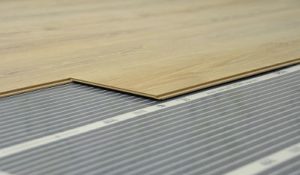
- Laminate flooring has low thermal conductivity. It's best installed with electric heating, especially infrared film.
- Linoleum and carpet are laid on water or film floors.
- Parquet does not work well with heating devices, although there are modern types of parquet designed specifically for installation on heated floors.
There's no definitive answer as to which underfloor heating system is best. There are many factors to consider: efficiency, environmental friendliness, cost, installation complexity, etc. Furthermore, when choosing a model, consider the type of room and the power required to heat it. If you've calculated everything correctly and installed your underfloor heating system properly, it will last for years.




Now I know a lot more about heated floors than I did before. However, the bottom line with heated floors, like with anything else, is that the more expensive, the better and more effective. The director installed heating cables at the factory, and we had a warehouse, lifts, and other equipment. Of course, after two weeks, it stopped working, literally wasting a huge amount of money. If I wanted it so badly, I should have installed a water-based floor. At home, I installed it with infrared film under laminate flooring; it was inexpensive and cost-effective for a studio. This is an excellent article; not several pages long, but clearly and understandably explains each type of flooring, its differences, pros and cons, and avoids specific technical jargon.
I'm currently renovating an old house myself and don't have anyone to talk to, so up-to-date renovation information is very helpful. I've taken note of a lot of the life hacks on the website. It's time to choose a heating technology, such as underfloor heating. Judging by the table in the article, and my calculations, infrared film is a better choice. Easy installation, cost-effectiveness, and the absence of electromagnetic waves—I chose based on these criteria. Thanks for the information.
The best is film TP in my opinion