A warm garage is every car owner's dream. After all, it's nice to get into a warm car in winter, and if it's parked in a heated garage, you don't have to turn on the heater and wait for it to warm up. Furthermore, parking in such a garage has a beneficial effect on its mechanical condition.
In this article, we'll discuss whether underfloor heating is necessary in a garage, what types are suitable for this space, and the advantages of each model. You'll also learn how to install underfloor heating in your garage yourself.
- Do you need underfloor heating in your garage? What are its pros and cons?
- Types of heated floors
- Water
- Electric
- Installation of infrared (film) floor
- Calculation
- Necessary tools and materials
- Drafting a project
- Preparing the base
- Waterproofing and thermal insulation
- Laying the heating element
- Connection
- Pouring the screed
- Installation of cable flooring
- Calculation
- Drawing up a diagram
- Necessary tools and materials
- Preparing the base
- Thermal insulation
- Laying heating elements
- Connection
- Pouring the screed
- Installation of water-heated floors
- Development of a laying scheme and calculation
- Tools and materials
- Preparing the base
- Hydro and thermal insulation
- Laying the pipeline
- Collector-mixing unit
- Pouring the screed
- We use antifreeze as a coolant
- Methods for insulating a garage
- Video on how to properly insulate a garage
Do you need underfloor heating in your garage? What are its pros and cons?
In a garage, it's often necessary to look under a car, which requires lying down on the floor. This is why many owners consider installing heating, with most opting for underfloor heating.
Performing repairs while lying down on a heated surface is not only comfortable but also safe for your health. And in winter, parking in a heated garage is better for your car than in the freezing cold.
Moreover, this type of heating can evenly heat the room. Costs are low, as a garage temperature of 15 degrees Celsius is comfortable for both people and cars. Using gas or solid fuel boilers will reduce costs even further. Maintaining the required temperature is easy with insulated walls and ceilings.
Remote adjustment is possible with the installation of appropriate equipment.
It is impossible not to mention the disadvantages of heated floors:
- When a car is driven from freezing temperatures into a heated garage, snow begins to melt and run off. There are areas of the car that are inaccessible to anti-corrosion treatment, but moist air can still get into them.
As the liquid heats up, it evaporates, creating condensation that impacts the colder parts of the car. Until all the parts warm up, the moisture will have time to negatively impact them. Many people try to solve this problem by installing a supply and exhaust ventilation system.
- The garage floor is under constant pressure from the weight of the vehicle. Therefore, it's important to properly calculate the load and install it correctly to ensure the weight from the wheels doesn't interfere with the system's operation.
- Repairing a heated structure is difficult, as it requires completely dismantling the surface.
- Metal elements on the gate may freeze, and ice may form on the outside of the door.
- When installing a water-heated floor, if there is no hot water supply, it will be necessary to install equipment to heat the water.
- When using electric heating, there will be, although not significant, constant energy costs.
Types of heated floors
There are two types of heated floors: water and electric, they differ in the heating method, design and construction technology.
Below we will examine each type in detail, their advantages and disadvantages, and provide instructions on how to install them yourself.
Water
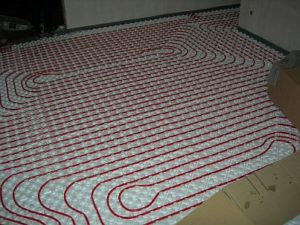
A water floor is a structure made of pipes (metal-plastic or steel – Find out which pipes are best to choose and why), through which the heated coolant moves. The structure is connected to the central heating system or to an independent power source (gas, electric, or solid fuel boilers).
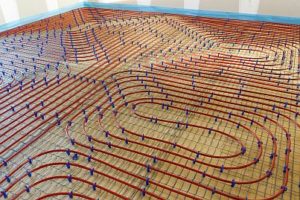
There are two technologies for installing a water system:
- by pouring concrete screed;
- in a flooring manner.
This type of heating system can evenly heat concrete without the need for electricity. However, there are additional costs—for a pump and boiler (if connected independently). If the device is not turned on for a long time, the liquid in the pipes will freeze, causing the entire structure to fail.
Electric
Electrical systems operate on electricity. They are:
- cable - the heating element is a cable, single or double-core, or self-regulating;
- Infrared film, heat source - carbon emitter that emits infrared rays.

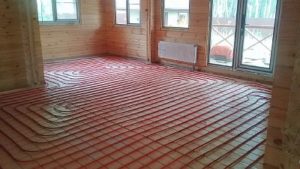
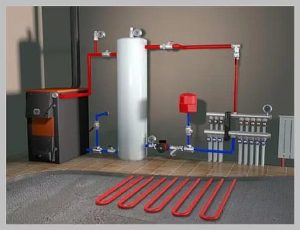
The advantage of electric heaters is that there's no risk of leakage. When installing an infrared model, it's also easy to install. The disadvantage is energy costs.
Installation of infrared (film) floor
When deciding to install an infrared floor in your garage, you need to minimize costs associated with heat loss through the walls and ceiling, and ensure that the wiring can withstand the additional load.
Calculation
You need to start by calculating the power of the heating substation, as its efficiency depends on it. It's best to entrust this work to professionals—heating engineers—as the calculations require complex formulas.
If you want to do this yourself, you need to use average values. The calculation is performed using the following formula:
P=p*S, where:
- P – power of the transformer substation;
- p – power of the heating element;
- S – room size.
If there are several rooms in the garage, the calculation must be done separately for each room.
Necessary tools and materials
The heating element is the core component of a film floor. Its selection must be approached carefully and considered during the design process.
There are several models of film systems:
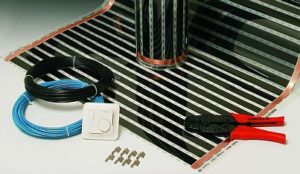
- Infrared film is a two-layer product, with a heating material – carbon plates – placed between the layers.
- The rod floor consists of flexible carbon rods placed parallel to the mat. Heat is generated by infrared waves.
In addition to the heating element, we will need:
- temperature controller;
- RCD - residual current device;
- grounding cable;
- fasteners;
- mixtures for screed.
To carry out the work we will also need:
- Hammer drill.
- Chisel.
- Hammer.
- Scissors.
- Screwdrivers.
- Meter.
- Level.
- Level.
Drafting a project
A laying plan is drawn up. The film is not placed under heavy objects such as lifts, machines, or areas where the vehicle will be located. It should be laid with a 10 cm gap from the wall.
If the infrared floor is the only heating system in the garage, it covers up to 70% of the surface. If additional heating is required, 50% is sufficient.
The place on the wall where the thermostat will be mounted is marked; it should be placed 15 cm above the surface.
Preparing the base
Unlike installing electric heating in an apartment, installing these systems in a garage doesn't require removing the flooring; the film can be laid over the existing floor. Simply clean the concrete slab of dust; minor unevenness is also acceptable.
For large holes and uneven areas in the slab, it is recommended to apply a thin, self-leveling screed. Allow it to dry completely before continuing with the "cake" installation.
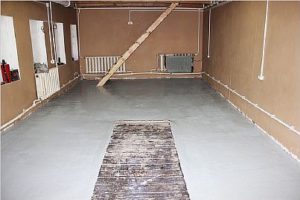
If there is an inspection pit in the garage, before pouring the screed, a brick edging is built around it, to the height of the intended “pie”.
Waterproofing and thermal insulation
A waterproofing material, such as polyethylene film, is laid on the prepared surface, overlapping the walls by 10–15 cm. Then, the perimeter of the garage is sealed with damper tape.
A 10 cm thick thermal insulation material, such as Penofol, is laid on top of the polyethylene, with the foil side facing down. 5 cm thick foam plastic can also be used.
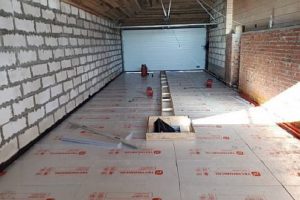
A reinforcing mesh is placed on the insulation. When using fiber and plasticizers, the mesh can be omitted.
Laying the heating element
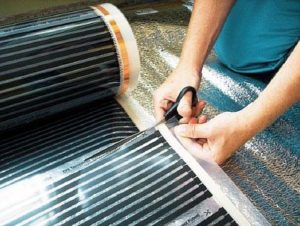
The film is laid on the mesh according to the prepared pattern. It can be cut along the designated lines. It is placed with the contacts facing down, toward the regulator.
The sheets should not overlap each other and should not be placed tightly against the wall - the recommended gap is 10 cm. The sheets are glued together with tape.
Connection
The electric infrared system is connected by connecting the film contacts and insulating them with bitumen mastic. After this, the film floor is connected to the temperature sensor, and the wire connections are also insulated.
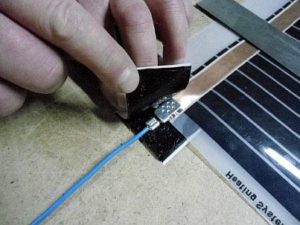
The device is then connected to the power supply and tested. If everything is working properly, the screed can be poured.
Pouring the screed
For the final screed, use a ready-made mixture or a homemade compound made from sand and cement. The entire garage should be poured in one go. The solution should be evenly distributed over the entire garage area and leveled.

The screed must dry thoroughly, which will take about a month. Only then can the system be turned on.
Installation of cable flooring
As mentioned above, cable floors operate on electricity, and since tariffs are quite high, the costs for it are also significant.
Therefore, it is necessary to consider all the ways to save it: the thermal capacity of the walls and ceilings, the quality of thermal insulation, which we will discuss in detail in this article.
Calculation
The installation of cable electric heating, like the installation of an infrared system, should begin with a power calculation; there is a single formula for this.
You can find the rules for calculating power in the section “Installing an infrared floor”.
Drawing up a diagram
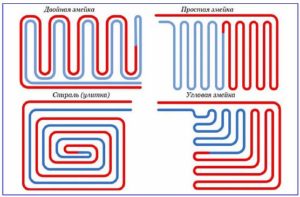
Before installing any underfloor heating system, it is necessary to prepare a diagram showing the cable laying areas and the location of the controller installation.
According to SNiP, if the area of heating elements exceeds 40 m², damping gaps are required. The rules for laying mats are similar to those for laying film.
Necessary tools and materials
Before you begin installing your heating system, you'll need to purchase the materials and gather the tools you'll need if you plan to do the installation yourself.
First you need to choose the type of heating:
- Resistive cables come in single- and double-core varieties. They generate heat energy, the amount of which depends on the wire cross-section.
- The heating mat is a flexible sheet with a pre-attached resistive wire. It's convenient and easy to install.

Any model is suitable for installation in a garage.
The remaining materials and tools for installing cable heating are the same as those used for installing an infrared system.
Preparing the base
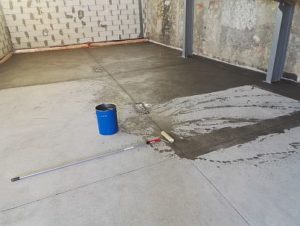
Preparing the subfloor in a garage for cable installation is no different from the work required for installing any underfloor heating system—leveling and cleaning the surface.
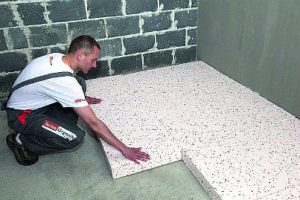
Thermal insulation
The detailed process for installing hydro and thermal insulation is described in the infrared flooring section; it's the same for all electric systems. This involves laying polyethylene, installing damper tape, and laying insulation and reinforcement.
Laying heating elements
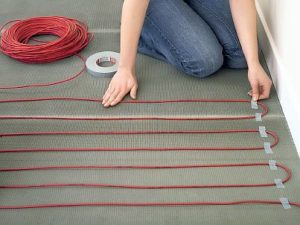
The heating cable is installed according to a pre-designed pattern (a "snake" or "snail"), with markings applied to the insulation. The wire is then laid in coils according to these markings. the standard distance between them is 0.3 meters.
The circuits must be parallel; bends in the cable should not be less than 90 degrees or excessively tensioned. The cable must be continuous, without twisting, as this will affect the performance and service life. The cable is secured to the mesh with clips or tabs on the mounting tape, which is attached to the insulation.
Installing heating mats significantly simplifies the installation of underfloor heating in a garage, as the wire is already secured to a special mesh. Simply roll out the mats and secure them in place.
Connection
A mounting box is attached to the designated location, into which the thermostat is installed. A power and ground cable is connected to it.
To install the temperature sensor, a recess must be made in the insulation 0.5 meters from the wall. A corrugated pipe with the sensor inside is inserted into this recess. The sensor's wire is also connected to the controller.
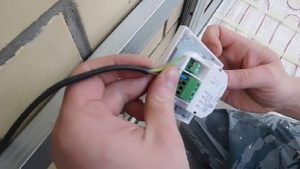
After connecting, be sure to test the device for functionality. The underfloor heating system should be plugged into a separate outlet.
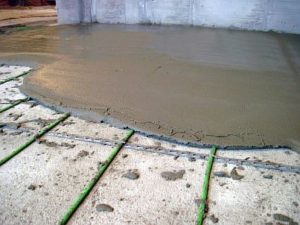
Pouring the screed
The solution for pouring a cable floor and the process itself are similar to pouring concrete for an infrared system. A concrete screed can be used as the final surface in the garage, but tiling is also possible if desired.
Installation of water-heated floors
If you have a garage attached to your home, installing a hydronic floor heating system is a cost-effective option, as it can be connected to the house's heating system. If this isn't possible, you'll need to install a separate boiler.
Development of a laying scheme and calculation
The fundamental factor in the calculation is the pipeline layout. Most often, pipes are laid in a “snake” or “snail” pattern.
An important factor is the laying pitch and the size of the loop. To ensure proper heating of the garage, the distance between the loops should be 10 cm.
Also, it is necessary to correctly determine the installation location of the distribution unit.
When calculating independently, it is recommended to use average indicators:
- cross-section of metal-plastic pipes - 16 mm;
- loop size, if the area is 60 m2 - from 70 to 80 meters;
- pump capacity - not less than 2 l/s.
Pipes should be laid more frequently near walls and gates than in the center of the room. The supply hose is located near the exterior walls.
Tools and materials
To install a water-heated garage floor yourself, you can purchase a standard kit with an automatic regulator, which is manufactured for non-residential premises measuring 60–80 m2, or purchase the components separately.
The average amount of material required for a hydrofloor in a garage of this size, with a pipe pitch of 15–20 cm and a 7 cm screed:
- metal-plastic pipes - 400 meters;
- plasticizer - 80 liters;
- damper tape - 60 meters;
- insulation - 60 m2;
- three-way valve - 1 pc;
- circulation pump - 1 pc;
- thermostat - 1 piece;
- plastic fittings;
- Automatic air vent - 2 pcs;
- servomotor—1 pc.
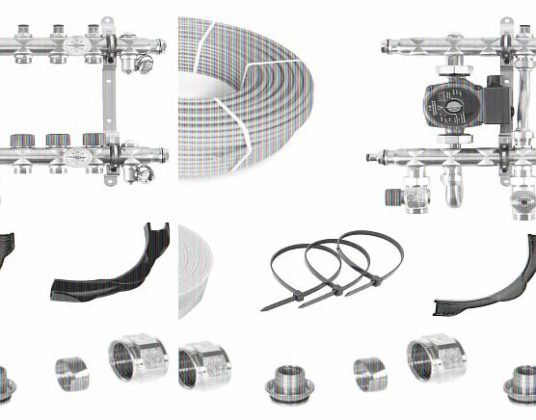
You will also need a standard set of tools for working with metal-plastic pipes, a set of screwdrivers, a tape measure, nippers, and a mixer for preparing the solution.
Preparing the base
The hydronic underfloor heating in the garage is installed on a rough leveling screed. It is poured onto a "pie" of:
- sand - 10 cm;
- crushed stone - 10 cm;
- insulation - 10 cm foam plastic;
- waterproofing - polyethylene or roofing felt;
- reinforcement.
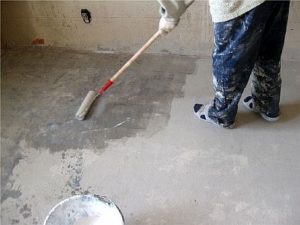
If you have a concrete floor, simply remove the top layer, clean, and level the surface. Unevenness in the garage should not exceed half the diameter of the pipe.
Hydro and thermal insulation
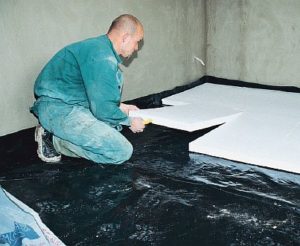
The waterproofing process for a hydrofloor is the same as for installing an electrical structure. A layer of waterproofing—thick polyethylene, but roofing felt is better for a garage—is laid over the subfloor, and the seams are sealed with bitumen mastic.
Next comes the insulation; it needs to be thick, as it will bear a lot of weight. To prevent heat loss to the floor, the foil side faces up.
It is mandatory to stick a damper tape around the perimeter of the room.
Laying the pipeline
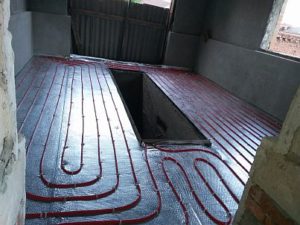
Pipe installation marks are made on the thermal insulation according to the diagram. Plastic supports are installed, and the lathing is mounted on them. The lathing should be placed 3-4 cm above the insulation to prevent cracking of the concrete.
The heating element is placed on the reinforcement, following the markings. The pipes are secured with clamps or brackets, installed every 30–40 cm and 15 cm at bends.
The coils of pipe should be unrolled gradually, 10-15 meter sections at a time. Pipe laying should begin from the manifold, starting with the loop furthest from it. A heat-insulating tube with a fitting is placed on the end of the hose; this is used to connect the hose to the manifold. The other end of the pipe, after laying it throughout the garage, should also return to the distribution unit.
Collector-mixing unit
The mixing unit is the "heart" of a hydronic underfloor heating system. It regulates and supplies hot water to the piping system, as well as removes waste heat from the system.
You can assemble the device yourself, or you can buy a ready-made one, which is reasonably priced. The heat load plays a major role in the collector.
The collector consists of:
- supply and drain valves;
- air vent;
- shut-off valve for draining water from the system;
- fittings for connecting pipes;
- circulation pump.
When selecting a manifold and mixing unit, you need to consider the number of circuits; the device must have an outlet for each one.
The manifold is installed in a specially designed cabinet in the garage. Its standard dimensions are 50 x 50 cm, with a depth of 15 cm. It can be mounted on a wall or in a specially designed niche.
The mixing unit is connected to the coolant supply source, which could be the main heating system or a boiler. Water circulation is provided by a pump.
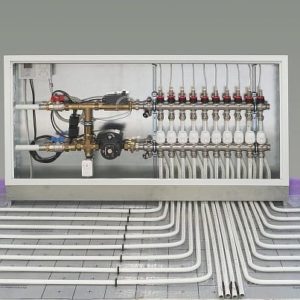
After installing the unit, it is necessary to connect both ends of the pipe of each circuit to the supply and return valves using fittings.
Before pouring the screed, check the system for leaks. To do this, inject a liquid heat transfer fluid into the main line at a pressure twice the operating pressure. If the pressure does not drop within 24 hours, the system has been installed correctly.
Pouring the screed
The concrete screed must be poured at the operating pressure in the system, and the temperature of the pipes must correspond to the temperature in the garage. The thickness of the concrete layer is from 5 to 12 cm.
The pouring begins in the far corner of the garage and ends at the gate. The system can only be turned on once the concrete has completely dried, which is after a month.

We use antifreeze as a coolant
The downside of a water-based underfloor heating system is the high freezing point of the coolant. This is especially true in a garage, where if it isn't heated regularly and the water isn't drained, the pipes can freeze and the system will fail.
This problem can be easily solved by using antifreeze, which has a freezing point of -30 to -65 degrees Celsius. It is made from ethylene glycol or propylene glycol.
The principle of installing a water-based system with antifreeze is the same as using water. However, using antifreeze requires a more efficient pump and more expensive equipment, but this will pay off over time.
Methods for insulating a garage
Car owners often use plywood to insulate their garage floors. The material also serves as a finishing coating.
It is permissible to use plywood of several grades, but the most suitable for a garage is moisture-resistant FSF. It is not suitable for residential premises, as it contains toxic glue, or FC, which is less hazardous to health.
If the product is intended solely for insulation, then inexpensive, low-quality plywood will suffice. For the finishing coat, it's better to choose a higher-quality material.
The process goes like this: the concrete slab is cleaned of dirt, polyethylene foam is laid, a frame of wooden beams is laid on top, and the subfloor is installed on top of them. Plywood is laid on top; if it will be the final surface, it should be varnished.

If you want to feel comfortable in your garage and avoid catching a cold while doing DIY repairs, it's best to install underfloor heating. Keeping your car in a heated space will also have a positive effect on its performance.