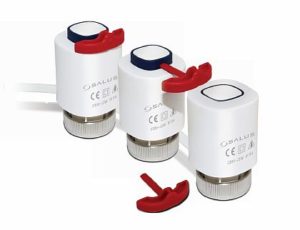
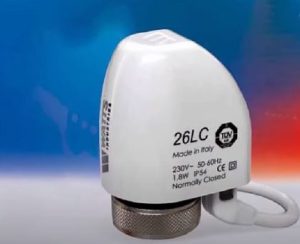
A servo drive is an automatic electromechanical valve that turns on, turns off, or regulates the flow rate of hot water in a separate circuit of a water-heated floor.
An important element of the underfloor heating system is a box with a union nut, which is attached to one of the manifold outlets.
- The operating principle of a servo-driven collector
- Servo drive device
- Types, technical characteristics, differences
- Mechanical
- Electronic
- Electrothermal
- Remote
- Recommendations for selecting servo drives
- Connection diagram
- Installing a servo drive on a heated floor manifold
- Adjusting heated floors with servo drives
- Major manufacturers
- Luxor
- Valtec
- Watts
- Rehau
- Neptune
- Henco
The operating principle of a servo-driven collector
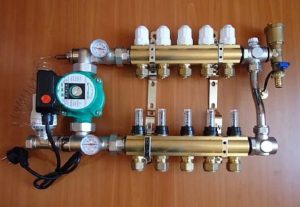
A manifold distributes the coolant flowing from the boiler through loops of heating pipes. A manifold is often called a comb. The comb consists of a supply and return beam with threaded connections.
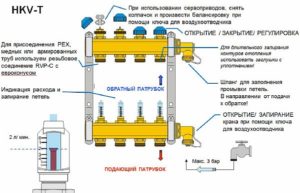
There are between 2 and 12 double-sided outlets on a single beam. Flow meters are installed on the supply console in the upper outlets, and the coolant is fed into the lower outlets, entering the circuit pipelines.
Drives with union nuts are attached to the upper outlets, and the return ends of the loops (contours) are connected to the lower terminals.
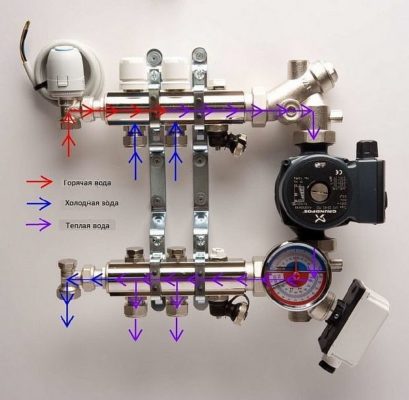
By turning the servo heads of the underfloor heating systems, you can mechanically turn the heat supply to each circuit on or off. In the middle position, the units operate automatically.
A voltage signal transmitted through a wire from the thermostat activates a mechanism that presses the valve stem of the collector's return beam. This controls the heating of the underfloor circuit in a specific room.
Servo drive device
The servo drive for a hydronic underfloor heating system is a crucial component of the underfloor heating system. Its core component is a bellows—a movable bulb filled with a special liquid (methyl benzene or toluene). When heated by an electric current from the thermostat, the substance expands the bellows. The bulb then presses on the valve stem of the return console.
Types, technical characteristics, differences
Today, there are several types of servomotors. The most commonly used mechanisms can be classified by their operating method as follows:
- mechanical;
- electronic;
- electrothermal;
- remote.
Mechanical
The simplest device to operate. It doesn't have a complex mechanism. To adjust the heating level of the desired circuit, simply turn the head of the device by hand. on the return comb Left or right, respectively, to increase or decrease the heating of the underfloor heating loop. Installing a manual valve is advisable in areas where the heating system consists of 2-3 circuits and no special automation is required.
Subsequent adjustments are not required, as the system is adjusted automatically. One of the advantages of a mechanical device is its low cost and long service life. One disadvantage is the inability to program the underfloor heating manifold's servo drive. Therefore, when leaving the home, the owner must set the desired temperature manually.
Electronic
Electronic models are equipped with liquid crystal displays that show the stages of servo drive operation.
It is also possible to program your own microclimate for each room.
This can be done either automatically or manually.
Electrothermal
These devices are two-position actuators in automated underfloor heating systems. The actuator housing has two LEDs. The green light illuminates when power is supplied to the actuator, and the blue light illuminates when the valve is open. When the power is disconnected, both lights go out.
Remote
The main difference from other models is that the remote actuator can be programmed online. The actuator has two sensors that monitor changes in temperature both outside and inside the room. The remote controls have nine operating modes. Additionally, the controllers can display information about the amount of electricity consumed on the thermostat display.
Additionally, there are closed and open-type actuators. The former are closed by default, while the latter are almost always open.
Recommendations for selecting servo drives
There are two types of servo drives. They differ in the initial position of the comb valves. A valve that is open by default will remain so if there is a power outage at the servo drive inlet, and the coolant will flow freely through the circuit. Otherwise, the servo drive will remain closed in its normal position. That is, without power, the servo drive will keep the valve closed.
It is better for the consumer to choose the model that is most suitable for the operating conditions in the home.
For example, in areas with long winters and frequent power outages, it's better to choose open-type units. The floor will stay warm as long as hot water flows from the boiler.
Enclosed-type servo drives are preferably installed in warm climates. In the event of a power outage, the temperature in the room will not drop to a critical level and cause negative consequences.
Connection diagram
Connect the servo drives according to the instructions included with the underfloor heating manifold. The equipment must be purchased as a complete set, consisting of components from the same manufacturer. This will help avoid any mismatches in the connections between the manifold components.
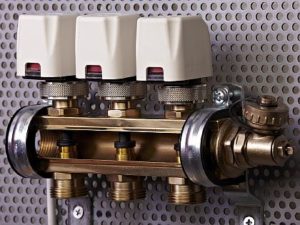
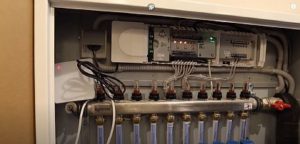
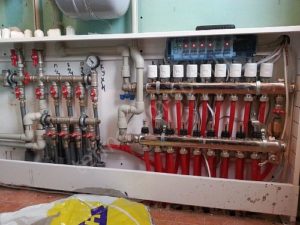
When there are a large number of heat consumers, the entire hot water distribution system is typically housed in a cabinet. For a large number of heated rooms, the equipment may even occupy several cabinets.
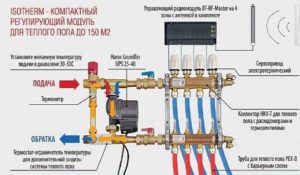
Installing a servo drive on a heated floor manifold
With certain knowledge and experience in working with plumbing, Connecting servo drives to a heated floor manifold won't be difficult for a home handymanYou should proceed as follows:
- They open the packages and remove the servos with instructions.
- On the collector (return comb), unscrew the protective caps and put them aside.
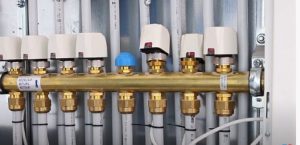
- In place of the removed caps, protruding rods are visible on the collector terminals.
- The servo drive cables are secured to the return pipes of the circuits with plastic clamps.
- The servo drives are installed with union nuts on the threads of the return comb pipes so that the valve stem enters the opening of the device without distortion.
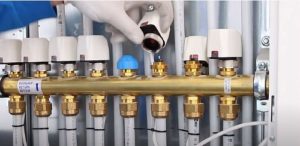
- The union nuts are tightened by hand. Then carefully tightened with a wrench.
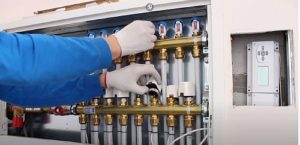
- Flow meters are installed on the distribution comb.

- For convenience and safe storage, all equipment is mounted on a panel in a cabinet.
- Wired automation with programming buttons, terminals for connecting servo drives and room thermostats is installed in the cabinet.
- To remotely control servo drives in online mode, connect the “Access Point” device.
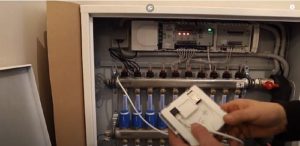
- The busy indicator appears differently on different drive models. It may appear as a red stripe in the lower housing cutout or a white circle under the servo motor cover.
- The indicator indicates that the circuit is currently heating to the set temperature. If there is no signal, the floor temperature has stabilized, and the coolant supply is currently stopped.

- For large areas of heated floors with hot water, the equipment is placed in one unit, which is a wide cabinet.
Adjusting heated floors with servo drives
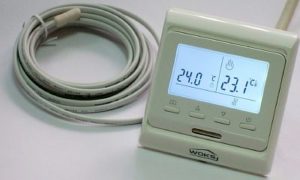
- Set the room temperature on each room thermostat. Install the device 1.5–1.6 m above the floor, away from heat sources and direct sunlight;
- the thermostat receives information from two temperature sensors - air and floor temperature sensors;
- the thermostat transmits information about the set parameters to the wired automation switching module;
- in turn, the module transmits a command via wires to the servo drive, which either opens or closes;
- If there is no automation, the floor temperature is adjusted manually by turning the servo drive heads.
Major manufacturers
Today, the following brands are among the leaders in the production of high-quality water-heated floor systems with various characteristics.
- Luxor.
- Valtec.
- Watts.
- Rehau.
- Neptune.
- Henco.
Luxor
Luxor hydronic underfloor heating systems are available in four types in the Russian market. The CD 468 system, based on two manifold beams (return and supply combs), has a number of outlets ranging from 3 to 12. The CD 477 model is equipped with flow meters. The CD 468 M series features ball valves equipped with temperature sensors. Some CD 473 M systems feature air vents and drain valves. Luxor systems are sensitive and require constant monitoring of their technical condition.
Valtec
The company has completely switched to using cross-linked polyethylene pipes in its circuits. Unlike simple polyethylene, whose molecules are not interconnected, cross-linked polymer has tight molecular bonds, which imparts high strength to the products. A drawback is that the pipes have difficulty maintaining the bends of the loop, requiring additional clamps.
Watts
Watts is unique in that it supplies heating units to the market fully assembled and ready to connect. This ensures quick installation. Its latest developments include a radio-frequency thermostat, allowing installation anywhere in the room.
Rehau
Rehau supplies high-quality equipment that is reliable, compact, and easy to install. The control unit can be installed quickly, allowing for quick connection of the servo drives to the switch. One drawback is the high cost of the equipment.
Neptune
The only Russian company supplying hydronic underfloor heating systems with corrugated stainless steel pipes. These systems differ from their polymer counterparts in that they offer near-perfect heat transfer and are resistant to freezing and water hammer. The equipment package includes all necessary fittings, insulation mats, and a circulation pump.
Henco
The manufacturer's underfloor heating system is based on a multilayer construction of metal-plastic pipes. The German company guarantees the heating system will operate for several decades. Counterfeit Henco products are often found in stores. Genuine products are manufactured only in Belgium.