Today, to make living conditions more comfortable during cold periods, most homeowners install hydronic underfloor heating. But even with proper system design and installation, achieving a comfortable indoor climate isn't always possible.
The cause lies in improperly adjusted heating systems. Therefore, it's important to understand how to properly configure hydronic underfloor heating.
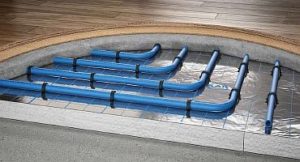
Please note! The advantage of individual heating systems is the ability to regulate the optimal heat level with minimal costs.
- Optimal temperature parameters
- Connection diagrams
- Combined
- Connecting to a radiator
- Temperature conditions
- Rules for filling the system
- Methods for regulating the temperature of heated floors
- Automatic adjustment
- Manual temperature equalization
- Hydraulic leveling system
- Three-way valve capabilities
- Video instructions
Optimal temperature parameters
Hydronic underfloor heating is configured based on individual needs. Some people prefer a warm room, while others prefer invigorating freshness, even in the most severe frosts. Despite this, there are general standards developed with sanitary regulations in mind, including:
- heating the floor up to 28 degrees;
- if there is another heat source or if you live in the room permanently, the ideal level is from 22 to 26 - these are optimal conditions for a person;
- If this type of heat source is the only one, or it is located in the bathroom, hallway, balcony, or in a house where people do not live permanently, it is permissible to raise the temperature to 32 degrees.
Therefore, when regulating water floors, in addition to your preferences, you should take these standards into account to ensure a healthy microclimate in your apartment.
Connection diagrams
Hydronic underfloor heating is often used as a supplemental heat source. It is typically integrated into the main heating system or hot water supply. The connection method determines the control features of the underfloor heating system.
There are several connection diagrams for water heating devices.
Combined
A popular and technologically feasible method is combination heating, which includes a radiator and underfloor heating. However, to install this system, we'll need:
- boiler;
- pump;
- expansion tank;
- collectors for radiators and underfloor heating;
- radiators;
- pipes.
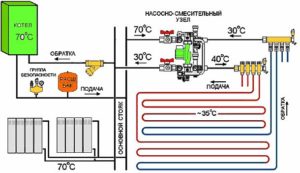
It's important to properly integrate different heating devices to ensure they function efficiently. The main methods for connecting radiators with underfloor heating into a single system are:
- Parallel connection of the manifold unit to the heating system. The circuits are inserted into the main line before the radiators. Fluid circulation is provided by a pump.
- Connection using coils, primary or secondary. The pipeline, when laid, forms rings, which are inserted into the supply system at several points. The coolant temperature depends on the distance of the coil from the heat source.
- Connection to a coplanar manifold, at its extreme point. Water is circulated in the circuit by a common-house pump located in the generator room. The underfloor heating system has priority when supplying hot water.
- Using a hydraulic distribution unit is an excellent option if there are multiple heating devices, with different floor loop lengths and water flow rates. This design also requires a coplanar manifold.
- Local circuit connection via a unibox using a parallel circuit. Suitable for small spaces, such as bathrooms and hallways.
Connecting to a radiator
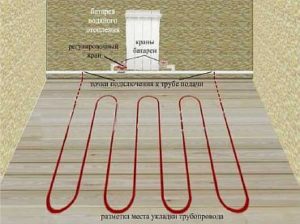
A common method for feeding underfloor heating from radiators. With this system, the temperature of the water in the underfloor heating is directly related to the temperature of the water in the radiator.
Find out maximum and optimal coolant temperature in an underfloor heating system.
To build this system, you need a main line with a supply and return line, as well as floor pipes and a unibox. Since the water in the radiator heats up to 80 degrees Celsius, it is recommended to connect the floor loops to the return line.
Unibox - design, types and operating principle, advantages of use, do-it-yourself installation.
From the boiler
This is a simple option: the installed boiler is designed only to heat water for underfloor heating, so no regulators are needed.
With a modern gas boiler, it can regulate the temperature automatically; simply set the desired temperature on the control panel. Even with a two-wire system, where the boiler heats water for both radiators and underfloor heating, the temperature for each component can be easily adjusted using the boiler's automation.
When using a solid fuel boiler, a compensating tank is required. Temperature and pressure are regulated by installing a safety unit on the tank, which consists of a pressure gauge, an air bleed valve, and a thermostat.
For your information! The operation of a water-heated floor is affected by the pipe layout - Find out what types of installation schemes there are, as well as methods for connecting heated floorsWith a "snake" design, heating will be uneven, with hot and cold spots. A "snail" design ensures uniform heating.
Temperature conditions
Hydronic underfloor heating operates differently from other heating devices. The main difference is the heating level of the coolant. Radiators are supplied with water heated to 80 degrees Celsius, while hydronic underfloor heating circuits reach a maximum of 42 degrees Celsius. At this temperature, the floor surface will heat up to 26 degrees Celsius.
There are two methods for adjusting the temperature of water-heated floors:
- By controlling the flow rate at the collector's supply point by mixing in wastewater, this is achieved using a three-way valve with a thermostatic head. Operation is based on the water temperature, not the air temperature, ensuring a constant volume of fluid consumed, even with slight temperature fluctuations.
- By restricting the flow of heated coolant into the pipes. This also requires a thermostatic valve, which is placed on the three-way valve and used to shut off the return flow. The supply and return valves are connected to a bypass, through which the flow is regulated by the limiting valve. Since underfloor heating is inert, water is supplied to the pipes at the nominal temperature, and only its consumption varies.
In both methods, the thermostatic head operates based on the return temperature.
Rules for filling the system
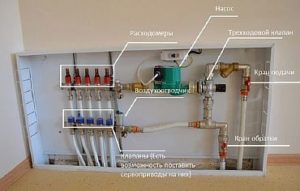
It's impossible to properly configure a water system if the volume of liquid in the pipeline fluctuates on its own. This can happen if there's air in the system. See the instructions on how to bleed the air from a heated floor yourself.Therefore, it is important to both professionally install the structure and fill it correctly.
To ensure proper system filling, both manifold lines should be equipped with automatic air vents. Floor heating loops should be filled separately from other heating units. The generator and radiators should be filled in advance. Before filling, the manifold inlet valves should be closed.
To properly start the floor, you need to connect a hose from the water supply or pump to the supply valve, and an air outlet hose to the return.
Filling the underfloor heating system should begin with the manifold and its distribution units. To do this, open the supply valve flow meters fully, and at this point, turn off the return valves.
The loops are filled one at a time, with water released from the bleed hose until it comes out clear and free of air bubbles. The water should be released at a gentle pressure to ensure a more even air release from the pipes. Once all the loops are filled, the unit can be turned on.
Working with collector flow meters
Balancing a heated floor system involves determining the required standards for each loop. The amount of water required to cool the coolant as it passes through the loop varies depending on the size of the floor loop. The volume of liquid passed through the loop is its thermal load.
It's often recommended to determine the coolant flow rate based on the pump power, meaning the incoming fluid volume is divided proportionally by the length of the loops. However, this method should be avoided, as it's difficult to accurately calculate the size of each coil using this method.
In addition, calculations using this method lead to a discrepancy between the pressure in the loops and the calculated value, which makes it impossible to adjust the design.
Myself Adjusting flow meters is simple – here's an article with step-by-step instructionsThe device's flow rate is adjusted based on the model, either by turning the housing or the stem with a key. The device displays the amount of water flowing in liters per minute; simply set the desired value.
Adjusting the flow rate of one loop generally affects the others. Therefore, the process should be repeated sequentially for each flow meter. Significant failures indicate that the valves are underperforming or the circulating pump is underperforming.
Methods for regulating the temperature of heated floors
To achieve the required temperature values that meet standard standards, the device must be configured.
Proper adjustment of underfloor heating is possible based on the room type. The appropriate temperature range for living spaces is 20 to 28 degrees Celsius. For kitchens, hallways, and bathrooms, a suitable temperature range is 19 to 24 degrees Celsius.
Please note! The acceptable indoor humidity level is 60%, but 40–50% is considered optimal.
The main goal of regulation is to ensure a constant temperature difference between the inlet and outlet. To determine this temperature difference, the thickness and material of the screed, as well as the spacing of the pipes, are taken into account.
The installed equipment influences the design's adjustment methods, which can be mechanical or automatic. The device responsible for water flow is adjusted, which can be done by mixing hot and cooled coolant, or by limiting it.
Automatic adjustment
If underfloor heating is controlled automatically, the main control elements are the RTL thermostatic head or the unibox valve. The floor heating level depends on the set value; the higher the value, the hotter the fluid flowing through the pipes will be, and therefore, the warmer the flooring.
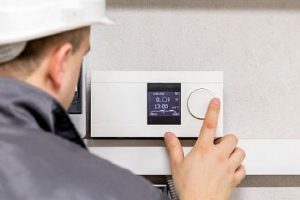
How to automatically adjust a water-heated floor - this can be done in two ways:
- Using a thermostatic self-regulating device, the adjustment is made using valves or a tap with heads.
- With the help of an electronic system, it includes an electric thermometer, a controller, and electric drives.
Electronic control devices are expensive, but they allow you to program underfloor heating and adjust it for optimal and efficient operation.
There are many companies offering electronic regulators on the market, but the most popular are Uponor products.
Manual temperature equalization
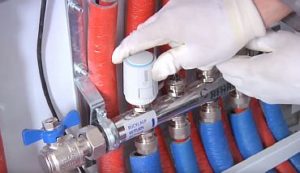
The manual setup process is simple but time-consuming. The water heating temperature is adjusted by opening or closing the valves. The process is significantly simplified by using a device that controls the flow to each branch.
For your information! Underfloor heating will function effectively with manual adjustments—with intensive water circulation in the pipeline, this can be achieved using a separate heat pump.
Before adjusting the temperature in a water-heated floor heating system, ensure the system is full and free of air pockets. Adjustment involves feeding coolant into each coil and setting its flow rate. This is done by taking into account the difference in flow temperature between the inlet and outlet. This procedure must be performed annually.
Important! The incoming and exhaust coolant temperatures in all loops must be approximately the same; the acceptable difference is 5–15 degrees.
Monitoring the water floor adjustment process is made easier by using a thermometer, either laser or electric. This will significantly reduce setup time.
Hydraulic leveling system
Underfloor heating is a reliable and safe system. But to ensure it's truly effective, it requires proper setup. To regulate underfloor heating in a private home, it's best to install a manifold assembly equipped with flow meters and an operating pressure of 6 bar. If the house is equipped with central heating, this capacity is insufficient.
If the manifold has servo drives, the water flow is adjusted automatically as needed. However, preliminary adjustments will still be necessary. Without such a drive, such adjustments are absolutely necessary.
The coolant flow rate can be calculated using the formula:
Good = Q/(1.163*Δt), in which
- Good — specific volume of water per m2;
- Q — floor power indicator;
- Δt is the difference in temperature of the coolant at the inlet and outlet;
- 1.163 is the correction factor.
To further calculate the volume of fluid that passes through the loop, multiply the specific flow rate by the surface area.
The simplest option for carrying out hydro-leveling:
- calculate the volume of water for each loop by multiplying the floor area where the loop is laid by 8.6 (average value);
- start the pump at first speed;
- set the thermal head to 30 degrees;
- check that the liquid flows freely through the loops and that all the air has come out;
- Adjust the flow meter on each circuit to obtain a value equal to the water flow rate you calculated.
The above steps are a preliminary setup, meaning that during actual operation of the heated floor, additional adjustments will be required, taking into account personal comfort preferences.
Three-way valve capabilities
If there is a three-way valve on the comb, then the adjustment is made using a servo drive. The mixing valve will then control the parameters. During this process, the three-way valve can be turned as often as needed. Adjusting the mixing valve, however, is more difficult.
Why is it needed? A comb for underfloor heating, let's look at its design and operating principleHow to choose, instructions with photos and videos on how to install and configure, or do it yourself.
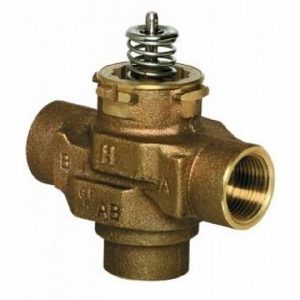
Another option for adjusting underfloor heating is to use a modular mixer, which consists of:
- three-way valve;
- thermometer;
- bypass;
- liquid circulation pump;
- thermostatic head;
- relay.
This kit is not cheap, but it is highly effective. A mandatory requirement for this module to function is European assembly.
Another method for regulating underfloor heating is to install a servo drive and a thermostat. The thermostat notifies the servo drive when the room temperature drops and prompts the flow of heated coolant. This method works even if you're assembling the manifold yourself.
Underfloor heating is a complex system, and if you decide to install one in your home, you need to understand that installing the system isn't enough; it also requires periodic adjustments according to the instructions. It's crucial to understand this process, otherwise, the floor won't meet your expectations.