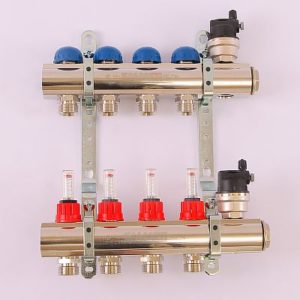
Nowadays, most homeowners prefer to use underfloor heating with water. The efficiency of this system depends on proper heat transfer.
Adjusting the flow meter of the underfloor heating manifold will allow you to control water consumption in the pipeline and fine-tune the system.
This device can facilitate the balancing process and efficiently distribute liquid across the heating circuits, thereby creating uniform heating throughout the entire room.
Do you need a flow meter or not?
A flow meter is a device designed to regulate the operation of underfloor heating systems, most often used in multi-circuit hydronic systems. Without it, it's difficult to achieve proper heating in the room. Manually adjusting the underfloor heating manifold is very difficult.
Adjusting underfloor heating circuits using flow meters means regulating the fluid flow through the coils. Depending on the size of the coil, different amounts of fluid are required to ensure that, as it moves through the loop, it cools down exactly according to the calculated value.
In the design without a flow meter:
- The temperature in different rooms will differ;
- Underfloor heating will result in excess energy consumption.
Please note: The idea that optimal water flow can be determined based on the performance of the circulation pump is incorrect.
Firstly, it's difficult to accurately calculate the coil length, and secondly, it violates the rule of selecting equipment parameters—based on the device's needs, not vice versa. Furthermore, this calculation method will result in the fluid volume in the circuits differing from the calculated value.
Flow meter device
A rotameter is a mechanical instrument with a plastic or brass housing. It has a polypropylene float inside. The housing is topped with a transparent bulb with a scale. This device is also called a float rotameter.
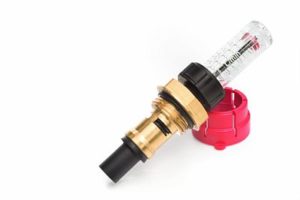
Please note! A plastic rotameter is most commonly used in underfloor heating systems.
It is recommended to install a mixing unit with flow meters and a thermostat on the return line. This device can supply each loop with the required amount of coolant, and the outlet valves will open and close as the water cools.
It should be said that there are several types of water meters:
- measuring rotameter - is mounted together with the valve, in which regulation is carried out independently, taking into account the measured indicators;
- regulating - serves as a coolant distributor;
- combined - this type combines both models, but it is also more expensive.
Operating principle and functionality
The main function of a flow meter is to regulate the coolant flow within the circuits. Rotameters allow:
- Control the heating of the liquid, which makes it possible to save electricity;
- Ensure uniform heating of all branches of the floor;
- Avoid temperature fluctuations in different rooms;
- Conduct visual monitoring of the volume of coolant flowing from the boiler to the main line.
Please note! The need to equip the manifold with flow meters when installing underfloor heating is especially acute in homes with rooms of varying sizes.
The larger the room, the lower the heating level. Therefore, achieving uniform heating without this device is very difficult.
The operating principle of flow meters in underfloor heating manifolds is quite simple. The coolant moving through the circuit sets a float in motion, causing it to move. Based on its location, the amount of water in the coil is measured on a scale printed on the bulb.
The water meter operates autonomously, requiring no additional power source. A faucet equipped with such a device significantly simplifies full control over the design, while installation and maintenance are simple.
Selection criteria
The flow meter model largely influences the proper functioning of the system, and therefore the comfort of the room. Therefore, its selection should be approached with great care.
When purchasing a rotameter for underfloor heating, you need to pay attention to:
- The body material. Brass is highly wear-resistant, and the top of this device is nickel-plated. This type of device is expensive. Plastic is affordable, but also less durable.
- Integrity - Before purchasing the product, you need to inspect the body and flask for cracks and defects.
- The inner spring must be steel.
- Flask. In high-quality products, it's made of polycarbonate. This material has increased heat resistance and strength.
- Technical specifications can be found in the instructions. Temperature is at least 110 degrees Celsius, and pressure is 10 bar.
- Throughput capacity - at least 2 - 4 m3 of water must pass through the rotameter.
- Manufacturer reliability is guaranteed by a quality certificate and a warranty period of at least 5 years. Unscrupulous manufacturers, seeking profit, try to replace expensive and high-quality components with inferior ones.
There's a huge selection of these devices available in stores, so by following these tips, you can purchase a quality product.
How to install a flow meter correctly
According to the manufacturer's recommendation, the flow meter is mounted on the return line of the manifold, although installation on the supply line is possible.
The main requirement for installing a rotameter is vertical placement. This will allow for accurate water level readings. Therefore, the comb must be positioned strictly horizontally. Installation accuracy can be determined using a plumb line or level.
Underfloor heating comb: installation and adjustment, DIY manufacturing, step-by-step instructions with photos and videos.
Since the device—a manifold and flowmeter—must operate automatically, an additional temperature sensor connection is required. This circuit completely or partially shuts off the coolant flow to the loops when the required temperature is reached.
DIY manifold installation: connection diagram and settings, types and operating principle.
The process of installing the flow meter is as follows:
- The rotameter is installed by screwing it into the collector's collecting comb socket using a special wrench, ensuring it is positioned strictly vertically. The device is equipped with a sealing ring and nut.
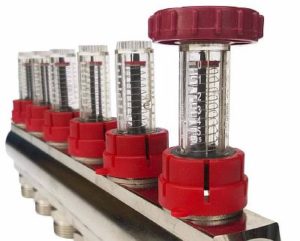
Please note: This connection does not require additional insulation.
- The bulb is unscrewed and removed by turning it counterclockwise. Then, the ring provided by the manufacturer for protection is removed. Afterwards, the bulb with the markings is reattached in the reverse order.
- The brass ring is turned clockwise to the required value, thereby balancing the speed of the incoming coolant.
- The brass ring is covered with a plate - this will prevent the device from mechanical damage.
After these steps, it is imperative to check the entire system for functionality.
Adjusting and correcting the underfloor heating manifold with flow meters
After verifying the system's functionality, many people wonder how to properly regulate underfloor heating using flow meters. The process is straightforward, as using rotameters significantly simplifies the process.
When setting up manually, the work is quite labor-intensive, since the adjustment is carried out using a conventional valve - a thermal head, which is installed on the return and supply lines.
This method significantly reduces installation costs, but the adjustments are time-consuming. Furthermore, the accuracy of manual balancing suffers, as the temperature must be determined based on personal experience.
The most convenient method is to perform adjustments using flow meters installed at the coil inlet. Individual adjustments should be made in each room, taking into account the liquid's heating level and hydraulic resistance.
All that will need to be done subsequently is to monitor the difference in readings between the circuits; they should not exceed 0.3–0.5 liters.
Before adjusting the underfloor heating system on a manifold using flow meters, it's important to understand why this is necessary. The purpose of balancing is to determine the demand of each branch and the overall flow balance.
Furthermore, the correct adjustment of the flow meters on the manifold affects the quality of the flooring during operation—it must not overheat. Higher temperatures will damage the flooring, requiring replacement.
The operating principle of underfloor heating differs from other heating devices. The key difference lies in the difference in water temperature: while radiators circulate liquid heated to 80 degrees Celsius, underfloor heating operates at 40 degrees Celsius, with the surface heating up to 22 degrees Celsius.
Please note! It is commonly believed that underfloor heating systems do not require balancing and that water flow in the loops is regulated automatically using automatic devices such as thermostats and controllers. However, this is incorrect.
Adjustment process
As mentioned above, each circuit must be adjusted separately, taking into account the piping layout. The required coolant volume for each coil varies, depending on its length.
This indicator is determined using a formula: the heat load is calculated based on the water's heat capacity and the temperature difference between the inlet and outlet. Before proceeding, the installed circuit must be checked for leaks, as these will distort the readings during adjustment.
To do this, the pipeline should be filled with water and let the air out, that is, open the flow meters, three-way valve, air vent, and shut-off valves on the supply and return lines.
This procedure is accompanied by a whistling sound; when it stops, this indicates that all the air has been released. After this, all valves except the supply one are closed, and each circuit is pressure tested in turn.
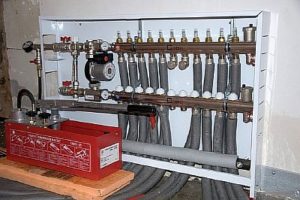
Then, you can proceed to adjusting the underfloor heating flow meters, the procedure is as follows:
- The volume of coolant passing through the manifold group in 1 minute is calculated. This figure is measured in liters, and the resulting value is taken as 100%.
- The water demand for each water circuit is determined separately, as a percentage. The result should then be converted to liters per minute. Start with the longest loop and the highest capacity, opening the regulating valve to full capacity.
Please note! Further, the flow rate in other coils will be determined relative to this coil.
- The volume of water supplied to the main line is adjusted using flow meters.
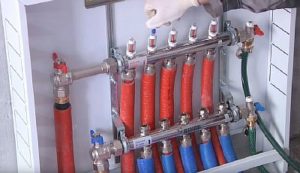
Once the flow meters are configured, the circulation pump at the distribution unit is turned on. Hot water will begin to flow into the pipeline, displacing the cold water. This process will take about three hours.
Please note! Before starting the floor heating system, set the flow meters to their maximum values. These values are usually different for each branch, and they must be adjusted subsequently to ensure uniform heating.
It's worth noting that the adjustment process for a flowmeter system depends on its model. If the flowmeter doesn't have a built-in valve, an additional shutoff element is required to ensure the flowmeter remains in the "open" position. Balancing occurs while the device is operating.
If you have a combined type of device, it is recommended to perform a preliminary adjustment by turning the built-in valve to full power.
How to clean a flow meter
A flow meter, like any device, requires periodic maintenance, or more specifically, cleaning. The process is simple, and you can do it yourself:
- The valve is closed by screwing the cap clockwise.
- The flask is removed and cleaned, then replaced. Cleaning involves wiping the inside with a soft cloth or rinsing with water and detergent.
- Then the valve is opened by turning it counterclockwise.
Please note: When removing the flask, there is no need to relieve pressure in the system, as the valves will prevent leaks.
It's not uncommon for the flow meter pointer to stick when the manifold assembly is operating. To restore its function, the shutoff valve must be forced open.
If the flask cracks while using the device, it is best to unscrew it and replace it with a new one, as the crack may interfere with determining the volume of the coolant.
To ensure efficient operation of your underfloor heating system, you need to not only select the right flow meter model but also install and configure it correctly. If you're unsure of your skills, it's best to hire a professional.


Hello. I adjusted the flowmeter settings as described in the video. I closed all the circuits and, opening each one one at a time, set the flowmeter to the desired value calculated in the Valtek program. However, after opening all the circuits after the adjustment, the flowmeter readings changed. Is this normal, or is something wrong?
Yes, they started off well, but ended the article in disrepair. Clearly, the article was copied and pasted, and the author has only a vague understanding of the process being described. They've added a lot of fluff, but the main point (namely, regulation) has been overlooked.
What specifically don’t you understand after reading the article?
I don't know what you're confused about. Everything is explained clearly and concisely, in plain English! It's convenient that the site has navigation! Thank you!