The smooth operation of any heating system depends on the correct selection of components, and hydronic underfloor heating is no exception. In this design, maintaining the correct temperature and flow rate of the coolant is crucial—a function performed by shutoff valves: two-way or three-way valve.
In our article, we'll explain what a three-way valve is, how it works, and the different types available. You'll also learn which valve to choose for your underfloor heating system, as well as how to install it yourself.
- Scope of application
- Functions
- Design and operating principle
- Types
- Manual
- Automatic
- Materials of manufacture
- Service life
- Marking
- Advantages and disadvantages
- Manufacturers
- How to choose the right one?
- Underfloor heating system with a three-way valve
- Scheme with a separately installed valve
- Valve with mixing unit
- Connection diagrams depending on the design
- Installation and connection of a three-way valve to a heated floor
- Materials and tools
- Progress of work
- System check
- Common installation mistakes
- Features of operation
Scope of application
Underfloor heating systems are increasingly popular in residential buildings today, but proper heating cannot be ensured without a regulating valve. A three-way valve is designed to regulate the heating level in a water-heated floor covered with screed.
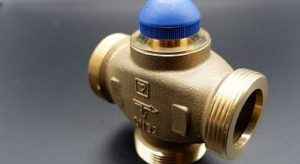
The valve is installed as a complete set mixing and distribution unit, and as a standalone device. In small spaces (bathroom, toilet, kitchen), installing a multi-functional manifold is pointless—it's expensive and unjustified.
A three-way thermostatic mixing valve can control the temperature and regulate the volume of liquid for such rooms.
Main areas of use:
- In a radiator heating system.
- In the hot water supply system.
- In warm floors.
Functions
Hydronic underfloor heating differs significantly from standard radiator heating. Floor pipes, which are embedded in a cement screed, require water at a specific temperature, significantly lower than that circulating in radiators. Therefore, a three-way mixing unit is required to bring the coolant to the required temperature.
Bringing the liquid to the required heating temperature, which meets the standards for heated floors (which ranges from +35 to 55 degrees), is the main function of a three-way thermostatic mixing valve.
Design and operating principle
A mixing valve is a device for mixing and regulating water flows. It has three openings: two inlets and one outlet. Between the inlets is a temperature-sensitive valve, which regulates the flow of liquid—both cooled and heated. Modern devices are equipped with a thermostatic valve or a regulating valve.
The underfloor heating valve operates continuously. The step-by-step process is as follows:
- heated water is supplied to the first input - its temperature is determined in the valve;
- If the water temperature exceeds that required for underfloor heating, the supply of cooled liquid from the return line is opened through the second hole;
- inside the valve, heated and cooled liquids are mixed;
- after reaching the required temperature, the return flow is closed;
- The coolant is supplied through the outlet to the underfloor heating pipes.
For the thermal valve to operate effectively, it is necessary to maintain a constant pressure in the line.
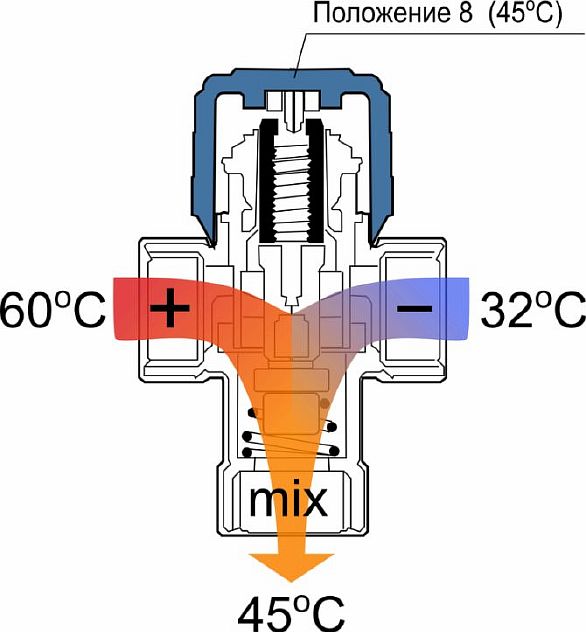
When operating an automatic thermal mixing valve equipped with a servo drive, heating is carried out in 3 minutes, if there is a thermal head, the liquid is heated in 15 minutes.
Types
Three-way thermostatic valves come in separate and mixing types. Mixing types are used for underfloor heating.
Furthermore, they have different activation methods, ranging from manual to automatic. They also differ in their design, including the placement of the inlet and outlet openings.
Manual
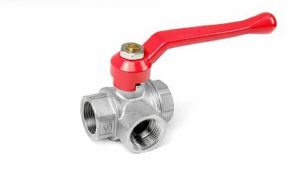
A manual device is inexpensive, but rarely used due to its inconvenience. It's only suitable for small spaces, such as bathrooms and kitchens. The temperature and flow rate are adjusted manually using a handle.
Automatic
Automatic taps have a thermal head or an electric drive, which can be controlled by a sensor.
Types of mixing units:
- Simple - if the temperature rises, the liquid expands, the valve opens, and cold and hot water mix.
- Three-way valves with a thermal head and a remote thermostat for underfloor heating are more advanced models. They are widely used because they are precise and do not require electricity to operate. Average prices range from 500 to 2500 rubles.
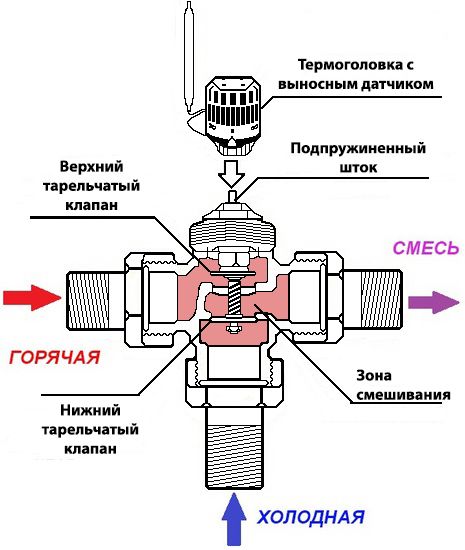
- Three-way heating valves with a thermostat regulate the flow of heated and cooled water, and the temperature is controlled by a built-in thermostat. The openings expand and contract automatically, depending on the temperature of the water.
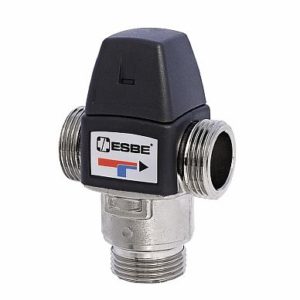
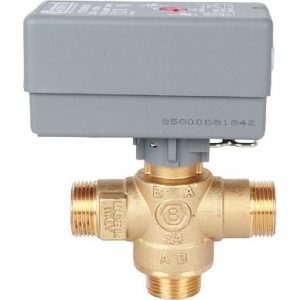
- Electric actuators (magnetic actuators or servo actuators)—the valve's flap is actuated by an electric motor, controlled by a controller, which receives a signal from a temperature sensor. They are easily connected, making them widely used. However, their main drawback is their unreliability, as they rely on electricity. They are more expensive than thermostatic valves, approximately 4,000–5,000 rubles.
- Pneumatically or hydraulically driven – these are more commonly used in industrial settings for high-pressure applications. They are more expensive, but have a longer service life.
- Electronic - regulation is carried out by a built-in electric motor or a control element with a thermometer.
Materials of manufacture
Three-way thermal mixing valves are made from the following materials:
- Brass is a copper alloy with added zinc. It is resistant to corrosion and is durable and long-lasting. Sometimes these thermostatic mixers are chrome- or nickel-plated to prevent tarnishing. This option is most often used in residential settings.
- Bronze is a copper alloy with added tin. It is rare, although its quality is no worse than brass.
- Stainless steel is an excellent metal for making control devices. It is durable, strong, and corrosion-resistant. However, stainless steel devices are expensive, making them unsuitable for homeowners.
There are regulators made of titanium and carbon steel, but these are recommended for industrial use. Valves are also made of silumin (an aluminum-silicon alloy), but their disadvantage is their low strength.
Service life
The service life of a valve is affected by its quality and the number of times it is operated. On average, the valve lasts 10 years or more. The most common causes of failure are the thermal head or the electric actuator.
Marking
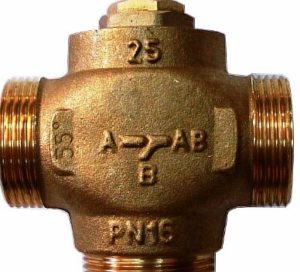
Three-way mixers have their own letter and number markings, which reflect:
- company name;
- valve series and number (for example VTA 321);
- product size in mm (let's say DN 20);
- temperature level indicators from 20 to 40;
- capacity in m3.
Advantages and disadvantages
Three-way thermostatic mixing valves are simple in design, yet reliable and durable. Their use allows for high-quality and precise control of underfloor heating.
Thermostatic valve for underfloor heating: types and their designHow to choose, installation diagrams, and alternative connection methods
The units are sealed and compact. Plus, they prevent pipes and screeds from overheating, extending the system's lifespan.
The benefits of control valves are undeniable, but they have a number of disadvantages:
- They increase hydraulic resistance, which negatively affects the functioning of a unit that has more than one manifold.
- There's a risk of a large volume of hot coolant entering the floor pipes. This can lead to leaks and air in the system. Such problems most often occur when the unit is starting up.
Manufacturers
Preference should be given to mixing valves from manufacturers with a proven track record. These companies include:
- Esbe (Sweden) — is a leader in the quality of this type of product. The valves are reliable, with a warranty period of over 5 years.
- Valtec — a Russian-Italian company whose mixer taps offer excellent performance at an affordable price. They come with a 7-year warranty.
- Honeywell (America) — This company's faucets prioritize convenient and easy installation. They are reliable, but expensive.
However, it should be remembered that even high-quality products, if installed incorrectly, will not ensure the correct operation of the system.
How to choose the right one?
It's recommended to select a three-way valve from a specialized store. When choosing a model, consider its specifications. When purchasing a device, you should:
- study all documentation - warranty, manufacturer's certificate, installation and operating instructions;
- give preference to bronze or brass appliances - they will not expand when heated;
- start from the valve capacity - this parameter must correspond to the boiler performance;
- Select a valve with a cross-section that exactly matches the size of the floor pipes; if they don't match, you'll have to buy adapters.
An important point: even the apparent match between the valve inlet and outlet diameters does not indicate the flow rate. This is determined by the internal cross-sectional area of the openings. This parameter is specified in the accompanying documentation.
The device should be selected based on the size of the room being heated. For larger areas, an automatic unit is recommended, as it can maintain the required heating level. For smaller rooms, a simple thermostatic unit will do the job, so there's no point in overpaying for a more complex model.
When purchasing, visually inspect the device for chips and cracks. If the device is brass, it should be gold-colored inside.
Purchasing automatic devices will simplify the regulation process. And software will allow you to adjust the temperature based on the time and day of the week.
Underfloor heating system with a three-way valve
A three-way valve can be installed together with a mixing and distribution unit, or as a separate device.
Scheme with a separately installed valve
If the valve is installed separately, it performs all the functions of the manifold. This design is intended for small rooms, no larger than 25 m². Temperature control is accomplished using a special device and thermostat, both located in the valve.
The disadvantage of using a valve in this design is that there is no way to dose the flow.
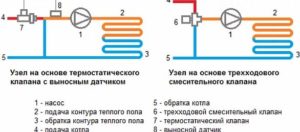
The system looks like this:
- a three-way valve is installed on the hot coolant supply pipe;
- a temperature sensor is attached behind it;
- Next, a circulation pump is installed; it will deliver water at the required temperature to the floor pipe.
Valve with mixing unit
If the area is large, then it is necessary to use a scheme where the valve is part of the distribution unit.
It will ensure the uninterrupted operation of the underfloor heating device, and the water entering the floor main will be at the required temperature and volume.
The connection diagram is as follows:
- a pump is installed on the supply pipe; it will pump the heated coolant from the source;
- then a temperature sensor is installed, it will control the degree of heating;
- At the next stage, a three-way valve is attached - it mixes the coolant to a specified degree;
- A valve is placed on the return circuit through which chilled water will flow into the three-way device.
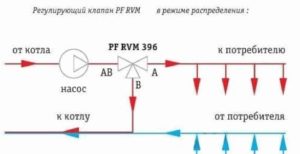
That is, the coolant heated to the required temperature will be supplied to the underfloor heating pipes.
Connection diagrams depending on the design
In addition, connection diagrams differ in design and direction of the coolant in the device, and are:
- L-shaped The device is equipped with two side openings and one round opening at the bottom of the housing. Heated liquid is fed into the side opening, and cooled liquid into the bottom opening. After mixing, the water flows into the floor drains through the other side opening.
- T-shaped — Both streams, cold and hot, enter the mixer through the side inlets. The mixed coolant is sent to the floor through the central lower outlet.
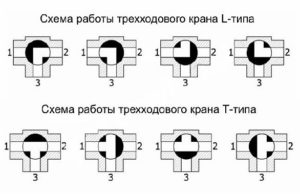
When deciding on a diagram for installing a three-position valve, you should consider how it will fit into the main line piping.
Installation and connection of a three-way valve to a heated floor
Connecting a three-way valve to underfloor heating is easy and can be done by yourself. Just follow the instructions included.
All inputs and outputs are marked with letters:
- A — inlet for heated coolant;
- C — inlet for chilled water;
- AB — outlet.
Before connecting the device, please note that it may need to be dismantled, so it is necessary to have unobstructed access to the unit.
Materials and tools
Before installing the valve, you'll need the necessary tools. You'll need two wrenches, pliers, union nut nuts with union nut washers, and FUM tape.
Progress of work
First of all, the three-way valve must be checked for functionality.
To do this, set the regulator to the minimum setting, then let hot water flow through the valve. If the device is functioning properly, the valve should close immediately.
The installation of the tap must be carried out together with the installation of the manifold group and before pouring the screed.
When using any scheme, the valve is installed using union nuts.
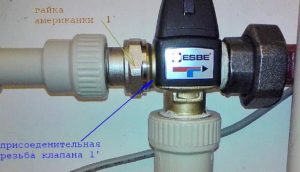
The work looks like this:
- The fittings located at the ends of the pipes are cleaned of dirt and burrs.
- The same procedure is done with the valve pipes.
- The nut is checked for the presence of gaskets.
- Then screw the nuts onto the pipes and tighten them—but not too tightly. This procedure requires two wrenches: one to tighten the nut and one to hold the valve in place.
- A mechanical filter is installed in front of the valve.
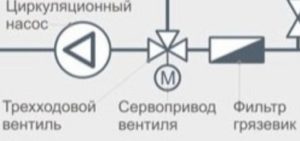
It is necessary to monitor the correct connection of the valve outlets: to A - hot water, to B - bypass coming from the return line, to AB - manifold with branches for the floor.
To ensure tightness of joints, it is recommended to use plumbing tape or FUM tape.
System check
In addition to proper installation of the mixing valve, it must be tested in operation. The system is tested with the coolant heated to 25 degrees Celsius. Pressure testing takes 24 hours.
After checking, you can proceed to pouring the screed.
Common installation mistakes
The most common mistake when installing a three-way valve is the supply and return floor circuits are connected incorrectlyFor example, when floor circuit pipes are connected to the inlet.
Therefore, care must be taken; the faucet outlets are marked with letters. If you mix up the holes, the device will not function.
In addition, it is necessary to strictly follow the manufacturer's instructions regarding maintaining the distance between straight sections before and after the propeller. Failure to do so will impair the regulator's operation.
Features of operation
There are some special considerations when using a mixing valve for underfloor heating. The most important is the mandatory installation of a filter. Furthermore, installing a thermostatic mixer valve in a manifold that serves more than one room or is located in an adjacent room is not recommended. A device with a remote temperature sensor located in the room being heated is suitable.
The mixing valve is the key component in a hydronic underfloor heating system. The quality of the room's heating depends on its proper operation. Therefore, its selection and installation must be approached with care. If you are unsure of your abilities, it is best to call a professional.