Hydronic underfloor heating systems, which are increasingly popular, will not function effectively without a special control device—a thermostatic valve. It allows you to control the temperature of the heating medium and adjust the floor's operation.
In this article, we will take a detailed look at the purpose of thermostatic taps.
We'll explain the different types of mixing valves, their design and operating principles, and how to choose the right model.
The purpose of the thermostatic valve and its scope of application
Thermostatic mixing valve is used in underfloor heating with circulating water inside.
The heating temperature of the coolant for conventional radiators is much higher than that required for hydronic floors. Overheating the concrete screed will worsen the microclimate and lead to damage to the flooring. A thermostatic mixing valve for underfloor heating can help solve this problem. Using it, you can create an independent circuit with the desired temperature. or power the underfloor heating from the central heating system.
A thermostatic valve can solve the following problems:
- Change the direction of the water flows and mix the hot with the cold in the required proportions;
- Obtain a liquid with a constant temperature at the output.
A mixing tap is not needed if:
- the coolant temperature is the same in all circuits;
- the heat source is capable of providing the required degree of heating of the coolant at the outlet.
Types and their structure
In a thermostatic distribution valve installed on a heated floor, cooled water is mixed with the heated water from the return pipe. This process is continuous while the heating is on.
Mixing valves for underfloor heating are available in: two-way and three-wayThey also differ in the mixing method and flow direction.
Two-way
A two-way thermostatic valve is an improved version of the manual type. It can be hydraulic, pneumatic, or electric.
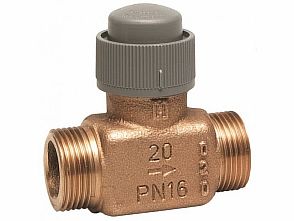
The design is simple, yet capable of effectively regulating the coolant temperature automatically. The device is installed in the heating system in place of a manual valve.
Main advantages:
- Automatic reduction of liquid temperature level;
- Simple design and low price;
- Easy installation.
Flaws — it can be installed on small pipes. If this valve is used for heating in a large room, the thermostat will operate intermittently. A two-way valve is more often used when underfloor heating is used as a supplementary heating system.
The valve consists of a brass or bronze body with one or two seats. A double-seat valve can completely shut off the water flow.
The device is equipped with a thermostatic head with a scale. The head's position can be adjusted manually or automatically. Manual models are simple and inexpensive. More modern devices operate automatically.
The two-way valve operates as follows: the coolant from the return line is re-introduced into the floor pipes, but before this, a device that opens the flow of heated water is activated. The two flows mix inside the housing to the desired temperature, after which a temperature sensor is triggered, and the valve automatically closes the opening containing the hot coolant.
The valve consists of a plunger and a seat. The plunger can be plate-, needle-, or rod-shaped. It is positioned perpendicular to the fluid flow.
Three-way valve
The operating principle of a three-way thermostatic valve for underfloor heating is that cooled water from the return line is mixed with hot water coming from the boiler.
The valve is designed for heating systems installed in large spaces. It offers the same advantages as two-way valves. Particularly noteworthy is the ease of adjusting the water temperature for underfloor heating.
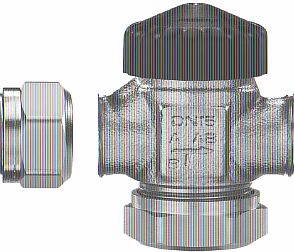
However, this thermostatic valve also has a drawback: when the thermostat is triggered, the valve opens fully, allowing hot coolant to enter the circuits. This can cause the heating system to overheat and even burst pipes. Furthermore, its flow capacity is lower than that of a two-way valve.
Three-way thermostatic mixing valves are available in brass and bronze. They are equipped with a thermal head or thermostat and can be driven by an electric actuator or servo. They are designed as a valve with two inlets and an outlet. Inside the body is a mixing chamber containing a thermostat and a digital control panel. The thermostatic valve is connected upstream of the manifold.
The operating principle of a three-way thermostatic valve:
- heated water moves through the right and front pipes - if its heating degree meets the required parameters;
- if the temperature of the liquid rises or falls, the thermostat comes into operation, it sets the rod in motion, as a result of which cooled water is mixed with the hot water;
- Once the set temperature is reached, the front opening is fully opened.
It's worth noting that when the device is turned on, the water flow voltage remains constant. This results in a uniform change in the temperature of the liquid supplied to the main line.
By mixing method
Mixing taps for underfloor heating, depending on the mixing method, are:
- With a thermostat function, it's possible to achieve and maintain the desired temperature of the coolant, as the device can regulate both flows (hot and cold). The thermostat in the faucet reacts to the temperature of the liquid, opening or closing the opening through which the heated or cooled coolant is supplied. Furthermore, the mechanism is designed so that if cold water is unavailable, the automatic shut-off of hot water is activated.
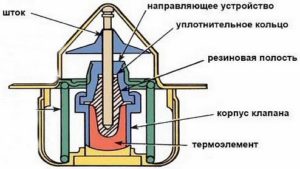
- Thermostatic valves are equipped with a sensitive thermostatic head with a remote temperature sensor located in each line. The valve's function is to detect the water temperature and send a command to the actuator.
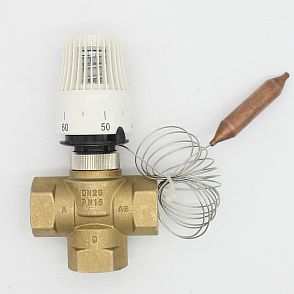
How to choose
A warm hydrofloor is a modern heating system whose efficiency is ensured by various devices, including a thermostatic valve.
When selecting a mixing unit, consider its flow capacity. It must be able to handle the water supplied by the heating system. This information is specified in the boiler's technical documentation.
For floor pipes, 26 mm pipes are most often used. The diameter of the thermostatic valve connections must match these dimensions. Otherwise, an adapter will need to be installed, which is not recommended, as the joints will be under constant pressure and will need to be checked for leaks.
In addition, the equipment should be selected depending on the temperature of the coolant in the floor main, from 55 to 35 degrees.
Whether choosing between manual or automatic equipment, automatic systems will simplify underfloor heating operation, create a comfortable indoor climate, and conserve resources, but are more expensive. Using a programmable device will allow you to adjust the temperature based on the time of day and day of the week.
When installing heated water floors in a small room, you shouldn't buy expensive equipment; a simple two-way valve will do.
When purchasing a device in a store, check for a certificate, warranty, and manufacturer's instructions for installation and operation.
Installation diagram
Today, hydronic underfloor heating is a common system for home heating, and various designs are used for its installation.
Underfloor heating system with a three-way valve
Installing underfloor heating with a three-way thermostatic valve is suitable for mixed heating systems. The radiator (water temperature 80°C) and underfloor heating (the liquid should not exceed 50°C).
Thermal head for a heating radiator – operating principle, different types of devices, how to choose and install.
The question arises: how to cool the water from 80 to 50 degrees Celsius? This is what a three-way thermostatic valve is designed for. It is attached to the supply pipe, and a circulation pump is connected downstream.
The work process is as follows:
- the cooled waste coolant is supplied from the return pipe;
- in the mixing chamber it is mixed with the hot liquid to a specified level;
- then the water flows into the floor branches.
The downside of this method is the inability to control the amount of wastewater added, which results in overheated or underheated coolant entering the main line. The upside is easy installation and low equipment cost.
There are two installation schemes for a water-heated floor with a three-way thermostatic valve, which differ in the direction of flow:
- T-shaped (symmetrical) - heated and cold coolant are supplied from the sides, the water mixes in the center of the valve body and comes out in the middle.
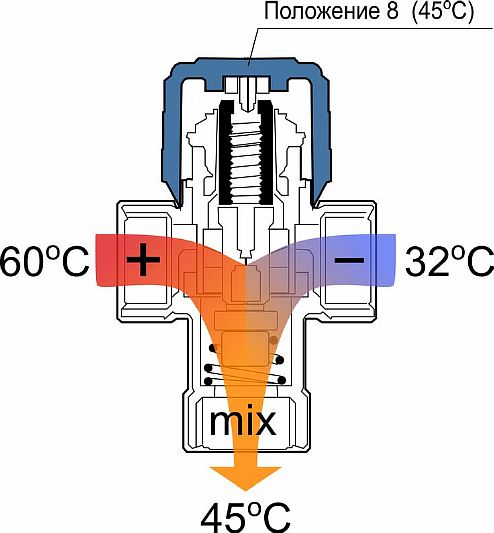
- L-shaped or asymmetrical—heated liquid enters from the side, and cooled liquid from below. Mixed water exits from the side, opposite the hot liquid.
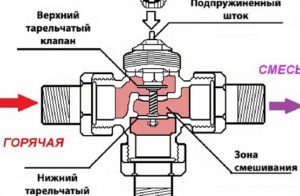
Both valves are compact and widely used in warm hydro floors.
Alternative methods for connecting underfloor heating
There are other options for connecting warm water floors:
- When installing underfloor heating in a room no larger than 10 square meters, temperature control can be achieved using a simple valve. To increase the heat, unscrew the valve; to decrease it, tighten it. The downside of this method is the manual adjustment. If you install a two-way valve on one side, the adjustment will be automatic, just like with a three-way valve.
- It's possible to connect a hydronic underfloor heating system directly to the boiler. However, a heat generator, safety valves, and a pump are required. Water from the tank is fed into the manifold unit, then directed into the floor pipes, and after bypassing the main line, returns to the boiler. This must be adjusted to the temperature of the underfloor heating medium.
If underfloor heating is installed using this system, it's best to install a condensing boiler, as it can operate at full capacity in low-temperature mode. A conventional boiler operating in low-temperature mode will cause heat exchanger failure. When using a solid fuel boiler, a buffer exchanger will be required to regulate the temperature.
- Connecting underfloor heating to a pump-mixing unit — this diagram is designed for a combined heating system with a radiator and underfloor heating. In the mixing unit, waste water is mixed with hot water coming from the heating source.
All pump-mixing units are equipped with a balancing valve, which doses the cooled liquid. This ensures the exact required water temperature for the heating system exits the equipment, increasing its efficiency.
There are different models of pump-mixing units, they are equipped with: a bypass, which has a bypass valve, a balancing valve or ball valves, they are located at the ends of the pump.
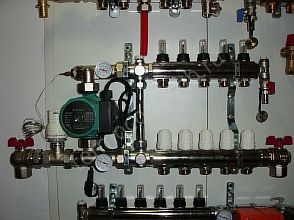
- Connecting underfloor heating to a radiator requires a special kit with temperature limiters for the coolant and air, and an air vent. Water is directed into the floor pipes directly from the high-temperature radiators, where it cools to the required temperature, and the next batch is supplied. However, this system creates overheating zones.
When planning to install underfloor heating in your home, it's important to consider all the design elements in advance. Most importantly, consider how the desired coolant temperature will be achieved in the heating system. While a pump-mixing unit is a more advanced device, it's more expensive, and not everyone can install it themselves.
A thermostatic valve is a great option. It's inexpensive, easy to connect, and does a great job of regulating and controlling the water temperature.