Today, heated floors are becoming increasingly popular. Installation technology for hydronic or electric heated floors requires a final screed.
Its most common type is cement-concrete mortar, which gives strength to the structure and protects structural elements from overheating and damage.
What influences the thickness of underfloor heating?
The main component that significantly influences the thickness of a hydronic underfloor heating system is the screed. Its size plays a crucial role in the installation of the water supply systems; without it, the floor will not be perfectly level, and the system will not function properly.
The size of the fill layer for a water-heated system should be calculated for each room separately.
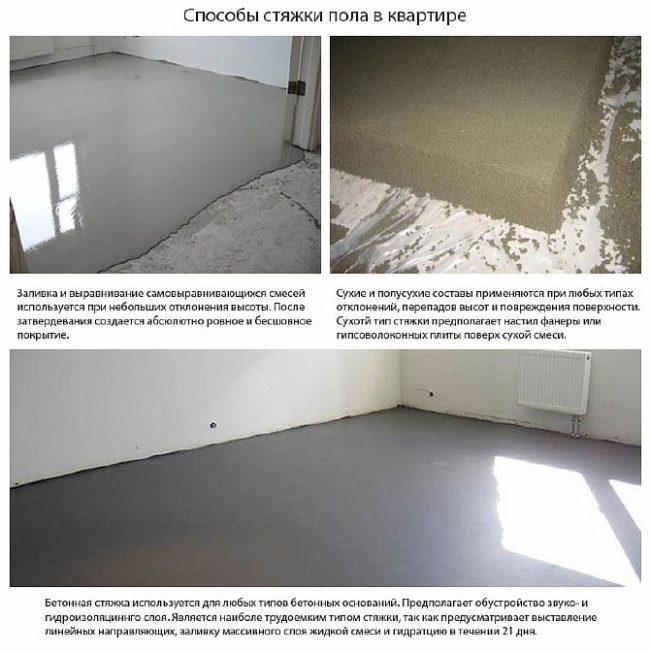
There are the following types of screeds: wet, semi-dry and dry:
- Wet mortar is a solution of cement and sand diluted with water. The recommended cement grade is M-300 or higher, and the sand should be sifted and quarried. For heated floors, a mixture with additives, such as plasticizers and fiber, is recommended.
- Semi-dry - consists of the same components as the wet form, only the water content is reduced.
- Dry is a loose material (expanded clay).
Furthermore, concrete foundations vary in size. Their size is influenced by:
- the purpose of the room and the floor itself;
- finishing coating that is planned to be installed;
- soil type - if laying is done on the ground;
- type of sub-base - concrete, wood or soil;
- pipe size - most often a product with an internal diameter of 16 mm and an external diameter of 20 mm is used;
- ceiling height;
- planned room temperature.
Also, the thickness of the concrete layer is influenced by the conditions under which the water-heated floor will be installed, the grade of cement, and the characteristics of the reinforcing product.
Description of the "pie"
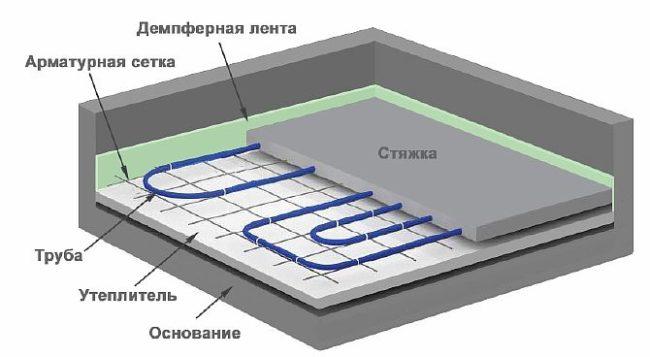
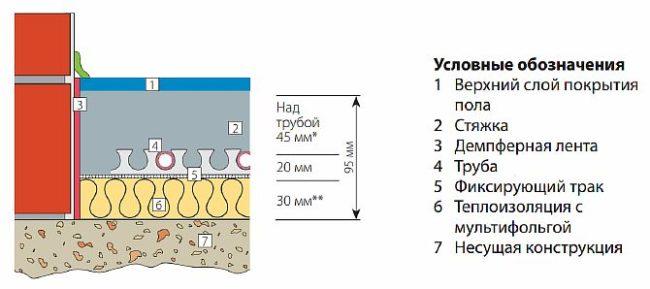
Standard "pie" of a water-heated floor looks like this:
- base - concrete, wood, or rough screed;
- waterproofing - polyethylene film (if groundwater is close);
- damper tape - necessary to compensate for temperature expansion, it is placed around the perimeter of the room, in places where shrinkage joints are installed, at the junction of the walls and the floor;
- Thermal insulation - polystyrene foam boards are used as insulation, standard thickness is 1 cm;
- waterproofing - polyethylene film;
- reinforcing mesh - average rod diameter 1 mm;
- heating elements (pipes made of metal-plastic, polypropylene or PEX);
- concrete screed - it is recommended to pour it using beacons, then it will be easier to level the surface;
- substrate;
- floor covering.
Thickness of the screed for a water-heated floor
When installing hydronic underfloor heating, correctly calculating the thickness of the concrete being laid is crucial. A thin layer significantly reduces energy consumption, but heating will be uneven, leading to failure of the entire system.
If the concrete layer of a water-heated floor is too high, the efficiency of the entire system will decrease and fuel costs will increase, but the surface will be heated more evenly.
For your information! When using tiles as the finishing surface, the concrete screed thickness can be 5 cm or more, as the tiles have high thermal conductivity. When laying laminate, which is a poor conductor of heat, the layer depth is kept shallow.
Minimum
There are no strict standards for the minimum thickness of a screed. Even a small concrete surface can fully fulfill its functions—improving structural strength and ensuring uniform heating.
According to state standards, the permissible thickness is:
- 20 mm—but this only applies when constructing a screed using a ready-made self-leveling mixture, with 16 mm pipe sizes, and tiles as the finishing coating, which are fixed with a layer of tile adhesive. Replacing even one element from this list will lead to floor deterioration.
- 40 mm – poured without reinforcement using cement-concrete mortar, when laying a minimum-sized contour, and only on a level surface. Any unevenness or the use of larger diameter pipes will increase the mortar thickness.
For example: A poured concrete layer of 7-8 cm is required when using a contour measuring 25 mm and with a base slope of 1 cm.
- 30 mm - when installing reinforcing mesh under heating elements.
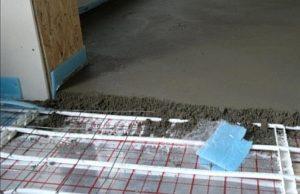
Pouring a thin layer of concrete is not suitable for industrial spaces or areas with heavy loads. Above heating systems, the concrete layer should be 30–40 mm thick. By choosing the right screed thickness, you can not only save money but also maintain ceiling height.
The thin layer is easily damaged, as rapid heating and cooling can cause a "spider web" to form. And the impact on the surface caused by periodic movement of furniture can cause damage.
When using dry screed, the minimum acceptable pouring layer is considered to be 40–45 mm.
For your information! According to SNiP, the height of the concrete solution should be such that it completely covers the pipes.
Maximum
The maximum screed thickness is not specified in regulatory documents and is calculated by calculation. The maximum value for underfloor heating can be determined based on the load the surface must withstand. The average load per square meter is 200–300 kg.
The need for an impressive screed arises only:
- If the subfloor is of poor quality. If the subfloor is uneven and uneven, it is recommended to first level it and seal the cracks before laying the pipes and pouring the concrete. This is because if the screed serves as a leveling surface for the water system, its thickness will vary, resulting in uneven heating of the surface.
- When it serves as a foundation. As for the foundation screed, its average size is 170 mm; any larger size doesn't make sense.
- If there is a room with varying degrees of loads - a garage, industrial buildings.
- When installing underfloor heating on the ground, and if it is of poor quality, it is used in construction in the private sector.
For your information! The heavier the concrete layer, the longer it will take for the system to heat up, and therefore, it will take longer to achieve heat output, resulting in higher costs. Furthermore, this structure significantly reduces available floor space.
There are certain parameters that must be adhered to:
- 100 mm - for installation in apartments and houses in the private sector;
- up to 200 - for construction in public spaces;
- 300 — in industrial buildings.
Optimal
The standard optimal pouring thickness, according to SNiP 3.04.01-87, is considered to be 45–70 mm. When installing heated floors over a large area, it is recommended to add fiber to the mortar. This creates a strong and durable surface capable of withstanding heavy loads.
Therefore, it is possible to significantly reduce the concrete layer, to 25–30 mm. If reinforcing mesh or rebar is used, the overall acceptable thickness is 6–7 cm.
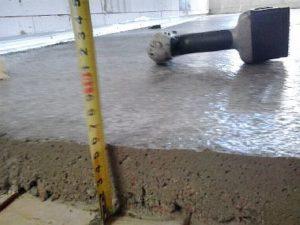
When using a semi-dry screed, the thickness varies from 4 to 20 cm. Its size is influenced by the level of surface unevenness.
For living rooms, the following ratio is recommended:
- when laying M 12 pipes, the thickness of the concrete mortar is 60 mm;
- M 17 - 65 mm.
Please note! If the screed is of the optimal size, then the underfloor heating system, according to engineering calculations, will heat up to 45-55°C at the inlet and 30°C below.
Under the pipes
Before laying pipes, a rough fill is required. It must be of high quality to ensure long-lasting service, as replacing it would require dismantling the entire structure, which, in addition to being labor-intensive, would also entail significant costs.
Subfloor screeds are subject to significant mechanical stress and must also withstand sudden temperature fluctuations. If the screed is of poor quality, the foundation will deteriorate, pipes will break, and a significant amount of thermal energy will be lost.
Subfloor mortar can be purchased ready-mixed or made yourself using cement, sand, and a plasticizer. The ratio of plasticizer to cement is 1 liter per 100 kg. PVA glue can be used in place of the plasticizer, in the same quantity.
Taking into account the experience of a professional, the standard thickness of the concrete layer under the pipes of a water-heated floor has been established - from 2.5 to 3 cm.
Above the pipes
The height of the concrete screed above the pipes when installing underfloor heating is affected by the diameter of the pipe installed in the system and its pitch. A thin screed can save fuel, but it won't create a smooth surface.
This leads to uneven heating and rapid floor failure. An excessively thick layer over the pipes reduces floor efficiency and increases costs.
In addition, the concrete covering over the water heating system must withstand static loads; in living rooms, this is within 2 kN/m², so the mortar layer must be at least 45 mm.
When planning the construction of a warm water system yourself, it is important to make the right choice not only of materials, but also of heating elements, thermal insulation, components included in the concrete mix, and an efficient boiler (electric or gas). It is also important to responsibly calculate the thickness of the concrete surface of the future structure.
To do this, it is necessary to study the data of all types of screeds, weighing the pros and cons in terms of price, quality and performance characteristics.
This will help you determine the correct and optimal screed thickness for your underfloor heating system. This, in turn, will ensure the efficient operation of your heating system.


Thank you, Vladimir, for the interesting article. Everything is explained in detail, step by step. We'll be installing heated floors soon, too, and this article will definitely be useful.