The range of heating systems for creating a favorable microclimate in the home is currently huge.
Previously, for heating the premises, mainly Radiators - learn how to install them yourselfNowadays, most private homeowners prefer underfloor heating. However, using underfloor heating alone doesn't always create comfortable conditions in an apartment. Therefore, professionals are increasingly recommending a combined heating system for private homes—one with radiators and underfloor heating.
Our article will be useful for those who are building their own home and planning to install a combined heating system.
You'll learn how to combine radiator heating and underfloor heating, what advantages this system offers over conventional radiators, how to design a system based on the calculations, and how to install it yourself.
We invite you to read the article - Which heating radiators are best to install in an apartment?, selection criteria and TOP manufacturing companies.
- Norms and restrictions
- Features of the combined system
- Pumping and mixing unit
- Diagrams and installation instructions for one boiler
- Installation of the system
- Schemes with mixing valve
- With 3-way mixing valve
- With 2-way mixing valve
- Using a built-in boiler pump
- When can systems be combined?
- Errors and problematic issues
- Video instructions
Norms and restrictions
Underfloor heating is a low-temperature heating system. According to current standards, the maximum coolant temperature should be 55 degrees Celsius. During operation, standard heating typically ranges from 35 to 45 degrees Celsius, with the floor heating reaching 26 to 31 degrees Celsius. Standards vary for different rooms:
- for bedroom, kitchen, living room - +26;
- for bathroom, toilet, hallway— +31.
A pump circulates the fluid through the floor lines. It also allows you to regulate the heating level in the room. The pump should be selected based on the water flow rate. The maximum acceptable flow rate for hydronic floors is 0.6 m/s.
The difference between the heating of the water at the supply and outlet should not be within 10 degrees.
Features of the combined system
The combined heating system includes radiators, which are high-temperature sources, and low-temperature ones - warm floors.
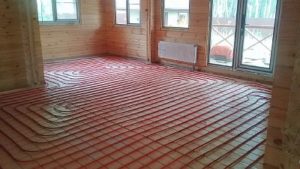
There are two ways to connect a water-heated floor in a mixed system:
- Attaching the heating system to an existing boiler reduces equipment costs and installation time. The disadvantage of this design is that it cannot operate independently. This increases energy consumption and reduces the floor's efficiency.
- Installing a separate underfloor heating system significantly increases installation costs. However, this system has the advantage of being self-sufficient and does not rely on radiators. This is convenient when the radiator heating is no longer functional.
There are several recommendations to consider when deciding to install a combined heating system in a private home:
- Set temperature settings separately for radiators and underfloor heating. Since radiators require approximately 70°C (158°F) and 55°C (158°F) of inlet and outlet water, respectively, while underfloor heating requires 40°C (104°F) and 30°C (86°F), boilers are unable to handle this task independently.
- Use specialized components for heating setup. Pump-mixing units and shutoff valves will reduce costs and allow for proper connection of the system to the tank where the water is heated.
- Adjust the combined system using specialized and properly installed technical equipment. For example, a mixing unit with a thermostatic head regulates the heating level of the water, while a thermostat controls the heating level of each room individually.
When installing a hydronic floor heating system, there's no point in limiting it to just the bathroom and toilet. It's better to install such a system wherever possible, as increasing its area doesn't significantly impact installation and operating costs.
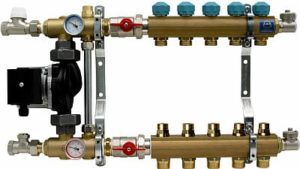
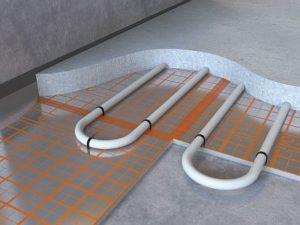
In any case, a mixing unit and a device that ensures fluid circulation will be required. And whether the manifold assembly is single-pipe, dual-pipe, or more is irrelevant.
The cost of the screed will also not change, even if the floor is installed only in one part of the room; the concrete solution will have to be poured over the entire area.
Pumping and mixing unit
A combined heating system in a private home can be built using a pump-mixing unit. This design is more efficient, but more expensive than a three-way valve, even though the operating principle is the same.
Cooled water from the return pipe dilutes the hot coolant, and the presence of balancing valves allows this to be done in the required proportions.
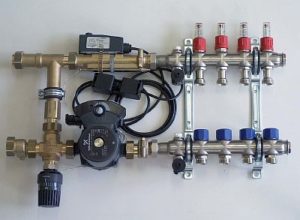
This unit comes in various configurations, depending on the intended use and cost of the equipment. A standard unit includes:
- thermostatic valve;
- immersion temperature sensor;
- balancing valve with a locking spring valve;
- circulation pump;
- immersion thermometer;
- threaded sleeve;
- bypass and shut-off valve;
- drain and ball valve;
- air vent;
- bypass valve.
Diagrams and installation instructions for one boiler
The simplest and most cost-effective way to build a combined heating system in a private home is with a radiator and underfloor heating from a single boiler. All components and the circulation pump are then installed from the boiler.
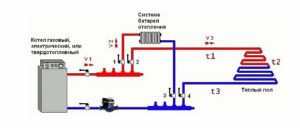
Some wall-mounted boilers have a pump built in. If you're using a floor-standing model, you'll need to install it separately.
When directly connecting to a gas appliance (this is the model experts recommend installing when installing a combined heating system in private homes), a condensate tank is recommended. Installing a conventional gas boiler will quickly result in the heat exchanger failing.
Gas equipment must be installed in rooms with ceilings at least 2 meters high. Ventilation is required.
If a solid fuel model is used, a buffer tank must be installed to connect it to underfloor heating. Its function is to limit the temperature, as it is difficult to regulate the temperature directly.
The operating principle of a combined heating system—underfloor heating and a radiator from a single boiler—is as follows. Heated water is directed into the mixing unit, where it encounters a safety valve. The valve detects the water temperature, and if it exceeds the required level, the valve opens, mixing the hot and cold water to the desired temperature.
The water is then distributed through the floor and radiator circuit lines. After traversing the entire pipeline, it returns to the heat generator for heating.
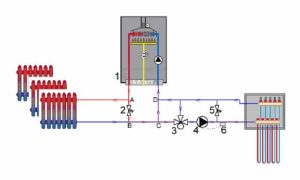
The connection diagram for underfloor heating and radiators from one boiler includes the following elements:
- boiler with expansion tank - heats the coolant;
- hydraulic arrow - a distribution system in the form of a pipe with four branches through which water moves;
- radiator and floor pump - they provide fluid supply to the collector unit;
- collector - floor loops are connected to its outlets, and hot water is supplied;
- mixing unit - where the coolant for the TP is diluted;
- thermostat - a head that opens or closes the flow of water into the circuits.
Installation of the system
After constructing the floor "pie" Once the foundation is leveled, waterproofing and thermal insulation are in place, and the heating elements are installed, we can move on to installation and connecting the combined heating system (underfloor heating and radiators) from a single boiler. Let's break this down step by step:
- The boiler is installed and its piping is done (In a private home, it is often installed in a separate building.) The room must have a chimney and air intake.
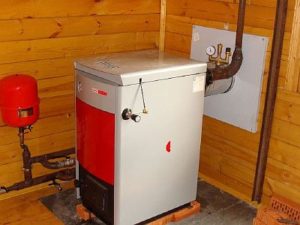
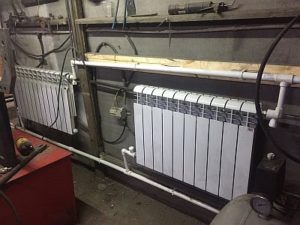
- The pipes from the radiators are connected to the water heater, and a pump is installed between them.
- The floor circuits are connected through a device that dilutes the water to the required temperature. This is accomplished using a mixing unit and a 2- or 3-way valve, which are attached to the supply pipe.
- A circulation pump is installed.
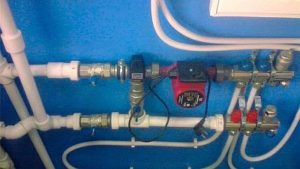
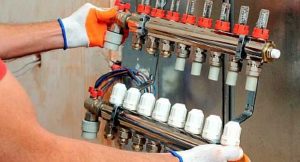
- The floor contours are connected through a comb to the hot water supply source, which is the coolant and will heat the room.
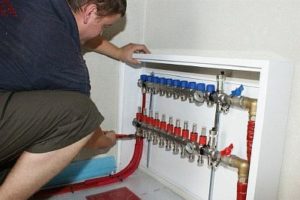
Schemes with mixing valve
In private homes, experts recommend choosing a combined heating system with a mixing valve, which can be 2- or 3-way.
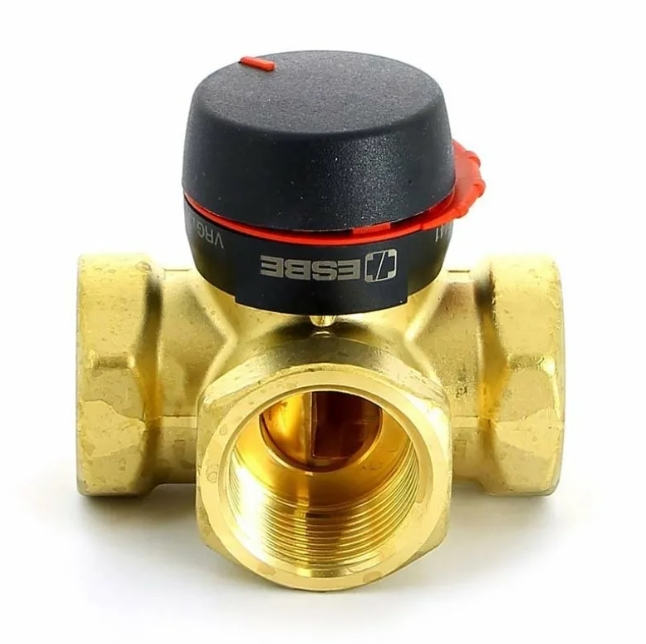
With 3-way mixing valve
In this combination scheme, the liquid for the radiator is heated to 80 degrees, and 40 degrees is required for underfloor heating.
The main task is to reduce the temperature of the water coming from the radiators to the required temperature for underfloor heating. This is precisely the problem solved by a 3-way thermostatic head.
The system operates by pumping heated water from the heat source through this device into the manifold, where it is diluted to the required temperature with cooled coolant from the heating substation return pipe. In this state, the liquid is then supplied to the floor heating circuits.
This combined system has a drawback: it's impossible to regulate or limit the flow of cooled water from the return line. Consequently, both excessively cooled and hot water will enter the main line, which can lead to overheating or insufficient heating of the floor.
However, these temperature changes may go unnoticed, as they are compensated for by the concrete screed.
A three-way valve system is easy to install and inexpensive. It's particularly suitable for single-story homes or smaller spaces.
If a three-way valve with a bypass is used, the mixing of heated and cooled coolant occurs inside the device.
Installation is simple:
- a tee is installed on the feed;
- Afterwards, the circulation pump is connected.
With 2-way mixing valve
Two-way valve - its thermostatic head controls the temperature level at the entrance to the floor pipe.
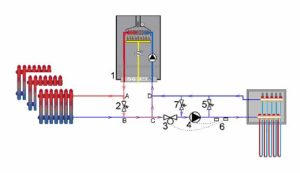
This system is recommended for use in large rooms, but no more than 200 square meters. A balancing valve allows for the mixing of the underfloor heating circuit fluid to be adjusted. It can shut off or open the flow of hot water.
The coolant's circulation process is designed so that the liquid moves in a circular motion, and heated water is added as the temperature drops. Since the device's capacity is small, regulation is smooth, without sudden changes.
It is also mounted on the supply line, and requires the installation of a device for forced circulation of the liquid.
Using a built-in boiler pump
This system involves the use of a boiler with a built-in pump with a capacity of up to 35 kW. It creates a pressure of 20–25 kPa at the tank outlet, with a water flow rate of 1,000–1,500 liters per hour.
The installation process is similar to the diagram for a conventional heating element, but an additional pump for underfloor heating is not required.
To fully utilize the device's potential and create circulation of the coolant in the heated floor and radiators, it is necessary to correctly connect the device to the circuits.
This can be achieved in this system by using a ring-shaped connection—the boiler, the heat pump, and the radiator. These two rings are connected by a small, low-pressure common section, so one circuit doesn't affect the other.
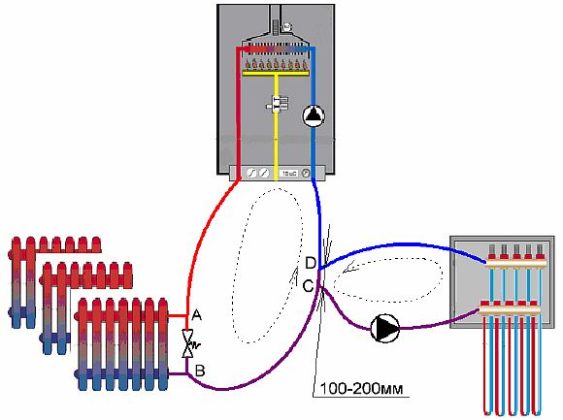
In this design, the slag trap is an oblique filter-mud collector, and air vents are located in the boiler, radiator, and floor circuit.
The ring system operates as follows: water flows from a tank where it is heated into the pipelines. Pressure surges in the supply and return pipes cause the liquid to move through the mains and back up.
When can systems be combined?
A combined heating system can be installed in any type of space. The key is to select the right finishing product and underfloor heating type according to your requirements. A combined system is the ideal heating solution for a two-story private home.
When installing a water-heated floor on the first floor, warm air masses, rising, will heat the floors of the second floor, where only radiators can be installed. For finishing material on the first floor, it is better to choose tiles, and for the second one any material will do.
Building a combined system in apartment buildings is not feasible, as connecting hydronic floors to the entire building's heating source is prohibited. A heat exchanger is the solution.
Errors and problematic issues
To save money, many people simplify designs by eliminating important elements. However, this shouldn't be done for the following reasons:
- When the radiators are closed and the heated floor is functioning, the boiler and TP pumps will interfere with each other’s operation.
- When radiators and underfloor heating are operating, the floor pump can reduce pressure, thereby reducing water circulation in the radiators.
- Even when the boiler equipment is shut down, the heating pump continues to move fluid through the boiler and radiators, which is unnecessary. While unnecessary coolant movement in the radiators can be addressed by installing a check valve, it's impossible to stop the water flow in the boiler.
- The absence of a protective thermostat can cause the mixing unit to fail, causing excessively hot water to enter the floor pipes, and there is a risk of damaging the screed.
- Without a bypass valve, if the floor hinges are closed, fluid circulation stops. Furthermore, if the pump is forgotten, it operates against a closed valve and overheats, leading to rapid failure.
It is not necessary to install a bypass valve if:
- one floor circuit will be permanently open;
- the pump has frequency regulation;
- The automation of the heating system can control the circulation and, if necessary, turn off the equipment.
If you've decided to heat your home using a combination heating system—underfloor heating and radiators—you should familiarize yourself with all the different systems, including their pros and cons. Only then should you choose a model that best suits your needs, budget, and the characteristics of your space.


Interesting, but I did it a little differently. The information the author provided is quite relevant and unique. He described everything in detail, thanks to him. Now I know these methods too.
Could you briefly describe how you did it? It would be interesting to read, and we could even write a separate article about it.
Good afternoon.
The only energy source available is electricity. Therefore, the choice is:
1. boiler with water heating (floor + radiators) and indirect hot water supply
or
2. fully electric (floor + convectors) and water heater
There's a huge mess with electric floors everywhere... I've used a UNIMAT BOOST rod—it seems fine, but people are giving it hell. And it doesn't seem like it's up to the job of heating.
There is less swearing on the water floor, and no personal experience at all.
I have very good experience with electric convectors and they are conveniently controlled remotely.
This is where I have a question, perhaps a strange one: does it make sense (or are there precedents) to install a water-heated floor, but electric convectors as radiators?
Hello. In principle, this circuit works, and such a combination is perfectly acceptable. But why complicate things? In most cases, a single transformer substation will suffice.
Hello. According to the description, my house requires a system with a two-way valve. Can you tell me if it's possible to add an indirect water heater to this system, and if so, how? This would avoid having to install separate hot water heaters for the kitchen and shower. Thank you. Very informative article.
Hello! Based on the description provided, it appears you need a system with a two-way valve for your home. Yes, it is possible to add an indirect device to this system. The process typically involves connecting an indirect device to the two-way valve and the heating system. Typically, you use a heat exchanger or coil in the indirect device to facilitate heat transfer between the primary (heating) and secondary (indirect) circuits.
To add an indirector to your system, follow these steps:
1. Select a suitable indirect heating device (e.g. indirect water heater or indirect heating coil) that is compatible with your heating system.
2. Connect the indirect device to the two-way valve using the appropriate piping configuration.
3. Provide adequate insulation for the indirect unit to prevent heat loss.
4. Install appropriate elements and sensors to control the flow of water between the two circuits for efficient heat transfer.
5. Hire a professional technician to perform these installations if you do not have the necessary skills or experience.
Be sure to follow local building codes and safety regulations and consult a professional if necessary.
Hello! To connect a two-way thermostatic valve to the heating system, a return line must be installed. Additionally, three-way valves must be installed on the supply line. This will allow the same hot water to be used for both space heating and domestic heating.