Unlike city apartment dwellers, homeowners can choose their own heating system. Any heating device—a standard radiator or underfloor heating—is acceptable.
However, many private home developers are stumped by the choice of heating system. Which is better, underfloor heating or radiators, and which will heat the space more efficiently and economically, creating a favorable microclimate?
To make the right choice, you need to know the features and operating principles of each system.
We invite you to read an article describing the characteristics and conducting a comparative analysis - what is the difference and which is better, convector or oil radiator?
- Types of heated floors
- Types of radiators
- Pros and cons of floors
- Heating zones (head or feet)
- Installation
- Cost-effective operation
- Difficulty of repair
- Heating speed
- Microclimate
- Combination with the interior
- Pros and cons of batteries
- Heating zones (head or feet)
- Installation
- Cost-effective operation
- Difficulty of repair
- Heating speed
- Microclimate
- Combination with the interior
- Combined heating - floor + radiators
- What do we choose in the end?
- Video tutorials
Types of heated floors
Warm floors are divided into water and electric:
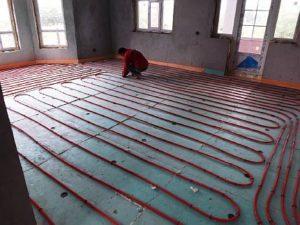
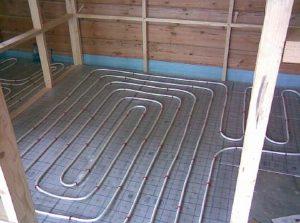
- Water-based systems consist of flexible pipes carrying a coolant heated to 30-35 degrees Celsius. The main line can be laid in a "snake" or "snail" pattern. They are most often installed under a cement-concrete screed. However, if there are wooden floors, installation without pouring concrete is possible.
- Electric heated floors come in:
- cable - this is a wire that can be located under any surface, laid in a screed or between insulation bosses;
- mats - also a cable type of construction, only the wire is already fixed on the substrate (mat) with a certain pitch;
- Infrared - this is a film with built-in carbon plates, does not require pouring a screed, the installation process is simple and quick.
Types of radiators
If we consider radiators, they are produced in three types:
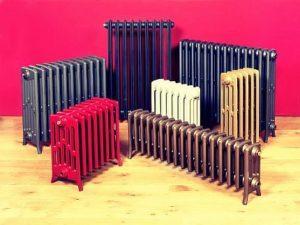
- Aluminum radiators are the most common model. The entire radiator body is made of aluminum, making it lightweight and improving heat dissipation. Their only drawback is their lack of durability.
- Bimetallic heating radiators — have an aluminum body with a steel or copper core. This core provides strength and can withstand high pressure and temperature fluctuations.
- Cast iron radiators are a classic and remain popular today, despite their considerable weight and relative inertia. They take a long time to heat up, but they retain and distribute heat better.
Radiators are also divided into gravity-fed and forced-flow. A gravity-fed system works by heating water in a boiler, after which, according to the laws of physics, it rises up the riser and descends as it cools.
They come in single- and double-pipe designs. Forced-action radiators use a pump to help move the liquid through the pipes.
Pros and cons of floors
Each heating system has its own advantages and disadvantages and is designed for specific conditions in which it will function most effectively, so it is worth familiarizing yourself with them.
Heating zones (head or feet)
The distinguishing feature of underfloor heating from radiators is the heating method, which in turn has a significant impact on the indoor microclimate.
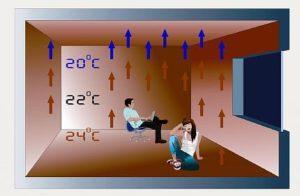
Please note! Favorable conditions for a person are warm feet and a cool head.
With heated floors, the room is heated from below, with warm air rising and gradually cooling. By the time it reaches the ceiling, it has cooled down to a minimum and then sinks back down.
However, this type of flooring can have a negative effect on people with varicose veins or allergies. Furthermore, children may feel hot on it for too long, as their blood circulation is faster.
Installation
Any repair work creates inconvenience and significantly impacts the wallet.
When installing a hydronic underfloor heating system in a private home, a screed is usually required. This is best and most conveniently done during the construction phase. Installing such a floor in a renovated space requires removing the existing flooring.
After this, you can begin installing the warmest structure, which consists of a layer of hydro and thermal insulation, heating elements, and a concrete screed.
The presence of a concrete layer requires a long time for it to harden, about 28 days, and only then can the final coating be laid and the device used.
The cost of the underfloor heating system itself and its installation depends on the components and the area to be heated. Correctly calculating the number of circuits and the installation spacing are crucial.
If the pipes are located too close together, the surface will overheat and it will be necessary to reduce the heating temperature of the coolant.
But this isn't cost-effective, as it increases material costs. Furthermore, the floor's efficiency is reduced due to the excessively long contour.
Cost-effective operation
When using heated floors, the surface is heated uniformly, with the air heated at a distance of 2 meters from the floor covering.
This is precisely the space in which a person exists. Furthermore, underfloor heating has a heat loss rate that's half that of a radiator, amounting to 10-15%.
Since, laying heated floors implies the presence of a "pie", which does not allow heat to escape in vain through the floor (no more than 5% is lost), the device functions more efficiently.
In addition, energy resources are consumed more economically (30-50% more than with radiators), since the coolant is heated to only 40-45°C.
Difficulty of repair
If the hydronic underfloor heating in a private home fails, it's difficult to find the cause and carry out repairs, as the pipes are covered with screed, which must be removed. This is a rather labor-intensive and dusty job.
Furthermore, after troubleshooting, it's necessary to refill the heating elements with concrete and wait for it to harden. However, it's important to note that such failures are extremely rare.
Heating speed
Heating of a water-heated structure occurs slowly, as the liquid inside the pipes warms up first, then the screed they are located in, and only then the floor itself. However, they also cool down slowly.
However, it is worth noting that underfloor heating will heat a private home better and faster, as it covers a larger area of the room.
Microclimate
When choosing a heating system, it's not only its ability to heat the room that matters, but also factors that affect a person's well-being:
- Air humidity. Underfloor heating, like any heating system, dries out the air. Installing a humidifier is recommended to improve the indoor microclimate. However, it's worth noting that hydronic underfloor heating is a device capable of maintaining water molecules at the required level, making it preferable.
- Drafts. Underfloor heating doesn't create drafts, unlike radiators, because it has a low conversion rate (30%). Another advantage of the draft-free system is that it reduces dust dispersion.
- Ventilation. If the room is equipped with a supply fan, incoming air flow must be controlled, and underfloor heating is not adequate for this task.
Combination with the interior
As with any construction project, flooring plays a vital role in creating a harmonious interior. When installing underfloor heating in a private home, it's important not only to ensure it fits into the overall style of the space but also to select a model that can be installed over the existing heating system.
The best option — Ceramic tiles and wood are not recommended. Although there are some models that are compatible with such devices, they are marked specifically.
Otherwise, warm water floors do not affect the design of the room, as they are hidden under the finishing coating.
Pros and cons of batteries
The battery has long been the main source of heating for premises of various purposes.
To determine the feasibility of installing them in a private home, you should carefully consider all their pros and cons.
Heating zones (head or feet)
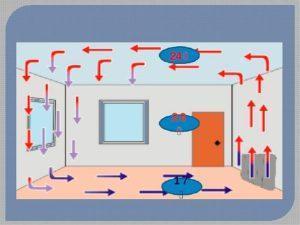
Radiators operate differently from underfloor heating: they quickly heat the air, which cools as it rises up the walls. Near the ceiling, its temperature drops significantly and it descends toward the center of the room. It is these air masses that warm the person.
It is worth noting that the distribution of heat from the battery is not uniform.
Installation
Installing and connecting a radiator in a private home is a simpler way to heat a room, taking just one day. The process involves:
- in laying pipes;
- radiator installation;
- connecting the system with fittings.
The cost of installation itself will not be expensive, compared to heated floors.
Cost-effective operation
Since, when heating a private house with a radiator, the warmest air is located under the ceiling, and it is through it that the majority of heat loss occurs (up to 30%).
Therefore, the efficiency of the system decreases, and the costs of maintaining the optimal temperature increase.
Difficulty of repair
Repairing a radiator heating system is much simpler than repairing an underfloor heating system, as the heating circuit is visible. The exception is if the pipes are embedded in the wall, but even then, fixing the problem is easier.
Heating speed
When connecting a radiator to the central heating, simply turn the valve, and the hot water entering the pipes will quickly heat the system.
If a private home has individual heating, the coolant in the circuit will first need to be heated, so the process will take longer.
Furthermore, the heating speed depends on the radiator type. Aluminum radiators heat up the fastest, followed by bimetallic ones, and cast iron ones take the longest.
Microclimate
The following factors influence a person’s comfortable existence in a room:
- Air humidity. Like underfloor heating, radiators dry out the air, so it's best to install humidifiers.
- Drafts. Radiators create strong air currents only above themselves, so they can only mitigate small drafts coming from a window. They won't cope with larger, colder air masses.
- Ventilation. To control the airflow from the supply duct, the best solution is to install a radiator. The hot air from it will combine with the cool air, thereby creating comfortable conditions.
Combination with the interior
From an aesthetic point of view, radiators are inferior to heated floors, since they are visible and cannot be hidden by a cabinet.
Although today, you can buy more refined models that look modern.
Combined heating - floor + radiators
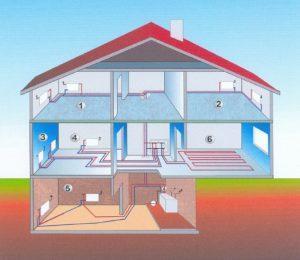
It is possible to combine two types of heating in a private house when:
- The batteries act as the main source of heat, and the heated floor is an additional one;
- Underfloor heating is the main heating system, and radiators are the auxiliary one.
If you have a two-story cottage, the ideal option for heating it would be to install heated floors on the first floor and heat the second floor using a radiator.
This combination allows you to fully utilize the positive aspects of both systems and heat your home more economically.
What do we choose in the end?
There's no definitive answer to the question of which heating system is better: heated floors or radiators. Each device has its own advantages and disadvantages, which must be considered when choosing.
If you have the budget and are building a house for your children and grandchildren, the best option is underfloor heating. If finances are tight, you might prefer radiators. After all, either system can heat your home and create a comfortable environment.


Hi everyone! Well, if you have to choose, a lot depends on the type of room and the purpose! In a house, for example, in a nursery or a bathroom, I think it's better to install underfloor heating, as it's important to heat the entire surface! This is especially true for ground floors and houses in damp areas.
I don't understand something about tiles with heated floors. So, in winter I walk on tiles barefoot, but in summer? Should I wear slippers? Or should I heat the floor in the summer too? The tiles are cold, aren't they?
Tiles as an option in the bathroom or toilet
Alexander, you're right. It's warm in the winter and cold in the summer, but most people wear slippers, whether it's warm or cold...
I have heated floors in my apartment, but only in public areas: the toilet, kitchen, bathroom, hallway, and radiators in the rooms... I really like it... the heat from the floor stays warm for a very long time, I can turn off the heating for the whole day... and turn it back on in the evening... I have very economical consumption... and so you understand, I pay about $15-17 for my apartment