Hydraulic testing of heating system pipelines is mandatory when:
- Preparatory work for the new season.
- Installation of boilers and pipes.
- Replacement of individual sections.
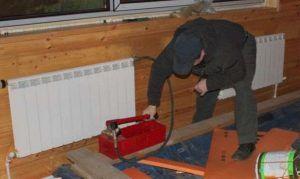 The main purpose of testing is to identify leaks and a range of local damage, connections without the proper level of tightness, as well as other problems that cause the heating pipeline to lose its functionality during further operation.
Pressure testing of heating systems is the process of testing heating equipment and pipelines using elevated test pressure. The purpose of the test is to verify the strength of the housings and walls of the entire circuit (pipes, radiators, fittings, etc.); the tightness of connections of all system components; and the functionality of taps, pressure gauges, valves, and gate valves.
In multi-apartment buildings, testing is the responsibility of housing and utilities staff. In private homes, owners are responsible for organizing the process themselves, but in these cases, everything must be done either in-house or by specialists with the appropriate skills.
Basic rules
Without hydraulic testing, it's impossible to ensure comfortable living conditions in a home. Heating system components are subject to wear and tear after a certain period of use. Inspections help prevent serious damage.
A hydraulic calculation for a heating system is performed before installing individual components. This calculation necessarily takes into account factors such as the internal diameter of the pipeline and its material.
The diameter of the shaped parts is calculated along with the fittings. Heating efficiency is significantly reduced if even one element is calculated incorrectly. This reduces the service life several times.
The cross-section of heating pipes is calculated using the following formula.
D =√354∙(0.86∙Q:Δt):V
V is the speed at which the coolant moves.
Δt is the difference in temperatures between the return and falling pipes.
Q – the magnitude of the load on a particular section requiring calculation.
D – designation of pipe diameter.
After this calculation, it becomes possible to determine the average diameter of a single pipe entering the heating pipeline. Significantly more data is available when the calculations are performed by true professionals.
What is the purpose of hydraulic testing?
 Every heating system has a specific operating pressure. This parameter determines the degree of heating in a given room. The same applies to heat loss and coolant circulation. As a result, operating parameters are selected based on a variety of factors:
- Quality of the highway.
- Number of floors.
- Building type.
Various hydraulic processes occur in pipelines as the coolant moves through them. This sometimes causes pressure surges, known as "water hammer."
Due to such loads, pipeline wear occurs in accelerated modeTherefore, during hydraulic tests, the pressure exceeds normal operating values.
Tests are mandatory in the following cases:
- When a house is disconnected from the general system, a blind plug is used for this purpose.
- Restoration of insulation layers on pipelines, replacement of worn materials.
- Strengthening the system's seal. For example, by using additional seals.
- Checking valves and fittings that shut off other elements.
The final stages of testing involve the use of drain-type taps.
The pressure testing process involves injecting liquid into the heating pipeline, maintaining moderate pressure to completely fill the pipeline. Excess air must be released periodically.
Heating pipe pressure testing technology
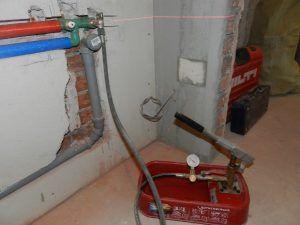
To identify problems, hydraulic tests are performed, with pressure 20-30 percent higher than operating pressure. A special pump is used for this purpose. A pressure gauge allows monitoring of the pressure.
Once it reaches its maximum, its level should remain constant for thirty minutes. If it begins to decrease, it means there are areas where the seal is compromised.
Shut-off valves and gaskets are the most common causes of seal failure. Radiators and bends are also common sites of defects. A pipeline is considered pressure-tested only when it is fully operational.
About staff and equipment
A heating pressure testing pump is a classic example of additional equipment. It is connected to the main circuit to monitor the increasing pressure inside the pipes.
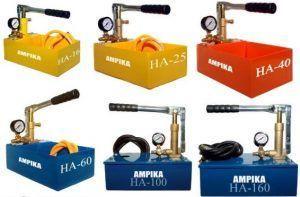 Pumps are also used, with manual drives, or powered by electricity. For most household tasks, hand tools are sufficient.
Hand pumps generate 25-50 bar of force, enough to test for leaks in a small five-story building.
- The equipment's compact size allows for effective use in small spaces. It's a very convenient option not only for personal use but also for professional use.
- Affordable equipment prices. Manual presses have always been known for their affordable prices.
- Operating parameters with a range that meets the heating needs of medium and small-sized systems. A standard pump is sufficient to generate pressure two or more times higher than normal operating parameters.
- A simple design known for its high reliability and long service life, the pump has a simple construction with nothing to break.
Electric pumps are used to perform hydraulic tests on large circuits with many branches.
These mechanisms allow for pressure maintenance that is impossible with other manual units. This equipment always includes self-priming pumps capable of generating high pressure.
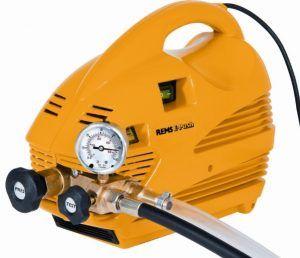 Electric units have a wide range of connection options for the heating system. Connections can be made either through a drain valve, a hose, or by using a tap to fill the pipe with liquid. A Mayevsky tap connector can also be used for such connections.
Electric machines have dedicated control units. They have additional protection against overheating. Users can set their own operating temperature limits.
If the temperature rises above this level, then the excess pressure is released, after which the unit does not start working for some time until the required parameters return to normal.
Types of tests, additional information
In most cases, hydraulic tests are performed on the following types of pipelines.
- Plumbing.
- Sewer.
- Heating.
To test internal heating system networks, use a pressure 0.1 MPa above the operating pressure. At the lowest point, the system pressure should be no more than 0.3 MPa. All boilers must be shut off before starting operation. Expansion pumps must be shut off along with the heating substations.
While the pipeline is filling with water, it must be removed all the air, present inside.
The pressure level must be coordinated with the CHP plant's administration if the structure requiring testing is operated by the CHP plant. The final stage is testing the components for heat generation. At this stage, each of the devices included in each main line is finally adjusted.
If network testing is carried out during the cold season, additional insulation is required.
Information on hydraulic testing standards
- When conducting tests, it is necessary to rely on such current regulations as NITUKHP-62, as well as SNiP III-G.9-62.
- The procedure must be supervised by the manager unless it is taking place in a private home. Typically, this function is delegated to the manager's authorized representative or a foreman. Compliance with the requirements of the Federal Service for Environmental, Technological and Nuclear Supervision (Gosgortekhnadzor) and safety regulations is mandatory. Technical documentation for the specific facility must be taken into account.
- Preliminary testing is mandatory for measuring instruments used during testing. Only sealed pressure gauges with an accuracy class of 1.5 or higher may be used.
Working with alternative heating systems
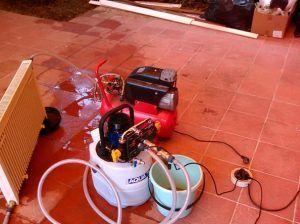 An operating pressure of 70 kPa is typical for steam heating systems and heating networks. To conduct the test, the pressure must be raised to 250 kPa. Measurements can be taken in the lowest section of the installation.
However, some steam lines have higher pressures. In these cases, the pressure during testing should be 100 kPa higher than the operating pressure. It's important to note that the test's effectiveness will be reduced if the pressure at the lowest point doesn't reach at least 300 kPa.
About other features of testing
The most important thing is that the hydraulic testing of the installation covers literally every component of the system. If the pipelines have previously been tested using ultrasound, no additional testing is required.
During testing, pressure is increased gradually, not immediately. The regulatory documentation specifies the rate at which the pressure should be increased.
The use of compressed air for installations is strictly prohibited. Test pressure must be applied to the components of the system for at least 10 minutes. The entire pipeline perimeter is thoroughly inspected once the parameters return to their original levels.
During a hydraulic test of heating systems, no moisture should form on the surface of the pipeline. Care should also be taken to ensure that the water pressure does not cause deformation of the heating system.
After the heating season has ended, pressure testing must be performed. When performing this work, it is imperative to comply with occupational health and safety requirements.
Following the inspection, a report must be drawn up in a simplified written form. The legally required forms must be completed to accurately reflect all necessary information.
Only in this case is it considered that hydraulic testing of water supply pipelines or heating was completed successfully.
I performed a hydraulic test of the heating system myself when I installed the boiler and replaced individual components—it's a must. I had an old system, and I overlooked a lot of things, which led to problems. As a result, I'm now replacing everything. When I performed a pressure test, the pressure did drop, but I was able to find leaks.