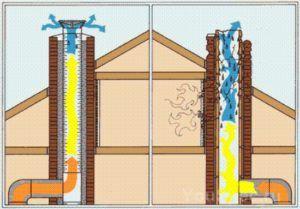
 Many homeowners are interested in how to insulate a chimney themselves. It's no secret that a home requires a high-quality heating system, especially in winter. It's important not only to install the heating system, but also to ensure its proper functioning, with minimal repair costs.
Stove heating requires smoke exhaust, regardless of the fuel used. If the structure is steel, condensation can accumulate in the structure during cold weather, preventing gas exhaust and damaging the structure from within.
Why insulate a chimney?
The flue can be made of various materials, it can be:
- firebrick;
- reinforced concrete;
- metal;
- asbestos cement.
The most dangerous in terms of fire, metal elements are considered, so independent insulation solves two important problems: ensuring fire safety and protecting the structure from the environment. Insulating the chimney from the outside can also solve the problem of moisture entering the attic, which will roll down the chimney walls during rain.
Before starting work, you need to not only purchase the necessary materials but also create a plan that determines the insulation thickness and the fastening method. If you plan to insulate an existing pipe, you'll need to reconstruct the roof, which requires precision.
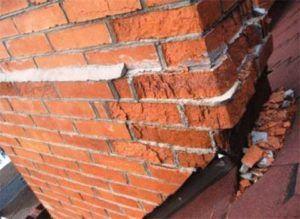 If you don't install thermal insulation on your chimney, it will quickly begin to deteriorate for the following reasons:
- Humidity in the chimney. Moisture always appears where temperature changes occur. As it accumulates, it turns into condensation, which, when frozen, can destroy any material, be it brick or concrete.
- The chimney gradually deteriorates due to contact with the aggressive environment created by carbon monoxide. Corrosive acids and alkalis can penetrate deep into any surface.
In winter, there's no need to worry about condensation, as the room is heated daily, and water simply evaporates from the chimney walls. In spring, when heating is less intense, condensation not only settles on the walls but also seeps into the stove structure. Therefore, it's important to insulate the chimney, especially since it's easy to do yourself.
What can be avoided by insulating the chimney
Thermal insulation of chimneys is essential. While no insulation material can completely protect the structure from the negative effects of aggressive components found in combustion products, it can extend the lifespan of the chimney. Insulation provides protection against:
- Accumulation of acidic residue mixed with condensate on the inner wall of the flue. Because moisture is not formed, all combustion products escape into the atmosphere without penetrating the flue walls;
- a strong temperature difference that occurs when a cold chimney and hot smoke come into contact;
- Heat loss. An insulated structure promotes energy conservation and stable operation of the heating boiler or furnace equipment;
- Strong gusts of wind. When installing thermal insulation, an additional frame is created that strengthens the pipeline structure;
- The roof's lifespan is increased. Because it's insulated, hot air from the structure doesn't affect the roofing material;
- Aesthetic appearance. This is especially true for iron pipes, which look much more attractive if they are insulated.
It's worth noting that the material used for thermal insulation must be non-flammable, as smoke temperatures range from 250 to 15,000 degrees Celsius. The most suitable thermal insulators are:
- Stone wool;
- Glass wool;
- Mineral wool;
- Firebrick;
- Cinder concrete;
- Concrete solution;
- Galvanized rolled pipe materials from which the casing for the insulation is constructed.
It is also possible to use sandwich-type insulation, where a stainless steel sleeve is installed on the chimney and filled with any non-combustible thermal insulation material.
Important! Before choosing insulation, calculate its load-bearing capacity. If it's too heavy, it could dent the roof. Mineral wool is considered the lightest.
Currently, the production of tubular insulation materials has been established. The inner surface of these insulation materials is lined with foil, which shields heat and perfectly insulates the chimney. Tubular insulation materials are available in a variety of specifications, making it easy to find the right insulation material.
DIY metal chimney insulation
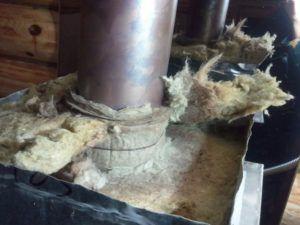 Before insulating a metal pipe, it's worth checking the quality of the installation and fastening. The simplest method is to insulate it with a "shell" according to the design parameters.
There are certain requirements that metal chimneys must meet:
- the height of the structure must be more than 5 m, otherwise there will be no traction;
- the roof, if it is made of flammable material, must be no closer than 25 cm;
- The iron pipe should be equipped with a spark arrester—a plate with a grate, usually made of stainless steel, attached to the end of the pipe. Additionally, a special cap should be installed to protect the end of the pipe from snow and wind.
Important! Maintain a safe distance between the top of the chimney and the ceiling. This is typically 0.5 m for a brick stove. If you're installing a cast-iron boiler, this distance should be at least 1.5 m.
Insulation materials
- Plaster.
These flues are often installed on decorative fireplaces, and they carry a low heat load. Therefore, a standard lime-cement mortar can be used as a thermal insulator. It's easy to prepare: simply take a dry mortar mix, add the required amount of water, and mix.
Then, using a medium-sized spatula – 80 cm wide – evenly apply the plaster to the flue.
Plaster can peel off an iron pipe, so before the plaster has time to dry, apply a reinforcing mesh. Fiberglass can also be used for reinforcement.
Once the first layer of plaster with reinforcement has dried well, a second layer of the composition is applied, which will cover the reinforced material.
After this, you need to apply a finishing coat, usually a moisture-resistant cement-based putty.
Advice! A metal chimney located in the attic can be simply wrapped with mineral wool. Alternatively, you can use a slab material, which can be simply secured with tape or wire. Mineral wool should not be used outdoors, as it absorbs moisture, which reduces its thermal insulation properties to zero.
In the attic, mineral wool can be protected with a sheet of galvanized iron.
- Sandwich chimney.
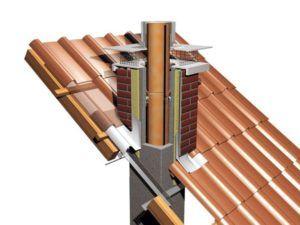
This method of insulation can be carried out in several stages:
- make a hole in the roof covering and roofing material, the optimal size of which is 20-30 cm larger than the diameter of the pipe;
- After the chimney is installed, it is wrapped in basalt wool (it does not absorb moisture). The insulation layer should be 5 cm thick. To prevent cold bridges, the material should overlap by approximately 5-8 cm.
- You can secure the insulation with regular knitting wire, which is wrapped around the pipe;
- Once the insulation is well secured, a stainless steel pipe of a larger diameter is placed over it;
- The sandwich structure is inserted into the prepared hole and placed over the flue pipe. The chimney is connected to the stove structure or boiler, and the remaining uninsulated space should be sealed with clay or asbestos.
Based on the above, it's safe to say that you can insulate a chimney yourself, without resorting to expensive professional help. Moreover, you won't have to spend a lot of money on materials, as basalt wool is inexpensive.
Insulating a brick chimney yourself
- Plastering:
- a reinforced mesh is mounted on a brick pipe;
- Mix a lime-slag mortar and apply it evenly over the entire surface of the pipe. The thickness of the plaster layer varies from 3 to 5 cm;
- the first layer must dry well, only after this the second layer of plaster is applied;
- As soon as the composition dries, the pipe is rubbed with a cement-sand composition and whitewashed with lime.
This thermal insulation reduces heat loss by 25%. It's the simplest and most cost-effective way to insulate a brick chimney yourself.
- Brickwork with thermal insulation:
- In this case, the insulator will be foam boards, which are resistant to mold, mildew, and ultraviolet radiation. The surface of the tube is covered with thermal insulation material, using cement mortar or foil-coated tape.
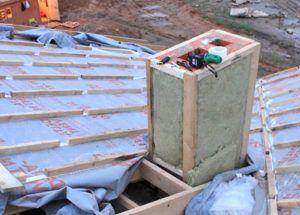
- a vapor barrier is installed over the insulation to prevent moisture from damaging the material;
- the insulation process can be completed with facing brickwork or cladding with polymer-coated metal profiles.
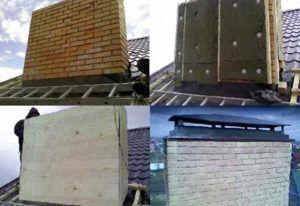
Insulating a chimney with penoplex reduces heat loss by half. Furthermore, this insulation protects the brickwork from damage, as moisture does not accumulate on the flue's surface.
- Do-it-yourself insulation with wooden panels:
- knock together a wooden box;
- cover it with slate from the inside;
- install the box on the pipe;
- seal all the gaps between the boards;
- fill the box with any loose thermal insulation material: expanded clay, sand, earth.
Important! To perform this thermal insulation, remember that the distance between the flue pipe and the box should be 5-10 cm. Therefore, the chimney box is insulated according to the same principle to prevent it from getting wet.
How to insulate an asbestos pipe yourself
Technology for carrying out insulation works:
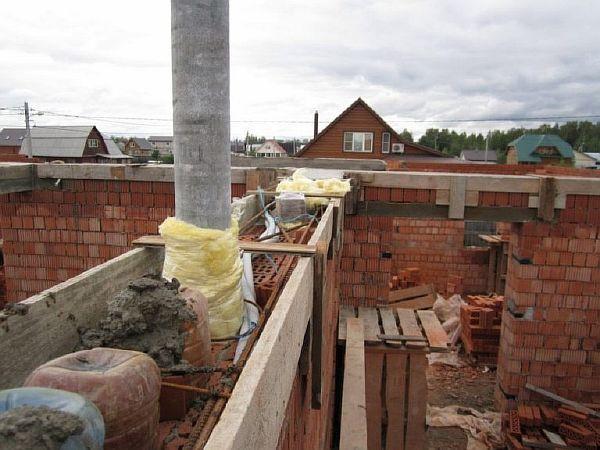
- take a sheet of galvanized iron or roofing material and make a casing out of it, into which the thermal insulation material should be placed;
- The frame diameter is selected based on the pipe parameters. The distance between the structure and the casing should be no less than 6 cm;
- For convenience, it is better to make a casing from several elements, the height of which will be equal to 1.5 m, since it is at this height that the density of the thermal insulation between the pipe and the frame will be of higher quality;
- the frame elements must be installed so that the gap between them is
 no more than 1 cm;
 - It is worth remembering that the asbestos-cement pipe must be thermally insulated to the very top;
- it is worth building a small slope on top;
- At the very top, the space between the flue and the casing is sealed with thick cement mortar; this will prevent moisture from getting into the insulating material.
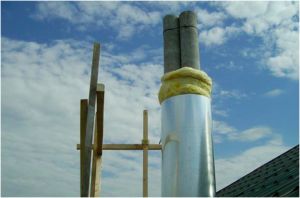
Some DIYers prefer to simply wrap the element with soft insulation and secure it with wire. This is not recommended, as the wind will quickly damage the material, reducing the insulation to zero.
Another way to insulate an asbestos chimney is to line it with facing bricks or foam blocks. Let's look at how this is done.
 Begin laying brick or foam block masonry around the flue. The distance between the masonry and the flue is 5 cm;
- as soon as the masonry is brought to the end of the pipe, place backfill thermal insulation in the gap;
- To prevent condensation and moisture from rain from accumulating in the bulk material, seal the top of the box with a cement mixture.
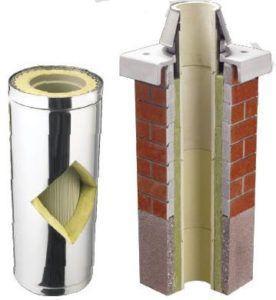
By using these methods of insulating an asbestos chimney in your home, you can significantly save on materials while reducing heat loss.
Bulk materials for insulation
This type of thermal insulation is very effective and can be done by any homeowner. The procedure is as follows:
- install a casing around the chimney, it can be made round or square;
- fill the space between the flue and the casing with loose insulation, for example: expanded clay, small-broken brick or sand;
- Mix a cement mortar, which is poured on top to prevent water from getting on the insulation.
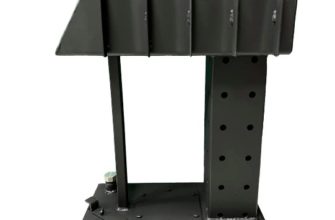
On the roof, you can fit a stainless steel pipe casing over the asbestos pipe and center it with spacers. Fill the 2-3 cm gap between the pipes with red fire-resistant foam through a meter-long tube with a diameter of 5-10 mm. Adding stainless steel meter by meter, gradually create a sandwich. Carefully trim the cured foam from the top with a knife, coat with red heat-resistant sealant, and attach a stainless steel drip cap.