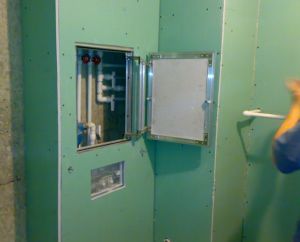
 When it comes to bathroom pipes, it's worth noting that they're not very attractive. Therefore, the question of how to build a pipe box for a bathroom is a concern for many people. After all, hidden pipes have more aesthetic appearance.
Installing a duct is the most common method. However, before installation, it's important to plan everything so that the main wiring is easily accessible.
Otherwise, it will not be possible to carry out repair work without dismantling the box.
- Tools required for work:
- First you need to make a frame
- Which material is better to choose?
- Plasterboard sheathing
- Access to communications is an important detail when installing the box
- Removable box made of plasterboard and tiles
- Finishing the box with plastic panels
- Covering pipes in the bathroom with plastic panels
Tools required for work:
- pliers;
- electric drill;
- square;
- knife;
- marker;
- hacksaw;
- hammer;
- metal shears;
- screwdriver;
- level;
- roulette.
First you need to make a frame
Regardless of the sheathing material and the position of the box, the frame is always constructed the same way. Let's look at this using the example of a vertical box.
Work begins with installing two guide profiles. If the box is located in a corner, they are installed on one side and the other side of the corner. In areas where the main line runs straight, they must be installed on both sides of the pipe.
The guides must be strengthened using a level and secured with dowels or self-tapping screws.
IMPORTANT! To avoid wasting too much space in the bathroom, ensure the profiles are positioned as close to the pipes as possible.
 Next, they move on to installing the guide profiles on the ceiling and floor of the bathroom. From the edge of the wall profile, lines are drawn parallel to the wall.
The intersection of the lines will indicate the length and direction for installing the guides. The required pieces are cut (two for the floor and two for the ceiling).
Then they are secured with dowels, and the direction indicated by the lines is maintained. This is necessary to avoid disturbing the vertical alignment of the angle that will be formed later.
First, install the ceiling, then use a plumb line to transfer the connection point to the floor. This is where the floor profiles meet.
Next comes the task of making one corner piece. To do this, you'll need to fold two guide profiles so that the recesses are at right angles to each other.
They must be fastened with self-tapping screws of 3.5 mm in diameter and 9 mm in length (tex).
This corner piece is cut to the correct height for the room and inserted into the ceiling and floor guides. The entire structure is then secured with tex.
The next stage of work will be connecting the wall and corner guides with blanks of supporting profiles.
They are spaced 5 cm apart, otherwise the frame won't have the necessary rigidity. Now you can move on to the sheathing.
Which material is better to choose?
Before installing the sheathing, it's recommended to fill the empty space inside with mineral wool. This reduces the noise from the water.
Most often, plastic or plasterboard are used for paneling. The main difference between these materials is that plastic construction is more convenient.
It can be quickly and easily disassembled if needed. It also folds up very easily. A box made of plastic panels doesn't require any additional finishing, while drywall does.
Plasterboard sheathing
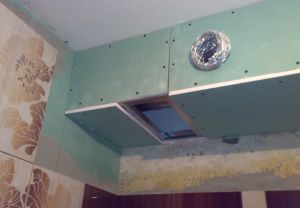 Building a plasterboard bathroom box isn't difficult. Here's the process:
- The plasterboard sheets are cut into pieces of the required size.
- These pieces are then screwed to the metal profile using 27 mm self-tapping screws. The fastenings are spaced 30 cm apart using a screwdriver or drill.
- A small chamfer must be removed from the joint where the drywall sheets are joined, and the resulting gap must be filled with putty.
The finishing of this material is done in the same way as finishing walls. Plastic panels, paint, wallpaper, or ceramic tiles are used.
Access to communications is an important detail when installing the box
It's important to remember that the network will eventually need to be repaired, so it needs to be easily and quickly accessible. For this purpose, an opening must be made in the structure.
The small size of such a hole makes it difficult to access, so take this into account in advance.
The opening is covered with a special hatch. A wide selection of these designs is available at hardware stores. Customers can choose any color, size, and model. The device is attached with magnets.
Another option is to use blinds for the opening. This solution isn't everyone's cup of tea, but it allows you to access the pipes in a couple of minutes.
Removable box made of plasterboard and tiles
A removable pipe box in the bathroom is suitable for situations where pipes need to be inexpensively and neatly sealed. The advantage here is that if a pipe breaks, the problematic area can be easily accessed.
Video 1
The removable structure is constructed using moisture-resistant drywall and metal guides. The entire structure is constructed from prefabricated pieces that are stacked on top of each other.
All sections are corner pieces and are attached to the wall using simple hinges, similar to those used for hanging shelves.
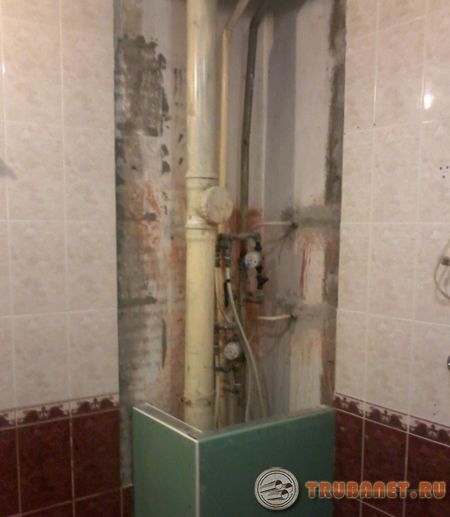 The structure is hung with screws and simultaneously supported by the floor. This design is resistant to shifting. A metal angle is used on the inside of the structure as additional fastening.
Access to utilities becomes possible through a hatch even after the top section is removed. Handles are attached to the inside of the sections to facilitate movement during installation.
The final covering of the removable box is best made of mosaic tiles, glued with liquid nails. A hatch is installed in the middle section to provide access to the ventilation ducts and meters.
The seam between the sections does not need to be grouted, but you can use a rubber seal or silicone.
Removable pipe boxes are quite heavy, but they are easy and quick to disassemble, making them very convenient to use.
Finishing the box with plastic panels
This design is considered a good alternative. This material is not significantly inferior to tile, which is the leading finishing material.
Plastic is easy to care for; it can be easily cleaned of dirt and grease stains.
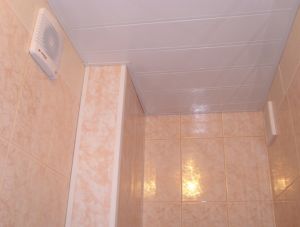 This material is resistant to temperature fluctuations, which is crucial for a bathroom. Its popularity is also based on its simple installation, which requires little time or expense.
If you decide to build a bathroom frame out of plastic panels, you don't have to worry about leveling the walls. Plastic panels are installed like laminate (using a puzzle-like method).
The installation process itself takes a couple of hours. A distinctive feature of this material is its resistance to deformation.
If you tile a frame in a new home, it may shrink over time. This will cause the tiles to deteriorate, but this doesn't happen with panels.
Plastic panels have another advantage: they're much cheaper than tiles. Besides the high cost of tiles, the installation costs include adhesive, grout, corners, and wall leveling.
None of this is necessary for plastic panels. Replacing tiles is also difficult, while replacing a damaged panel is much easier. For these reasons, plastic pipe boxes are used more often than other types of pipes in the bathroom.
IMPORTANT! To ensure the durability of this structure, seal the areas where the panels are attached with silicone sealant.
Covering pipes in the bathroom with plastic panels
- In this case, it is recommended not to install the entire profile at once. Only the wall-mounted starter element should be installed first.
- The paneling begins with one side. The plastic is cut into small pieces and inserted horizontally from bottom to top. No fastening is required. Cutouts are made in the areas where the main line needs to be controlled, and the door is installed.
- A decorative corner element. The plastic corner is placed over the protrusion of the assembled plastic. Once in place, it must be secured to the frame with screws.
- The second side of the structure is sheathed in the same way as the first.
- The back shelf is removed from the last starting profile. It is coated with silicone and glued into the corner.
- The gaps and joints between the frame and the tiles are filled with sanitary silicone. Any excess is carefully removed with a damp cloth.
Video 2
Whatever box you choose, the most important thing is that it fully fulfills its intended purpose. It should cover unsightly pipes and allow easy access to them.
At the same time, this design should be in harmony with the overall design of the entire room. Using the information above and watching the video, you will learn how to build a pipe box for your bathroom yourself. This project will be hassle-free.