Which is better: a tankless water heater or a storage water heater? For small and irregular consumption, a tankless water heater is sufficient. For constant consumption, a boiler is better. For larger consumption, you can combine the two, for example, a tankless water heater in the kitchen and a storage water heater in the bathroom.
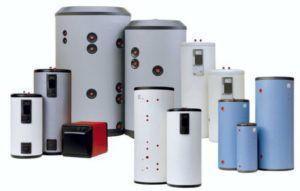 In today's world, there's no reason to justify the need to supply a residential building or country house with hot water. However, our homes don't always have a centralized water supply, particularly for hot water. This is precisely where water heating systems come in, and they are categorized as storage or instantaneous.
In this article, we'll explore the key question: what's the difference between a flow-through water heater and a storage water heater, and which is best for installation in a house or apartment.
Let's look at the design features of each of them, their pros and cons, and try to answer the question posed above.
- Types of water heaters
- Instantaneous water heater – operating principle, design and characteristics
- Let's take a closer look at heating elements and their features.
- Heating control methods
- Pros and cons of flow-through systems
- Instantaneous gas water heaters
- Storage water heaters - operating principle, design and characteristics
- Volume of storage water heater
- Heaters and power
- Installation and assembly
- Which device is better to choose and why?
- Provision of needs
- Operating costs
- Installation
- Popular models from well-known manufacturers
- Conclusion
Types of water heaters
Devices for heating water in domestic conditions are divided into two main types: flow-through and storage.
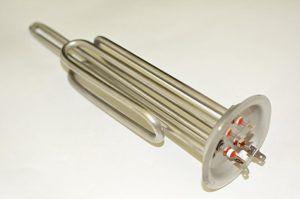 A flow-through water heater is designed to continuously produce water at temperatures up to 65 degrees Celsius. The temperature is increased in a limited chamber as the water passes through the heater. Electric heaters of various designs are used for this purpose.
The degree of heating of running water is regulated using special regulators.
Induction instantaneous water heaters, which are a closed vessel filled with heat-generating metal elements (steel balls or chopped nails with a diameter of about 5 millimeters), are worthy of attention.
This could be a plastic pipe wrapped with a coil of enameled copper wire. When current passes through the wire, eddy currents are induced on the surface of the heat-generating elements, heating them and the water flowing through the pipe.
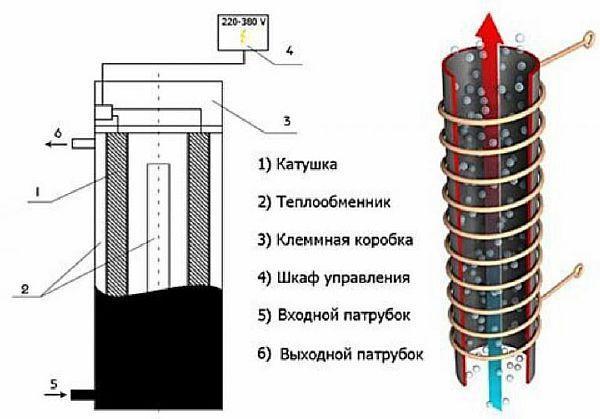
TO cons The need to use a circulation pump in such a system can be attributed to the device.
A storage water heater is a container with a capacity of up to 200 liters that constantly maintains the desired temperature. Depending on the container's capacity, the heating time can be up to 5 hours, but after that, the temperature is maintained constant.
The temperature ceiling can be quite high, up to 95 degrees, but this isn't used in practice. The standard setting is no more than 65 degrees, and a mixer tap is used.
Water heating in a storage water heater is produced using electricity, natural gas and non-traditional sources, such as solar energy.
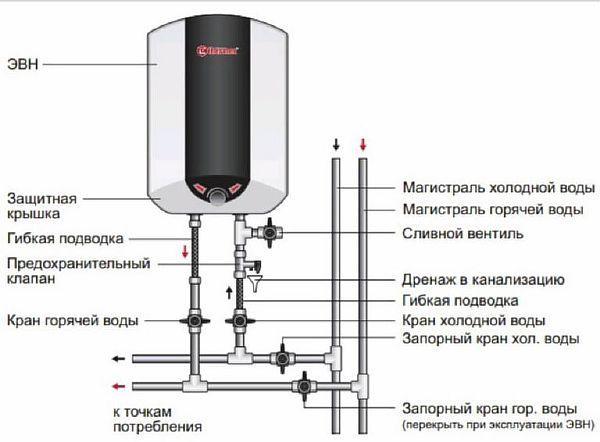
Instantaneous water heater – operating principle, design and characteristics
Currently, the Russian market offers a wide range of these devices from various manufacturers. They may differ in build quality, design complexity, and other parameters. But the operating principle is the same for all of them: heating water in a stream in a short period of time.
High-power electric heaters are used for this purpose, and the water in such a boiler heats up almost instantly. In most of these boilers, the heating element is activated by turning the faucet handle.
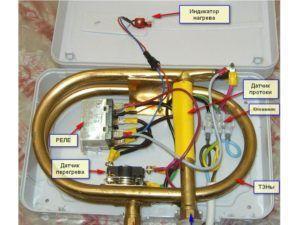 Electric instantaneous heaters are becoming increasingly popular among population due to its ease of use and reliability.
There are two types of devices of this kind:
- Closed-type pressure valves.
- Gravity-free open.
A pressurized system can supply hot water to several points operating simultaneously. The limiting parameter is the pressure limit that the water supply network can provide.
Gravity heaters operate normally at any pressure if they are connected directly to the water intake point.
A control system is installed inside the body of the instantaneous water heater, which automatically shuts off the power supply if the temperature rises above the normal level.
Let's take a closer look at heating elements and their features.
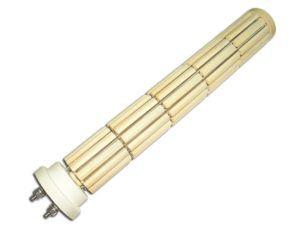 Possible variations in pressure drop in the water supply system are also taken into account in most designs by installing a stabilizer.
Heating elements, either coils or tubular elements, are installed either directly in a sealed housing or enclosed within durable plastic tubes. In either case, they cool very quickly when the water supply is interrupted, preventing scale buildup on their surfaces.
Similar designs are used in regions where increased water hardness is observedEnclosed heaters are the same devices, but enclosed in copper or brass tubes. This increases the fire safety of the entire unit.
Heating control methods
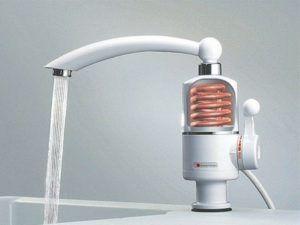 In modern types of flow heaters, two main heating process control schemes are used:
- Hydraulic – This allows for manual adjustment of the process in a stepwise fashion. Most models have six adjustment levels, which are set manually. With this adjustment method, the heater may not turn on if the water pressure in the system is low.
- Electronic control - performed automatically using a thermostat, with which the desired temperature is set.
The second control option is undoubtedly more convenient and popular with users. Heating is controlled by a microprocessor to maintain the set temperature, using the optimal amount of energy. Therefore, these heaters are more energy-efficient.
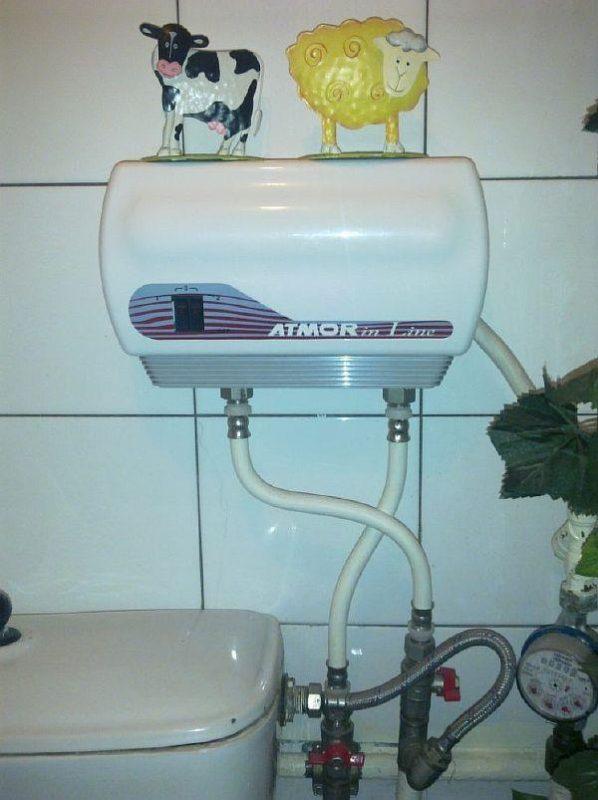
Electronically controlled devices are usually installed away from the points of consumption, as they are produced in the form of plastic boxes with built-in control units.
Pros and cons of flow-through systems
The current popularity of instantaneous systems stems from their compact size and ease of installation. They're also much more convenient to use—water heats up in seconds, and you can use any amount. A 100-liter boiler, on the other hand, takes about 5 hours to heat.
The positive aspects of flow-through types include the following points:
- Ease of use – turn it on, use it, turn it off.
- The ability to consume any amount of hot water over a long period of time. The water heating time is approximately 2 minutes.
- Instantaneous water heaters do not require additional care and maintenance.
- The compact size of the device allows it to be installed in any hidden place, including the space under a sink or washbasin, or even in place of a faucet.
- When consuming a limited volume of hot water, instantaneous water heaters are more economical than storage water heaters.
- The cost of flow-through systems is lower than that of storage systems.
- Water does not lose its qualities when heated; it can be used for cooking and even drinking.
At the same time, there are moments that can be attributed to cons:
- The maximum water temperature when using instantaneous heaters is 40-42 degrees Celsius. This is sufficient for any household needs.
- Power consumption increases with increasing device power.
- Obtaining large quantities of water is associated with increased energy consumption.
- The stable operation of instantaneous water heaters depends on a stable power supply. The use of stabilizers may be necessary.
It is important to note that instantaneous water heaters are high-power devices, so they require separate connections from the main network.
The wire cross-section depends on the power of the device, and the connection should be made through additional circuit breakers of 9-16 amps.
- The device should be installed as close as possible to the point of consumption to avoid significant heat loss in the pipeline.
- If you have very hard water, you must use special filters, otherwise limescale will form on the pipes and heating elements.
- It is not recommended to use such a water heater in an unheated country house.
- The location of the water heater must prevent water splashes from getting on its body.
It's important to remember that in older homes, the wiring is designed to handle no more than 3 kilowatts of power. To ensure proper operation of the tankless water heater, it's essential to install separate wiring from the electrical panel.
Instantaneous gas water heaters
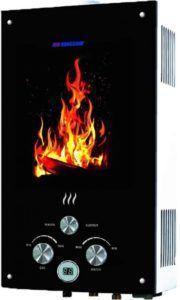 If there is a gas pipeline in the region, appliances that run on this fuel can be used. Gas appliances are much less costly to operate than electric ones.
Water in a gas water heater passes through a copper heat exchanger heated by a burner. The unit is equipped with automatic protection against pressure surges in the water supply system, gas supply interruptions, and other abnormal conditions. Temperature is regulated by adjusting the dial.
For proper operation and safe use of a gas water heater, a reliable flue gas exhaust system and effective supply ventilation are required. Commissioning is performed by a gas service specialist, with the relevant report drawn up.
Which water heater is more economical, a flow-through or a storage one, has only one answer – It is better to choose a gas instantaneous heater.
Storage water heaters - operating principle, design and characteristics
When choosing between a flow-through water heater and a storage water heater, you need to consider the following circumstances:
- capacity;
- power consumption;
- heater type;
- method of mounting the device;
- body coating;
- number of additional functions.
Let's take a closer look at each point.
Volume of storage water heater
This figure is determined based on the water heater's intended use. If it's only needed for washing dishes, a capacity of 15 liters is sufficient.
For washing, showering, and other similar needs, you will need a device with a capacity of 100-120 liters, and a storage boiler can provide simultaneous consumption for several water points.
It's worth noting that in an apartment, the room size is also a limiting factor. When installing the device in a spacious country house, its capacity can reach up to 200 liters.
Heaters and power
The capacity of a storage water heater to store hot water directly depends on its capacity. Depending on its capacity, the unit is equipped with one or more heating elements. The heating element is a nichrome coil hermetically sealed within a copper or brass tube.
For a small tank with a capacity of up to 15 liters, 1 kW is sufficient, but a 30-50 liter storage water heater will require 1.5 kW. Tanks larger than 80 liters require a heater with a capacity of at least 2.5 kW. Keep in mind that the heating time for larger tanks can be quite significant – up to 5 hours.
Installation and assembly
Installing a floor-standing storage water heater is not a problem – you just need to position the unit horizontally.
However, the quality of the wall is important for this type of boiler, as the total weight of the device filled with water can reach hundreds of kilograms.
Installing such a unit on a partition is problematic. In this case, a supporting frame must be constructed from angle steel measuring at least 30 x 30 millimeters.
Which device is better to choose and why?
Which water heater should you choose, a storage or a tankless one? When asking this question, there are many factors to consider. Let's take a look.
Provision of needs
One of the first is the problem of provision, which depends on the maximum level of satisfaction of the needs of residents.
If there are 2-3 people living in a house, a low-power flow-through unit is sufficient. In this case, a wait period is possible, as such a device only supplies one point of consumption.
A storage water heater reliably supplies hot water to several water draw-off points simultaneously.
Operating costs
Common sense dictates that hot water costs depend primarily on consumption. It's difficult to give recommendations here; much depends on water consumption habits.
An energy-intensive instantaneous water heater can be used so efficiently that costs are minimal. Optimization is also possible for storage water heaters. Therefore, the main criterion in this matter is the acceptability of hot water costs for a particular consumer.
It's important to keep in mind that storage water heaters require constant maintenance and periodic forced replacement of the heaters. Instantaneous water heaters do not have this drawback.
Installation
When installing storage water heaters A plumbing system must be created to ensure their operation. When using flow-through models, in some cases it is possible to simply replace the faucet with a heated one.
A common requirement for these types of water heaters is the need to install a separate power supply wire.
The choice of a tankless or storage water heater will depend primarily on the pros and cons, which we've detailed in this article, and the consumer's requirements for the appliance itself. However, it's safe to say that a tankless gas water heater is the most economical (if you have a gas line).
Popular models from well-known manufacturers
Water heaters are manufactured worldwide to varying standards and vary slightly in their key parameters. Listing them all in a short article is impossible, but there are recognized industry leaders that are worth mentioning:
- One such example is the Italian manufacturer Ariston. Its distinctive feature is its unwavering commitment to market demand and continuous improvement of its products. Its core product line consists of storage water heaters with capacities of 30-100 liters. A signature feature is the inclusion of silver in the inner lining of the tank. Stainless steel and titanium are also used in their manufacture. Advantages include sophisticated electronic controls using touchscreens.
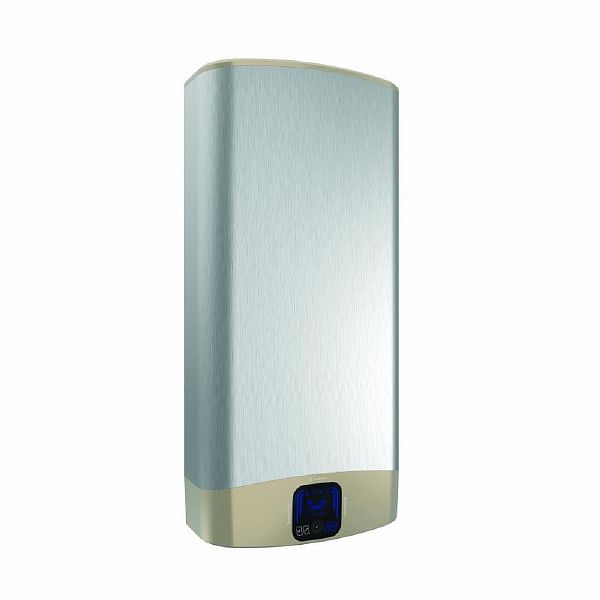
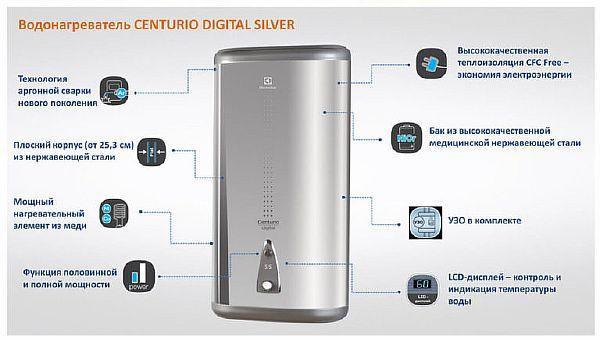
- No less renowned is the renowned manufacturer Electrolux (it celebrates its 100th anniversary in 2019). While the functionality of its appliances is constantly expanding, they are always distinguished by their high quality. Modern models feature efficient automatic pressure and temperature controls.
The inner surface is coated with durable glass ceramics, which also has disinfectant properties.
Most designs use paired heaters. This design allows for energy savings.
The disadvantages of this brand's products include, first of all, the high cost of the products, with a noticeable difference when compared, and the short service life of the heating elements.
Electrolux brand products are distinguished by their refined elegance.
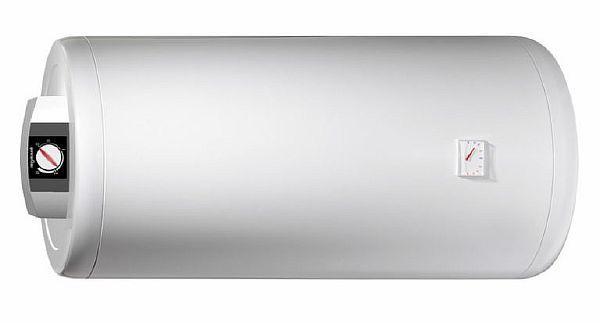
- Products from the Slovenian manufacturer Gorenje are distinguished by their commitment to meeting customer needs while maintaining high quality. High-quality enamel and stainless steel are used for the tank interiors. A distinctive feature of these appliances is their wide range of capacities and power ratings. Products from this brand are equipped with an efficient control system for monitoring all key operating parameters.
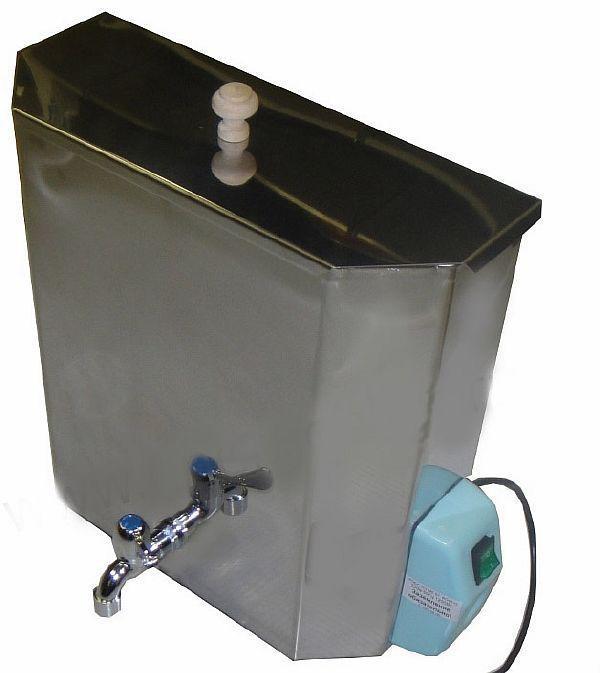
- It's possible that consumers will be interested in domestic products. For example, the Elvin water heater is of interest; it heats 30 liters of water to 70 degrees Celsius in 40 minutes. The unit is housed in a 1-millimeter-thick stainless steel housing. The heating element produces only 1.5 kW.
Conclusion
We've provided enough information to help you decide which is better—a storage or instantaneous electric water heater—for your home or apartment, how they differ, and which unit is best. However, it's worth reiterating that choosing between electric water heaters is only necessary if you don't have access to natural gas.
A flow-through gas water heater is, by most measures, much more cost-effective, and its operation and maintenance will not pose any problems for even the most demanding consumer.