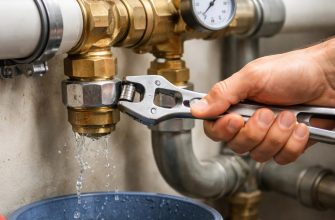
Monotonously and inexorably, with metronome precision, the slapping sounds repeat, flushing brains and money straight down the drain. The cause is simple and banal: a dripping faucet in the kitchen or bathroom.
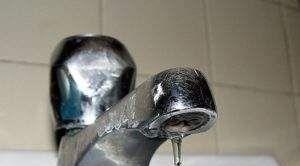 The situation is simple and familiar to everyone; such breakdowns are far from uncommon, and this situation is fraught with many problems, from the risk of flooding the neighbors below to rising water bills.
Constant monitoring of the operation and condition of plumbing equipment, as well as careful adherence to operating rules, helps avoid such phenomena.
A kitchen faucet isn't a particularly complex piece of equipment, but it still operates under pressure. Despite the apparent simplicity of this mechanism, it requires increased attention.
- Let's look at the reasons why water might drip from a kitchen faucet.
- What to do when the faucet in the kitchen is dripping?
- How to fix a single-lever kitchen faucet
- How to fix a ball faucet
- How to repair valve taps
- Elimination of leaks caused by other reasons
- Selecting and using a kitchen faucet
- Tips and recommendations
Let's look at the reasons why water might drip from a kitchen faucet.
There may be several reasons for leaks:
- Incorrect use. All equipment has specific performance characteristics. When providing a warranty for their products, every manufacturer includes a number of limitations, the violation of which leads to accelerated wear and tear and failure. And often, fulfilling these limitations or monitoring these parameters is virtually impossible.
- Poor workmanship or low-quality materials. Often, when making a purchase, people try to choose a less expensive item, aiming to save money. However, this often results not just in inconvenience but also in direct financial loss due to the forced replacement of a defective product. Especially unpleasant are cases when a breakdown occurs when no one is present. When purchasing a faucet for your apartment, it's better to pay for the brand, as this also includes quality. However, the low price of a popular brand should be a warning sign—it's likely a low-quality counterfeit.
- Natural wear and tear associated with long-term use. Faucets are opened and closed repeatedly throughout the day, and their sealing components (gaskets, bushings, and cartridges) are subject to intense use and wear out quickly. Therefore, the best way to prevent leaks is to promptly replace quickly wearing components.
- Poor assembly quality can be a cause of failure. The most common errors include misaligned parts and damaged seals due to overtightening. Manufacturing defects cannot be ruled out, so a thorough inspection upon purchase is essential.
What to do when the faucet in the kitchen is dripping?
What should you do if your faucet is leaking? Some of the most common causes of leaks include worn rubber seals, which need to be replaced. If the packing gland is worn, replace it or install a PTFE tape insert.
First, you need to determine the cause of your kitchen faucet's dripping and determine whether you can fix it yourself. If the problem can be repaired yourself, then you'll need to go to a plumbing supply store to purchase the necessary parts and begin repairing the problem yourself.
Video: How to fix a dripping kitchen faucet yourself
Knowing how to fix a dripping kitchen faucet will allow you to have everything you need in stock and avoid chasing after trivial items.
How to fix a single-lever kitchen faucet
Mechanisms of this type are the most popular among consumers because they are quite reliable and simple in design. The control element is a non-detachable cartridge.
Repairs are needed when the water pressure from the spout has decreased, or a leak is observed when the faucet is turned off. Why does the faucet drip when the water is turned off? This is a clear indication that the shutoff elements are worn.
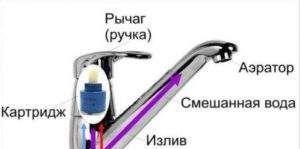 The diagram shown here should be considered typical only; units from different brands may have significant differences. However, they all share the same cartridge retaining nut, which is held in place by a functional lever.
The mount is hidden by a decorative cover on the housing. Pry it off with a screwdriver, after which the cartridge can be removed and replaced with a new one.
If you notice a leak between the faucet body and the sink, this indicates a defective sealing ring. Unscrew the body, remove the sealing ring, and replace it with a new one.
Basically, that's all you need to know about fixing a dripping single-lever faucet. However, given the differences in design between models, it's important to first read the instructions included with your specific product.
How to fix a ball faucet
Ball valve locking devices are the second most common type after single-lever locking devices.
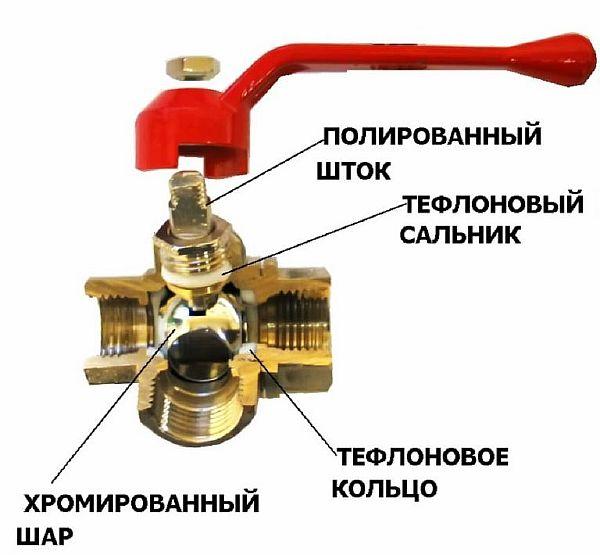 This is due to their durability and ease of use. They are constructed using high-strength materials, ensuring a long service life.
The main "enemies" of a ball valve are contaminants, which are always present in water. These contaminants come from insoluble salts or oxides. Therefore, to ensure their interaction, the water must pass through several filters.
The first is a coarse filter. It consists of a housing containing a brass mesh. This element traps most solid particles. The mesh needs to be cleaned periodically to remove sediment; it can become clogged to the point of complete obstruction.
Fine filters are also installed in front of household appliances that require clean water, allowing only microscopic sediment to pass through.
 If the ball valve is dripping, proceed as follows:
- Remove the handle mounting screw.
- Remove it from the shaft.
- Using a screwdriver, remove the threaded screw.
- Remove the cover and the sealing plastic element.
- Inspect and clean the gasket from dirt; if necessary, replace it with a new part in case of significant wear.
- Remove and inspect the locking element – the ball; replace it if necessary.
- Use a thin screwdriver or tweezers to remove the seals that hold the ball in place; it is best to replace them forcibly.
Video: How to fix a dripping kitchen faucet
When reassembling, lubricate all contact parts with silicone grease for better sealing.
ADVICE! If a ball valve in your kitchen is leaking, it's best to replace it with a new one. Despite its simple design, such a valve is difficult to repair due to the high precision required for assembly.
How to repair valve taps
This type of locking device is the least expensive to repair, but requires it much more frequently. This is due to the sealing material used—rubber.
It is used for both sealing glands and shutoff elements. Recently, silicone seals have been installed, which provide improved performance, but the service life has not significantly improved.
There are two main types of valve taps used: worm gear and ceramic gear.
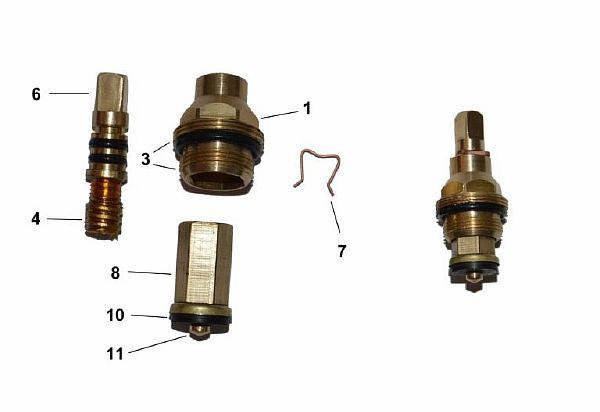
 The first of these is threaded on the movable stem. As the stem rotates, it moves forward and, through a hexagon, presses a rubber gasket against the seat on the valve body.
This is where the weak point lies. If excessive force is applied, the gasket will quickly fail. Therefore, this product requires extreme care when handling.
Additional gland sealing gaskets are installed on the valve stem itself, isolating it from the body.
It should be noted that the durability of the locking device is very limited, so when purchasing a axle box, it is necessary to immediately purchase spare gaskets and seals.
A more recent design solution for crane axle boxes is the use of ceramic inserts. This design eliminates the piston rod's translational movement. It utilizes two ceramic washers with opposing semicircular cutouts.
When the axle box flywheel rotates, the holes align, opening the passage for water, or overlap, blocking it. The half rings are sealed together by a rubber shock absorber.
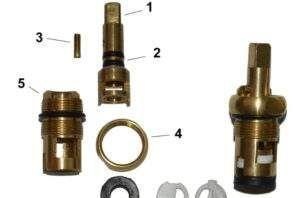
Given the high wear resistance of ceramics, this design solution has proven very successful and is being used successfully. However, if a ceramic faucet starts dripping, repairs require replacing the inserts and shock absorber.
Video: Faucet repair or why it drips (flows) in the kitchen
- You need to remove the decorative cover on the flywheel by carefully prying it off with a narrow screwdriver.
- Unscrew the screw and remove the flywheel.
- Carefully loosen and remove the oil seal nut.
- Unscrew the rod with the rubber gasket.
- Clean the valve seat from dirt.
- Change the rubber gasket.
- Assemble in reverse order, after which you can turn on the water.
Elimination of leaks caused by other reasons
The most important thing to do if your kitchen faucet is dripping is to correctly determine the source of the leak. Knowing the source of the leak will significantly simplify repairs and likely reduce the cost, as unnecessary disassembly of the plumbing fixture often results in damaged seals.
- leak at the drain point;
- unsatisfactory condition of the sealing gasket between the spout and the tap;
- leak between the sink and the faucet;
- dripping directly from the tap itself.
Water leaking from the valve usually indicates increased wear of the gaskets, which need to be replaced.
A leak can form where the faucet's seat meets the sink surface. This can occur if the faucet body is hit with a sharp, careless blow, causing a crack in the gasket, especially if it's old.
If you're experiencing drips at the spout, check the condition of the faucets and replace all seals. Wear and tear on materials can cause leaks.
Any repair must begin with turning off the water supply at the riser.
Selecting and using a kitchen faucet
Plumbing system breakdowns occur with surprising regularity, and the cause can be a lack of proper maintenance. Monitoring the plumbing system's operation is paramount.
The system operates reliably only under stable pressure; sudden changes in pressure destroy it, and the first to suffer are the sealing gaskets and threaded connections of the locking devices.
Single-lever devices are convenient to use and can be operated with one hand. Avoid purchasing products from Chinese and Turkish manufacturers, as they are typically of poor quality and durability and begin leaking immediately after installation.
Tips and recommendations
The plumbing system in an apartment or private home is a source of increased danger. Therefore, when using it, it's important to follow certain rules to avoid problems. Let's list them:
- Have the ability to quickly shut off water from the riser.
- A set of tools for carrying out repair work should always be at hand.
- It is necessary to keep a set of replacement parts for the taps and faucets in use at home.
- Be prepared to call emergency water utility services immediately in case of a serious accident.
- And, of course, you need to know the rules and procedures for independently eliminating an emergency situation.