Before we investigate the cause of noise from a faucet or tap, let's try to understand its nature. Any sound is acoustic vibration at a specific frequency, generated by vibration.
For this reason alone, such a phenomenon requires special attention, since it is possible for it to enter a resonance phase, and then one must expect trouble, since the amplitude of oscillations increases sharply.
This usually leads to the destruction of the resonating objects. Therefore, promptly identifying why the faucet is making noise when the water is turned on can help avoid major problems associated with potential major repairs.
Reasons for noise when turning on the tap
Why does a faucet make noise when opened? There are several reasons:
- Increased pressure in the water supply network. Typically, it's around two atmospheres, but the system itself is designed to withstand up to six. This significantly increases the flow velocity in the pipe, causing vibration, which causes noise from the faucet or valve.
However, noise can originate not only at the faucet but also at a bend in the pipe. It manifests itself in the tap. This is difficult to resolve on your own; you'll need to contact the management company's control room to request a specialist.
To determine the presence of excess pressure in the water supply system you need to open the tap sharply and then close it just the same wayIf the tap continues to hum, it means high blood pressure is present.
What should you do if your faucet makes noise when you turn on the water? A reliable solution is an air damper. It's a pipe about 40 centimeters long with a plugged top end. When the pressure in the system increases, the air lock acts as a shock absorber, as air is an elastic medium. After this, the faucet no longer makes noise or growls.
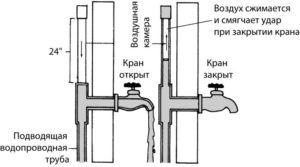
You can connect the shock absorber yourself.
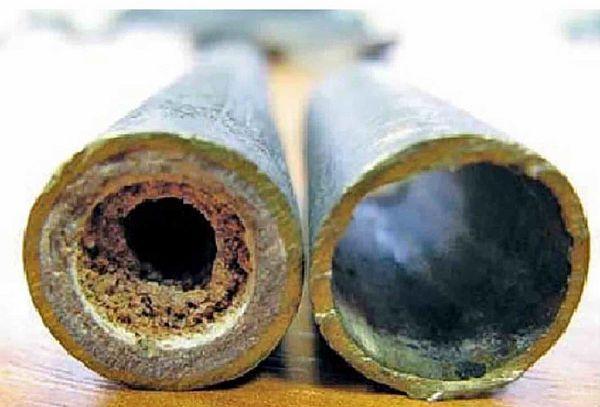
- Wear and clogging in metal pipes of old water supply systems. This can include rust, as well as significant deposits of limestone deposits. Such defects most often appear at bends in the pipes, resulting in significant pressure and fluid flow rate fluctuations, leading to abnormal noise in the system.
- Violation of piping system installation rules. If unusual sounds are detected, inspect the entire accessible piping network and correct any installation defects found. After this, the hot water faucet will no longer make noise, nor will the cold water faucet.
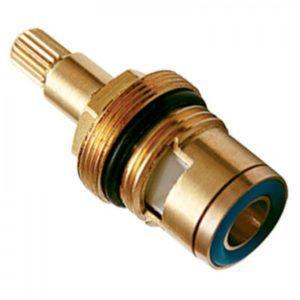
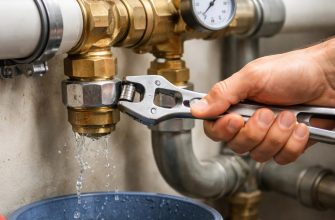
- Wear of gaskets in shut-off devices such as faucets or taps. This can also manifest itself as leaks or drips from the faucet. The simplest solution, accessible to any consumer, is replacement. When purchasing these parts, pay attention to the quality of the gaskets and seals, choosing products from reputable manufacturers even at a higher cost.
A noisy faucet from a neighbor's home should also be a cause for concern. Where should you complain? The only appropriate person to contact is the management company, which should respond quickly to such a signal.
It is dangerous to hope that the vibration of pipes behind the wall does not affect you; it needs to be eliminated just as quickly as in your own apartment.
See also: instructions on how to disassemble the lever and valve mixer, what tools you'll need, everything is described in detail step by step with videos and photos.
Single lever faucets
This is the most popular modern version of the kitchen faucet. It features a single lever. Turning it up and down adjusts the water flow, while turning it left and right adjusts the water temperature.
- ball;
- with a ceramic cartridge.
In models with a ball valve, adjustment is made through three holes on the ball - hot and cold water enters through two of them, and the third is the outlet, through which water at the required temperature flows out.
A mixer with ceramic inserts works on almost the same principle, with all parameters being adjusted using ceramic rings with matching holes.
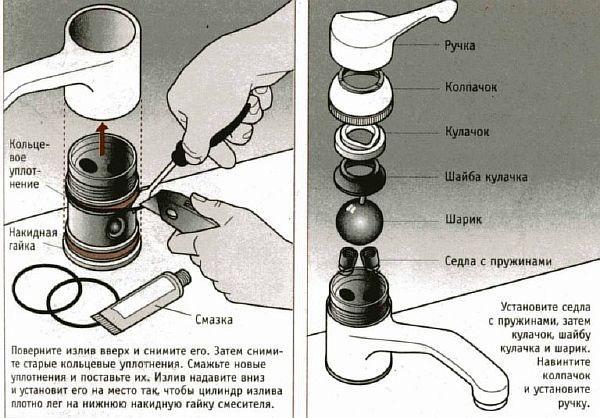
Single-lever faucets rarely make noise, and this is usually not due to a malfunction of the device itself. The most common cause is increased pressure in the pipes.
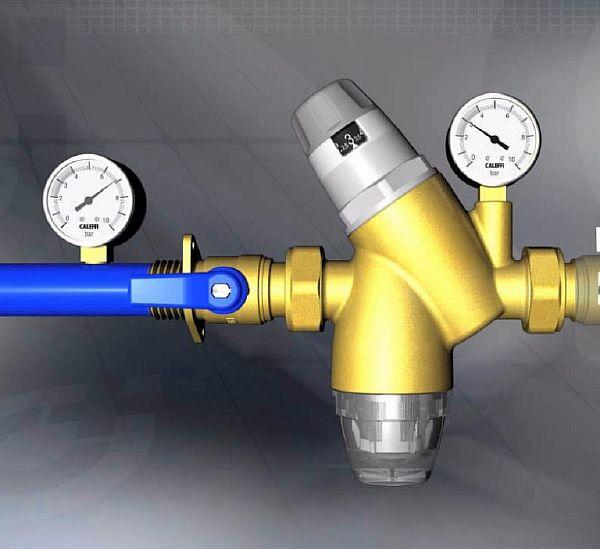
We have already considered the possibility installation of an air damper, but a more reliable way to avoid plumbing noise is to install a pressure reducer in the water supply system that prevents pressure from rising above 2.5 atmospheres.
This way, you can reliably eliminate this unwanted phenomenon. When considering why a single-lever kitchen faucet might be noisy, it's safe to say that the cause lies not with the faucet itself, but with the plumbing system.
Mixers with cartridge
This is the most advanced device for regulating the flow of water from a faucet. The design eliminates threads, a common weakness in shut-off valves, and modern, high-precision manufacturing technologies ensure a long service life.
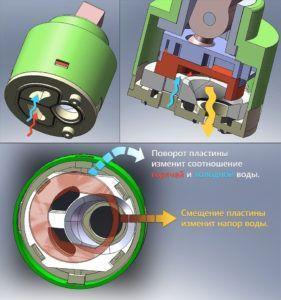
The cause of the noise can be determined by understanding the faucet's design. In addition to the designs listed above, mixed-type devices are widely used, using both bushings and ceramic inserts. The latter type is more likely to cause similar problems, but the former is not immune to this problem.
Determining the type of valve used in a faucet is easy. When opening a valve with a hub, it takes several turns to achieve full flow. A faucet with ceramic inserts does this in no more than half a turn. The main thing is that any unusual noises during faucet operation indicate a fault in the system.
A cartridge faucet can make noise due to its design. The ceramic plates are pressed together by a special silicone gasket, which wears out over time. At high flow rates, they begin to vibrate, and it's easy to tell that the cartridge is the source of the noise; sometimes the noise turns into a whistling sound.
They are integrated into the piping system and reliably trap most contaminants, but require constant maintenance. Every two to three months, the filter elements should be removed and rinsed under a strong stream of water. If they become heavily clogged, a brush should also be used to clean the mesh.
The introduction of filters into the water supply system should be considered as a mandatory measure to ensure its operation.
The procedure for eliminating emerging noise and assessing the condition of the water supply system
If the faucet in the kitchen or bathroom is noisy, the troubleshooting procedure may be as follows:
- You need to start by turning off the valve on the inlet pipe from the riser to the internal wiring of the system.
- Unscrew the cold water shut-off valve on the mixer.
- Inspect the gaskets and replace any worn ones with new ones, using rubber or silicone products. Strictly speaking, it's best to replace the gaskets in any condition, unless it's a brand new faucet.
- The same operation must be performed with the hot water tap.
- If the locking device is a cartridge with ceramic plates, it's best to replace it entirely. If desired, this component can be repaired later.
After connecting the water to the inlet pipe, check to see if the faucet still makes noise. If this continues, the initial installation of the plumbing system is faulty. Carefully inspect the pipeline for the following defects:
- Misalignment during welding of threaded tips. This defect occurs due to poor welder skills or careless workmanship. Misaligned parts disrupt the flow direction. At elevated pressures, turbulence can occur, causing vibration.
- Incorrect pipe bend angle selection. The minimum radius of the inner bend surface should be at least 2.5 times its diameter, which is an extreme value. The problem is that internal piping systems use water and gas pipes compliant with GOST 3262-75. These pipes are made from steel strip using electric or furnace welding.
Pipes are produced in three series: light, medium, and heavy. The difference between them lies in wall thickness. Light-series products, with their thinnest walls, require special care when bending, and it's best to choose a larger bending radius.
Otherwise, the cross-section may become smaller, even leading to complete flattening of the pipe at the bend. This difference in cross-section creates the preconditions for vibration.
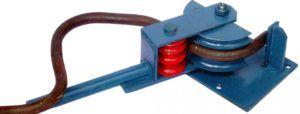
The position of the longitudinal weld is also important. When bending, it should be placed along the inside surface of the bend. Only then is it guaranteed not to crack during bending. The weld position is easily controlled by the protrusion inside the pipe (the internal burr).
- Noise when opening a faucet is often caused by limescale buildup inside the pipes. Over time, this buildup significantly reduces the internal flow, and this occurs unevenly.
Various methods of cleaning pipes using mechanical or chemical methods have been developed and are used, but they are only effective on larger diameter pipes with long straight sections.
These methods are not used in internal plumbing installations within an apartment or house; it is easier to replace the pipeline using modern plastic pipes, which do not deposit limescale on their walls.
After this, you can turn on the water and check the results of the measures taken. If the internal piping has the defects listed above, it will become clear why the new kitchen faucet is making noise—it's not the faucet itself that's causing the noise.
Iddis faucets are often complained about, as they make noise and sometimes even whistle immediately after installation. There's no point in repairing such a device, especially if it's Chinese-made. It's best to return it to the store and replace it with a different model.
Tips and recommendations
The internal piping system of an apartment or private home is a complex engineering structure, requiring careful attention both during installation and operation. It must meet the following requirements:
- Manufacturability. All system elements must comply with the technical documentation for their manufacture.
- Maintainability. Free access must be provided for dismantling and replacing any part or assembly if necessary.
- Design. Pipes should be located in accessible but inconspicuous locations. If necessary, use boxes to conceal the wiring.
During operation, it is necessary to carry out periodic inspections of the system; if necessary, tightening of threaded connections, replacement of sealing elements and other preventive measures are carried out.
A hum, noise, or whistling sound when opening a faucet indicates a malfunction in the system and requires immediate action to fix it. If you can't resolve the issue yourself, call a specialist immediately.


Hello, Vladimir! Could you please advise a possible solution to my problem? My 15mm ball valve is connected to the toilet cistern fittings via flexible hose (the fittings and hose are new). When water is drawn into the cistern, the valve and hose begin to vibrate loudly while the cistern is filling (the water meter impeller rotates evenly and at the same speed, slowing down as the water finishes filling the cistern). I am aware that a ball valve is not designed to regulate the flow of water and has only two operating positions (either fully open or closed). Once a month, before submitting water meter readings, I always rotate the flywheels of all the ball valves (open-closed-open). What's interesting is that the described effect is not constant and may not appear for weeks. I suspect a new valve may need to be installed. Sorry to interrupt you from your daily work. Good health and good luck!
Hello. If the vibration and noise were constant, there's a high probability that there's a blockage inside the hose or faucet preventing the free flow of water. This could be caused by a piece of rust driven in by the flow, or by a threaded liner that slipped off during faucet installation, partially blocking the flow hole. Resolve this by repacking the faucet and flexible hose and flushing each component.
The intermittent occurrence of this problem is more likely caused by high-pressure water mixed with air. This creates a type of hydraulic shock within the pipeline, causing vibration in the pipes and flexible hoses.
One solution is to install a filter with a cartridge at the water supply inlet, with a bleed button on the cover. Try reducing the overall pressure in the system by closing the shutoff valve at the inlet. This can be accomplished with even a half-turn of the ball valve.