Cross-linked polyethylene is a polymer with a modified molecular bond structure. It is produced by polymerizing ethylene under high or low pressure. It is the densest of all polyethylene materials and is resistant to high temperatures, aggressive chemical environments, and mechanical stress.
Today, truly revolutionary changes are taking place, driven by the widespread use of plastic products, with steel piping being replaced by plastic ones. Therefore, many DIYers may find it necessary to install cross-linked polyethylene water supply pipes themselves.
In this article you will find all the information on technical specifications of these products, let's consider them advantages and disadvantages, at what moments is it necessary pay attention when choosing.
We also suggest you study the detailed instructions for installing polyethylene water pipes, including drawings and video tutorials.
- Technical characteristics of cross-linked polyethylene pipes
- Pipe production technology and physical properties of the material
- Let's look at the characteristics
- Cold water supply pipes
- For hot water supply and heating
- Advantages and disadvantages
- Installation instructions
- What tool is needed?
- How to choose cross-linked polyethylene pipes for water supply
Technical characteristics of cross-linked polyethylene pipes
Statistics show that more than a quarter of all plumbing systems in the country are made using PEX. So what explains the popularity of polyethylene pipes? Let's look at their technical specifications:
| Name of indicators | Size |
| Specific gravity, g/cm3 | 0.932 |
| The value of the modulus of elasticity, mPa (N/mm2) | 605 - 909 |
| Thermal conductivity coefficient, W | 0.405 |
| Tensile yield strength, MPa | 17.8 |
| Relative elongation at break, % | 349 |
| Deviation in dimensions when heated to 100O, % | 3 |
The level of cross-linking of polyethylene depends on the method of its production and should be:
- 70% — PEX-a;
- 65% — PEX-b;
- 60% — PEX-c.
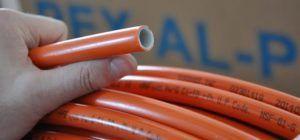 It should be noted that polyethylene, cross-linked in one way or another, in GOST 25134-2003 differs only in the degree of cross-linking.
The homologous size range of polyethylene pipes for water supply installations includes the following dimensions:
10x1.4 - 12x1.8 - 16x2.2 - 20x2.8 - 25x3.5 - 32x4.4 - 40x5.5 - 50x6.9 - 63x8.6.
At this point, this series needs to be interrupted, since other sizes are practically not used for installation in apartments and private houses.
Polyethylene products are available in various lengths, the most common being coils of 200, 400, and 600 meters. For ease of retail distribution, a scale ruler is applied to the surface of the pipe, allowing for easy measurement of the required quantity.
Pipe production technology and physical properties of the material
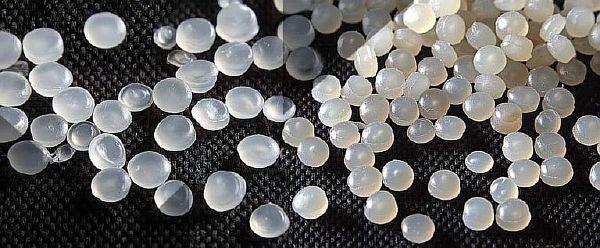
The material used to manufacture these products is granulated polyethylene. It is loaded into a hopper and heated until completely melted. The mass is then fed under pressure into a forming head. The head exits in the form of an annular slit corresponding to the size of the product being produced.
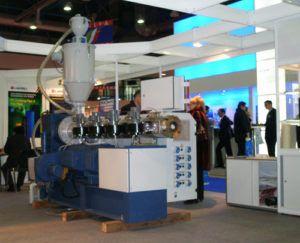
The cross-linked polyethylene pressing tool is replaceable and is installed depending on the production program. Because it operates at high temperatures, the tool requires constant cooling. This is accomplished through internal water channels. As the liquid passes through them, it heats up, removing some of the heat from the work area.
At the exit of the forming head, the end of the pipe is gripped by a puller and, under controlled tension, removed from the machine. To ensure dimensional accuracy, compressed air is injected into the product. The expanding pressure presses the still-plastic mass against the walls of the forming section, ensuring the product's nominal size.
During the production flow, markings containing complete information about the product being manufactured are applied to the outer surface.
Let's look at the characteristics
What is cross-linked polyethylene? The raw material for this material is ethylene gas. Its chemical formula is C2H4, which contains two carbon molecules and four hydrogen molecules. Structurally, the carbon molecules have two bonds, and the hydrogen has one. The C molecules are linked together, and each forms a bond with two hydrogen corpuscles. One of the C=C bonds is stronger than the other.
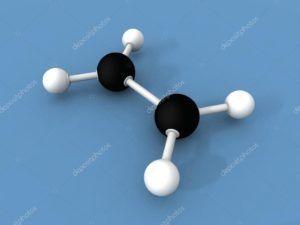 Under certain conditions, the weaker bond breaks, forming a free valence. This free valence is realized by combining with the same site on another molecule. As a result, ethylene particles form long chains.
When they begin to bond with each other, macromolecules are formed, which is called cross-linking, and the material is called cross-linked polyethylene. The process can be compared to the formation of a crystal lattice, even though the material is amorphous.
The polymerization process occurs under various conditions, the main ones being:
- high temperature;
- high blood pressure;
- radiation exposure.
Depending on the method of exposure, different types of polyethylene are obtained.
Polyethylene is a thermoplastic material with the following properties:
- Opacity at significant layer thickness.
- Ability to crystallize in the temperature range from -60 to -270 degrees.
- Non-wettability by water.
- Under normal conditions, the material is insoluble in organic solvents.
- At temperatures above 80 degrees, it is capable of swelling when exposed to aromatic hydrocarbons and halogen derivatives, followed by dissolution.
- Polyethylene is resistant to alkalis, acids, and salts. At temperatures above 60 degrees Celsius, it can be easily destroyed by nitric or sulfuric acid.
- By treating the surface with active oxidizers, the surface becomes wettable, which allows for bonding to polyethylene materials.
Of all plastics, polyethylene is most widely used in the manufacture of water supply pipes using extrusion or injection molding. Compression molding is used for sizes ranging from 6 to 300 millimeters, and it can be formed into coils by winding them onto a reel.
This allows for the installation of long, seamless sections of water supply systems, which increases the efficiency of construction work.
Large-diameter pipes (up to 1,300 millimeters) are produced using centrifugal casting. Granulated material is loaded into the casting machine and heated to the required temperature.
The drum is set in rotation along its axis. Centrifugal force evenly distributes the melt along the drum walls and, as it cools, forms the product.
The characteristics of polyethylene allow products made from it to be used for a wide variety of purposes.
Cold water supply pipes
Low-density polyethylene (HDPE) pipes are used for cold water pipelines. They have a temperature limit of no higher than 40 degrees Celsius. Compared to their metal counterparts, they offer several advantages:
- Durability. HDPE pipes in pressure and gravity (sewage) water systems can last up to 50 years.
- Flexibility. This characteristic protects pipelines from freezing. They expand under the influence of frozen water, returning to their original dimensions after thawing. It should be noted that this situation can only occur if the designers miscalculate the pipeline's installation depth, as it would interrupt the facility's operational life.
- The corrosion resistance of HDPE pipes allows them to be used for laying water supply systems in harsh conditions, particularly in swamps, and for transporting aggressive liquids. Their service life remains virtually unchanged.
- Environmental friendliness allows the use of HDPE pipes for supplying clean drinking water.
- Ease of installation ensures high productivity during construction.
- The economic efficiency of using such water pipelines is ensured by lower prices and advantageous logistics.
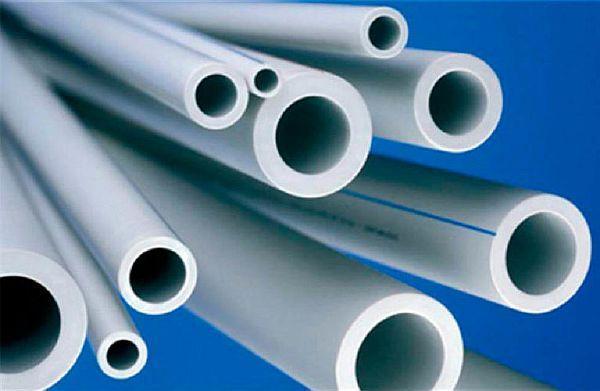
HDPE pipes are manufactured in sizes ranging from 40 to 800 millimeters. They are available in coils on reels or as straight pipes up to 11.5 meters long. For gravity-fed systems, the pipes are manufactured with a socket-type design.
For hot water supply and heating
Before we begin to examine this issue, we would like to point out that HDPE products have higher strength and performance characteristics than similar products made from high-density polyethylene (HDPE).
These high-tech products are widely used in heating systems and hot water supply systems. This is due to their ability to withstand temperatures up to 95 degrees Celsius. To ensure durability under conditions of increased heat exposure combined with pressures of up to 20 atmospheres, it became necessary to develop a material with improved properties.
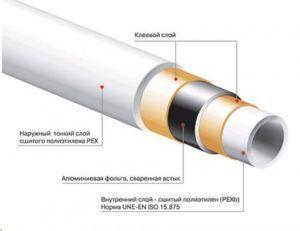 To further improve the quality of cross-linked polyethylene pipes, a multilayer manufacturing technology is used, incorporating metal, fiberglass, and polypropylene polymer additives as reinforcing agents. The use of aluminum foil as an oxygen barrier extends the service life of not only the water supply system itself, but also boiler equipment and metal piping components.
In internal heating and hot water supply systems made of cross-linked polyethylene, threaded metal connections are most often used, for which oxygen protection is equally important. However, this does not allow this material to be used for concealed systems. Such piping requires constant monitoring and maintenance.
Advantages and disadvantages
Products of this type have very specific positive qualities:
- The material is characterized by high chemical resistance, allowing products made from it to maintain their integrity and shape when exposed to aggressive environments – acids and alkalis.
- High level of strength characteristics, allowing it to withstand significant bending, impact and tensile forces.
- Flexible cross-linked polyethylene pipes can withstand a wide range of temperature fluctuations. They do not freeze at -70 degrees Celsius. The upper heating limit is +95 degrees Celsius, at which point the PEX product does not sag or deform over long periods of use. This property allows for installation of cross-linked polyethylene pipes with deviations from a straight line, without the use of additional fittings.
- There are no obstacles created when liquid passes through the cross-section – the surface of this material is almost perfectly flat.
- The environmental friendliness of the product is due to the properties of the material; it does not emit substances harmful to humans.
Despite the many positive aspects, there are also some negative factors. Disadvantages include the following:
- The destructive effect of oxygen on a material in the presence of microdamage on the surface.
- Instability to the effects of harsh ultraviolet radiation, which prevents its use for external water supply networks.
- The use of threaded connections at joints, which are the weak point of any plumbing system and require regular inspection and maintenance.
Installation instructions
As a positive quality of the material of the type in question, such a factor as simplicity has already been mentioned installation of cross-linked polyethylene pipesThis article covers this issue in more detail. It doesn't require complex technological equipment.
What tool is needed?
Laying a cross-linked polyethylene water supply system requires specialized equipment. Since the system may never be needed again after its long lifespan, it's advisable to consider leasing it on a daily basis.
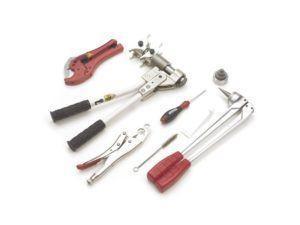
What tools might be needed to install cross-linked polyethylene pipes?
- Special scissors or a pipe cutter to ensure a smooth end of the part.
- A collet expander is used to expand the end of a cross-linked polyethylene pipe before installing a fitting end into it.
- Wrenches.
- Pressing vice.
- Pliers for crimping threaded fittings.
- For connections in external water supply networks – a device for welding PE pipes.
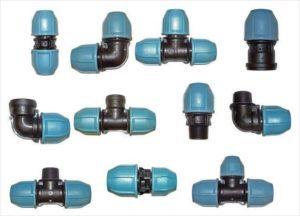
 Fittings are specialized connecting components used to connect various pipeline components. They include various couplings, crosses, elbows, and more. They can differ in the connection method:
- press-on;
- compression;
- capillary;
- threaded.
Installation is usually carried out using two types of connections:
- using a compression fitting;
- using a compression fitting for cross-linked polyethylene pipes;
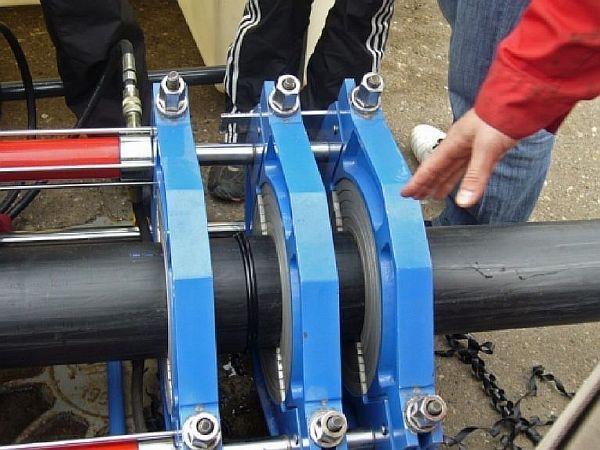
- In outdoor water supply networks, butt welding is used for connections, end-to-end. This is done using a simple welding machine that aligns the opposite ends of the pipes, heats them, and compresses them, creating a secure connection. Before joining cross-linked polyethylene, the perpendicularity of the ends must be checked.
How to choose cross-linked polyethylene pipes for water supply
Purchasing the primary plumbing materials is the most critical task for anyone planning to install them. The following factors must be considered:
- Despite the higher price, try to buy products from reputable brands. This virtually guarantees high quality and long-term, trouble-free use of your water supply system.
- To verify that a product is genuine, ask the seller for two documents: a quality certificate and a certificate of conformity. These documents provide more or less protection against purchasing a counterfeit product.
- To have future claims prospects, you need to keep the sales receipts - both soft and hard.
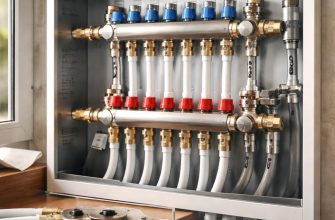
- When calculating the required pipe length for closed circuits (underfloor heating), consider the possibility of constructing the pipe from a single piece. Threaded fittings can be used at two points – at the connection to the manifold.
- During installation, it is necessary to comply with all design and installation rules set out in the following documents:
- SNiP 2.04.01-85, concerning internal water supply and sewerage systems.
- SNIP 2.04.01-84, regulating the rules for the installation of water supply networks and their external networks.
- SNiP II-34.76 concerning hot water supply.