 For years, there has been debate about whether sewer pipes can be used for ventilation installations. Experts believe that ventilation systems should not be constructed from sewer pipes because they are made of low-quality plastic, which can release toxic substances into the air.
In this article, we'll explore the pros and cons of building a DIY ventilation system from sewer pipes in a private home.
The construction materials market offers buyers a wide selection of materials for installing ventilation systems.
Ventilation pipes
Any room, whether an apartment, a private home, or especially a busy area, requires a ventilation system. For DIY installation, it's recommended to use high-quality plastic pipes.
PVC is used most often. This material has the following advantages:
- lightweight, but at the same time durable;
- convenient in the maintenance process;
- not afraid of ultraviolet radiation;
- safe for human health.
Can sewer pipes be used for ventilation? They're significantly cheaper, so many homeowners who have to build their own ventilation systems wonder if it's possible to build one in a private home using sewer pipes.
There are some nuances that are better to know in advance before purchasing materials.
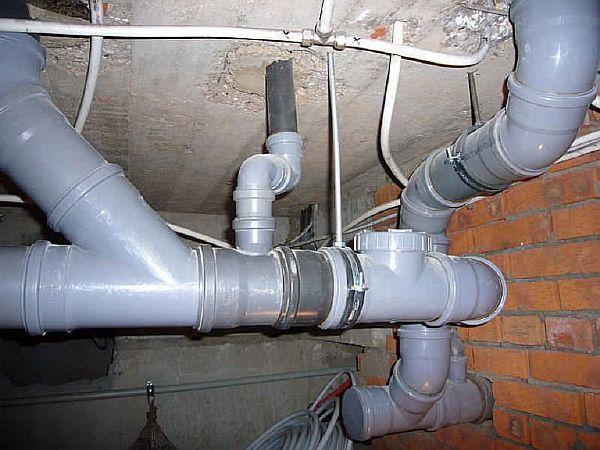
These products are not designed for ventilation purposes, so they are often made of low-quality plastic. If airflow occurs through such low-quality material, harmful chemicals, dirt particles, and dust will enter the room along with the air, which will accumulate on the interior walls when electrified.
If the design is intended for exhaust rather than fresh air intake, any materials can be used, including harmful plastics, as harmful compounds will be drawn out rather than ingested. Sewer pipes quickly become clogged and coated with a thick layer of dust.
Ventilation system made of plastic sewerage
The main advantages of plastic air ducts:
- ease of installation with maximum material strength;
- durability (plastic is not subject to corrosion);
- more economical than iron analogues and cheaper.
For the above reasons, designers recommend using high-quality plastic components for ventilation.
Plastic pipes are smooth and do not have any roughness, unlike iron ones, which allows air to freely penetrate into the room.
Before you begin building a ventilation system in a private home yourself, you should decide on the type of design, which can be forced or natural.
While additional elements (fans, valves) are used for forced ventilation, natural ventilation simply requires laying ducts vertically from the ventilated room to the roof.
The main thing to remember is that installing ventilation from sewer pipes is the same as installing ventilation from any other type of pipe. It's important to remember that sewer pipes can only be used in exhaust systems, and it's best to purchase high-quality plastic materials for air supply.
Watch the video
Each room in a private home should have both exhaust and supply ducts to ensure that the air in the room is always clean and fresh, which is very important for human health.
Ventilation duct design
Exhaust ventilation in a private house consists of ducts in the wall, the cross-section of which should not be less than 38 cm. The inlet openings are located under the ceiling slab itself.
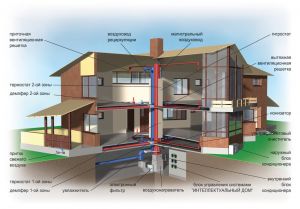
The most efficient location for such a pipe is considered to be a wall erected in the central part of the house. From this location, it will be easiest to distribute the plumbing throughout the house using standard plastic pipes with a cross-section of 10-12 cm.
It's desirable to have a minimum number of horizontal branches from the main pipe. The more branches, the less draft there will be, and the air flow will be significantly reduced. All branches lead to a single, common pipe and then exit through it.
Please note that the exhaust pipe must be lined with at least double brickwork to prevent freezing in winter at sub-zero temperatures and to prevent the cooling of rooms in a private house by allowing cold air to enter.
The height of the main chimney is calculated to be just above the ridge; otherwise, draft will be impaired. To calculate the correct outlet height, draw a straight line from the ridge to the chimney at an angle of 10 degrees; the chimney should not be lower than the drawn line.
The principle of natural ventilation
Before you start calculating the natural ventilation in a private house, you need to understand how it worksAll ducts are installed vertically. It's important to note that natural ventilation in a private home is planned during the construction phase. The number of ducts and their placement are also calculated at that time.
Watch the video
- shaft thermal insulation,
- number of ventilation branches;
- traction force
- narrow places or other obstacles;
Natural ventilation draft is affected by wind force. And because no additional mechanisms are used during installation, it's simple, quiet, and durable.
Calculation of ventilation ducts
When installing a ventilation system in a private home, it's best to use plastic pipes with a diameter of 15 cm. This diameter will ensure air movement of up to 30 cubic meters per hour with a duct height of three meters. If the duct height is lower, the mechanism may not work or will produce minimal draft.
If increased air flow capacity is desired, both the duct cross-section and its length can be increased. To ensure maximum draft in all rooms on the floor, it's important to ensure the duct length is the same.
Disadvantages of natural ventilation
The most significant drawback is its dependence on temperature factors outside and inside the building. The greater the difference between these two parameters, the more efficient the ventilation system is, while a minimum difference significantly reduces the system's efficiency.
In winter, a quarter of all warm air escapes through ventilation ducts, which causes a drop in temperature (this is especially noticeable during the heating season).
Forced ventilation
Watch the video
The easiest way is to install fans in the pipes yourself, which will help speed up air exchange.
By following the above guidelines and choosing the right ventilation system, it's easy to create your own, using plastic sewer pipes whenever possible. High-quality ventilation in a private home will ensure a cozy and comfortable microclimate in every room!